





1. Brief Description:
The SOP for Handling of the Feeding Area describes the controlled procedure for transferring lubricated granules from IPC bins to the compression machine while maintaining product identity, cleanliness, and GMP compliance. It assigns responsibility to Production personnel for execution, the Head of Production for implementation and compliance, and the Head of QA for oversight. Before feeding, the area must be clean, IPC bin labels must be verified against the BMR, and bin weight must be counter-checked. The bin is connected through an inner stainless-steel pipe, silicon bellow, and Y-chute to the hopper. After QA line clearance, valves are opened to allow granule flow into the compression machine. After compression, the empty bin is labeled “To be Cleaned” and sent for washing. The inner feeding pipe is cleaned according to Type A or Type B requirements, followed by 70% IPA wiping, compressed-air drying, and final lint-free cloth drying before subsequent use.
Skip to PDF content2. Flow Diagram:
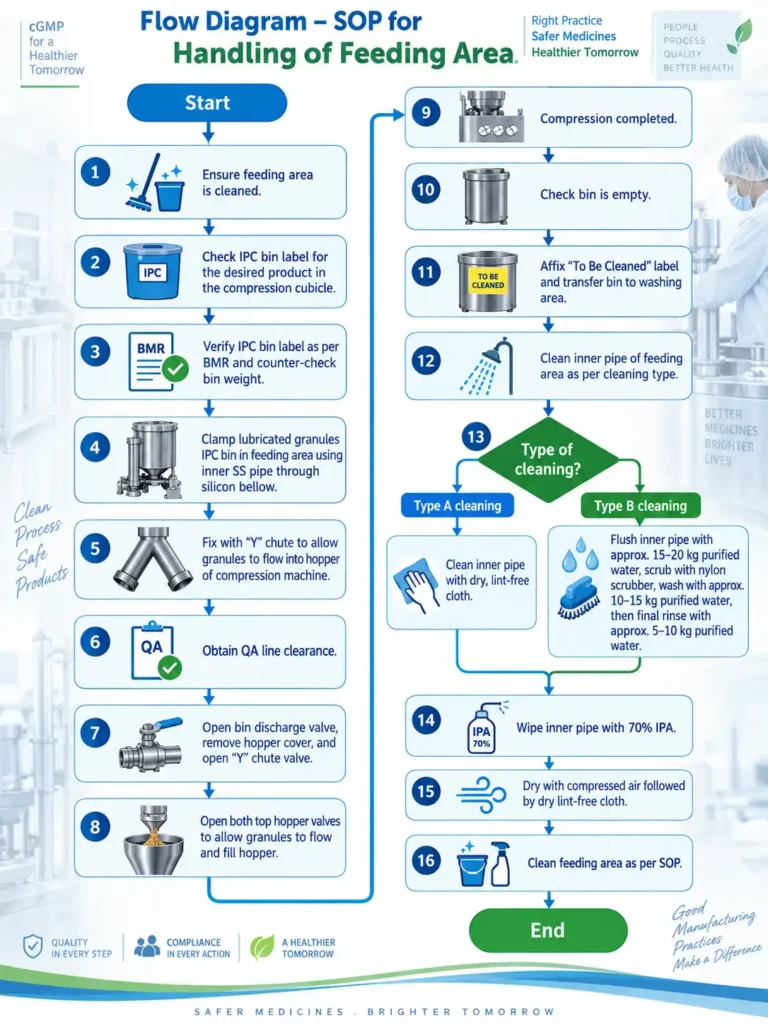
The flow diagram presents the step-by-step procedure for safe and controlled handling of the feeding area during tablet compression. The process begins with cleaning the feeding area, checking the IPC bin label for the required product, and verifying the label and bin weight against the BMR. The lubricated granules IPC bin is then connected to the feeding system using the inner SS pipe, silicon bellow, and Y-chute. After obtaining QA line clearance, the discharge and hopper valves are opened to allow granules to flow into the compression machine hopper. Once compression is completed, the bin is checked for emptiness, labeled “To Be Cleaned,” and sent to the washing area. The inner feeding pipe is then cleaned according to Type A or Type B requirements, followed by wiping with 70% IPA, drying with compressed air and lint-free cloth, and final cleaning of the feeding area. This ensures GMP compliance, cleanliness, product identity, and prevention of cross-contamination.
3. Brainstorming:
The brainstorming diagram summarizes the key activities, controls, and GMP considerations for the SOP for Handling of the Feeding Area During Tablet Compression. It groups the discussion into pre-start checks, operational steps, cleaning activities, and GMP/responsibility points. Important ideas include ensuring the feeding area is clean, verifying the IPC bin label and BMR details, counter-checking bin weight, correctly connecting the inner SS pipe, silicon bellow, and Y-chute, and obtaining QA line clearance before starting granule transfer.
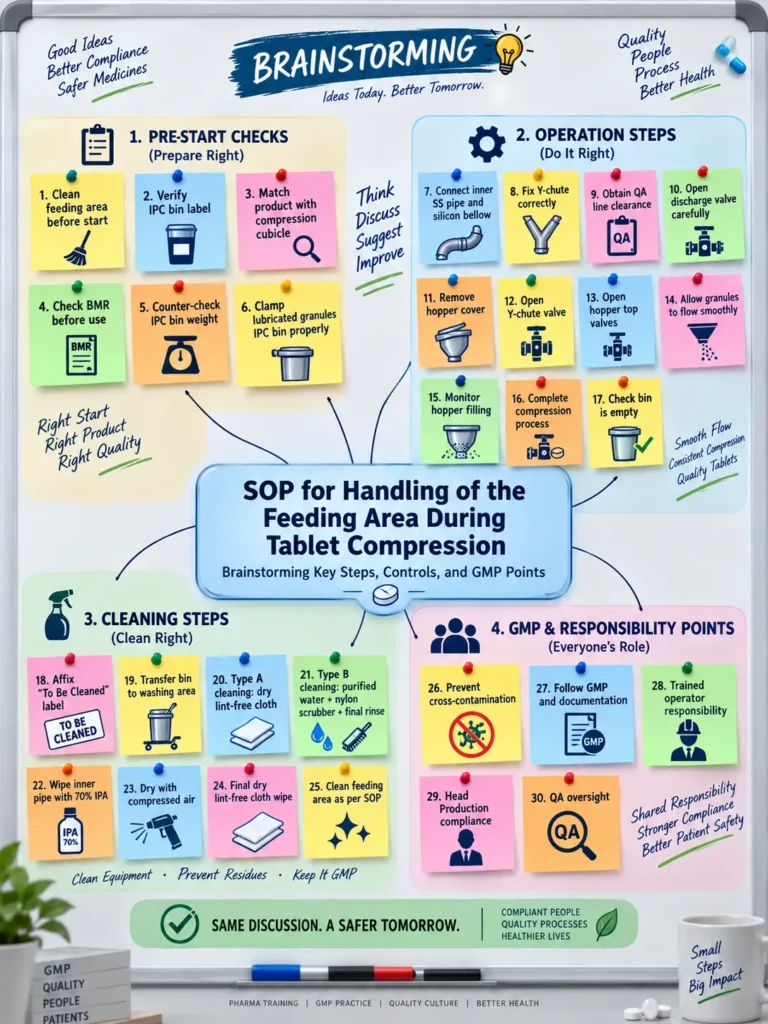
The brainstorming also highlights end-of-process controls such as checking bin emptiness, affixing the “To Be Cleaned” label, transferring the bin for washing, and selecting the appropriate Type A or Type B cleaning method. Cleaning includes purified water where applicable, 70% IPA wiping, compressed-air drying, and lint-free cloth drying. Overall, the exercise supports contamination prevention, GMP compliance, correct product handling, and clear accountability between Production and QA.
4. 5 Why Analysis:
The 5 Why analysis identifies the underlying reasons for failure to follow the SOP for Handling of Feeding Area during tablet compression. The first why indicates that the operator missed required feeding-area steps such as cleaning, label verification, bin connection, or valve operation. The second why shows incomplete understanding of critical requirements including BMR verification, QA line clearance, and correct bin/hopper handling. The third why points to inadequate training and insufficient practical demonstration of the SOP. The fourth why highlights weak supervision and inadequate line-start verification before operation. The fifth why identifies a broader system weakness in training, monitoring, checklist use, and routine SOP compliance checks.
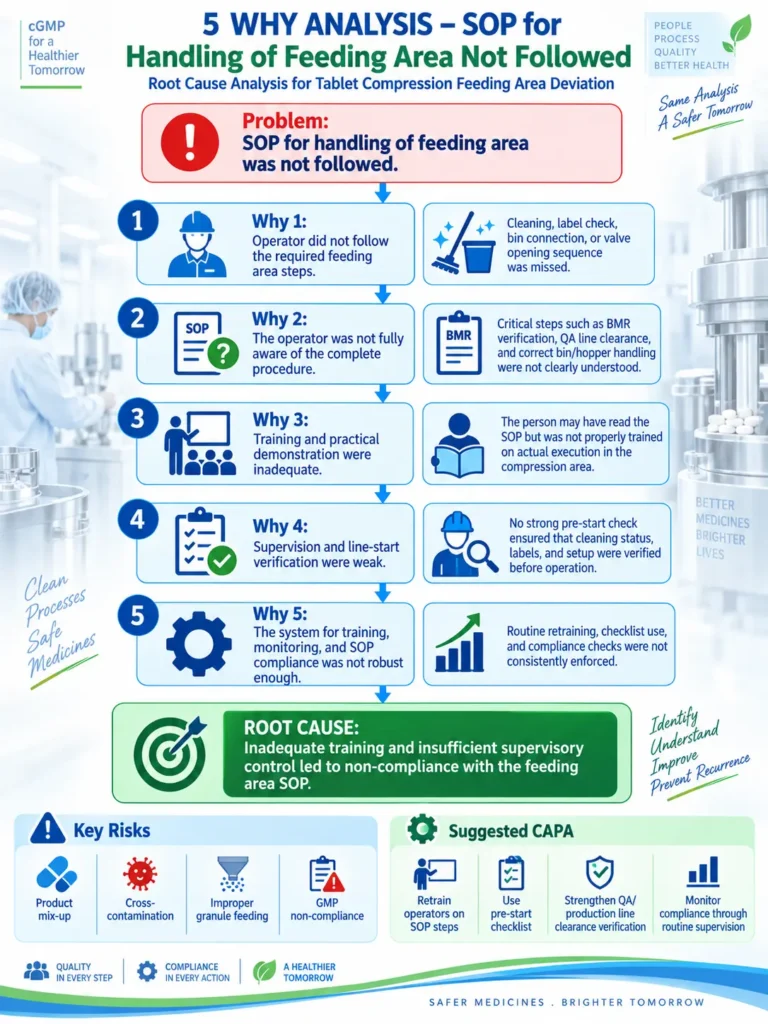
The analysis concludes that the main root cause is inadequate training combined with insufficient supervisory control. This can increase the risk of product mix-up, cross-contamination, improper granule feeding, and GMP non-compliance. Recommended CAPA includes retraining, pre-start checklists, stronger QA/Production verification, and routine compliance monitoring.
5. Failure Mode Effect Analysis:
The FMEA evaluates potential risks that may arise when the SOP for Handling of Feeding Area during tablet compression is not followed. The analysis considers failure modes such as inadequate cleaning of the feeding area, incorrect IPC bin or BMR verification, improper bin connection, absence of QA line clearance, incorrect valve operation, and failure to clean the feeding pipe after use. These failures may lead to product mix-up, cross-contamination, improper granule feeding, equipment problems, batch rejection, and GMP non-compliance.
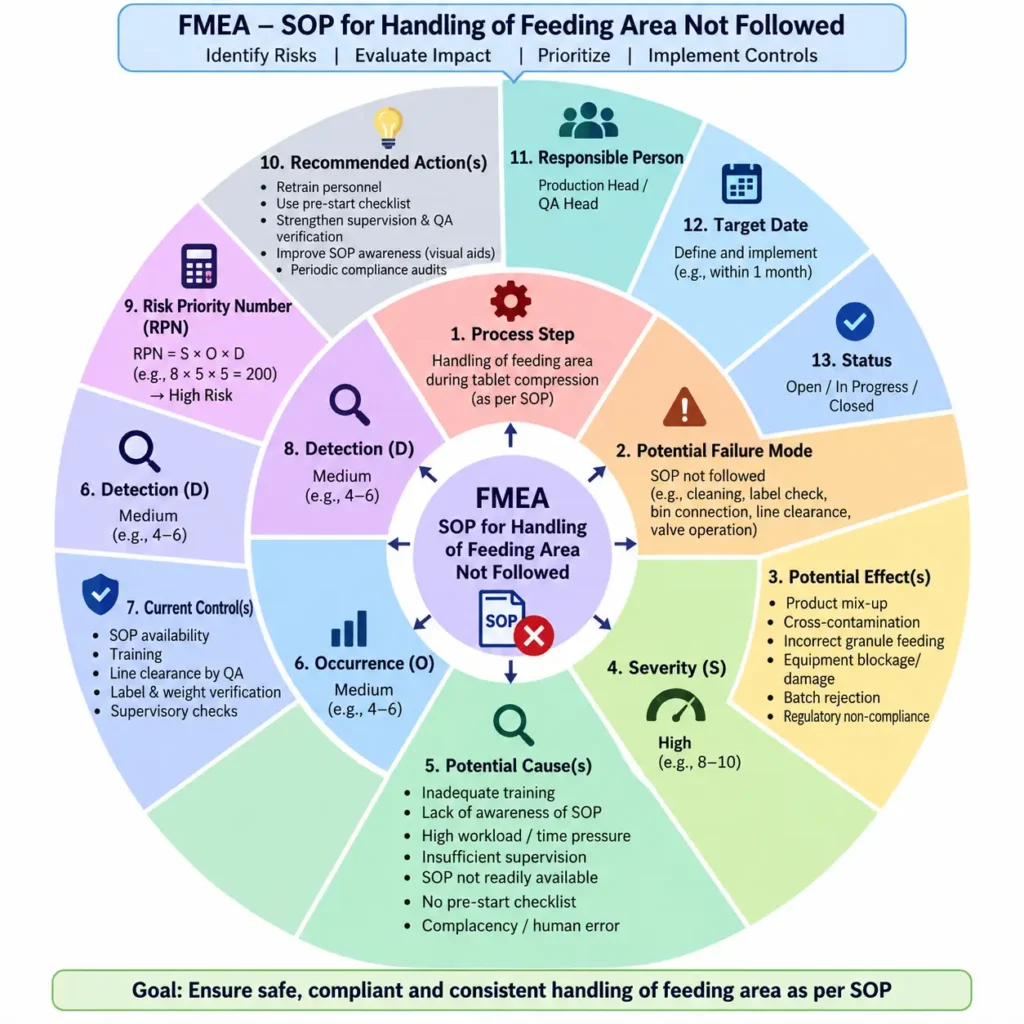
Each failure mode is assessed using Severity (S), Occurrence (O), and Detection (D) to calculate the Risk Priority Number (RPN). Higher-risk activities require immediate corrective and preventive actions. Recommended controls include operator retraining, use of pre-start checklists, double verification of IPC labels and BMR details, mandatory QA line clearance, stronger supervisory checks, and verification of cleaning and drying status. The FMEA helps prioritize risks, strengthen process controls, and ensure safe and consistent feeding-area operations.
Impact Assessment:
Failure to follow the SOP for Handling of the Feeding Area during tablet compression may have a significant impact on product quality, process control, GMP compliance, and contamination prevention. The SOP requires cleaning of the feeding area, verification of IPC bin labels, confirmation against the BMR, counter-checking of bin weight, correct connection of the SS pipe and silicon bellow, and QA line clearance before granule feeding. Based on these controls, non-compliance could increase the risk of product mix-up, incorrect material transfer, improper granule feeding, residue carryover, and cross-contamination. Failure to verify bin emptiness or apply the “To Be Cleaned” label may also affect equipment status control. Inadequate Type A or Type B cleaning, improper purified-water rinsing, or failure to wipe with 70% IPA and dry the inner pipe may leave residues before the next batch. Therefore, the deviation should be investigated and appropriate CAPA, retraining, cleaning verification, and supervisory controls implemented before routine continuation.
Questions & Answers
1. What is the objective of the SOP for Handling of Feeding Area?
The objective is to define the procedure for proper handling of the feeding area during production activities.
2. Who is responsible for execution of this SOP?
Production Technical Associates, Officers, Executives, and Assistant Managers are responsible for execution. The Head of Production ensures execution and compliance, while the Head of QA ensures overall compliance.
3. What should be checked before bringing an IPC bin into the feeding area?
The IPC bin label should be checked to confirm that it contains the desired product for the compression cubicle.
4. What verification is required before connecting the IPC bin?
The IPC bin label should be verified against the BMR, and the bin weight should be counter-checked with the BMR.
5. How is the IPC bin connected to the compression machine?
The lubricated granules IPC bin is connected through an inner SS pipe and silicon bellow and then fixed with the Y-chute for granule flow into the hopper.
6. When can the discharge valve of the IPC bin be opened?
The discharge valve can be opened only after obtaining line clearance from QA.
7. What is done after completion of compression?
The IPC bin is checked for emptiness, a “To Be Cleaned” label is affixed, and the bin is transferred to the bin washing area.
8. How is the inner pipe cleaned during Type A cleaning?
For Type A cleaning, the inner pipe is cleaned using a dry, lint-free cloth.
9. How is the inner pipe cleaned during Type B cleaning?
For Type B cleaning, the inner pipe is flushed with approximately 15–20 kg purified water, scrubbed with a nylon scrubber, washed with approximately 10–15 kg purified water, and finally rinsed with approximately 5–10 kg purified water.
10. What is done after washing the inner pipe?
The inner pipe is wiped with 70% IPA, dried with compressed air, and then dried using a lint-free cloth.
11. Why is QA line clearance important before granule feeding?
It confirms that the area is ready for operation before opening the discharge and Y-chute valves, helping maintain controlled product transfer.
12. What is the purpose of checking the IPC bin label against the BMR?
It confirms that the correct material and batch are being used for the intended compression activity.
13. What abbreviations are defined in the SOP?
The SOP defines IPA as Iso Propyl Alcohol, SOP as Standard Operation Procedure, and QA as Quality Assurance.
14. What key GMP risks may arise if this SOP is not followed?
Based on the controls described in the SOP, possible risks include incorrect material feeding, product mix-up, inadequate cleaning, residue carryover, and non-compliance with line-clearance requirements.
15. What is the overall purpose of following this SOP correctly?
To ensure correct product handling, controlled granule transfer, proper cleaning, QA oversight, and consistent GMP compliance during tablet compression.