







1. Introduction – SOP for Handling of Out-of-Expectation Results:
The SOP for Handling of Out of Expectation Results (OOE) establishes a systematic procedure for the identification, reporting, investigation, assessment, documentation, and closure of results that are outside the expected outcome during pharmaceutical analysis. The SOP is applicable to OOE results observed during pharmacopoeial evaluation and routine analysis of raw materials, packing materials, and finished products. OOE results may arise from pharmacopoeial changes, laboratory errors, non-process or operator-related errors, and process or manufacturing-related errors. Each identified OOE should undergo a documented investigation and impact assessment, including evaluation of potentially affected batches or finished products where applicable. Additional testing may also be performed in consultation with process development when considered necessary. Implementation of this SOP helps ensure that unexpected analytical results are evaluated consistently, scientifically, and traceably before appropriate decisions are made regarding the affected material or batch. Investigation records, laboratory data, deviations, approval notes, and the assigned OOE identification number should be properly maintained to provide complete documentation and support effective quality assurance oversight.
Skip to PDF content2. Flow Diagram – SOP for Handling of Out of Expectation Results:
The SOP for Handling of Out of Expectation Results (OOE) defines a controlled and systematic approach for managing analytical results that fall outside the expected outcome during pharmaceutical testing. It covers OOE results observed during pharmacopoeial evaluation and routine analysis of raw materials, packing materials, and finished products.
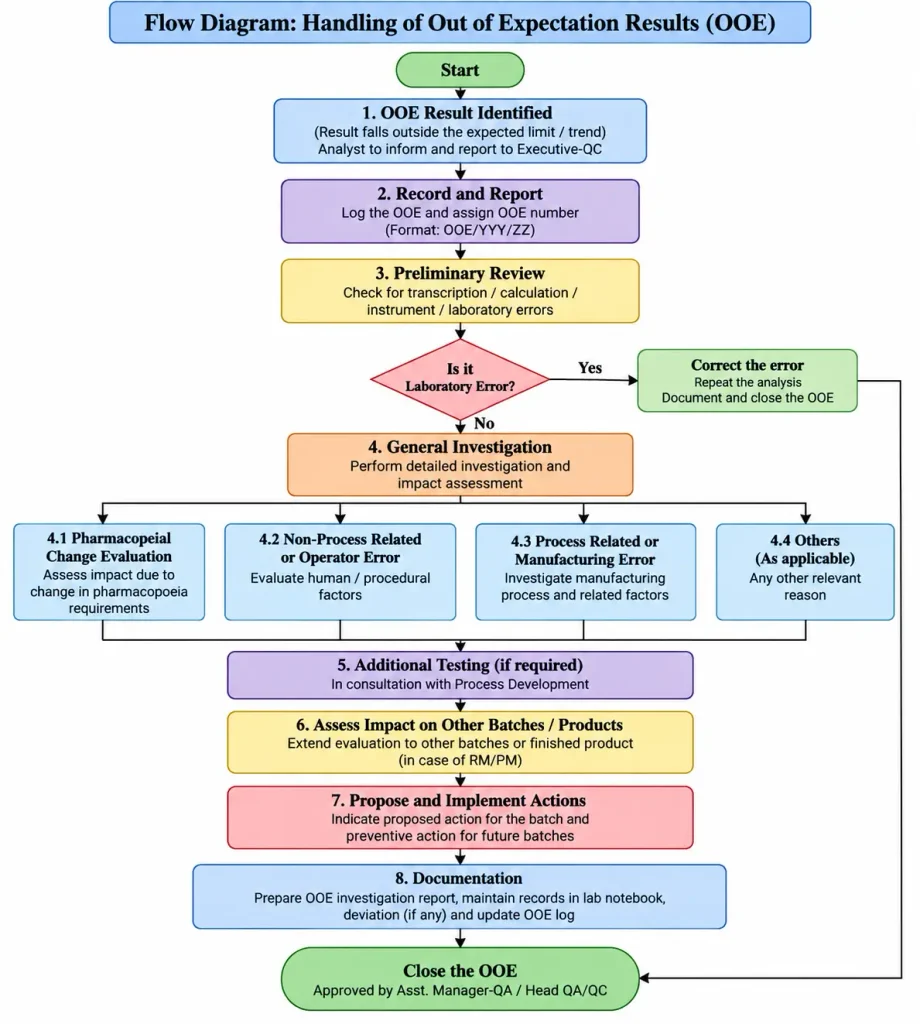
The procedure includes OOE identification and reporting, investigation, impact assessment, additional testing when required, evaluation of affected batches or products, documentation, and closure. It also considers potential causes such as pharmacopoeial changes, laboratory errors, operator-related errors, and manufacturing or process-related errors. Following this SOP helps ensure that unexpected analytical results are investigated consistently, scientifically, and traceably before appropriate quality decisions are made.
3. Benefits of Following SOP – SOP for Handling of Out of Expectation Results:
The SOP for Handling of Out of Expectation Results (OOE) provides a structured system for identifying, reporting, investigating, assessing, documenting, and closing unexpected analytical results generated during pharmaceutical testing. The procedure applies to pharmacopoeial evaluation and routine analysis of raw materials, packing materials, and finished products.
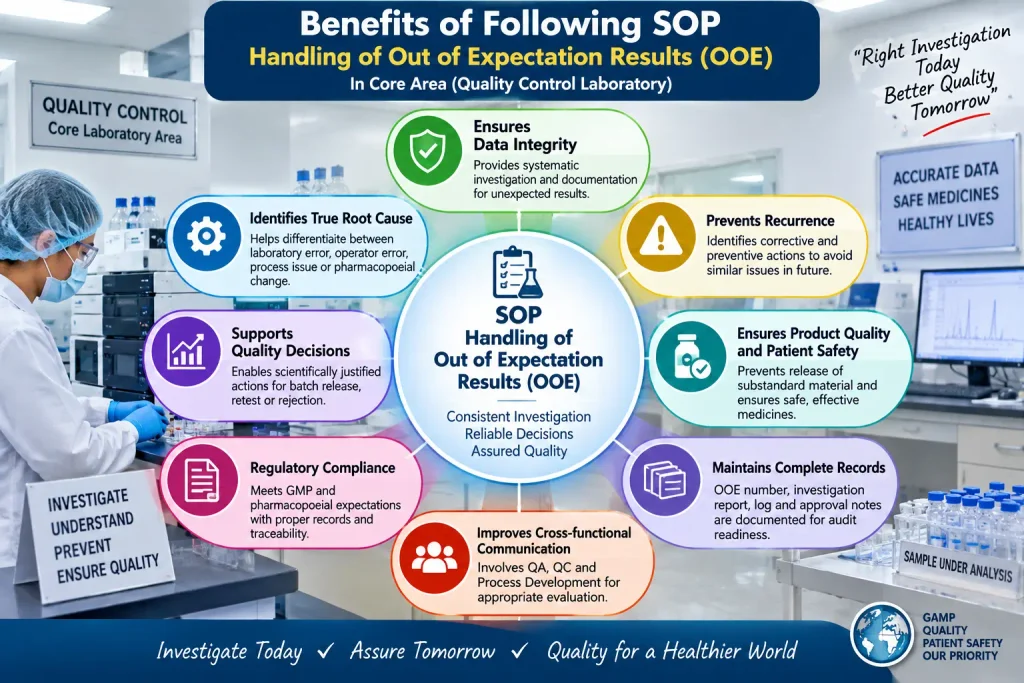
Following this SOP supports consistent investigation, data integrity, proper documentation, traceability, scientific decision-making, and effective quality oversight. OOE results are evaluated for possible causes such as pharmacopoeial changes, laboratory errors, operator-related issues, and manufacturing or process-related errors, with impact assessment extended to other batches or finished products where applicable. Proper implementation also ensures that investigation reports, laboratory records, deviations, approval notes, OOE numbers, and yearly OOE logs are maintained, helping strengthen GMP compliance, audit readiness, product quality, and prevention of recurrence.
4. Brainstorming for SOP Failure – SOP for Handling of Out of Expectation Results:
The SOP for Handling of Out of Expectation Results (OOE) requires unexpected analytical results to be identified, reported, investigated, assessed, and properly documented before closure. The SOP recognizes possible causes such as pharmacopoeial changes, laboratory errors, non-process or operator-related errors, and process or manufacturing-related errors.
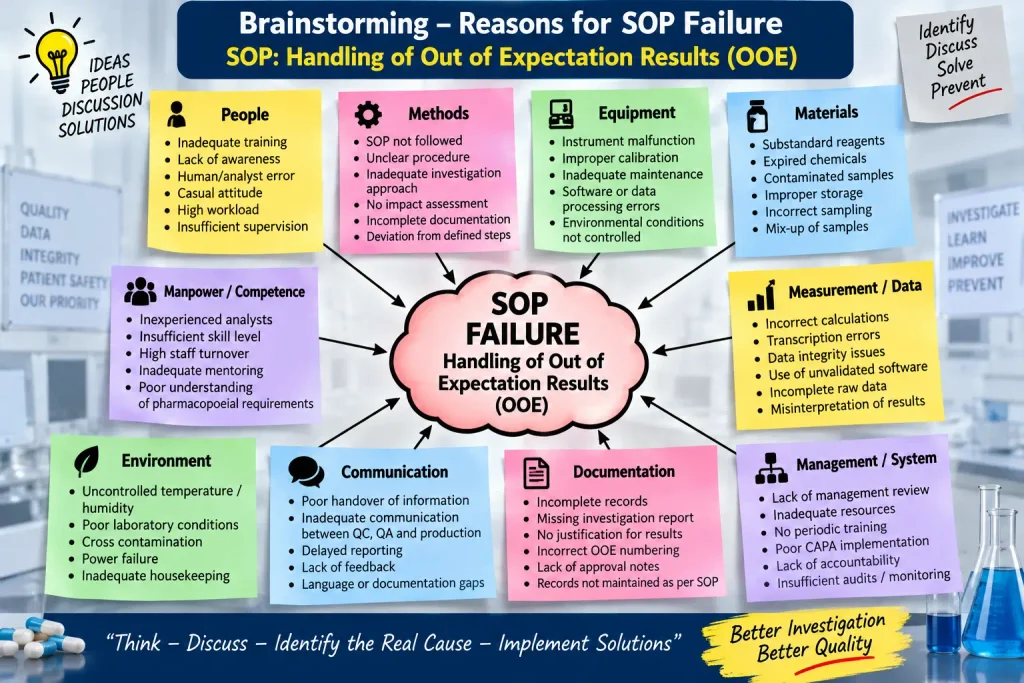
The brainstorming diagram expands these areas into potential contributors such as personnel, methods, equipment, materials, data handling, communication, environment, documentation, and management systems. These brainstorming categories can help an investigation team systematically explore possible causes, determine the most relevant root cause, evaluate impact on other batches or products, and define suitable corrective and preventive actions. The SOP also requires investigation records and OOE documentation to be maintained for traceability.
5. 5-Why Analysis for SOP Failure – SOP for Handling of Out of Expectation Results (OOE):
The 5-Why Analysis for failure of the SOP for Handling of Out of Expectation Results (OOE) is used to trace an investigation failure from the visible problem to its underlying root cause. The analysis begins with the problem that an OOE result is not properly investigated or managed and progressively examines why the analyst failed to follow required steps, why awareness was inadequate, why training was insufficient, and why an effective training and monitoring system was not maintained.
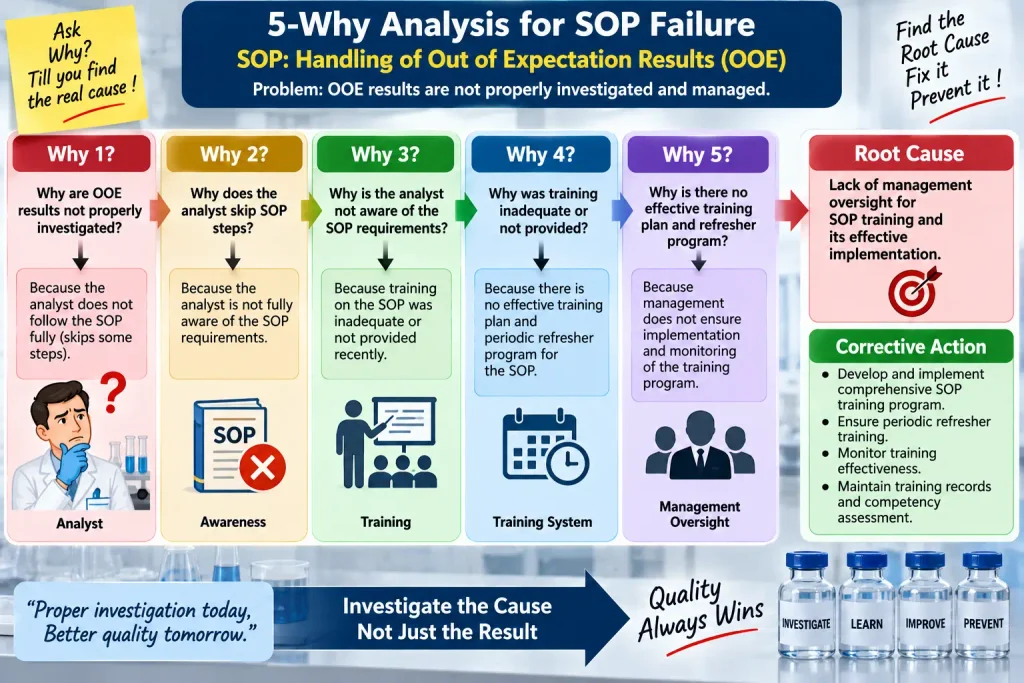
This analysis supports identification of systemic causes such as training gaps, inadequate supervision, weak implementation, and insufficient management oversight. Corrective actions may include SOP retraining, competency assessment, periodic refresher training, and monitoring of training effectiveness. The SOP itself requires systematic investigation and impact assessment of OOE results before appropriate action is taken.
6. Fault Tree Analysis for SOP Failure – SOP for Handling of Out of Expectation Results (OOE):
The Fault Tree Analysis for failure of the SOP for Handling of Out of Expectation Results (OOE) provides a structured method to identify the combination of failures that may result in an OOE being inadequately investigated, assessed, documented, or closed. The top event may be defined as “OOE result not properly investigated or managed.” Potential contributing events include failure in OOE identification and reporting, laboratory or operator error, process/manufacturing error, inadequate impact assessment, and insufficient follow-up testing where required.
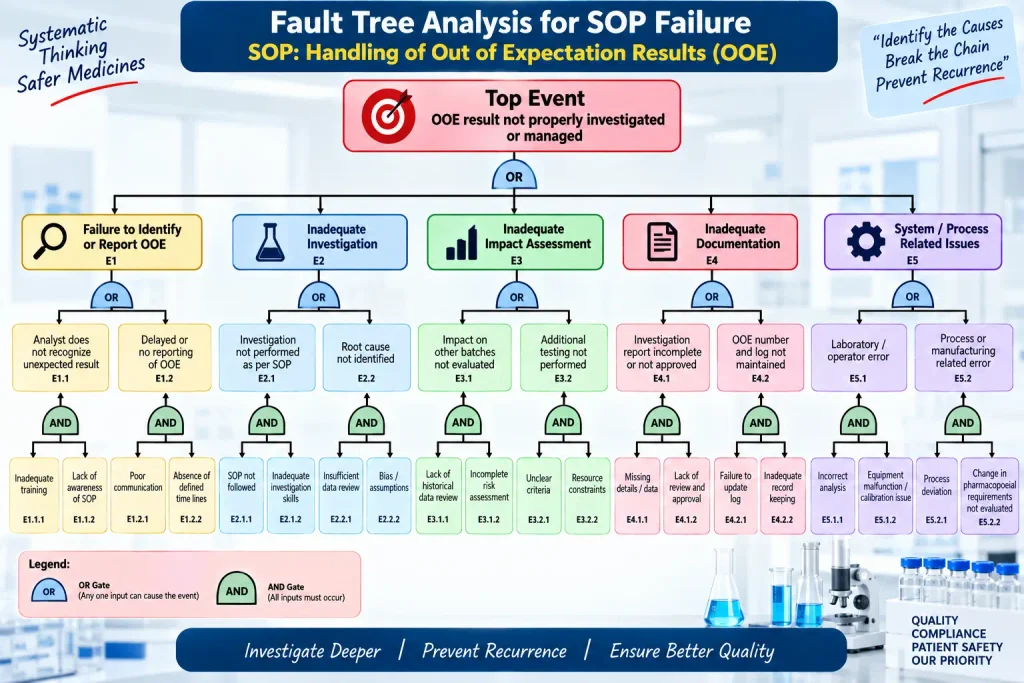
The analysis also considers weaknesses in documentation, investigation records, approval notes, OOE numbering, and log maintenance. By tracing these contributing events to their underlying causes, the fault tree supports systematic root-cause identification and development of suitable corrective and preventive actions to strengthen compliance, traceability, and overall pharmaceutical quality management.
7. Fishbone Analysis for SOP Failure SOP for Handling of Out of Expectation Results (OOE):
The Fishbone Analysis for failure of the SOP for Handling of Out of Expectation Results (OOE) provides a structured approach for identifying potential causes that may lead to improper identification, investigation, assessment, documentation, or closure of an OOE result. The diagram groups possible causes under areas such as manpower, methods, equipment, materials, environment, documentation, measurement/data, and management systems, helping the investigation team examine the problem systematically.
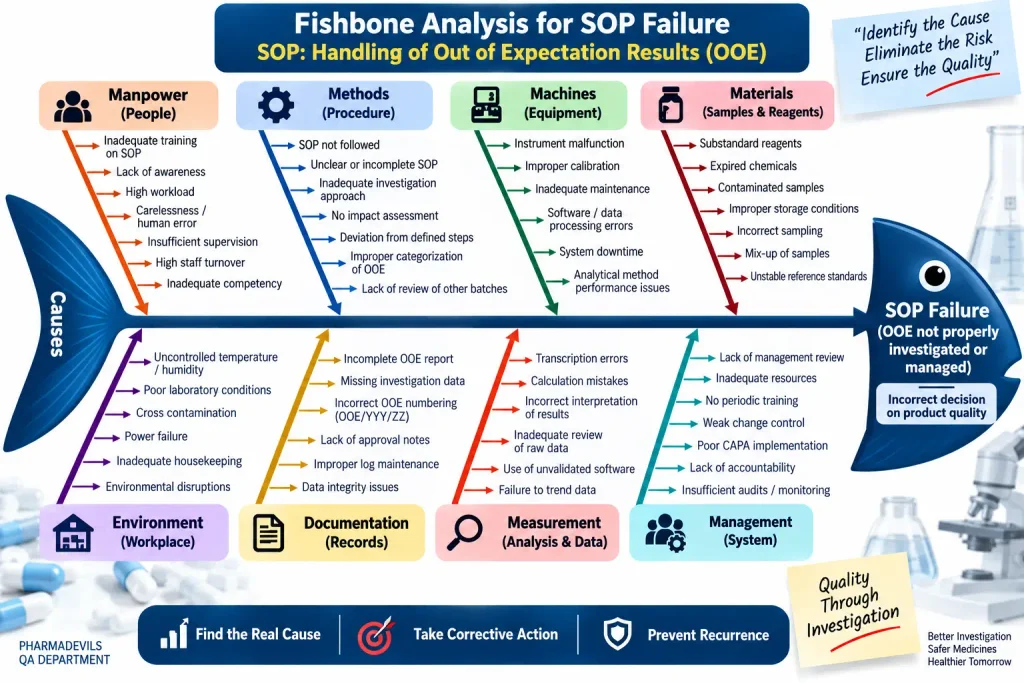
The SOP itself recognizes OOE causes such as pharmacopoeial change, laboratory error, non-process or operator error, and process or manufacturing-related error, and requires investigation with an appropriate impact assessment. Using a fishbone analysis helps investigators organize potential contributing factors, identify the most probable root cause, and establish suitable corrective and preventive actions. Proper investigation records, approval notes, OOE numbering, and log maintenance further support traceability and effective quality-system follow-up.
8. Impact Assessment SOP for Handling of Out of Expectation Results (OOE):
The Impact Assessment for SOP for Handling of Out of Expectation Results (OOE) evaluates the potential consequences when an OOE result is not identified, investigated, documented, or managed appropriately. The assessment considers possible effects on product quality, affected batches or finished products, compliance, documentation, investigation effectiveness, and future batch decisions.
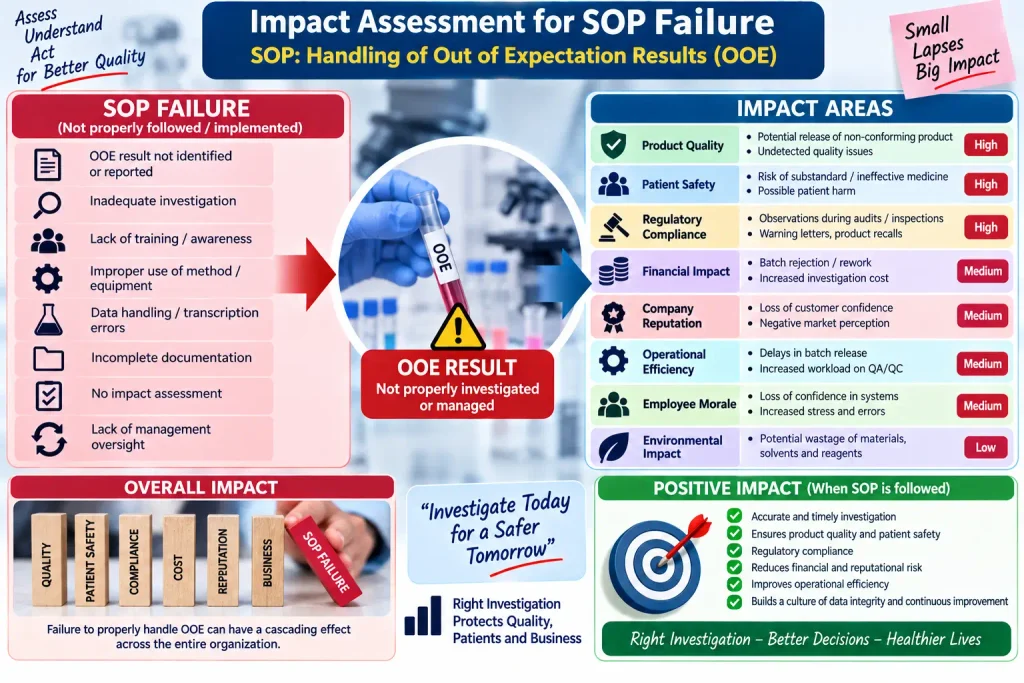
As defined in the SOP, a general investigation and impact assessment shall be performed for out-of-expectation results, and the assessment should be extended to other batches or finished products where applicable. Additional testing may also be performed when necessary, followed by appropriate actions for the affected batch and future batches. A properly performed impact assessment helps ensure that the significance of the OOE is understood, affected materials are appropriately evaluated, and suitable corrective or preventive measures are implemented before closure.
Questions & Answers – SOP for Handling of Out of Expectation Results (OOE):
- What is the objective of this SOP?
The objective is to provide a procedure for handling Out of Expectation (OOE) results observed during analytical evaluation. - What is the scope of the SOP?
It applies to OOE results observed during pharmacopoeial evaluation and routine analysis of raw materials, packing materials, and finished products. - Who is responsible for execution of the SOP?
The Analyst and Executive-QC are responsible for execution of the SOP. - Who is responsible for effective implementation of the SOP?
The Assistant Manager-QA and Head QA/QC are responsible for effective implementation. - What general categories of OOE results are described in the SOP?
The SOP includes:- Pharmacopoeia change evaluation
- Laboratory error
- Non-process related or operator error
- Process related or manufacturing error
- What is the first stage of OOE handling?
The first stage is OOE identification and reporting. - What should be done after an OOE result is identified?
A general investigation should be carried out and an impact assessment should be performed. - Should the impact assessment be extended to other batches?
Yes. The SOP states that the assessment should be extended to other batches or finished product, particularly in the case of RM/PM. - Can additional testing be performed during an OOE investigation?
Yes. Additional testing may be performed in consultation with Process Development, if necessary. - What action is required when the OOE involves a raw material?
Batches prepared using the raw material should be reviewed before release, and the proposed action for the current batch and future batches should be indicated. - What records are required for an OOE investigation?
Required records include the OOE investigation report, approval notes, laboratory notebook records, investigation data, and related exception/deviation records. - How is an OOE investigation numbered?
Each OOE investigation has its own identification number in the format OOE/YYY/ZZ, where YYY represents the serial number and ZZ represents the last two digits of the year. - Is an OOE log required?
Yes. A log should be maintained for all Out of Expectation results observed on a yearly basis. - What is the reference mentioned in this SOP?
The reference is stated as In House. - What annexure is provided with the SOP?
Annexure-I: Out of Expectation (OOE) Investigation Log is provided. - What information is recorded in the OOE Investigation Log?
The log includes OOE number, investigation date, product details, batch number, test, analyst, close-out date, and investigation closed by. - Who receives the controlled copy of the SOP?
The controlled copy is distributed to the Head of Department – Quality Control. - Who retains the master copy?
The master copy is retained by the Head of Department – Quality Assurance.
Reference Guideline – SOP for Handling of Out-of-Expectation Results (OOE):
- In-House Procedure / Internal Quality System Requirement – the SOP specifically lists “In House” under Section 5.0 Reference.