






1. Introduction:
An Out of Trend (OOT) result is a test result that shows an unusual change or movement compared with the established historical trend, even though the result may still be within the approved specification limits. In pharmaceutical manufacturing, such results should be identified, reported, investigated, documented, and evaluated carefully because they may indicate an emerging problem in the laboratory, manufacturing process, sampling activity, equipment, materials, or environmental conditions. The SOP for Handling of Out of Trend Results provides a systematic procedure for managing OOT observations identified during trend analysis. It applies to trends related to water quality, environmental monitoring, and physical and chemical parameters of pharmaceutical products. The SOP assigns responsibility to QC personnel for execution and to QA/QC management for effective implementation. According to the SOP, OOT results may generally arise from laboratory error, non-process/operator-related error, or process/manufacturing-related error. The investigation therefore follows a structured approach beginning with OOT identification and reporting, followed by Phase I laboratory investigation, Phase II expanded investigation, and Phase III production/process investigation, where applicable. Retesting, re-sampling, root-cause determination, and corrective and preventive actions may be performed based on the investigation outcome. Proper handling of OOT results helps detect adverse trends before they develop into serious quality failures. It supports scientifically justified decisions, prevents inappropriate rejection or acceptance of results, improves process understanding, protects product quality, and strengthens the pharmaceutical quality system through documented investigation and appropriate CAPA.
Skip to PDF content2. Flow Diagram:
The flow diagram explains the step-by-step process for Handling of Out of Trend (OOT) Results in a pharmaceutical quality system. The process starts with routine trend analysis of water, environmental monitoring data, and product physical or chemical parameters. When an unusual result is identified, the analyst reports it to the concerned section head and preserves relevant samples, standards, and solutions for investigation. The investigation begins with Phase I, where laboratory activities are reviewed for possible errors in testing, calculations, instruments, reagents, sample preparation, storage, or method execution.
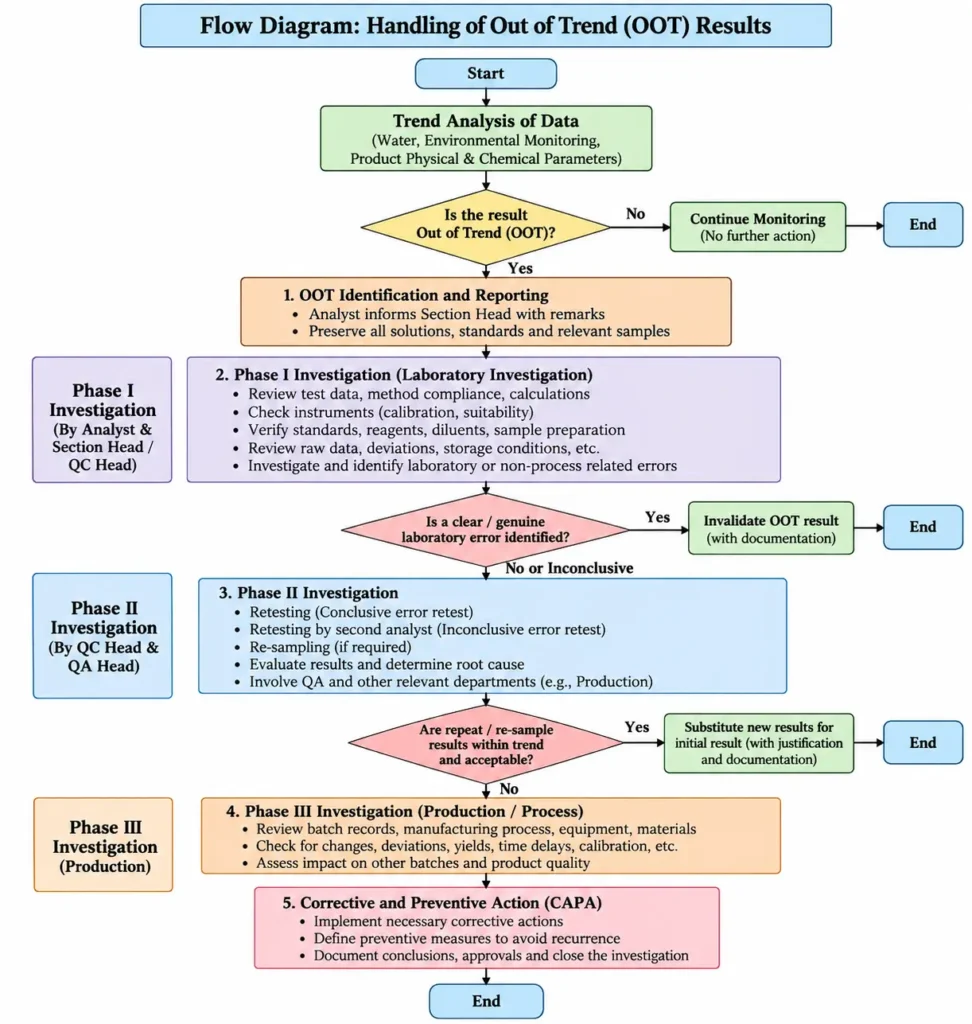
If the cause is not clearly identified, Phase II may include retesting, testing by a second analyst, and re-sampling when scientifically justified. When the issue may be related to manufacturing, Phase III reviews production records, process deviations, materials, equipment, yields, delays, and other process factors. Finally, appropriate corrective and preventive actions (CAPA) are implemented, documented, approved, and the investigation is closed.
3. Benefits of Following the SOP:
The image explains the major benefits of following the SOP for Handling of Out of Trend (OOT) Results in a pharmaceutical quality system. It shows that proper OOT handling helps identify unusual trends early, before they develop into serious quality problems.
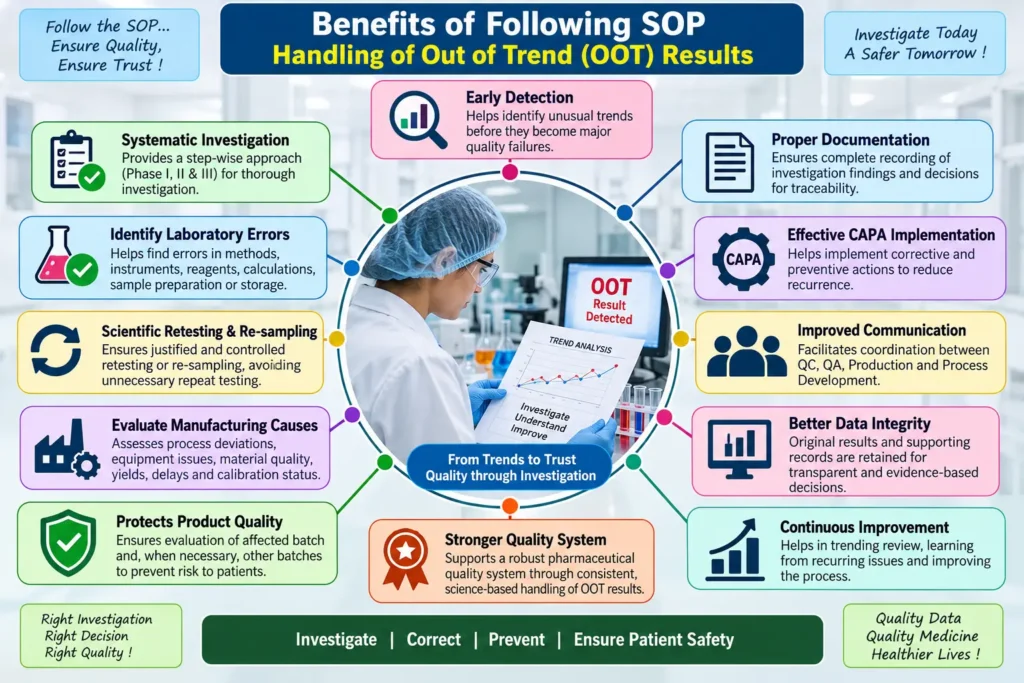
The SOP provides a systematic investigation process through different investigation phases and helps identify laboratory errors related to methods, instruments, reagents, calculations, sample preparation, or storage. It also ensures that retesting and re-sampling are scientifically justified and properly controlled. Following the SOP supports evaluation of manufacturing causes such as process deviations, equipment problems, material issues, delays, yield variations, and calibration status. It also improves documentation, traceability, data integrity, and communication between QC, QA, Production, and Process Development. Most importantly, proper investigation helps protect product quality and patient safety. Effective CAPA can then be implemented to prevent recurrence, strengthen the pharmaceutical quality system, and support continuous improvement.
4. Brainstorming for SOP Failure:
The brainstorming image shows the worst-case situation when the SOP for Handling of Out of Trend (OOT) Results is not followed. The central sticky note highlights the main failure, while the surrounding notes identify possible causes and weaknesses that can contribute to poor OOT handling. Key issues shown include delayed OOT reporting, failure to preserve samples and standards, Phase I investigation not performed, analytical method not followed, instrument calibration not checked, calculation errors, uncontrolled retesting, unjustified re-sampling, poor documentation, lack of QA involvement, missed production review, inadequate CAPA, training gaps, weak communication, and ignored trend review.
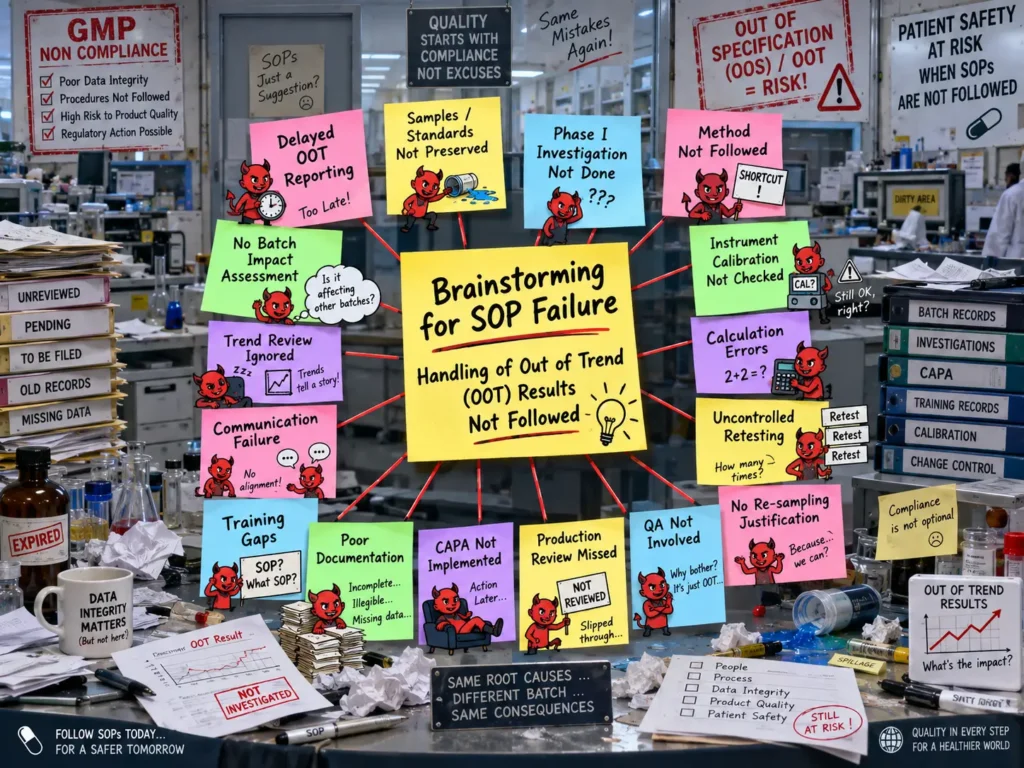
The devil characters represent shortcuts, negligence, poor GMP behavior, and careless decision-making that can worsen the situation. The disorganized laboratory environment, pending records, missing data, and unreviewed documents further illustrate the consequences of SOP failure. Overall, the image emphasizes that failure to follow the OOT SOP can lead to poor data integrity, incorrect conclusions, repeated deviations, inadequate investigations, risk to product quality, and potentially increased patient-safety risk.
5. 5-Why Analysis for SOP Failure:
The diagram combines a Pareto chart and 5-Why analysis to study failure of the SOP for Handling of Out of Trend (OOT) Results in Quality Control. The Pareto section highlights common QC failure points such as calculation errors, method not followed, calibration not checked, standards or samples not properly controlled, documentation gaps, uncontrolled retesting, training gaps, and inadequate QA involvement. The incident numbers shown in the chart are illustrative for visualization, not actual values taken from the SOP. The 5-Why section traces a selected QC failure from undetected calculation errors to deeper causes such as missing second-person review, skipped checklist/SOP steps, insufficient training and supervision, and weak implementation of the quality system. The SOP itself requires review of calculations, method compliance, calibration, standards, reagents, and test preparations during OOT investigation.
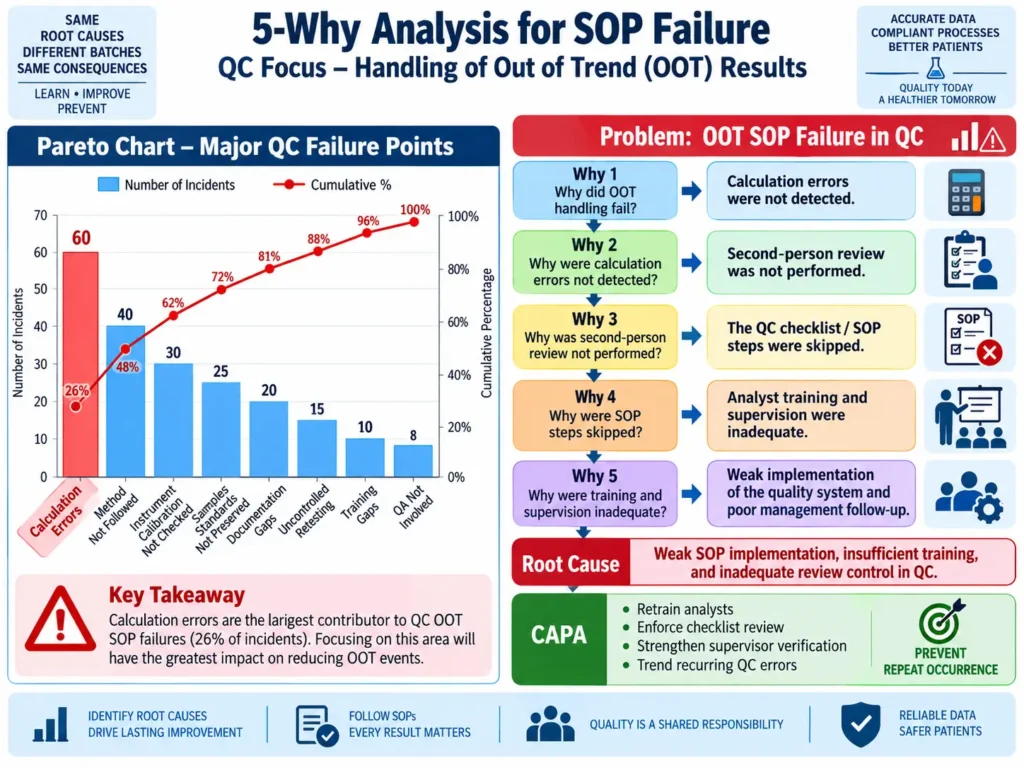
The analysis ultimately identifies weak SOP implementation, inadequate training, and insufficient review controls as potential root causes. CAPA focuses on analyst retraining, mandatory checklist review, stronger supervisory verification, and trending of recurring QC errors to prevent recurrence.
6. Fishbone Analysis for SOP Failure:
The fishbone diagram presents a structured root-cause analysis for failure of the SOP for Handling of Out of Trend (OOT) Results in Quality Control. It groups the possible causes into six major QC check-point categories: Analyst/People, Sampling, Preparation & Testing, Instrument/Equipment, Data/Calculation, and Documentation/System. The diagram highlights common failure points such as inadequate training, weak supervision, improper sampling, loss of sample integrity, incorrect weighing or dilution, use of unverified standards or reagents, missed calibration checks, incorrect instrument settings, calculation errors, ignored trend review, incomplete investigation checklists, poor documentation, unjustified retesting, and delayed QA involvement.
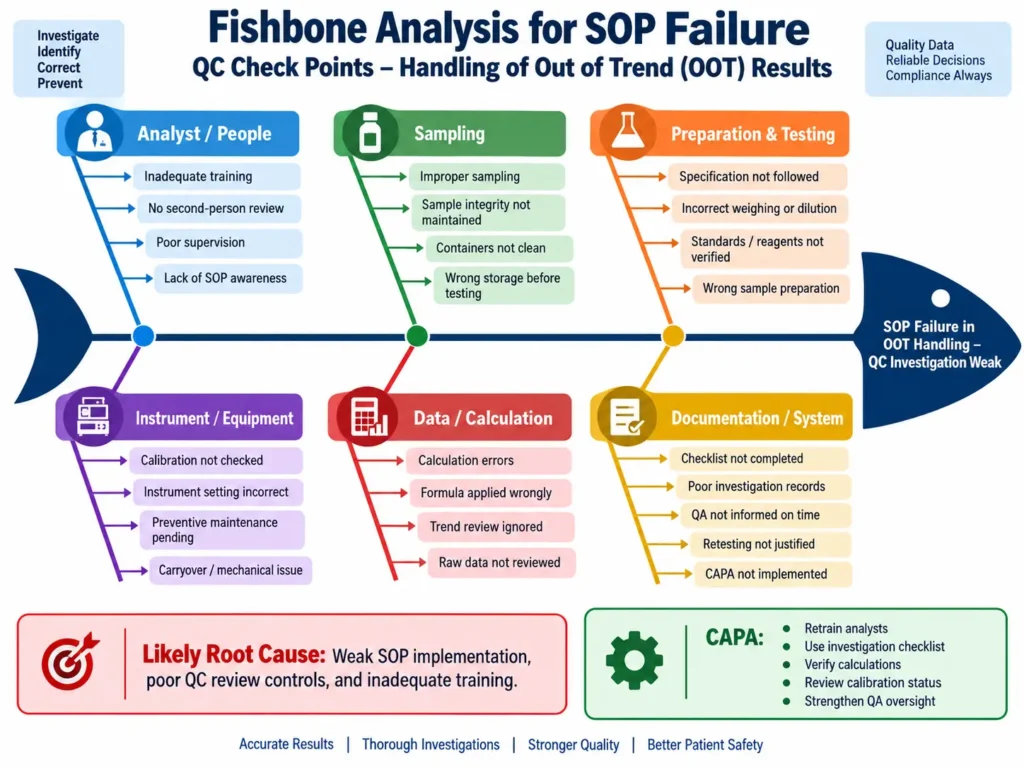
By organizing the causes in a fishbone format, the diagram helps the investigation team identify where the OOT handling process may have broken down instead of focusing only on the final abnormal result. The likely underlying causes shown are weak SOP implementation, insufficient QC review controls, and inadequate training. Suggested CAPA includes analyst retraining, mandatory investigation checklists, verification of calculations, review of calibration status, and stronger QA oversight.
7. Fault Tree Analysis for SOP Failure:
The diagram presents a Fault Tree Analysis (FTA) for failure of the SOP for Handling of Out of Trend (OOT) Results. The top event is improper handling of an OOT result, which is broken down into major failure branches such as investigation not performed, incorrect investigation, incomplete documentation, incorrect conclusion, and ineffective or missing CAPA. Each branch further identifies possible underlying causes. These include failure to review OOT results, lack of QA involvement, inadequate training, poor communication, unchecked laboratory errors, unverified calibration status, failure to evaluate manufacturing causes, incomplete investigation records, unjustified retesting or re-sampling, weak data review, poor document control, and lack of CAPA effectiveness monitoring.
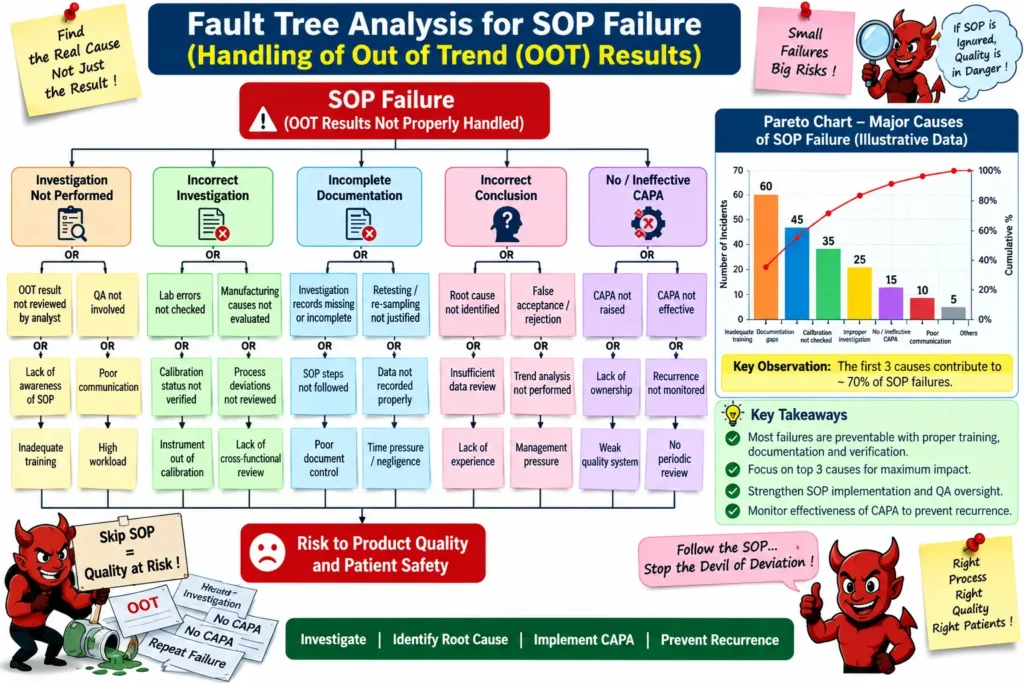
The accompanying Pareto chart highlights major contributing areas so that attention can be focused on the most frequent or significant causes. The chart values are illustrative, not actual data from the SOP. Overall, the analysis shows how several smaller control failures can combine and result in weak OOT investigation, wrong quality decisions, recurrence of deviations, and increased risk to product quality and patient safety. The key message is to investigate properly, identify the true root cause, implement effective CAPA, and verify that recurrence is prevented.
8. Impact Assessment:
The impact assessment image explains the possible consequences when the SOP for Handling of Out of Trend (OOT) Results is not followed properly. A single missed investigation or documentation step can affect several areas of the pharmaceutical quality system. The major impacts shown include product quality risk, patient safety risk, regulatory non-compliance, business loss, poor data integrity, operational delays, training-related problems, and damage to company reputation. Improper OOT handling may result in incorrect acceptance or rejection of results, repeated investigations, delayed batch release, unjustified retesting, weak traceability, increased workload, and ineffective CAPA.
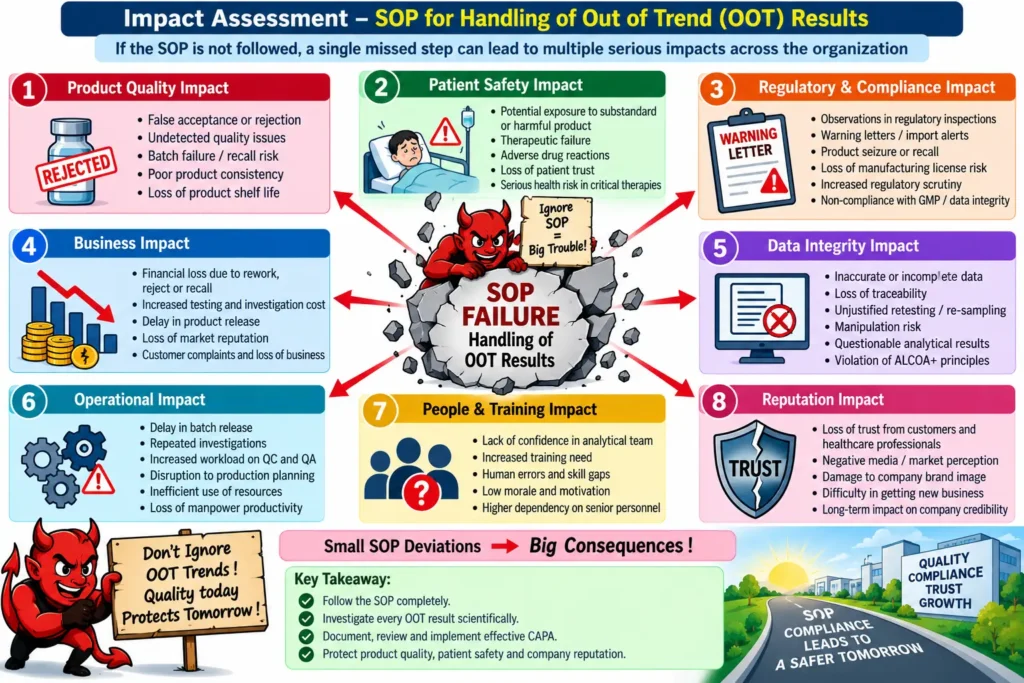
The image also emphasizes that failure to investigate OOT results scientifically may allow recurring problems to continue and can weaken confidence in QC and QA systems. The SOP itself requires investigation findings to be recorded, proposed actions to be identified, relevant departments to be involved, and corrective actions to be taken. Overall, the key message is that small SOP deviations can lead to major quality consequences. Complete SOP compliance, proper documentation, scientifically justified investigation, effective CAPA, and follow-up are essential to protect product quality, patient safety, compliance, and organizational trust.
Questions & Answers:
- What is the purpose of the OOT SOP?
The purpose is to provide a defined procedure for handling Out of Trend results observed during trend analysis. - Where is this SOP applicable?
It applies to OOT results identified during trend analysis of water, environmental monitoring, and physical and chemical parameters of products. - Who is responsible for execution of the SOP?
The Analyst and Executive-QC are responsible for execution of the SOP. - Who is responsible for effective implementation of the SOP?
The Assistant Manager QA and Head-QA/QC are responsible for effective implementation. - What are the three general categories of OOT results mentioned in the SOP?
They are laboratory error, non-process/operator error, and process/manufacturing error. - What should an analyst do immediately after obtaining an OOT result?
The analyst should inform the section head with remarks and preserve all relevant solutions and standards properly for investigation. - What is Phase I investigation?
Phase I is the initial investigation performed by the analyst and section head/QC head to assess whether the OOT result may be due to a laboratory-related error. - What should be checked during Phase I investigation?
Test data, method compliance, instrument calibration and suitability, reference standards, solvents, reagents, preparations, raw data, storage conditions, and any deviations should be reviewed. - What happens when a genuine laboratory error is identified?
The OOT result may be invalidated after proper investigation and documentation of the genuine error. - What is a conclusive-error retest?
When a clear error is identified, retesting may be performed using the second aliquot or another aliquot from the same original sample, as described in the SOP. - What happens if the initial investigation is inconclusive?
Retesting may be performed by a second analyst with higher experience, using an additional portion of the original sample, with QA and Production involvement where applicable. - Can retesting be used simply to obtain a passing result?
No. Retesting is described as part of a documented investigation and must be linked to evaluation of the initial result and possible error. - When can re-sampling be considered?
Re-sampling may be considered when investigation demonstrates that the original sample may not have been representative of the entire lot or sample integrity was affected. - Who authorizes re-sampling?
Re-sampling is performed under the authority of the Quality Control Head and Quality Assurance. - Is re-sampling applicable to content uniformity and dissolution testing according to this SOP?
No. The SOP specifically states that Situation III for re-sampling is not applicable to content uniformity and dissolution tests. - What happens if re-sampling results remain outside the trend?
Retesting stops and the case proceeds to a full-scale investigation of the manufacturing or processing operation through QA and Production/Process Development. - What is Phase III investigation?
Phase III is the production/process investigation performed when the OOT issue may be related to manufacturing rather than only laboratory activities. - What manufacturing factors are reviewed during Phase III?
The review may include authorized changes, process deviations, input-material quality, yields, time delays, facility/equipment changes, equipment breakdowns, calibration status, and process validation. - Should the investigation be extended to other batches?
Yes. The SOP provides for extension of the investigation to other batches when required. - Which departments may be involved in the final investigation report?
The investigation report is to be signed by Production, Quality Assurance, and Process Development, and authorized by the Plant Head. - What corrective action is specified when laboratory error occurs?
Retraining of the first analyst should be performed and documented when a laboratory error is identified. - What should be done if the testing or sampling procedure requires revision?
The procedure should be updated promptly with due analytical method validation, and concerned personnel should be informed. - What records are required for OOT investigations?
OOT investigation reports, laboratory investigation records, supporting data, exceptions/deviations, and the yearly OOT log are required to be maintained. - How is an OOT investigation identified?
The SOP specifies an identification format such as OOT/YYY/ZZ, where YYY represents the serial number and ZZ represents the last two digits of the year. - Why is proper OOT investigation important?
It ensures that unusual trends are scientifically investigated, the possible cause is identified, relevant batches are evaluated, appropriate actions are documented, and CAPA is taken where necessary.
Reference Guidelines:
- US FDA – Investigating Out-of-Specification (OOS) Test Results for Pharmaceutical Production, May 2022. Although focused on OOS, it provides important principles for laboratory investigation, retesting, root-cause evaluation, production investigation, documentation, and batch disposition. (U.S. Food and Drug Administration) FDA OOS Guidance
- EU GMP – EudraLex Volume 4, Part I, Chapter 6: Quality Control. This chapter covers pharmaceutical QC requirements and specifically includes expectations concerning investigation of Out-of-Specification results. (Public Health) EU GMP Volume 4
- MHRA – Out-of-Specification Investigations. Provides a practical investigation framework covering laboratory analysis and Phase I, Phase II and Phase III investigations, which is closely aligned with the investigation structure used in your SOP. (GOV.UK) MHRA OOS Investigation Guidance
- WHO TRS 1052, Annex 4 – Good Practices for Pharmaceutical Quality Control Laboratories, 2024. Provides guidance for pharmaceutical QC laboratory quality systems and reliable analytical results. (World Health Organization) WHO Pharmaceutical QC Laboratory Guidance
- ICH Q9(R1) – Quality Risk Management and ICH Q10 – Pharmaceutical Quality System. These support risk-based investigation, CAPA, monitoring, continual improvement, and an effective pharmaceutical quality system. (U.S. Food and Drug Administration)