





1. Introduction:
Inspection by Regulatory Authorities is an important part of the pharmaceutical quality system. The purpose of this SOP is to provide a systematic approach for managing regulatory inspections so that company personnel can coordinate properly with inspectors, answer questions appropriately, provide required documents and records, and support the inspection tour of the manufacturing facility. The procedure applies to all inspections conducted by regulatory authorities. The inspection process begins with receiving and confirming the inspection schedule, arranging the inspector’s visit, and coordinating their arrival at the manufacturing unit. After reaching the site, inspectors are introduced to concerned department heads and may be provided with a presentation about the facility and the Site Master File. Questions raised during the inspection are answered by authorized personnel, while relevant department heads or responsible staff may provide additional clarification when required. During the inspection, requested documents and records are provided through authorized personnel, and inspectors are accompanied during the facility tour. Any non-compliance identified by inspectors is addressed on priority, followed by preparation of an audit compliance report, implementation of corrective actions, submission of responses within the required timeframe, and continued follow-up until commitments are completed. The SOP also requires monitoring of the compliances submitted to regulatory authorities to confirm their effective implementation. Following this SOP helps ensure that regulatory inspections are handled in an organized, professional, transparent, and controlled manner, while supporting continuous GMP compliance and inspection readiness.
Skip to PDF content2. Flow Diagram:
The flow diagram explains the complete process for handling an inspection by Regulatory Authorities in a pharmaceutical facility. The process starts when an official inspection intimation is received and forwarded to QA or the Corporate Office. The inspection programme is then confirmed, and necessary arrangements such as travel, accommodation, airport or hotel pick-up are planned. On arrival at the site, the inspector is received and taken to the conference room. Concerned department heads are introduced, and site information or the Site Master File may be presented. Inspectors’ questions are answered by authorized personnel, with support from respective department heads when further clarification is required.
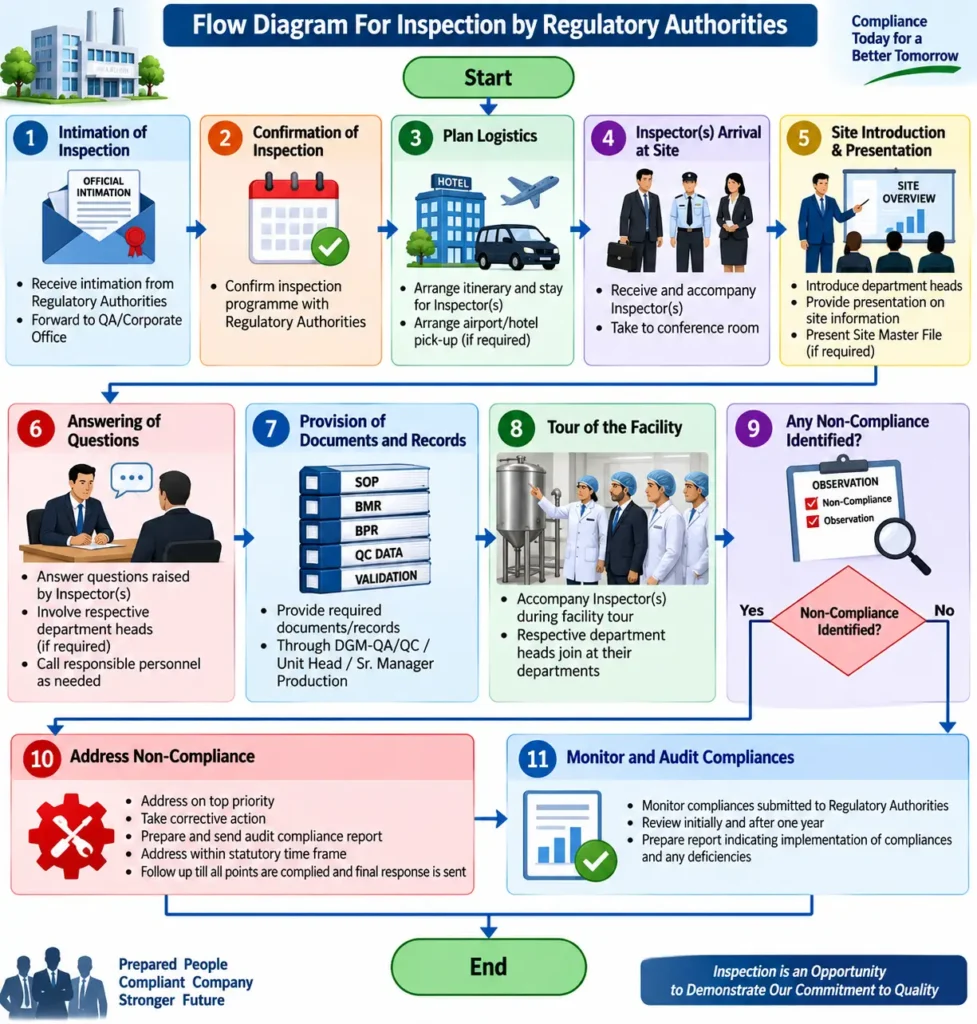
Requested documents and records are then provided, followed by a tour of the facility with responsible personnel. If any non-compliance is identified, it is addressed on priority through corrective action, preparation of a compliance report, timely response to the authority, and follow-up until closure. Compliance commitments are subsequently monitored and reviewed to verify effective implementation. Overall, the flow ensures that regulatory inspections are handled in an organized, controlled, professional, and compliant manner.
3. Benefits of Following SOP:
The image explains how following the SOP for Inspection by Regulatory Authorities helps a pharmaceutical manufacturing facility remain prepared, organized, and compliant during an inspection. It highlights that proper SOP implementation improves inspection readiness, clearly defines the roles and responsibilities of employees, and ensures that important documents such as SOPs, batch records, training records, logbooks, and change-control records are maintained properly and made available when required. The SOP also supports clear and consistent communication with inspectors and helps the facility conduct an organized tour of manufacturing areas.
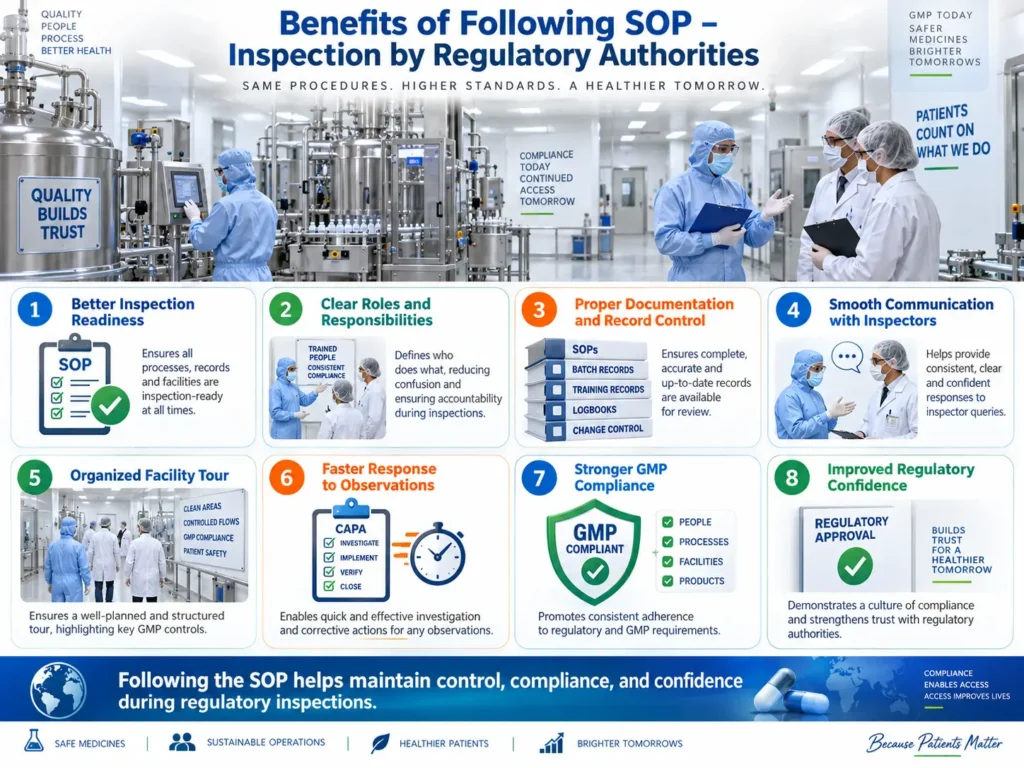
Another important benefit is faster handling of regulatory observations. When any non-compliance is identified, responsible personnel can initiate corrective actions, prepare the compliance report, submit the response within the required timeframe, and follow up until closure. Overall, following the SOP strengthens GMP compliance, document control, inspection coordination, regulatory confidence, and continuous compliance monitoring, helping the organization demonstrate a controlled and professional quality system.
4. Brainstorming for SOP Failure:
The image presents a brainstorming analysis for failure to follow the SOP for Inspection by Regulatory Authorities. The central problem is shown as the SOP not being followed properly during a regulatory inspection, while surrounding sticky notes identify possible contributing causes such as poor inspection readiness, unavailable documents, training gaps, unclear responsibilities, weak departmental coordination, inadequate facility-tour planning, incomplete records, delayed response to observations, weak communication, poor CAPA follow-up, and insufficient compliance monitoring.These brainstorming points are consistent with the main control areas described in the SOP, including inspection coordination, answering inspector questions, providing documents and records, conducting the facility tour, addressing non-compliances, and monitoring commitments submitted to regulatory authorities.
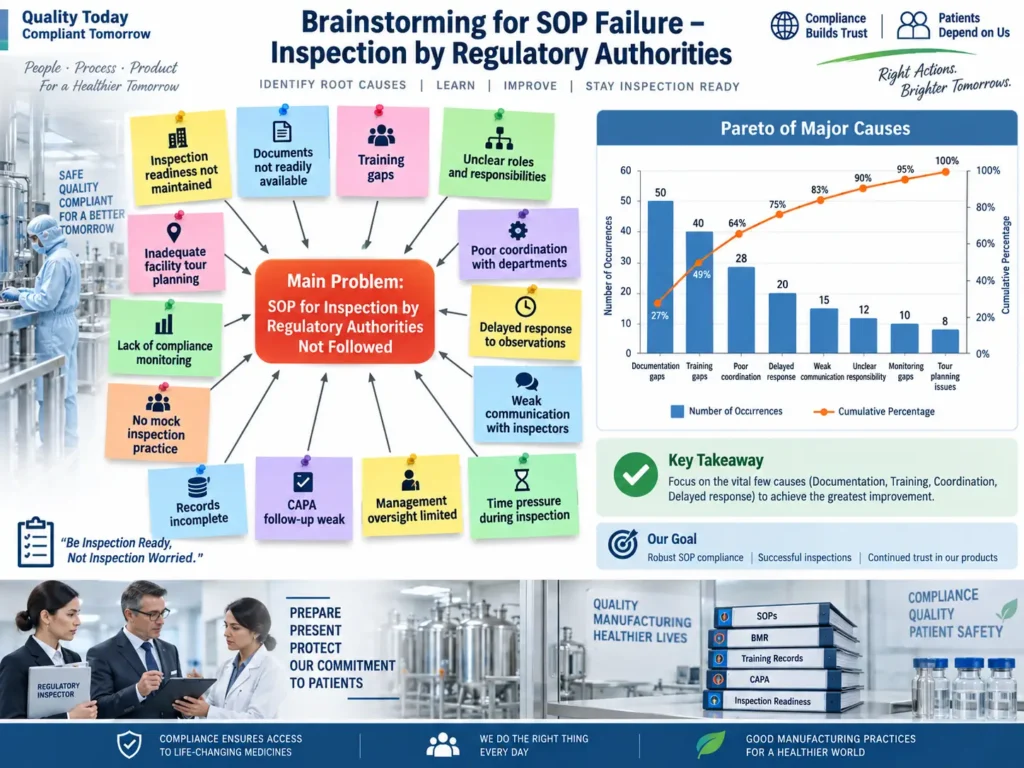
The Pareto chart on the right visually prioritizes potential causes so that the investigation team can focus first on the “vital few” issues that may contribute most to SOP failure. In practice, the frequencies and cumulative percentages in a Pareto chart should be calculated from actual deviation, audit, inspection, training, or CAPA data. The values shown in the image are therefore best treated as an illustrative example, unless they are replaced with real site data. Overall, the diagram helps QA and management convert a broad SOP failure into specific, reviewable causes and identify where corrective and preventive actions should be focused first.
5. 5-Why Analysis for SOP Failure:
The 5-Why diagram explains a possible root-cause path for failure to properly follow the SOP for Inspection by Regulatory Authorities. It starts with the main problem: the SOP is not followed effectively during an inspection. The first “Why” identifies that required documents, records, or information may not be readily available when inspectors request them. The second “Why” links this problem to records not being properly maintained or updated. The third “Why” points toward inadequate training of concerned personnel regarding the SOP and inspection readiness. The fourth “Why” identifies weaknesses in planning, implementation, or monitoring of the training program. Finally, the fifth “Why” indicates insufficient management oversight and accountability for ensuring training, competence, and compliance.
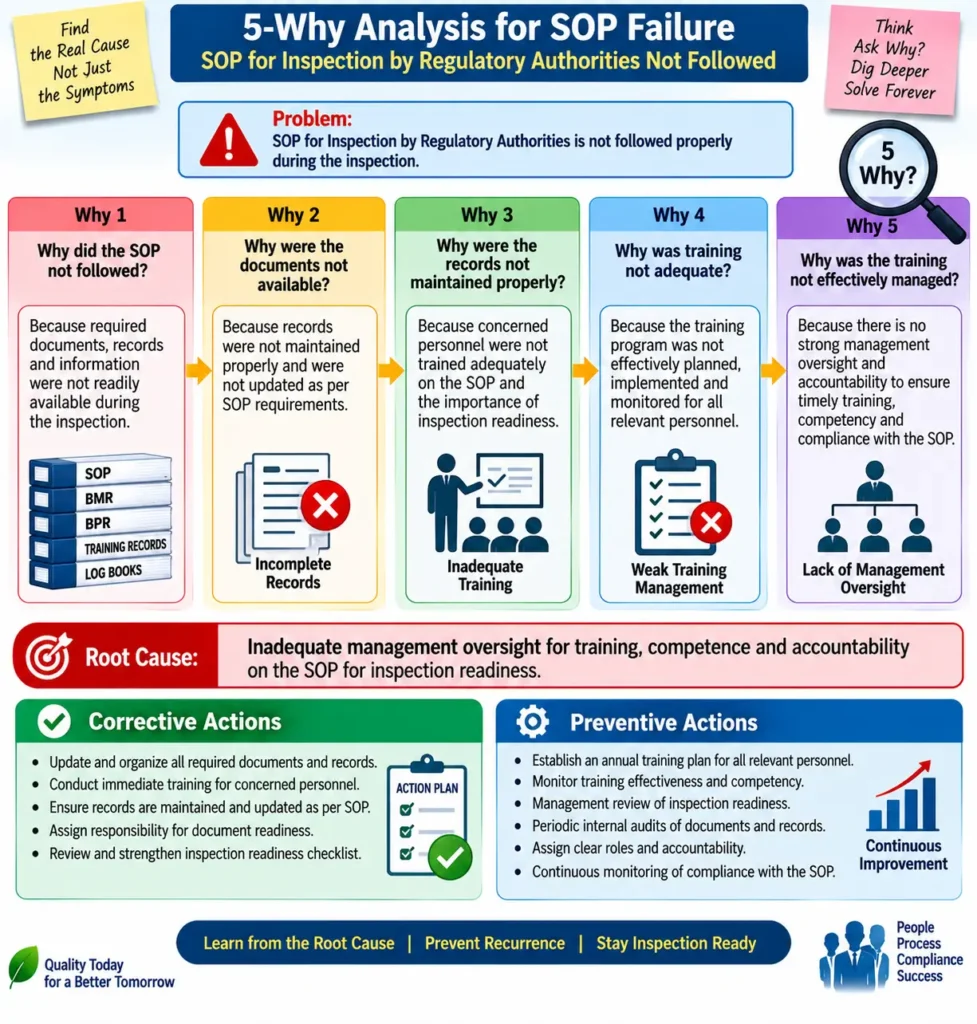
The SOP itself requires proper coordination, authorized responses to inspectors, controlled provision of documents and records, and organized handling of the facility tour. The diagram therefore identifies the illustrative root cause as inadequate management oversight for training, competence, document readiness, and accountability. Corrective and preventive actions focus on updating records, conducting training, assigning clear responsibilities, reviewing inspection readiness, periodically auditing documentation, and continuously monitoring compliance. This analysis helps the organization move beyond the immediate failure and identify deeper system weaknesses that may need CAPA to prevent recurrence.
6. Fishbone Analysis for SOP Failure:
The Fishbone Analysis diagram shows the possible causes behind failure to properly follow the SOP for Inspection by Regulatory Authorities. The main problem is placed at the head of the fish, while potential contributing causes are grouped under the common 6M categories: Man, Machine, Method, Material, Measurement, and Mother Nature. The Man category covers issues such as inadequate training, unclear responsibilities, inexperienced personnel, and poor communication. Machine/Systems includes problems with document-retrieval systems or supporting equipment. Method focuses on unclear procedures, weak inspection-readiness practices, lack of checklists, and inconsistent implementation. Material/Documentation includes missing SOPs, incomplete records, outdated versions, and unavailable training or CAPA records. Measurement/Monitoring highlights weak compliance monitoring, inadequate tracking of commitments, and poor follow-up. Environment considers housekeeping, congestion, access, and other workplace conditions that may affect inspection readiness.
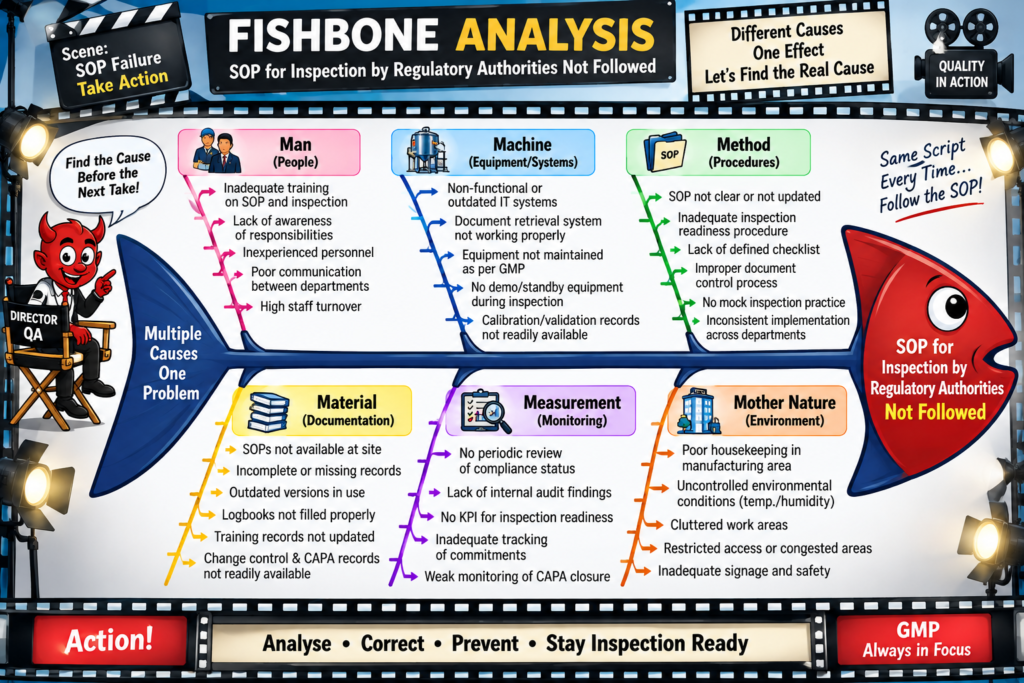
The uploaded SOP specifically requires coordinated inspection handling, controlled answering of questions, provision of documents and records, and an organized facility tour. It also requires priority action on non-compliances, preparation of an audit compliance report, follow-up until closure, and monitoring of commitments submitted to regulatory authorities.The additional causes shown in the fishbone diagram are illustrative investigation points rather than findings stated in the SOP. Overall, the diagram helps the QA team systematically examine multiple possible causes, identify the real root cause, and develop appropriate CAPA to prevent recurrence.
7. Fault Tree Analysis for SOP Failure:
The Fault Tree Analysis (FTA) explains how different failures can combine and lead to the main event: “SOP for Inspection by Regulatory Authorities Not Followed.” The analysis starts with the top failure and breaks it into major contributing branches such as poor inspection coordination, incomplete or unavailable documents, inadequate communication, insufficient training, weak facility-tour control, delayed response to observations, and ineffective follow-up of regulatory commitments. These branches reflect the key controls required by the SOP, including proper coordination of the inspection, answering inspector questions through authorized personnel, providing requested records, and managing the facility tour.
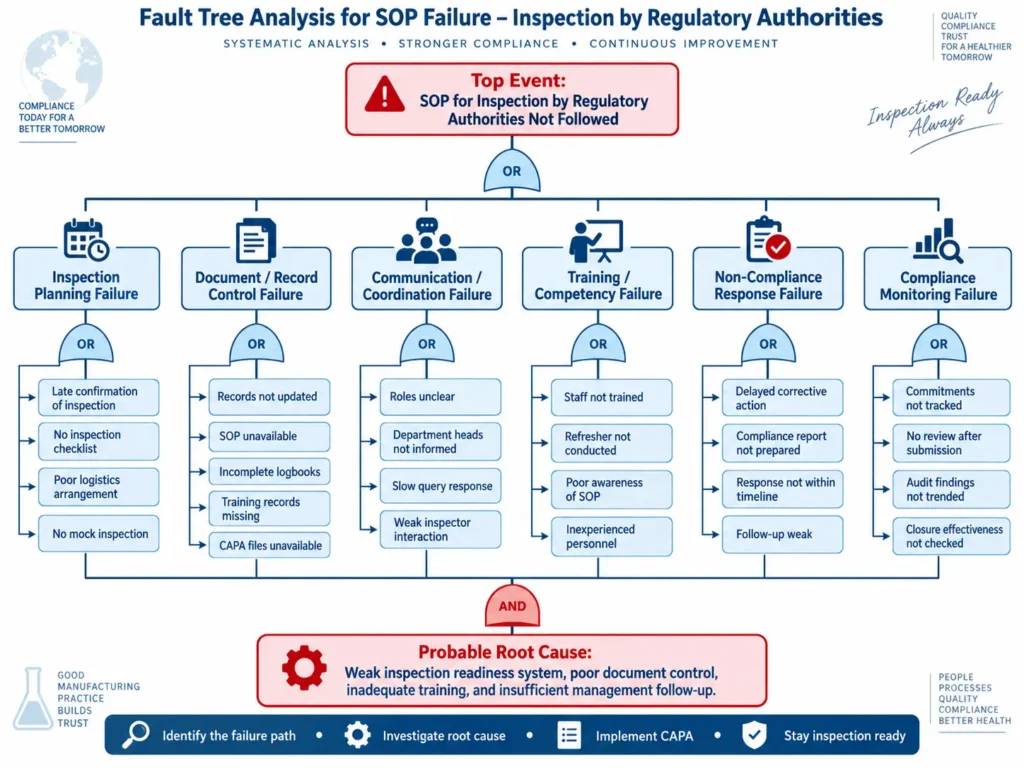
The lower levels of the fault tree can further identify basic causes such as unclear responsibility, poor document readiness, inadequate preparation, weak monitoring, or delayed CAPA follow-up. The SOP specifically requires non-compliances to be addressed on priority, compliance reports to be submitted, and commitments to be monitored until completion.Overall, the FTA helps identify how several small control failures can combine into a major inspection failure and supports selection of effective corrective and preventive actions.
8. Impact Assessment:
The Impact Assessment image explains the possible consequences if the SOP for Inspection by Regulatory Authorities is not followed properly. It evaluates the failure from several important areas so that QA and management can understand the seriousness of the risk. The diagram covers Product Quality Impact, such as undetected quality problems, risk to product quality, recalls, and loss of market confidence; Regulatory Impact, including inspection observations, increased regulatory scrutiny, delayed approvals, or possible enforcement action; and Patient Safety Impact, where ineffective or unsafe medicines could potentially affect patients.
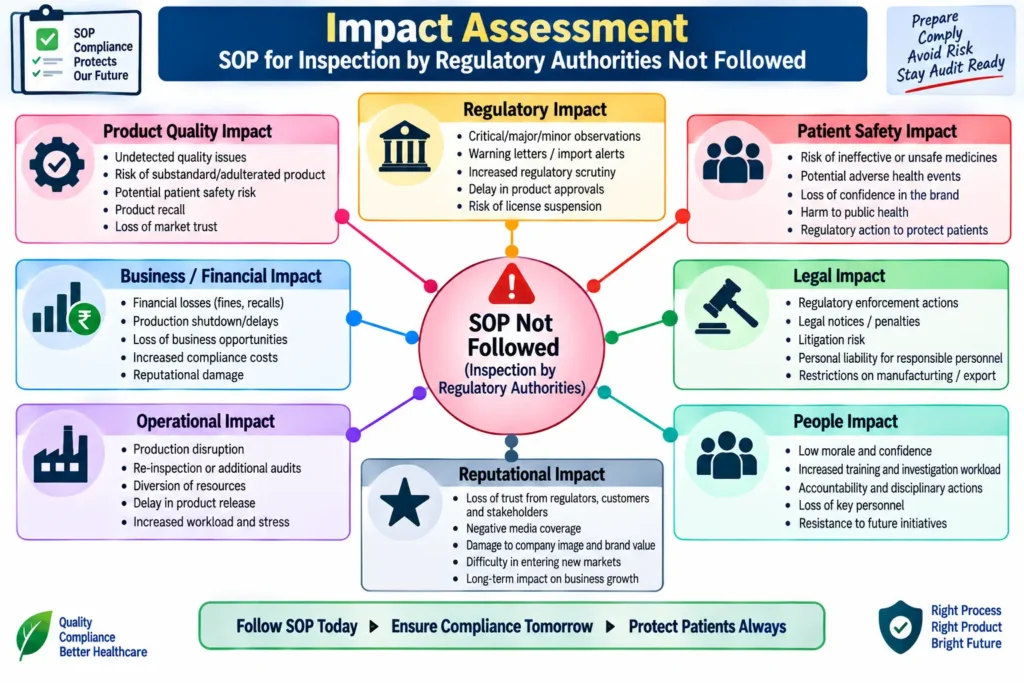
It also highlights Business/Financial Impact, such as increased compliance costs, production delays, recalls, and loss of business opportunities. Operational Impact includes disruption of manufacturing activities, additional audits, delayed product release, and increased workload. Legal Impact considers penalties, legal notices, litigation, or restrictions on manufacturing and export. The image further includes People Impact, such as increased investigation workload, accountability issues, and reduced confidence, along with Reputational Impact, including loss of trust from regulators, customers, and other stakeholders. The SOP itself requires regulatory non-compliances to be addressed on priority, followed by corrective action, compliance reporting, timely response, and continued follow-up until completion. The wider impacts shown in the image are illustrative risk considerations, not specific consequences stated in the SOP. Overall, the assessment demonstrates why proper inspection readiness and consistent SOP compliance are essential for protecting product quality, patients, regulatory status, operations, and organizational reputation.
Questions & Answers:
Q1. What is the objective of this SOP?
Answer: The objective is to provide guidelines to the factory’s technical staff for coordinating with inspectors, answering questions, providing records, files and quality-control data, and supporting a facility tour during a regulatory inspection.
Q2. What is the scope of this SOP?
Answer: It is applicable to all inspections conducted by Regulatory Authorities.
Q3. Who is responsible for execution of the SOP?
Answer: The Chemist/Executive-QA is responsible for execution of the SOP.
Q4. Who is responsible for effective implementation of the SOP?
Answer: DGM-QA/QC, AGM-Production, GM-Production, and the respective Department Head are responsible for effective implementation.
Q5. Who receives the intimation of inspection?
Answer: Inspection intimation from Regulatory Authorities is received by QA/Corporate Office.
Q6. Who confirms the inspection programme with the Regulatory Authority?
Answer: QA/Corporate Office confirms the inspection programme.
Q7. Who arranges the inspector’s itinerary and stay?
Answer: Corporate Office or the Unit PR Department arranges the itinerary and stay of the inspector(s).
Q8. What happens when the inspector arrives at the unit?
Answer: The inspector is taken to the conference room and introduced to the concerned department heads.
Q9. Who gives the site presentation to the inspector?
Answer: The Unit Head, DGM-QA/QC, or Sr. Manager-Production presents the site information.
Q10. Who answers questions raised by the inspector?
Answer: Questions are answered by the Unit Head, DGM-QA/QC, or Sr. Manager-Production. If additional clarification is needed, the respective Department Head or another responsible person may be called.
Q11. Who provides requested documents and records?
Answer: Requested documents and records are provided by DGM-QA/QC, Unit Head, or Sr. Manager-Production.
Q12. Who accompanies the inspector during the facility tour?
Answer: The Unit Head or DGM-QA/QC accompanies the inspector, and the respective Department Head joins when the inspector reaches that department.
Q13. What should be done if a non-compliance is identified?
Answer: The non-compliance should be addressed on top priority by DGM-QA/QC and the Unit Head for corrective action.
Q14. Who prepares the audit compliance report?
Answer: QA prepares the audit compliance report and sends it to the Regulatory Authority.
Q15. Within what timeframe should non-compliance be addressed?
Answer: It should be addressed immediately or within the timeframe specified by the respective statutory authority.
Q16. How long should follow-up continue?
Answer: Follow-up should continue until all points are complied with and a firm response is sent.
Q17. How are regulatory compliances monitored?
Answer: Submitted compliances are monitored initially and again after completion of one year.
Q18. What should the monitoring report contain?
Answer: It should indicate the implementation status of the compliances submitted to Regulatory Authorities and any deficiencies in implementation.
Q19. What is the reference mentioned in the SOP?
Answer: The reference is stated as In House.
Q20. What abbreviations are defined in the SOP?
Answer: QA – Quality Assurance, QC – Quality Control, NA – Not Applicable, PR – Personnel, and SOP – Standard Operating Procedure.
Reference Guidelines:
- WHO – Quality Assurance of Pharmaceuticals, Volume 2: Good Manufacturing Practices and Inspection, 10th Edition (2024). This compendium provides broad GMP and pharmaceutical inspection guidance for manufacturers and regulators. (World Health Organization)
WHO GMP & Inspection Compendium - WHO TRS 996, Annex 4 – Guidance on Good Manufacturing Practices: Inspection Report. It provides principles and a recommended format for pharmaceutical GMP inspection reporting and follow-up. (World Health Organization)
WHO TRS 996 Annex 4 - WHO – Inspection of Pharmaceutical Manufacturers, TRS 823, Annex 2. This guidance covers inspection practices, assessment of GMP compliance, inspection activities, and responsibilities of pharmaceutical inspectorates. (World Health Organization)
- US FDA – Investigations Operations Manual (IOM), 2026, particularly Chapter 5: Inspections. The IOM is FDA’s primary operational reference for investigators and is useful for understanding how FDA inspections are conducted. (U.S. Food and Drug Administration)
FDA Investigations Operations Manual - European Commission – EudraLex Volume 4, EU Guidelines for Good Manufacturing Practice. This is the principal EU GMP framework against which medicinal-product manufacturers are inspected. (Public Health)
EudraLex Volume 4 – EU GMP - CDSCO – Drugs Rules, 1945 and Revised Schedule M. For Indian pharmaceutical facilities, Schedule M establishes GMP requirements that are assessed during regulatory inspections. CDSCO also publishes GMP inspection checklists and risk-based inspection guidance. (CDSCO)
CDSCO Drugs Rules and Schedule M