







Brief Description
This Standard Operating Procedure (SOP) describes the methods used for microbial staining in the microbiology laboratory. Its purpose is to ensure that microorganisms are stained, observed, and differentiated in a consistent manner. The Microbiologist is responsible for performing the procedure, while the Head of Department is accountable for its implementation. The SOP covers Gram staining, spore staining, and fungal staining. Gram staining differentiates bacteria into Gram-positive organisms, which appear blue/purple, and Gram-negative organisms, which appear red/pink. Spore staining uses the Schaeffer-Fulton method with malachite green and safranin to identify bacterial spores. Fungal staining uses Lactophenol Cotton Blue for observing fungal structures under a microscope. The SOP also provides precautions, staining techniques, result interpretation, microbial morphology information, training requirements, distribution details, abbreviations, and revision history.
Skip to PDF content1. Flow Diagram:
The flow diagram gives a simple overview of the microbial staining process used in the microbiology laboratory. The procedure begins with basic precautions, such as avoiding overheating of the smear and using staining reagents carefully.The analyst then selects the required staining method: Gram staining, spore staining, or fungal staining.
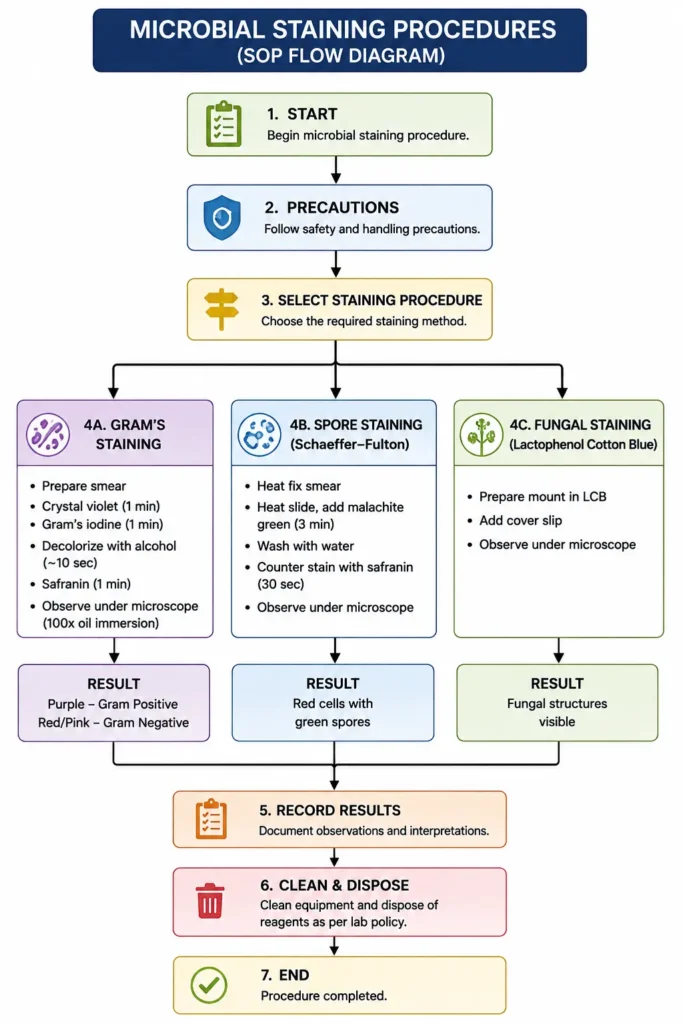
Gram staining differentiates bacteria into Gram-positive and Gram-negative organisms using crystal violet, iodine, alcohol, and safranin. Spore staining uses the Schaeffer-Fulton method with malachite green and safranin to identify bacterial spores. Fungal staining uses Lactophenol Cotton Blue to observe fungal structures under a microscope.After staining, the slide is examined microscopically, results are interpreted, observations are recorded, and the procedure is completed.
2. Brainstorming for SOP Failure:
Brainstorming is used to identify all possible reasons why the SOP for Microbial Staining Procedures may fail during laboratory work. The SOP requires controlled staining steps, proper reagent handling, suitable smear preparation, correct staining time, and microscopic examination.During brainstorming, possible causes are grouped into areas such as human/training, reagents, equipment, sample or culture, procedure, environment, documentation, maintenance, and management.
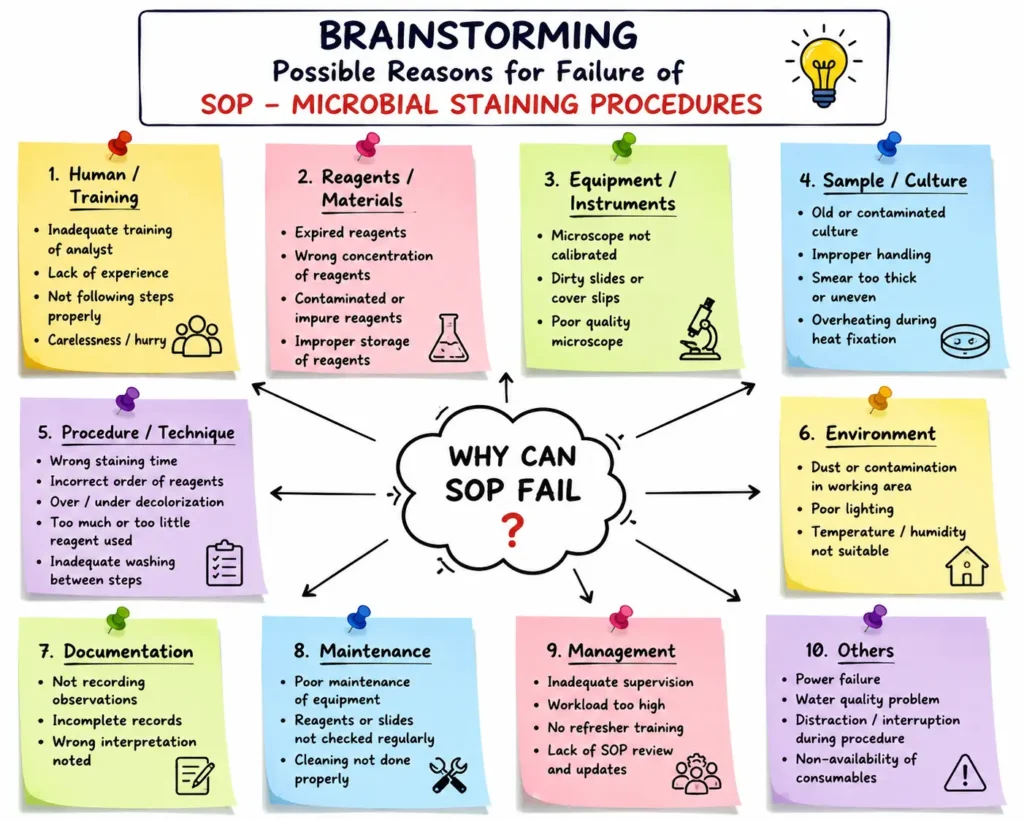
Examples include inadequate analyst training, expired or contaminated reagents, uncalibrated microscopes, dirty slides, improper smear preparation, incorrect staining time, over- or under-decolorization, poor documentation, and inadequate supervision.The brainstorming exercise helps the investigation team consider different possibilities without immediately selecting one cause. These ideas can then be evaluated using tools such as 5-Why Analysis, Fishbone Analysis, or FMEA to determine the actual root cause and establish appropriate CAPA.
3. 5-Why Analysis for SOP Failure:
The 5-Why Analysis is used to identify the root cause of failure in the SOP for Microbial Staining Procedures by repeatedly asking “Why?” about the observed problem.In this example, the problem is incorrect or unreliable Gram staining results. The analysis shows that the wrong staining result may occur because the decolorization step is not performed correctly. The SOP requires absolute alcohol to be added drop-wise for approximately 10 seconds until the free blue colour is removed.
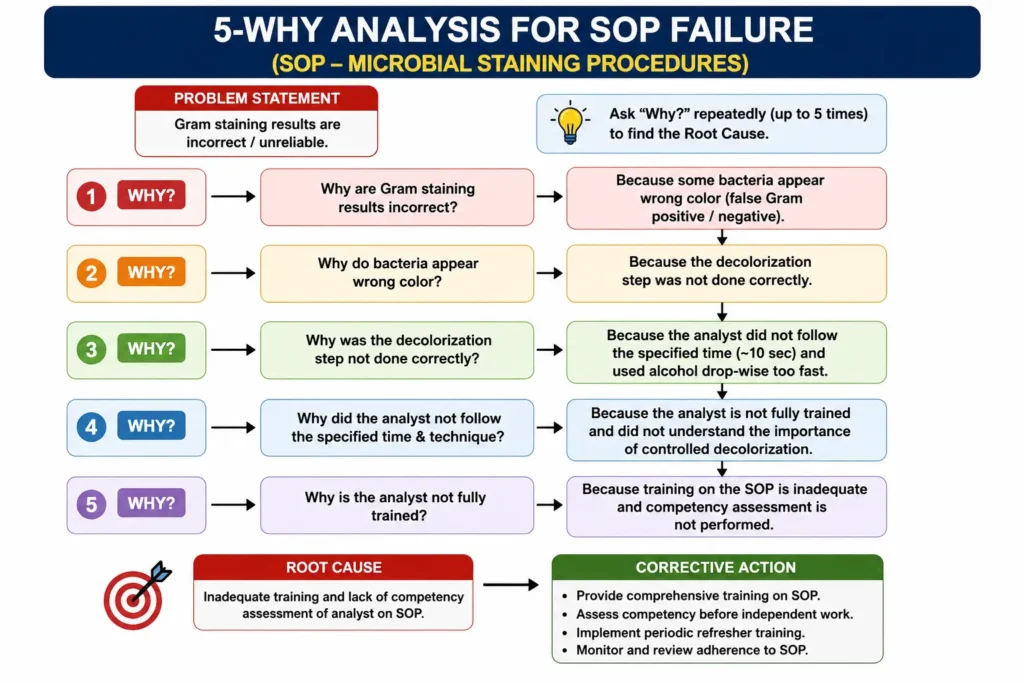
Further questioning may indicate that the analyst did not follow the specified time or technique due to insufficient understanding, inadequate training, or lack of competency assessment.The 5-Why method helps move from the visible problem to the underlying cause. Once the root cause is identified, suitable CAPA can include SOP retraining, competency assessment, refresher training, and periodic monitoring of SOP compliance.
4. Fishbone Analysis for SOP Failure:
The Fishbone Analysis (Ishikawa Diagram) is used to identify and organize possible causes of failure in the SOP for Microbial Staining Procedures. The main problem considered is incorrect or unreliable microbial staining results.Possible causes are grouped into six major categories: Manpower, Method, Machine/Equipment, Materials/Reagents, Sample/Culture, and Environment. Examples include inadequate training, failure to follow SOP steps, incorrect staining time, improper decolorization, expired or contaminated reagents, uncalibrated microscope, dirty slides, improper culture handling, and unsuitable laboratory conditions.
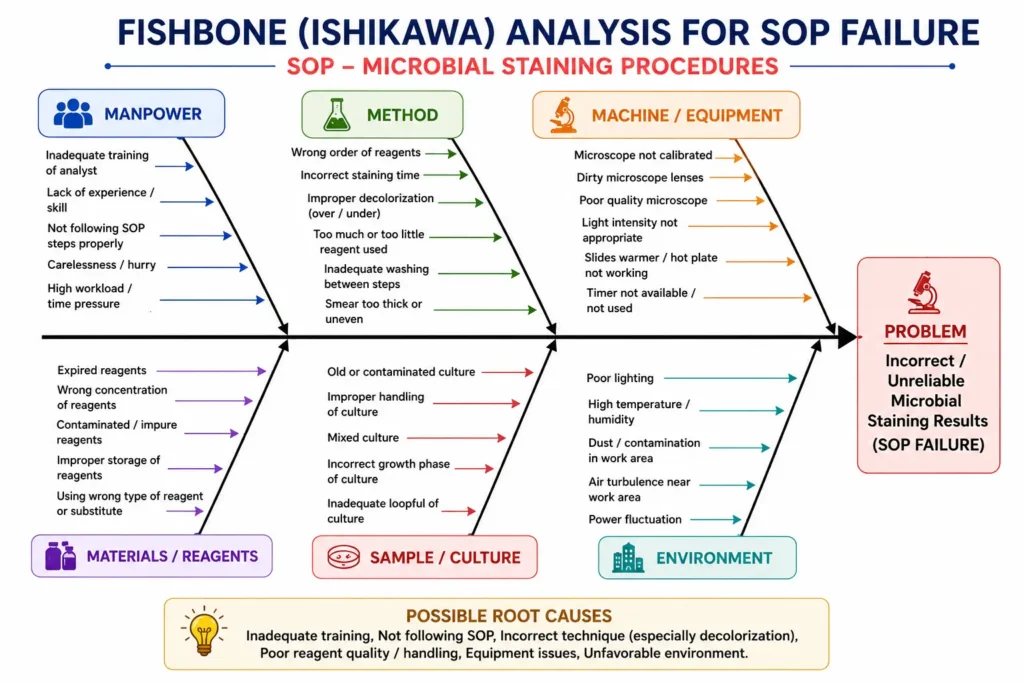
These factors are important because the SOP requires correct smear preparation, controlled staining times, proper reagent sequence, washing, decolorization, and microscopic examination.Fishbone analysis helps the investigation team systematically review all possible causes, identify the most likely root cause, and establish suitable corrective and preventive actions (CAPA) to avoid recurrence.
5. Fault Tree Analysis for SOP Failure:
Fault Tree Analysis (FTA) is a systematic tool used to identify the possible causes that can lead to failure of an SOP. For the Microbial Staining Procedures SOP, the top event may be an incorrect microbial staining result. The causes can be grouped into operator errors, method or procedure errors, reagent or material errors, and system or management errors.
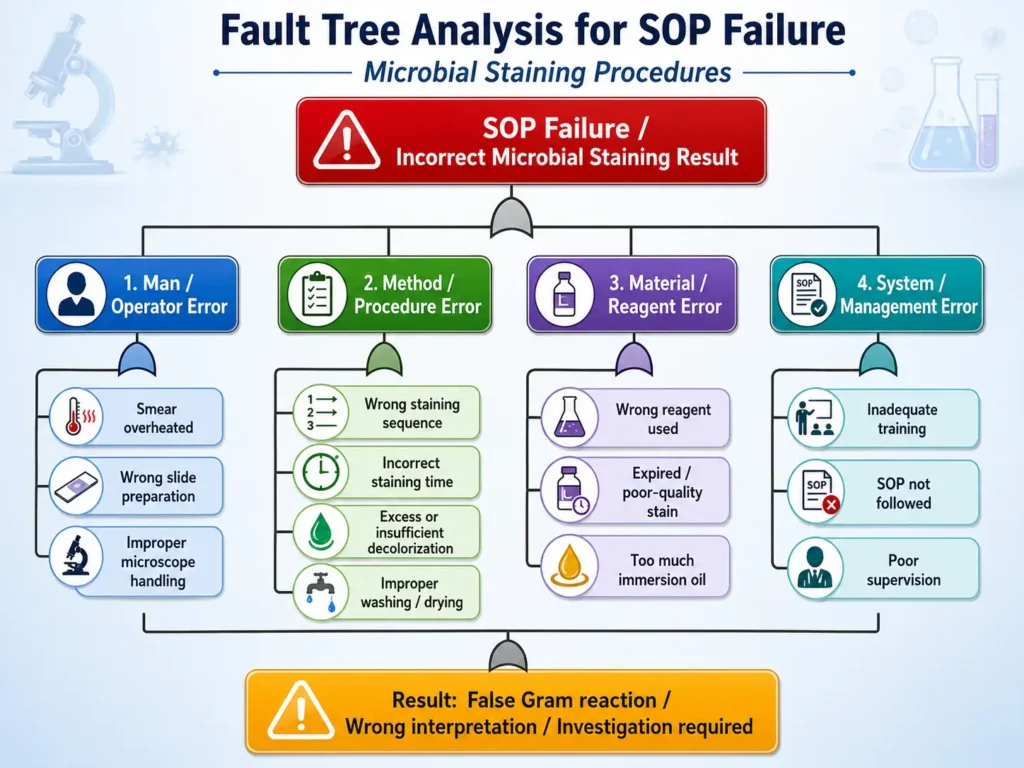
Examples include overheating the smear, incorrect staining sequence or timing, improper decolorization, wrong or poor-quality reagents, excess immersion oil, inadequate training, and failure to follow the SOP. The SOP specifically emphasizes precautions such as avoiding smear overheating and controlling immersion oil use, along with defined staining steps and timings.FTA helps trace these causes in a logical tree structure so that the root cause can be identified and suitable corrective and preventive actions can be taken.
Questions & Answers – Microbial Staining Procedures
- Q: What is the purpose of this SOP?
A: To lay down the procedures for microbial staining. - Q: Where is this SOP applicable?
A: It is applicable to the microbiology laboratory. - Q: Who is responsible for performing the procedure?
A: The Microbiologist is responsible. - Q: What important precaution should be taken during smear preparation?
A: The smear should not be overheated. - Q: Which stain is used as the primary dye in Gram staining?
A: Crystal violet is used as the primary dye. - Q: What is the role of Gram’s iodine?
A: Gram’s iodine acts as the complexing agent. - Q: Which reagent is used as the decolorizer?
A: Absolute alcohol is used as the decolorizer. - Q: Which counter stain is used in Gram staining?
A: Safranin is used as the counter stain. - Q: How are Gram-positive bacteria identified?
A: Gram-positive bacteria appear purple in color after staining. - Q: How are Gram-negative bacteria identified?
A: Gram-negative bacteria appear red or pink in color. - Q: Which stain is used for spore staining?
A: Malachite green is used for spore staining, followed by safranin as the counter stain. - Q: Which staining method is used for fungi?
A: Lactophenol Cotton Blue staining is used for fungi. - Q: Under which microscope objective is the stained preparation examined?
A: It is examined under the oil immersion objective at 100×. - Q: Who receives training on this SOP?
A: Quality Control personnel receive the training, and the training period is one day. - Q: What should be done if staining results are incorrect?
A: The source SOP does not specify a separate investigation procedure for incorrect staining results; it provides the staining steps, precautions, and result interpretation.