






1. Introduction – SOP for Mock Recall:
The SOP for Mock Recall describes the systematic procedure for conducting a simulated recall of a distributed finished pharmaceutical product to evaluate the effectiveness and readiness of the organization’s product recall system. The exercise verifies whether batch history, distribution information, stakeholder communication, stock details, and reconciliation records can be collected promptly and accurately. During a mock recall, Quality Assurance selects an appropriate distributed batch, obtains approval from the Plant Head and Head-QA, coordinates with the mock recall committee and distribution department, and communicates the recall information to relevant stakeholders. The exercise includes review of BMR/BPR, QC reports, control samples, invoices, distribution records, stock statements, reconciliation, evaluation, and final closure by Head-QA. The SOP requires the mock recall process to be completed within 30 working days from initiation.
Skip to PDF content2. Flow Diagram – SOP for Mock Recall:
The SOP for Mock Recall provides a structured process for evaluating the effectiveness of the pharmaceutical product recall system. The procedure begins with initiation of the mock recall, allocation of a unique mock recall number, and selection of a distributed finished-product batch by Head-QA. The selected batch details are reviewed and approved by the Plant Head and Head-QA before execution.
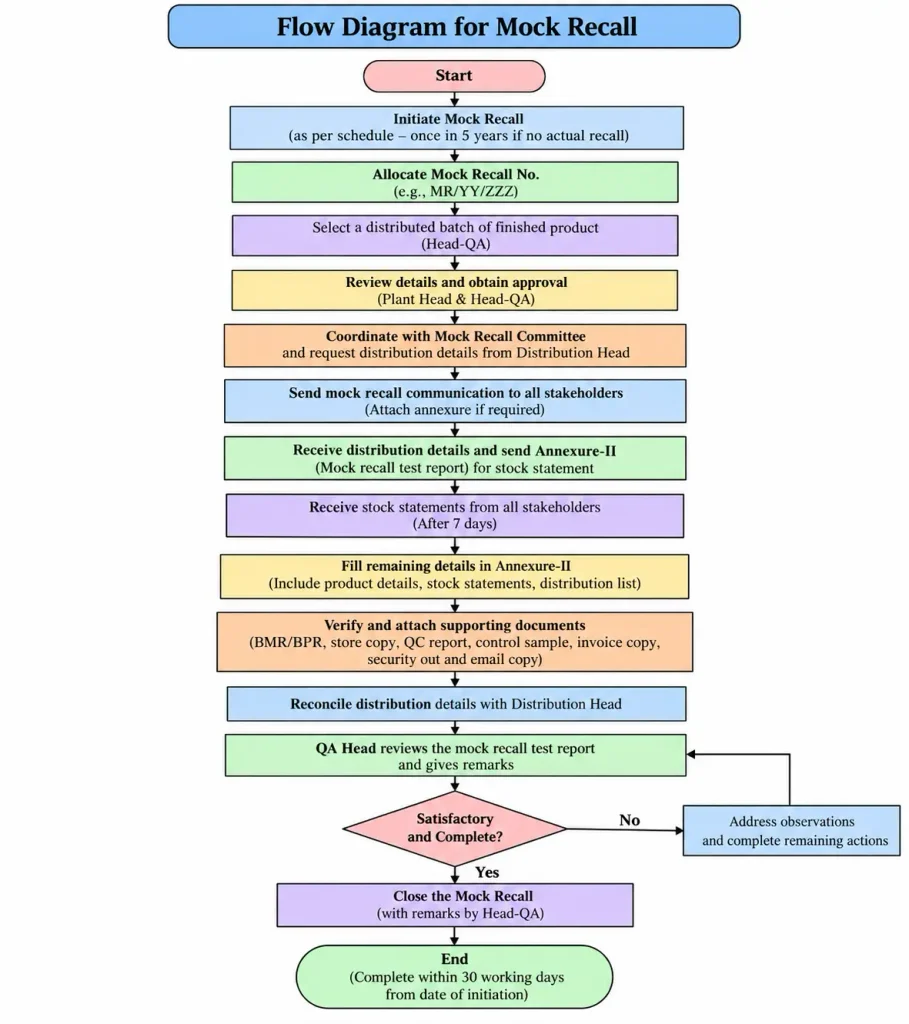
QA then coordinates with the mock recall committee and Distribution Head to obtain distribution details and communicates the mock recall to all concerned stakeholders. Stock statements are collected, product and distribution information are recorded, and reconciliation is performed. Supporting records such as BMR/BPR, QC reports, control samples, invoices, security-out records, and communication records are reviewed before final evaluation. Head-QA reviews the mock recall report, records remarks, and approves closure. The entire mock recall exercise should be completed within 30 working days from initiation.
3. Benefits of Following SOP for Mock Recall:
Following the SOP for Mock Recall helps ensure that the pharmaceutical organization remains prepared to effectively manage a real product recall. The procedure verifies whether batch history, distribution records, stakeholder communication channels, stock information, and supporting documentation can be retrieved and reviewed in a timely and controlled manner. The SOP specifically requires coordination with the mock recall committee, communication with stakeholders, collection of stock statements, and completion of the mock recall test report.
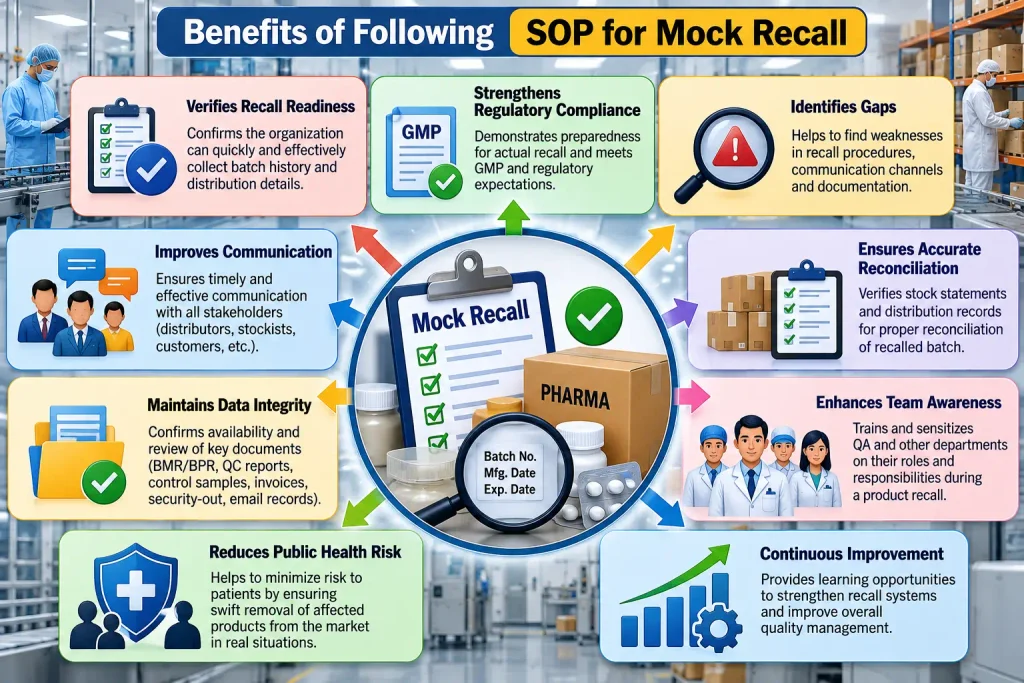
Effective implementation also strengthens traceability and reconciliation by requiring review of BMR/BPR records, QC reports, control samples, invoices, and distribution-related evidence. This structured approach helps identify weaknesses in the recall system, improves departmental coordination, supports accurate documentation, and enhances overall recall preparedness. Final evaluation by Head-QA confirms whether the mock recall was satisfactory and whether the distributed batch was successfully reconciled.
4. Brainstorming for SOP Failure – Mock Recall:
The SOP for Mock Recall depends on timely coordination, accurate records, effective communication, complete documentation, and proper reconciliation of the selected distributed batch. Brainstorming for potential SOP failure helps identify weaknesses that may prevent the mock recall exercise from being completed effectively. Key concerns include inadequate staff training, incomplete distribution data, poor communication with stakeholders, lack of coordination between QA and other departments, delayed stock statements, documentation gaps, data-integrity issues, insufficient resources, and reconciliation mismatches.
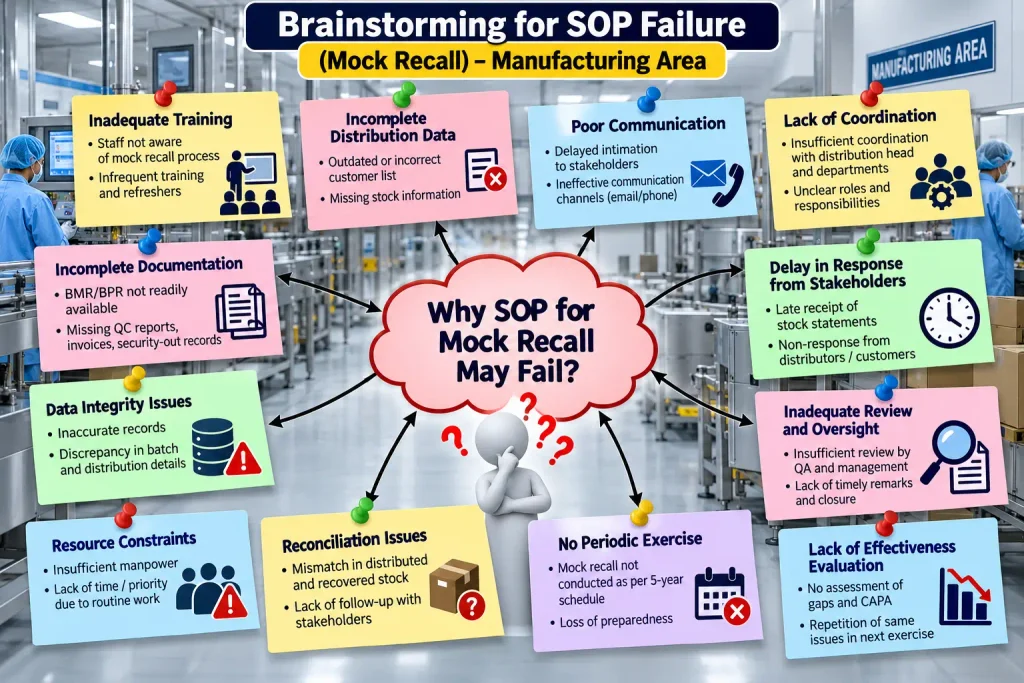
The SOP requires QA to coordinate with the mock recall committee, obtain distribution details, communicate with stakeholders, collect stock statements, and complete the mock recall report. It also requires review of BMR/BPR, QC reports, control samples, invoices, and related records before closure. Identifying these potential failure points supports better preparedness, stronger follow-up, clearer responsibilities, and more effective execution of future mock recalls.
5. 5-Why Analysis for SOP Failure – Mock Recall:
The SOP for Mock Recall requires coordinated execution, timely collection of distribution and stock information, complete documentation, effective communication, reconciliation, review, and closure of the mock recall activity. The 5-Why Analysis helps identify the underlying causes when the mock recall procedure is not performed effectively. Potential failures may begin with delayed stock statements, incomplete distribution data, missing BMR/BPR or QC documents, poor stakeholder communication, or mismatches between dispatched and recovered quantities. The SOP specifically requires QA to obtain distribution details, communicate with stakeholders, collect stock statements, and complete the mock recall report. It also requires verification of BMR/BPR, QC reports, control samples, invoices, and related records before final review and closure.
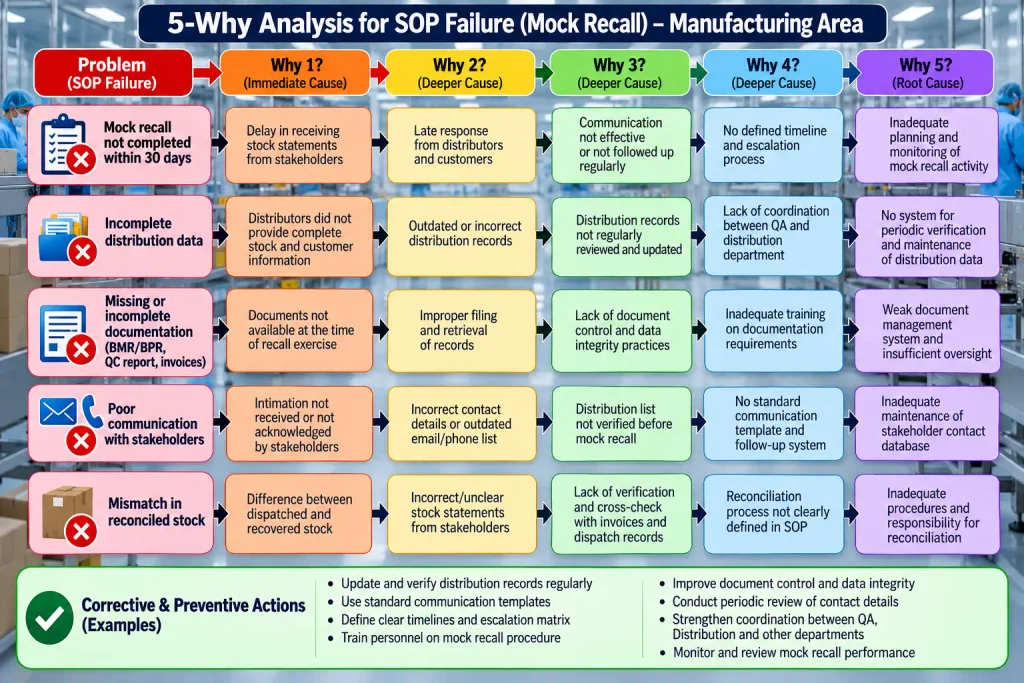
By repeatedly asking “Why?”, the analysis can trace these visible problems to deeper causes such as weak planning, outdated records, inadequate document control, unclear responsibilities, insufficient training, poor follow-up, or ineffective reconciliation controls. This supports identification of suitable corrective and preventive actions and improves future mock recall effectiveness.
6. Fishbone Analysis for SOP Failure Mock Recall:
The SOP for Mock Recall requires effective coordination, communication, documentation, reconciliation, review, and timely closure of the mock recall exercise. The Fishbone Analysis diagram organizes potential causes of SOP failure into major categories such as People, Process, Materials/Records, Machine/Systems, Method, and Environment. These categories help teams systematically explore why a mock recall may not be completed effectively.
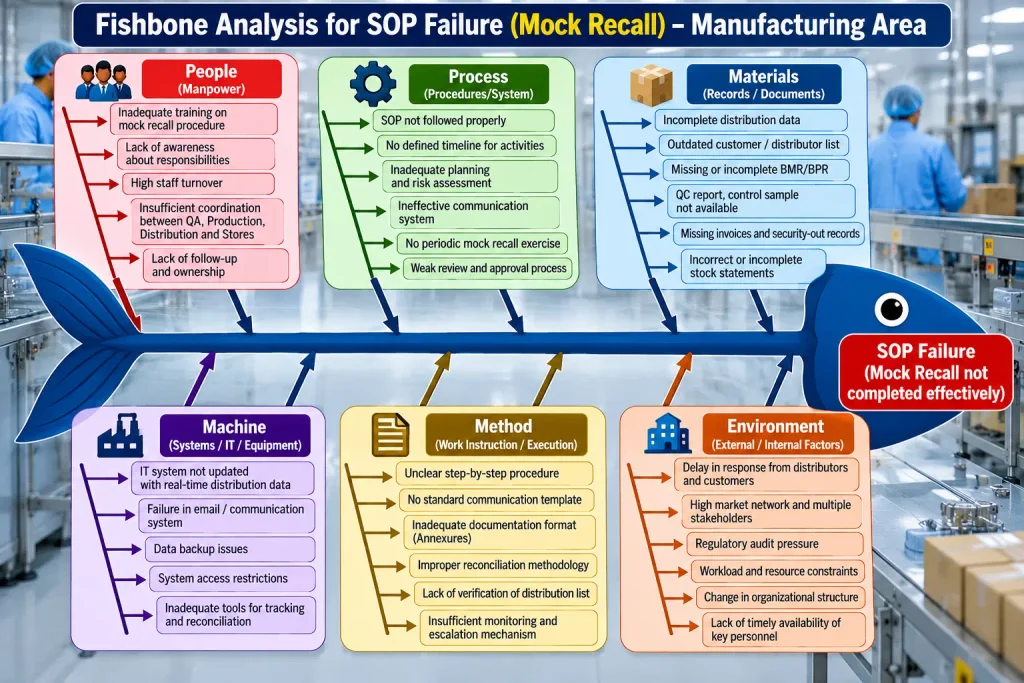
The SOP specifically requires QA to coordinate with the mock recall committee, obtain distribution details, communicate with stakeholders, collect stock statements, and complete the mock recall test report. It also requires verification of BMR/BPR, QC reports, control samples, invoices, distribution records, and reconciliation before final QA review and closure. Potential contributing causes shown in the fishbone—such as inadequate training, incomplete records, communication failures, weak follow-up, system limitations, and unclear execution methods—are analytical possibilities derived from the SOP workflow. Identifying these causes supports focused investigation, corrective action, and improvement of future mock recall performance.
7. Fault Tree Analysis for SOP Failure – Mock Recall
The SOP for Mock Recall requires systematic coordination, communication, documentation, reconciliation, review, and closure to demonstrate that the organization can effectively trace and account for a distributed finished-product batch. Fault Tree Analysis helps examine how different failures can combine and result in an ineffective mock recall. Major failure branches may include inadequate distribution information, poor stakeholder communication, incomplete supporting documentation, and failure in stock reconciliation. The SOP requires QA to obtain distribution details, communicate with stakeholders, collect stock statements, and complete the mock recall report. It also requires verification of BMR/BPR, QC reports, control samples, invoices, security-out records, and related evidence before final review.
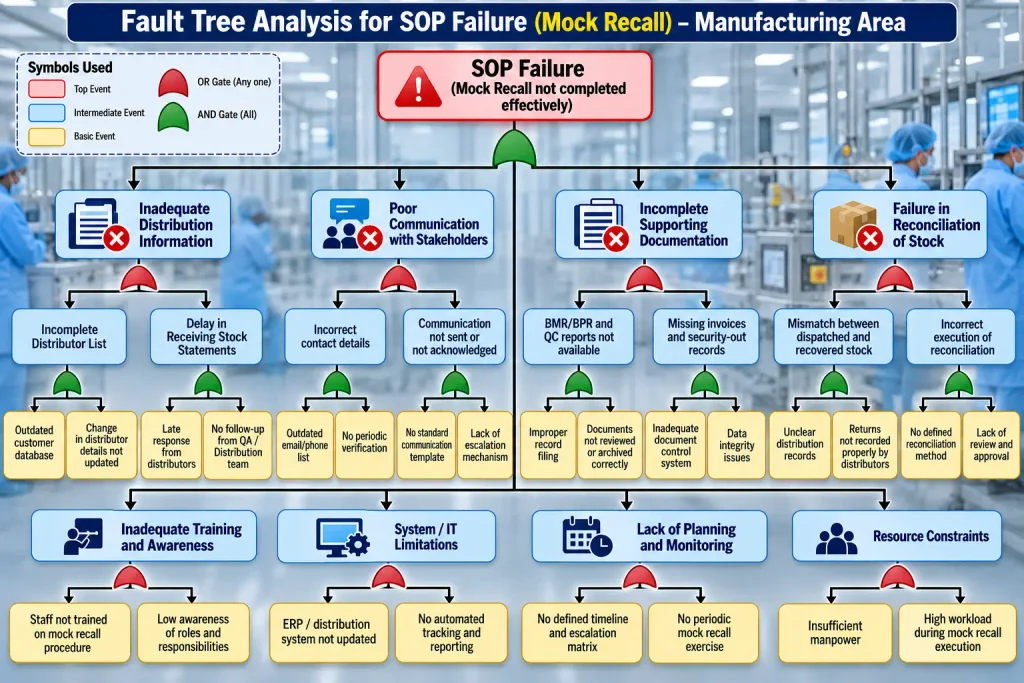
The fault tree further helps trace these failures to underlying causes such as outdated distributor records, delayed responses, missing documents, weak follow-up, unclear reconciliation practices, inadequate training, system limitations, poor planning, or resource constraints. Identifying these root causes supports targeted CAPA and strengthens the effectiveness of future mock recall exercises.
8. Impact Assessment for SOP Failure – Mock Recall:
The SOP for Mock Recall is intended to verify whether the organization can effectively trace, communicate, reconcile, review, and close a simulated recall of a distributed finished-product batch. The impact assessment highlights the consequences that may arise when this procedure is not followed effectively, as well as the benefits of proper implementation.
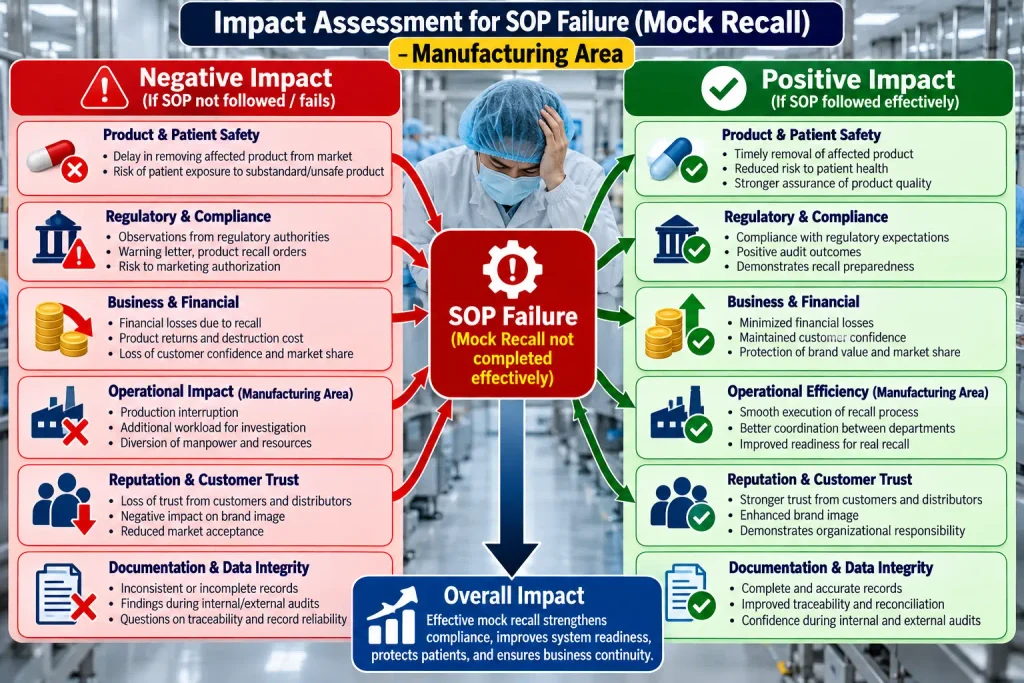
Failure of the mock recall process may lead to delayed retrieval of distribution information, incomplete stock reconciliation, communication gaps, missing supporting records, and weak recall preparedness. The SOP requires QA to obtain distribution details, communicate with stakeholders, collect stock statements, reconcile the batch, and maintain supporting documentation. Effective implementation, therefore, supports stronger traceability, better departmental coordination, reliable documentation, improved recall readiness, and timely evaluation by Head-QA. The SOP also requires final assessment of whether recipients were notified, whether the recall reached the intended level, and whether the distributed batch was successfully reconciled before closure.
Questions & Answers – SOP for Mock Recall:
- What is the purpose of the SOP for Mock Recall?
The purpose is to establish a procedure for conducting a mock recall of a finished pharmaceutical product. - Who is responsible for conducting the mock recall?
Executive-QA is responsible for conducting, monitoring, and executing the SOP, while the Assistant Manager-QA and Head-QA/QC are responsible for its effective implementation. - What is a mock recall?
A mock recall is a routine exercise used to assess recall procedures, responsiveness, collection of batch-history details, and effectiveness of communication channels. - When should a mock recall be initiated according to this SOP?
If no actual product recall has occurred, the SOP states that a mock recall test should be initiated every five years. - How is a mock recall number assigned?
QA assigns the number in the format MR/YY/ZZZ, where MR means Mock Recall, YY represents the last two digits of the year, and ZZZ is the serial number. - Who selects the batch for the mock recall exercise?
Head-QA selects a distributed finished-product batch to be considered the subject of the mock recall. - Who approves the selected product and batch for mock recall?
The Plant Head and QA Head review the product and batch details and provide approval for the recall exercise. - What information does QA obtain during the mock recall?
QA coordinates with the mock recall committee and Distribution Head to obtain batch distribution details and communicates with stakeholders to collect stock information. - When are stock statements reviewed?
The SOP requires QA to record the received stock-statement information after seven days of mock recall intimation. - Which supporting documents are checked during the mock recall?
QA checks the BMR/BPR store copy, QC report, control sample, invoice copy, security-out record, and email-related records. - Who reviews and closes the mock recall report?
Head-QA reviews the mock recall test report, records remarks, and approves closure of the exercise. - Within what time should the mock recall be completed?
The mock recall process should be completed within 30 working days from the date of initiation. - What are the main annexures in the SOP?
Annexure-I is the Mock Recall Logbook, and Annexure-II is the Mock Recall Test Report. - What is evaluated before final closure?
The evaluation checks whether recipients received and understood the recall notification, whether the recall reached the required level, and whether the distributed batch was successfully reconciled. - How is the final outcome of the mock recall recorded?
The mock recall is recorded as Satisfactory or Not Satisfactory, followed by closure approval from Head-QA.
Reference Guidelines – SOP for Mock Recall:
- WHO Good Distribution Practices for Pharmaceutical Products – Section 17: Recalls — requires a written recall procedure and periodic evaluation of recall-system effectiveness. (World Health Organization)
- WHO Technical Report Series (TRS) 986, Annex 2 – GMP for Pharmaceutical Products: Main Principles — provides general GMP requirements supporting complaint, defect, distribution, and recall controls. (World Health Organization)
- PIC/S GMP Guide PE 009, Part I, Chapter 8 – Complaints and Product Recall — addresses written recall procedures, readily available distribution records, investigation, CAPA, and effective recall arrangements. (PicScheme)
- EU GMP Guide, Volume 4, Part I, Chapter 8 – Complaints, Quality Defects and Product Recalls — provides requirements for managing quality defects and conducting prompt and effective product recalls. (Public Health)
- Revised Schedule M, Drugs Rules, 1945, India – GMP Requirements for Pharmaceutical Products — establishes the Indian pharmaceutical quality-system and GMP framework under which documented procedures, responsibilities, distribution controls, and quality-system activities are maintained. (CDSCO)
- WHO Quality Assurance of Pharmaceuticals, 10th Edition — provides broader GMP and quality-assurance guidance covering manufacturing, distribution, complaint handling, and related quality systems. (World Health Organization)