







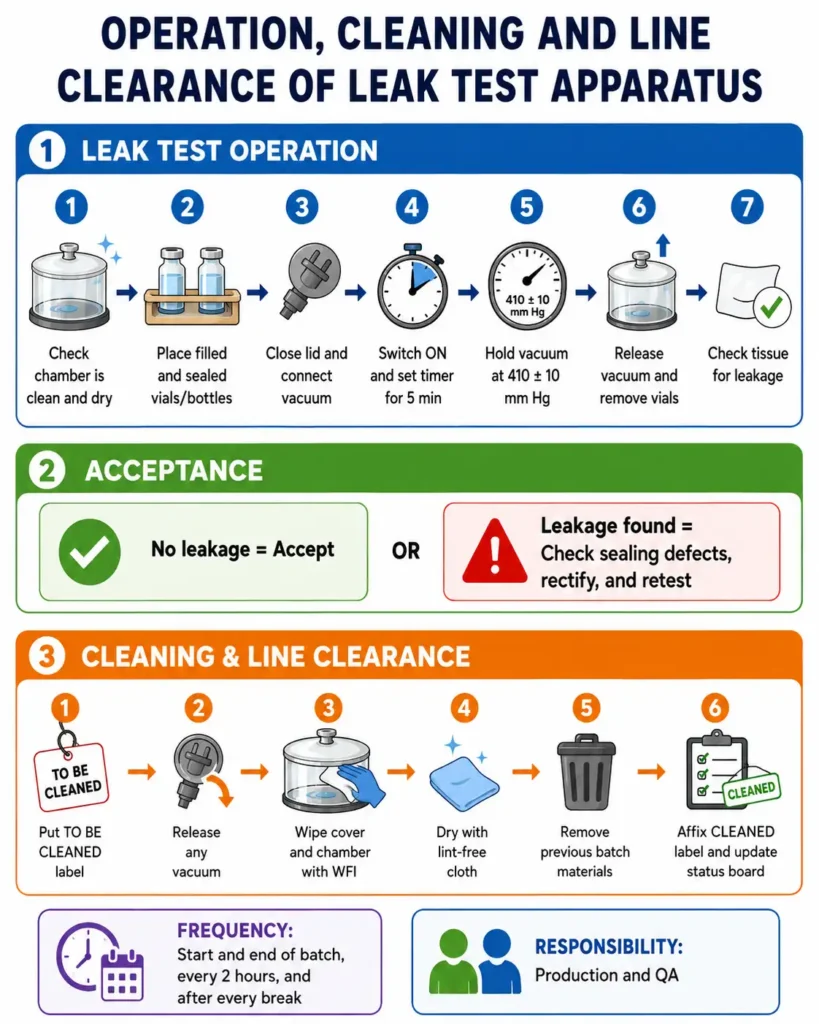
This SOP explains the correct operation, cleaning, and line clearance of the Leak Test Apparatus used for sealed vials and bottles during filling and sealing activities in the Nasal Spray department. The leak test checks whether the primary container and closure are properly sealed and able to protect the product from leakage or outside contamination. During testing, filled and sealed containers are placed in the vacuum chamber, wrapped with dry absorbent tissue, and tested under a vacuum of 410±10 mm of Hg for five minutes. After the test, the tissue is checked for any sign of leakage; no vial or bottle should leak. If leakage is found, the sealing system or defective head is checked, corrected, and retested. The SOP also describes equipment cleaning with WFI and lint-free cloth, status labeling, removal of previous batch materials, line clearance, documentation, and responsibilities of Production and Quality Assurance personnel before routine use.
IMPACT ASSESSMENT
The leak test apparatus has an important impact on product quality because it confirms that sealed vials and bottles do not leak. A proper leak test helps protect the product from contamination, loss of contents, and damage during storage or use. The SOP requires the chamber to be clean and dry, the vacuum gauge to be calibrated, and the test to be performed at 410±10 mm of Hg for five minutes. If leakage is found, the sealing defect or faulty head must be checked, corrected, and the affected containers retested. Regular testing at the start and end of the batch, every two hours, and after breaks helps detect problems early. Cleaning with WFI and lint-free cloth prevents contamination. Proper line clearance also ensures that materials from the previous batch are removed. Following this SOP therefore supports container integrity, product safety, batch quality, traceability, and GMP compliance during routine manufacturing operations.
Question & Answers – Operation, Cleaning and Line Clearance of Leak Test Apparatus
- What is the purpose of the leak test apparatus?
Answer: It is used to check the integrity of sealed vials or bottles and confirm that there is no leakage from the primary container. - What vacuum should be maintained during the leak test?
Answer: The vacuum should be maintained at 410 ± 10 mm of Hg for 5 minutes. - What is the acceptance criterion for the leak test?
Answer: No vial or bottle should leak. The tissue paper should remain dry after completion of the test. - What should be done if leakage is observed?
Answer: Check for sealing defects or defective pumps/heads, rectify the problem, and retest the bottles from the affected head. - How frequently should the leak test be performed?
Answer: It should be performed at the start and end of the batch, every two hours, and after every break. - How is the leak test apparatus cleaned?
Answer: The cover, disc, outside body, and inside chamber are wiped using a lint-free cloth dipped in WFI, followed by drying with a clean lint-free cloth. - What should be checked during line clearance?
Answer: Ensure the area and apparatus are cleaned, previous batch vials or bottles are removed, the status board is updated, and the “CLEANED” label is affixed. - Who is responsible for operation and compliance with this SOP?
Answer: Production staff and Quality Assurance personnel are responsible. - Why should the vacuum gauge be calibrated?
Answer: A calibrated vacuum gauge helps ensure that the required vacuum is correctly maintained during the leak test. - What safety precaution should be followed during leak testing?
Answer: Personnel should wear latex gloves while handling leak-test samples.