



1. Introduction – SOP for Operation & Cleaning of Autocoater-48″ Coating Machine:
The SOP for Operation & Cleaning of Autocoater-48″ Coating Machine provides a standardized procedure for the safe, consistent, and controlled operation and cleaning of the Auto Coater used during pharmaceutical tablet coating activities. The SOP applies to the GEM Coater 48, Equipment ID ……………, and defines responsibilities for Production personnel and supervisory/QA-QC staff. The procedure describes Type A cleaning for batch-to-batch changeover of the same product and potency, and Type B cleaning for product changes, different actives or colours, potency changes, maintenance, or specified cleaning frequencies. It also covers equipment pre-start checks, utility verification, machine start-up, setting of operating parameters through the MMI, monitoring of coating conditions, safe shutdown, post-operation activities, and documentation. Proper implementation helps maintain equipment cleanliness, coating consistency, prevention of cross-contamination, operator safety, traceability, and GMP compliance throughout the tablet-coating process.
Skip to PDF content2. Flow Diagram – SOP for Operation & Cleaning of Autocoater-48″ Coating Machine:
The flow diagram for the SOP for Operation & Cleaning of Autocoater-48″ Coating Machine presents the complete sequence of activities required for safe operation and effective cleaning of the coating machine. The process begins with checking equipment status, cleanliness, line clearance, utilities, filters, and machine readiness before starting the equipment. Operating parameters such as inlet air temperature, pan speed, process time, spray system, and solution transfer are then set and monitored during coating. After completion of coating, the spray system, pump, blowers, dampers, and pan motor are stopped in a controlled sequence, followed by recording batch and equipment usage details.
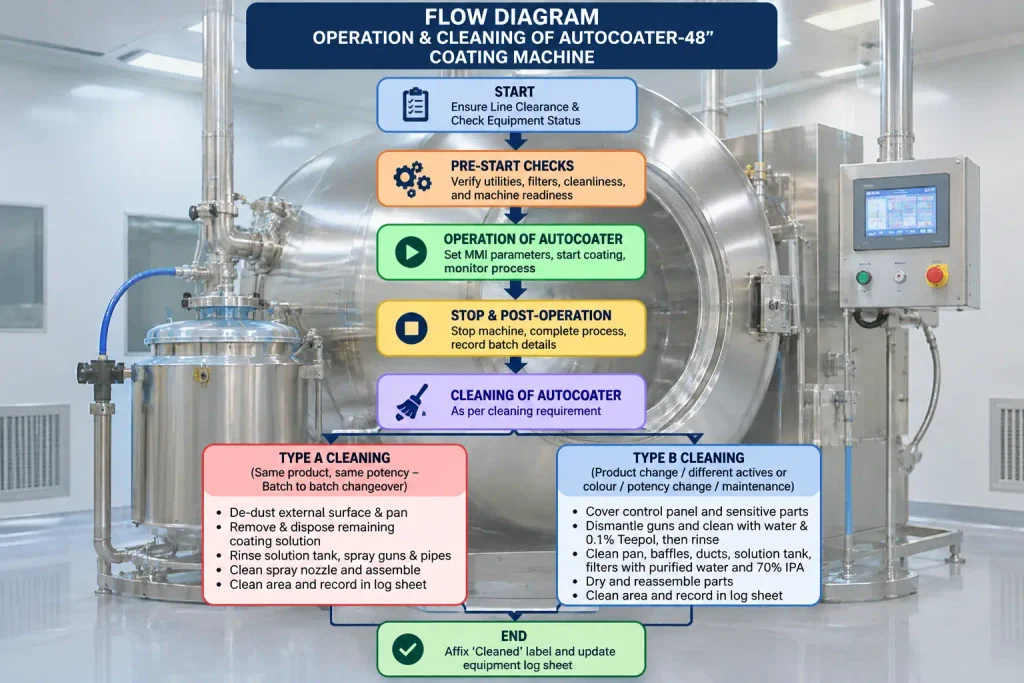
The flow then directs the operator to the appropriate cleaning method. Type A cleaning is used mainly for successive batches of the same product and potency, while Type B cleaning is used for product changeover, different actives or colours, potency changes, maintenance, or defined cleaning frequency requirements. The procedure concludes with proper drying, completion of cleaning records, application of the “Cleaned” status label, and updating of the equipment usage log sheet, thereby supporting GMP compliance, prevention of cross-contamination, equipment readiness, and process consistency.
3. Benefits of Following SOP – SOP for Operation & Cleaning of Autocoater-48″ Coating Machine:
The flow diagram for the SOP for Operation & Cleaning of Autocoater-48″ Coating Machine illustrates the systematic sequence for preparing, operating, shutting down, and cleaning the equipment. The procedure begins with verification of equipment cleanliness, required utilities, filters, proper assembly of machine components, and readiness of the control system. During operation, the operator sets the required parameters through the MMI, including inlet air temperature, pan RPM, process time, spray conditions, and solution transfer. Critical parameters such as inlet, exhaust and bed temperature, pan speed, spray pattern, coating uniformity, and alarms are continuously monitored.
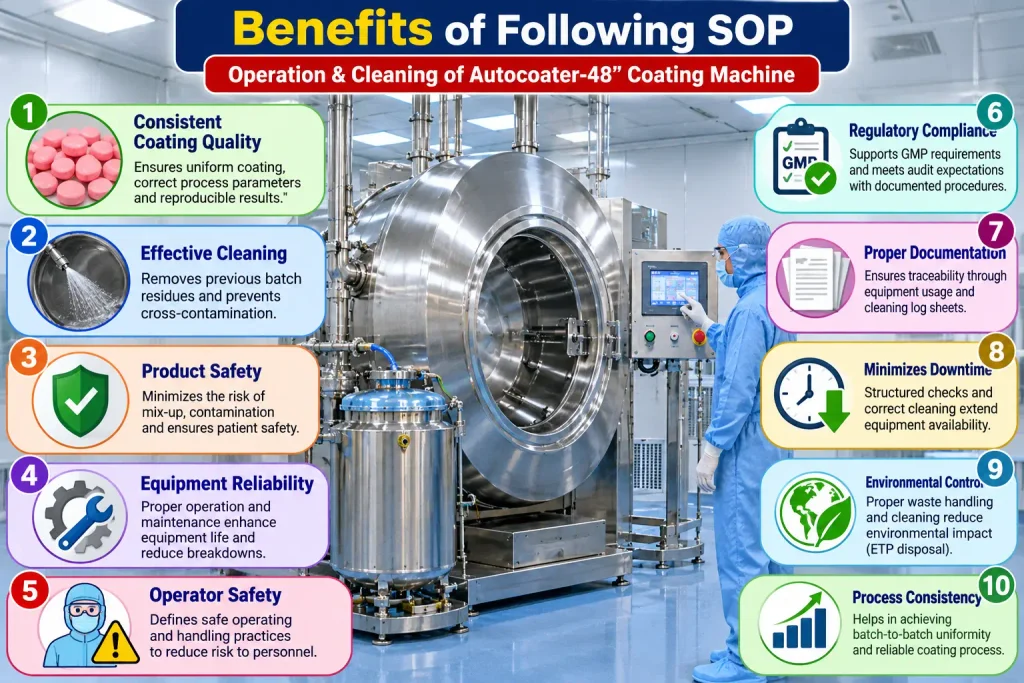
After completion, the spray system, peristaltic pump, blowers, dampers, and pan motor are stopped in a defined sequence. The equipment is then subjected to Type A or Type B cleaning, depending on the changeover requirement. Cleaning is completed with appropriate status labeling and documentation in the equipment usage log sheet.
4. Brainstorming for SOP Failure – SOP for Operation & Cleaning of Autocoater-48″ Coating Machine:
The brainstorming analysis for the SOP for Operation & Cleaning of Autocoater-48″ Coating Machine identifies potential reasons why the approved procedure may not be followed effectively during operation, coating, cleaning, and changeover activities. The analysis groups possible failures under key areas such as Man, Machine, Method, Material, Measurement, Environment, Utilities, Documentation, Cleaning & Changeover, Process Parameters, Maintenance, and Quality & Safety. Possible concerns include inadequate operator training, incorrect machine assembly, spray-gun or nozzle problems, improper parameter settings, incomplete cleaning, inadequate rinsing or drying, utility fluctuations, poor maintenance, missing logbook entries, and incorrect equipment-status labeling. These factors may contribute to non-uniform coating, residual product carryover, cross-contamination, deviations, equipment downtime, and product-quality risks.
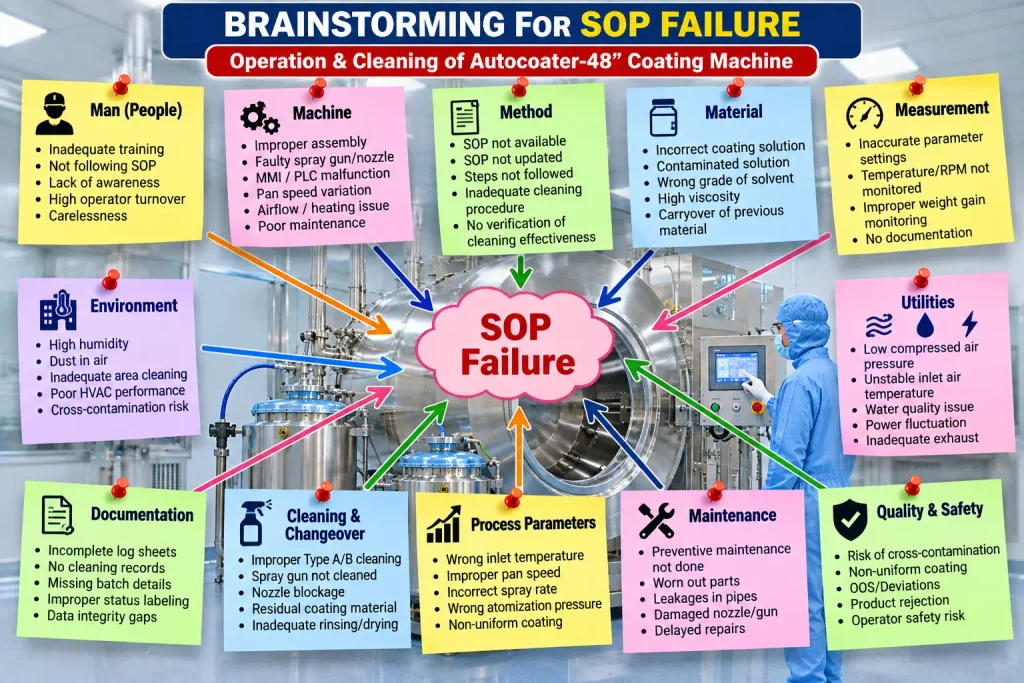
The SOP itself requires defined pre-start checks, monitoring of coating parameters, controlled shutdown, documented cleaning, and Type A/Type B cleaning according to the applicable changeover condition. This brainstorming exercise therefore helps the team identify potential weak points in SOP execution and supports focused training, maintenance, documentation, and procedural controls to improve consistent GMP-compliant operation.
5. 5-Why Analysis for SOP Failure – SOP for Operation & Cleaning of Autocoater-48″ Coating Machine:
The 5-Why Analysis for SOP Failure – Operation & Cleaning of Autocoater-48″ Coating Machine evaluates a possible root-cause chain when the equipment is not operated or cleaned according to the approved procedure. The analysis begins with the problem of incomplete SOP compliance and progressively examines why required operational and cleaning steps may be missed. The analysis indicates that failure may begin when the operator does not follow the complete procedure, followed by inadequate understanding or training on critical SOP requirements. Further questioning may identify weaknesses in training planning, documentation, supervision, periodic assessment, and monitoring of SOP compliance. The resulting root cause may therefore be an ineffective training, monitoring, and supervisory system for SOP implementation.
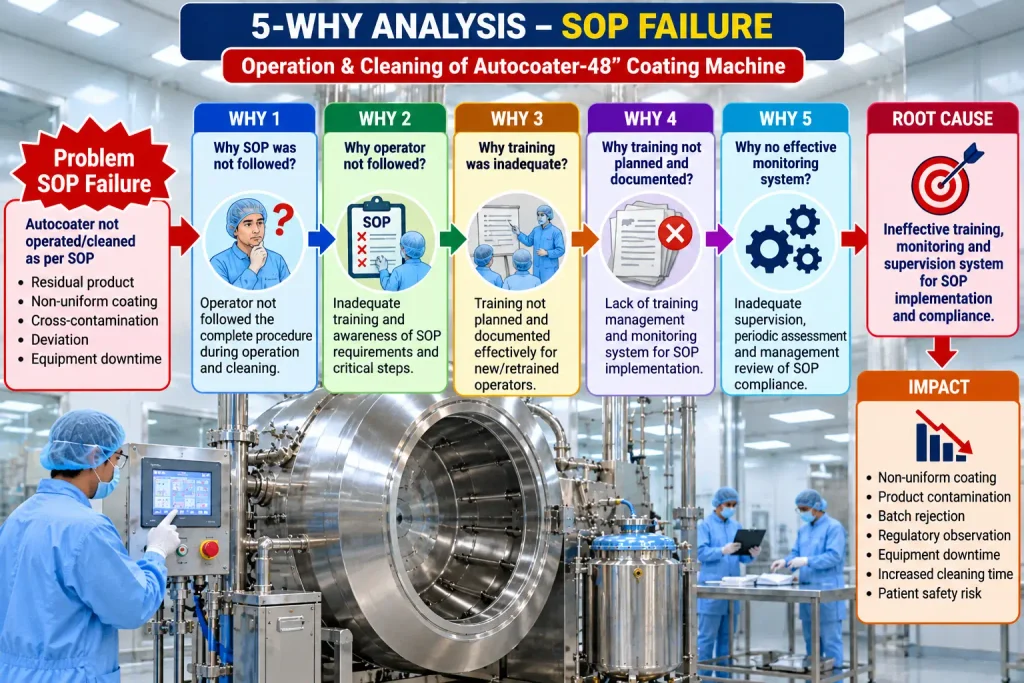
Such failure can contribute to residual product, non-uniform coating, cross-contamination, deviations, increased cleaning time, equipment downtime, batch rejection, and potential product-quality risk. The SOP itself requires defined cleaning procedures, pre-start checks, monitoring of operating parameters, proper shutdown, status labeling, and equipment usage documentation. The 5-Why exercise therefore helps identify system-level causes so that appropriate corrective and preventive actions can be established for training, supervision, documentation, and routine verification of SOP compliance.
6. Fishbone Analysis for SOP Failure – SOP for Operation & Cleaning of Autocoater-48″ Coating Machine:
The Fishbone Analysis for SOP Failure – Operation & Cleaning of Autocoater-48″ Coating Machine identifies potential causes that may lead to improper operation, ineffective cleaning, or incomplete compliance with the approved procedure. The causes are organized under major categories such as Man, Machine, Method, Material, Measurement, Environment, Utilities, and Management. Potential people-related causes include inadequate training, poor awareness, failure to follow SOP steps, and insufficient supervision. Machine-related causes may include faulty spray guns or nozzles, incorrect pan speed, MMI/PLC malfunction, airflow or heating problems, filter blockage, and inadequate maintenance. Method-related causes may involve incorrect cleaning or changeover practices, while material-related causes include unsuitable coating solution, incorrect solvent, or carryover of previous product.
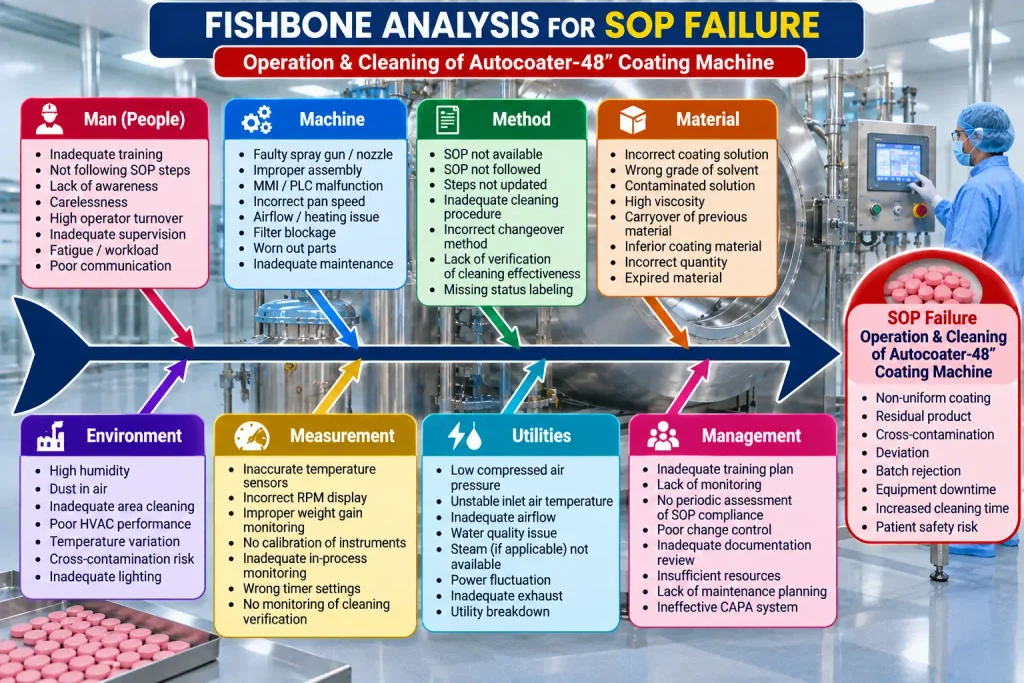
The SOP requires defined Type A and Type B cleaning, correct status labeling, cleaning records, equipment checks, and controlled operation of the Autocoater. The analysis also considers monitoring, environmental conditions, utility availability, documentation, and management controls. Failure in any of these areas may contribute to residual product, non-uniform coating, cross-contamination, deviations, equipment downtime, or batch-quality concerns. The fishbone approach therefore provides a structured method for identifying probable contributing factors and supports effective root-cause investigation and CAPA development.
7. Fault Tree Analysis for SOP Failure – SOP for Operation & Cleaning of Autocoater-48″ Coating Machine:
The Fault Tree Analysis for SOP Failure – Operation & Cleaning of Autocoater-48″ Coating Machine systematically evaluates how different failures can lead to the top event: failure to operate or clean the Autocoater-48″ according to the approved SOP. The analysis groups the major failure pathways into inadequate operation, ineffective cleaning, inadequate monitoring and control, and inadequate documentation. Operational failures may include improper equipment assembly, incorrect parameter settings, poor equipment condition, or insufficient operator understanding. Cleaning-related failures may involve incorrect Type A or Type B cleaning, inadequate rinsing or drying, or lack of verification of cleaning effectiveness. The SOP defines Type A cleaning for same-product/same-potency changeover and Type B cleaning for defined product-change and maintenance conditions.
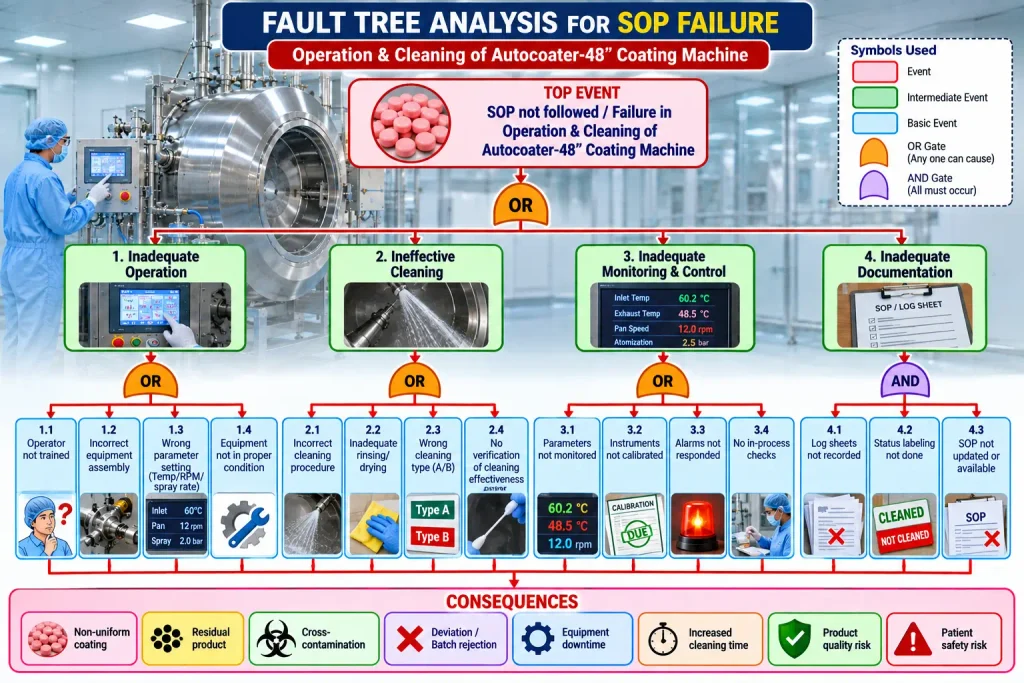
Monitoring failures may arise when critical parameters such as inlet temperature, pan RPM, spray conditions, alarms, and in-process checks are not adequately controlled. The SOP requires these operating conditions to be monitored during coating. Documentation failures may include incomplete logbook entries, incorrect status labeling, or missing cleaning records. Such combined failures can contribute to non-uniform coating, residual product, cross-contamination, deviations, equipment downtime, increased cleaning time, and batch-quality concerns. The fault tree therefore provides a structured method for tracing potential causes from the top event down to basic failures and supports focused investigation and CAPA development.
8. Impact Assessment – SOP for Operation & Cleaning of Autocoater-48″ Coating Machine:
The Impact Assessment for SOP Failure – Operation & Cleaning of Autocoater-48″ Coating Machine illustrates the potential consequences of not following the approved operating and cleaning procedure and contrasts them with the benefits of proper SOP compliance. Failure to follow the SOP may lead to non-uniform coating, residual product, product carryover, cross-contamination, process deviations, increased cleaning time, equipment downtime, batch rejection, and potential product-quality risks. The SOP requires defined cleaning practices, correct equipment-status labeling, monitoring of coating parameters, controlled shutdown, and proper recording of equipment usage and cleaning activities.
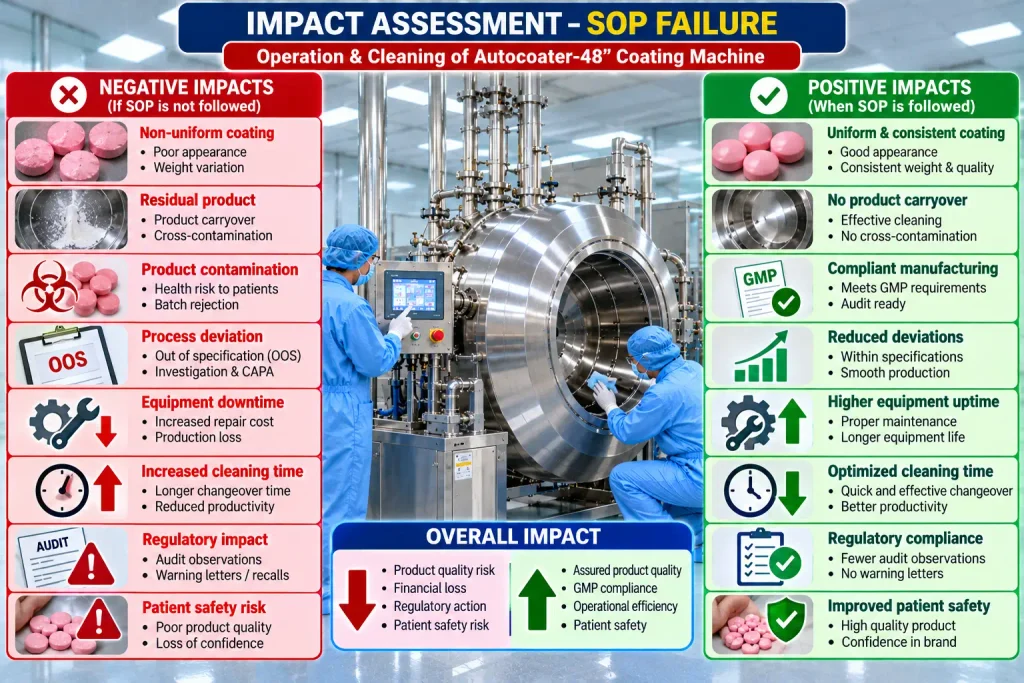
When the SOP is properly followed, it supports consistent coating performance, effective removal of previous-product residues, improved equipment reliability, reduced deviations, better traceability, and GMP-compliant manufacturing. The assessment therefore demonstrates that strict SOP adherence is important for maintaining product quality, equipment readiness, operational efficiency, and patient safety.
Question & Answer – SOP for Operation & Cleaning of Autocoater-48″ Coating Machine:
Q1. What is the objective of this SOP?
Answer: The objective is to lay down the procedure for operation and cleaning of the Autocoater.
Q2. Which equipment is covered under this SOP?
Answer: The SOP applies to the Autocoater-48″, Equipment ID PD/TAB/EQP/147, Model GEM Coater 48.
Q3. Who is responsible for executing this SOP?
Answer: Concerned Production personnel and the Production Chemist are responsible for execution of the SOP.
Q4. What is Type A cleaning?
Answer: Type A cleaning is the cleaning procedure used for changeover from one batch to the next batch of the same product and same potency.
Q5. What are the major activities performed during Type A cleaning?
Answer: Major activities include changing the equipment-status label, recording cleaning time, dedusting the external surface and pan, removing remaining coating solution, rinsing the solution tank, cleaning spray guns and solution pipes, cleaning the spray nozzle, and cleaning the production area.
Q6. When is Type B cleaning applicable?
Answer: Type B cleaning is applicable for product changeover involving different actives or colours, descending potency, maintenance of contact parts, or after the specified number of Type A cleanings/batches.
Q7. Why are the control panel, peristaltic pump, air motor and balance covered during Type B cleaning?
Answer: They are covered with polybags to avoid water entering these components during cleaning.
Q8. How is the Autocoater pan cleaned during Type B cleaning?
Answer: Purified water is placed in the sink at the bottom of the pan, and rotation of the drum through the water helps clean the pan. The pan is also scrubbed with a nylon brush and rinsed until adhered material is removed.
Q9. What quantity of purified water is specified for the final rinse of the Autocoater?
Answer: The SOP specifies a final rinse using 40–60 litres of purified water.
Q10. What should be done if the machine remains idle for more than 72 hours after cleaning?
Answer: The cleaned status label should be replaced with an “Under Cleaning” label, and the machine should be cleaned with a dry lint-free duster followed by wiping with 70% IPA solution before use. A new “Cleaned” label should then be affixed and cleaning details recorded.
Q11. What utilities must be verified before starting the equipment?
Answer: The SOP requires verification of electrical supply, compressed air, and steam where applicable. Electrical supply is specified as 3-phase, 415 V, 50 Hz, while compressed air should be at least 6 bar and free from oil, dust and water.
Q12. Which components should be checked before starting the Autocoater?
Answer: The operator should ensure that components such as the pan, spray guns, baffles and solution tank are correctly assembled, and that the emergency stop is not engaged.
Q13. Which parameters are set through the MMI before operation?
Answer: The operator sets parameters including inlet air temperature, pan RPM and process time as required by the BMR.
Q14. What should be monitored during coating operation?
Answer: The SOP requires monitoring of inlet, exhaust and bed temperature, pan RPM, blower RPMs, spray pattern, coating uniformity, bed movement and drying, along with relevant alarms and interlocks.
Q15. What are the main post-operation activities?
Answer: After operation, the equipment should be allowed to cool, remaining material should be removed from the pan, cleaning should be started as per the SOP, equipment usage and parameters should be recorded in the logbook, and any abnormality or deviation should be reported to QA/Engineering.
Reference Guidelines – SOP for Operation & Cleaning of Autocoater-48″ Coating Machine:
- WHO Good Manufacturing Practices (GMP) – requirements for production equipment, prevention of contamination, cleaning, maintenance, and documentation.
- EU Guidelines for Good Manufacturing Practice, Part I
- Chapter 3 – Premises and Equipment
- Chapter 5 – Production
- PIC/S Guide to GMP (PE 009) – requirements relating to equipment operation, cleaning, contamination control, and production activities.
- US FDA 21 CFR Part 211
- 21 CFR 211.63 – Equipment Design, Size and Location
- 21 CFR 211.67 – Equipment Cleaning and Maintenance
- 21 CFR 211.68 – Automatic, Mechanical and Electronic Equipment
- 21 CFR 211.100 – Written Procedures; Deviations
- 21 CFR 211.182 – Equipment Cleaning and Use Log
- ICH Q9 – Quality Risk Management – risk-based evaluation of equipment operation, cleaning failures, and contamination risks.
- ICH Q10 – Pharmaceutical Quality System – management of procedures, training, deviations, CAPA, and continual improvement.
- Approved Batch Manufacturing Record (BMR) – for product-specific coating parameters such as temperature, pan speed, spray conditions, and process time.
- Related Internal SOPs – Status Labeling, Equipment Usage & Cleaning Logbook, Cleaning of Production Area, Preventive Maintenance, Calibration, and Cleaning Validation.