







1. Brief Description:
The SOP for Operation of Bin Washing & Drying Machine describes the standardized method for operating the equipment used for cleaning and drying IPCs/Bins in the granulation area. It defines responsibilities for Production personnel, Head Production, and Head QA to ensure proper execution and compliance. The procedure includes status labeling, dismantling of inlet and outlet parts, cleaning of gaskets and components, positioning of the unclean IPC/Bin inside the machine, and preparation of soap solution when required. Critical operating parameters include hot water temperature, hot air temperature, internal wash pressure, and external wash pressure. The machine can be operated in automatic or manual mode with defined password access levels. After washing and drying, the Bin/IPC is inspected, wiped, assembled, labeled as “CLEANED,” and cleaning start and completion times are recorded in the equipment logbook.
Skip to PDF content2. Flow Diagram:
The flow diagram explains the step-by-step procedure for operating the Bin Washing & Drying Machine (Cybernetik) used for cleaning IPCs/Bins in the granulation area. The process starts with changing the equipment status label, preparing the unclean Bin/IPC, dismantling removable parts, and cleaning gaskets and components with purified water. The Bin is then correctly positioned inside the machine and the door is securely locked.
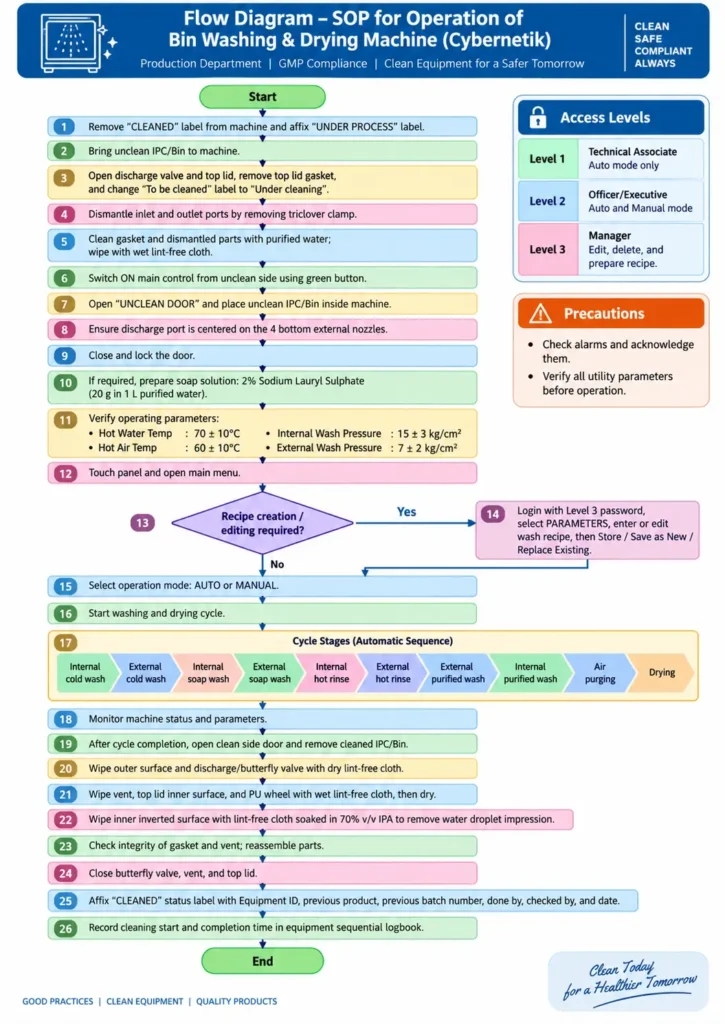
Before operation, critical parameters such as hot water temperature, hot air temperature, internal wash pressure, and external wash pressure are verified. The operator selects the required recipe and Auto or Manual mode, then starts the washing and drying cycle. After completion, the cleaned Bin is removed, wiped, inspected, and reassembled. Finally, a “CLEANED” status label is affixed and the cleaning start and completion times are recorded in the equipment logbook for traceability and GMP compliance.
3. Brainstorming:
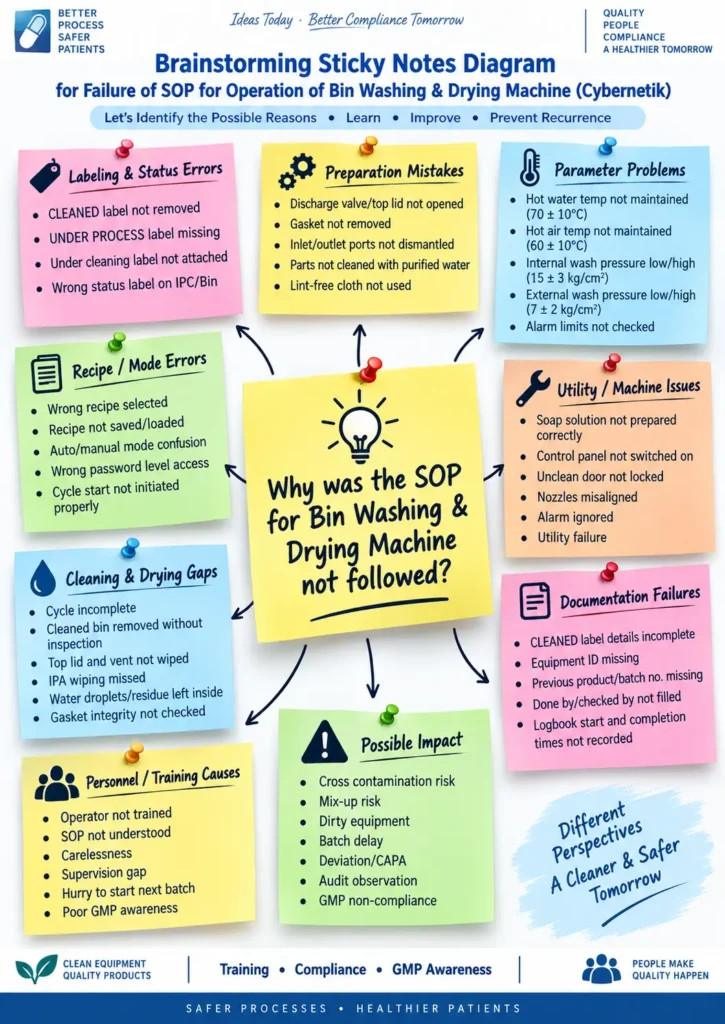
The brainstorming analysis identifies the possible reasons why the SOP for Operation of Bin Washing & Drying Machine (Cybernetik) may not be followed correctly. The main causes include labeling and status errors, preparation mistakes, incorrect operating parameters, recipe or mode selection errors, utility or machine problems, cleaning and drying gaps, documentation failures, and inadequate personnel training. Critical deviations may include failure to remove or affix the correct status label, incomplete dismantling and cleaning of parts, incorrect hot water or hot air temperature, improper wash pressure, wrong recipe selection, door or nozzle positioning errors, incomplete drying, missed IPA wiping, and incomplete logbook entries. The SOP specifically requires verification of operating parameters and proper cleaning documentation. These failures may increase the risk of cross-contamination, mix-up, dirty equipment, deviations, batch delays, audit observations, and GMP non-compliance.
4. 5 Why Analysis:
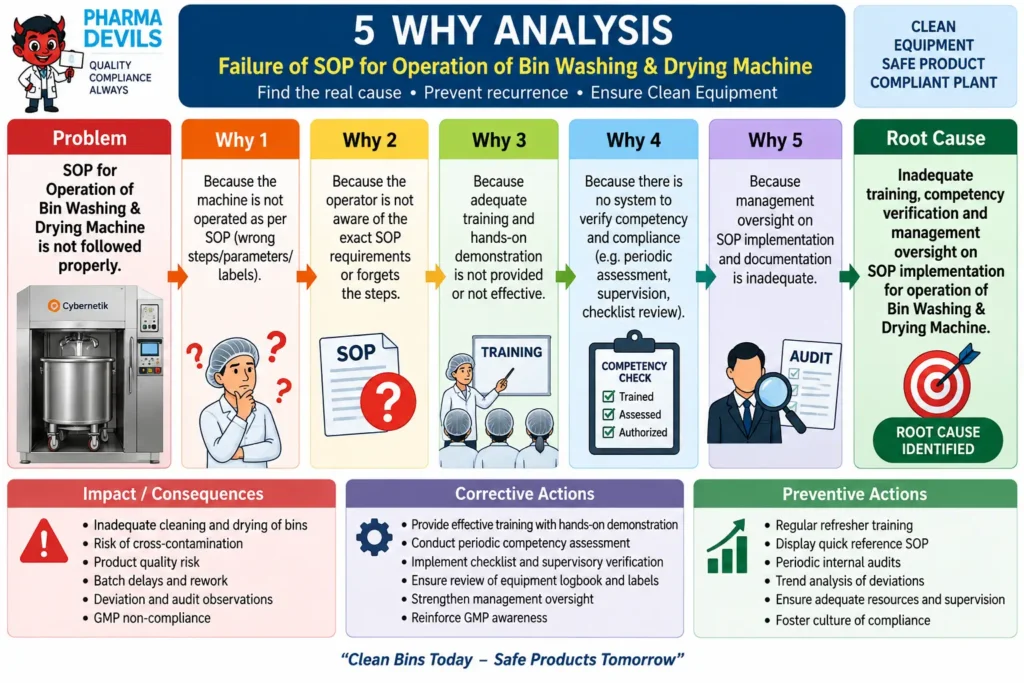
The 5 Why Analysis evaluates the reasons behind failure to properly follow the SOP for Operation of Bin Washing & Drying Machine (Cybernetik). The analysis begins with the problem of incorrect machine operation, such as wrong operating steps, parameters, labels, or cleaning practices. The first underlying cause is inadequate operator awareness of the exact SOP requirements. This is further linked to insufficient or ineffective training and lack of practical hands-on demonstration. The analysis then identifies inadequate competency verification, supervision, and periodic compliance checks as deeper causes. Finally, insufficient management oversight of SOP implementation and documentation is identified as the key root cause. The SOP itself requires defined responsibilities, correct operating parameters, proper cleaning steps, labeling, and recording of cleaning activities. Strengthening training, competency assessment, supervision, documentation review, and periodic audits can help prevent recurrence and maintain GMP compliance.
5. Failure Mode Effect Analysis:
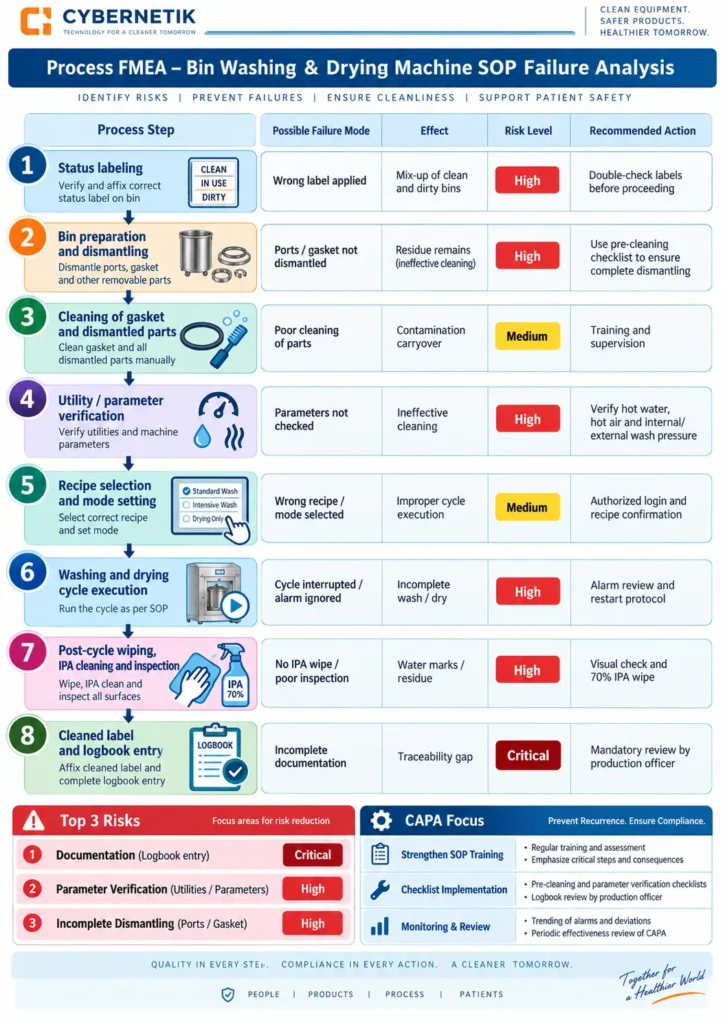
The FMEA for failure of the SOP for Operation of Bin Washing & Drying Machine (Cybernetik) identifies potential failure modes at critical stages of the cleaning process and evaluates their possible effects on equipment cleanliness, traceability, and GMP compliance. Key areas considered include incorrect status labeling, incomplete dismantling of inlet/outlet parts, improper cleaning of gaskets and components, incorrect operating parameters, wrong recipe or operating mode, incomplete washing or drying cycles, missed post-cleaning inspection, and incomplete documentation. The SOP requires verification of critical parameters such as hot water temperature, hot air temperature, internal wash pressure, and external wash pressure before operation. It also requires post-cycle wiping, inspection, reassembly, application of the “CLEANED” status label, and recording of cleaning start and completion times. FMEA helps prioritize these risks and supports appropriate preventive actions such as training, checklists, supervision, parameter verification, and documentation review.
Impact Assessment:
Failure to follow the SOP for Operation of Bin Washing & Drying Machine (Cybernetik) can directly affect equipment cleanliness, process control, documentation, and GMP compliance. Incorrect dismantling, inadequate cleaning of gaskets or removable parts, improper positioning of the IPC/Bin, or failure to use purified water and lint-free cloth may leave residues on product-contact surfaces. Deviation from specified operating parameters such as hot water temperature, hot air temperature, internal wash pressure, or external wash pressure may result in ineffective washing or drying. Incomplete post-cycle wiping, missed inspection, failure to check gasket integrity, or residual water may increase the risk of carryover or contamination during subsequent use. Incorrect status labeling or incomplete logbook recording may create traceability gaps and increase the possibility of mix-up or use of an inadequately cleaned Bin. Overall, such failures may lead to deviation, re-cleaning, batch delay, audit observations, and potential impact on product quality and GMP compliance.
Questions & Answers –
- Q: What is the objective of this SOP?
A: To define the procedure for operation of the Bin Washing & Drying Machine (Cybernetik). - Q: Where is this SOP applicable?
A: It is applicable to operation of the Bin Washing & Drying Machine in the granulation area. - Q: Who is responsible for operating the machine?
A: Production Technical Associate, Officer, Executive, and Assistant Manager are responsible for operation, while Head Production and Head QA ensure execution and compliance. - Q: What status label is affixed before starting operation?
A: The “CLEANED” label is removed and an “UNDER PROCESS” label is affixed on the machine. - Q: How are dismantled parts and gaskets cleaned?
A: They are cleaned with purified water and wiped using a wet lint-free cloth. - Q: What soap solution may be used when required?
A: A 2% Sodium Lauryl Sulphate solution may be prepared by dissolving 20 g in purified water and making the volume up to 1 litre. - Q: What are the specified operating parameters?
A: Hot water temperature: 70 ±10°C, hot air temperature: 60 ±10°C, internal wash pressure: 15 ±3 kg/cm², and external wash pressure: 7 ±2 kg/cm². - Q: What operation modes are available?
A: The machine can be operated in Auto and Manual modes. - Q: How many password access levels are defined?
A: Three levels: Level 1 for Technical Associates, Level 2 for Officers/Executives, and Level 3 for Managers. - Q: Who can create or edit a wash recipe?
A: A Manager using Level 3 password access can create, edit, delete, or prepare recipes. - Q: What is checked before starting the Auto cycle?
A: The operator must ensure that all entered parameters and required utilities are correct and as per requirement. - Q: How is the automatic washing cycle started?
A: The operator selects Auto mode and presses the “CYCLE START” touch button after completing the required pre-start steps. - Q: What happens after completion of the Auto cycle?
A: The machine stops automatically, the clean-side door is opened, and the cleaned IPC/Bin is removed. - Q: How is the inner inverted surface of the Bin treated after washing?
A: It is wiped with a lint-free cloth soaked in 70% v/v IPA to remove water droplet impressions. - Q: What checks are performed before closing the cleaned Bin?
A: The integrity of the top lid gasket and vent is checked, and the inner surface and butterfly valve are inspected. - Q: What details are included on the “CLEANED” status label?
A: Equipment ID, previous product, previous batch number, done by, checked by Production Officer, and date. - Q: What cleaning activity must be recorded?
A: The Bin/IPC cleaning start and completion times must be recorded in the equipment sequential logbook. - Q: What precautions are mentioned in the SOP?
A: Any alarm must be checked and acknowledged, and all utility parameters must be verified before starting operation.