







1. Brief Description:
The Operation of Boiler SOP provides a standard procedure for safe and controlled operation of the boiler by the Engineering Department. Its purpose is to ensure that the boiler is started, operated, monitored, and stopped correctly. The Officer/Executive – Engineering is responsible for performing the activity, while the Head – Engineering is accountable for overall compliance.
Before startup, the operator checks the furnace oil level, water level, main steam valve position, and furnace oil temperature, which should not be less than 50°C. The main control panel is then switched ON, Auto Mode is selected, and the boiler is started. After the forced draft blower operates and firing begins, boiler pressure is monitored. The steam valve is opened when pressure reaches approximately 7 kg/cm². Unusual noise and loose nuts or bolts are also checked. After operation, the boiler is stopped from the control panel and operating parameters are documented in the Boiler Operation Record.
Skip to PDF content2. Flow Diagram:
The flow diagram explains the step-by-step operation of the boiler in a simple sequence. It begins with pre-startup checks, including checking the furnace oil level, water level, closing the main steam valve, and confirming that furnace oil temperature is at least 50°C.
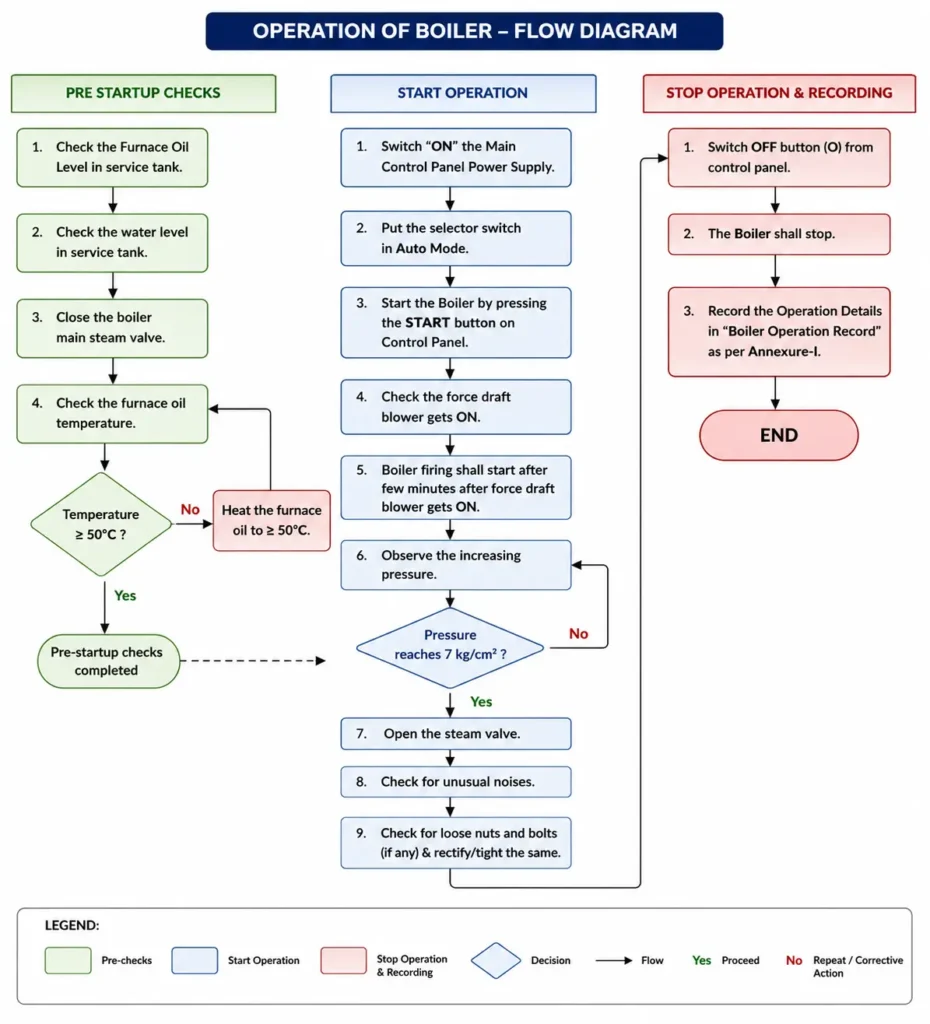
After completing these checks, the operator switches ON the main control panel, selects Auto Mode, and starts the boiler. The forced draft blower starts first, followed by boiler firing. Boiler pressure is then monitored, and when it reaches about 7 kg/cm², the steam valve is opened. During operation, the operator checks for unusual noises and loose nuts or bolts. After completion, the boiler is stopped from the control panel. Finally, all operating details are entered in the Boiler Operation Record for proper monitoring and documentation.
3. Critical Process Parameters (CPPs) & Critical Quality Attributes (CQAs):
Based on the Operation of Boiler SOP, the following parameters are important for safe and controlled boiler operation. The SOP itself does not explicitly classify parameters as CPPs or CQAs, so the table below is a practical interpretation of the controls and records specified in the document.
| Category | Parameter / Attribute | Requirement / Control | Purpose |
|---|---|---|---|
| CPP | Furnace oil level | Adequate level in service tank | Ensures continuous fuel supply |
| CPP | Water level | Adequate level in service tank | Supports safe boiler operation |
| CPP | Furnace oil temperature | Not less than 50°C | Ensures suitable oil condition before startup |
| CPP | Main steam valve | Closed during pre-startup | Prevents uncontrolled steam release |
| CPP | Control mode | Selector switch in Auto Mode | Ensures automatic controlled operation |
| CPP | Forced draft blower | Must operate before boiler firing | Provides required combustion air |
| CPP | Boiler pressure | Monitor until approximately 7 kg/cm² | Determines when steam valve can be opened |
| CPP | Boiler firing | Starts after forced draft blower operation | Ensures proper startup sequence |
| CQA / Operational Attribute | Boiler outlet pressure | Recorded limit 6–7 kg/cm² | Confirms required operating pressure |
| CQA / Operational Attribute | Boiler outlet temperature | Recorded limit 25–50°C in Annexure-I | Monitors recorded operating condition |
| CQA / Operational Attribute | Abnormal noise | No unusual noise | Indicates satisfactory mechanical condition |
| CQA / Operational Attribute | Nuts and bolts | No loose nuts/bolts | Supports mechanical integrity |
| CQA / Documentation Attribute | Operation record | Complete and verified | Provides traceability of boiler operation |
The startup requirements for oil level, water level, steam valve position and furnace oil temperature are defined in the SOP. Boiler startup, blower operation and opening of the steam valve at about 7 kg/cm² are also specified. The Annexure-I record includes boiler outlet pressure, temperature, furnace-oil level, operator/checker signatures and remarks, with listed pressure and temperature limits.
4. Brainstorming in Case of SOP Failure:
Brainstorming is used to identify possible reasons when the Boiler Operation SOP is not followed correctly or the boiler operation fails. The team should involve Engineering, QA, operators, maintenance personnel, and other concerned staff to discuss all possible causes without immediately blaming any individual.
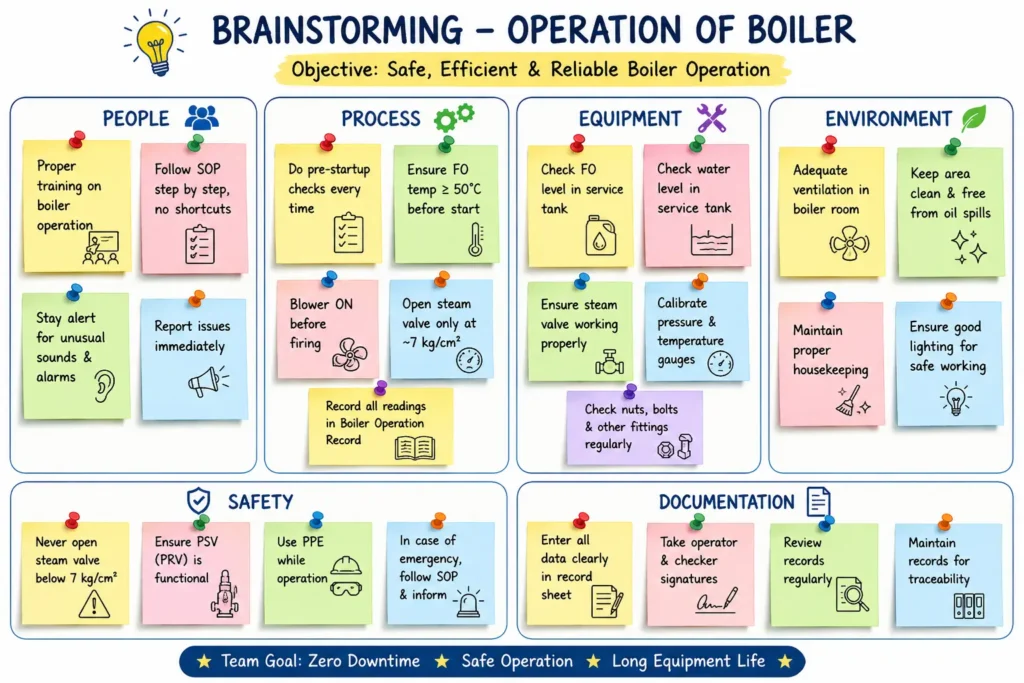
The discussion can focus on areas such as people, procedure, equipment, safety, environment, and documentation. Possible causes may include incomplete pre-startup checks, inadequate furnace oil or water level, furnace oil temperature below the required 50°C, incorrect operating sequence, failure of the forced draft blower, opening the steam valve before the required pressure is reached, unusual equipment noise, loose nuts or bolts, or incomplete recording of operational details. These checks and operating steps are specified in the SOP. All ideas generated during brainstorming should be documented, evaluated, and shortlisted for further root cause investigation and appropriate CAPA.
Standard procedure for safe, controlled boiler startup, operation, monitoring, shutdown, and accurate engineering recordkeeping practices.
5. 5-Why Analysis:
The 5-Why Analysis is used to identify the probable root cause when the Boiler Operation SOP is not followed correctly. The investigation begins with the problem that the operator did not follow the approved boiler operating sequence. The first level identifies that one or more required checks were missed. The next level examines why those checks were skipped and may find that the operator relied on routine practice instead of verifying each SOP step. Further questioning may show that there was no effective step-by-step checklist or point-of-use verification during operation. Finally, the analysis may indicate that training, supervision, and periodic review of SOP compliance were not sufficiently effective.
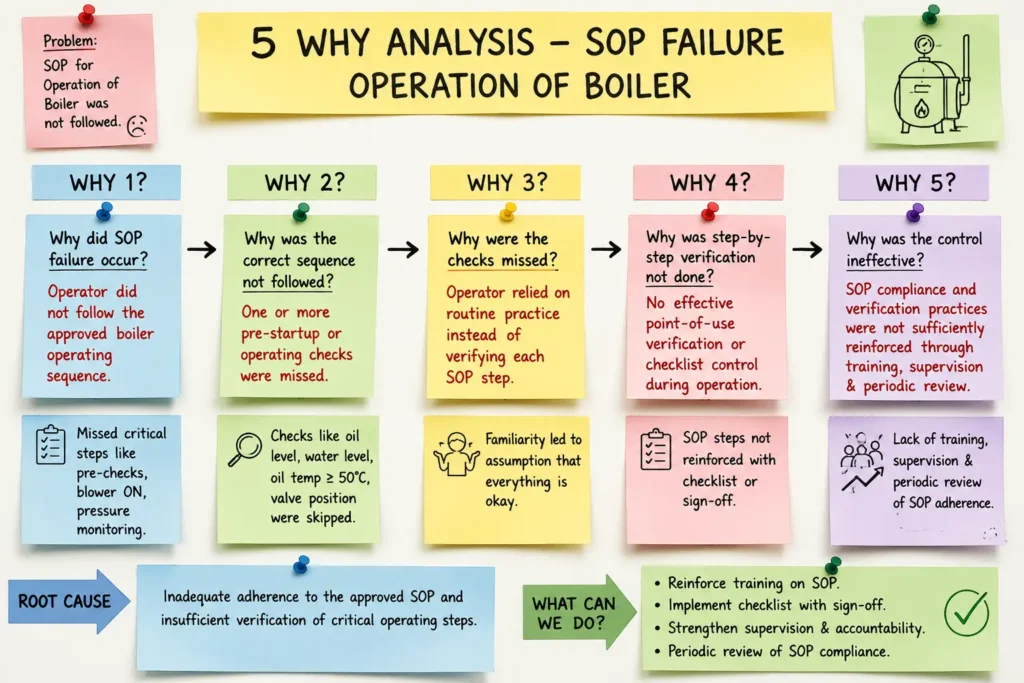
The probable root cause is therefore inadequate adherence to the approved SOP and insufficient verification of critical operating steps. Corrective actions may include retraining operators, introducing a signed checklist, strengthening supervision, and periodically reviewing SOP compliance.
6. Fault Tree Analysis:
The Fault Tree Analysis (FTA) is used to identify possible causes when the Boiler Operation SOP is not followed correctly. The top event is defined as unsafe or improper boiler operation. The analysis divides the possible causes into major areas such as inadequate pre-startup checks, incorrect operating sequence, equipment or instrument failure, and inadequate monitoring or supervision.
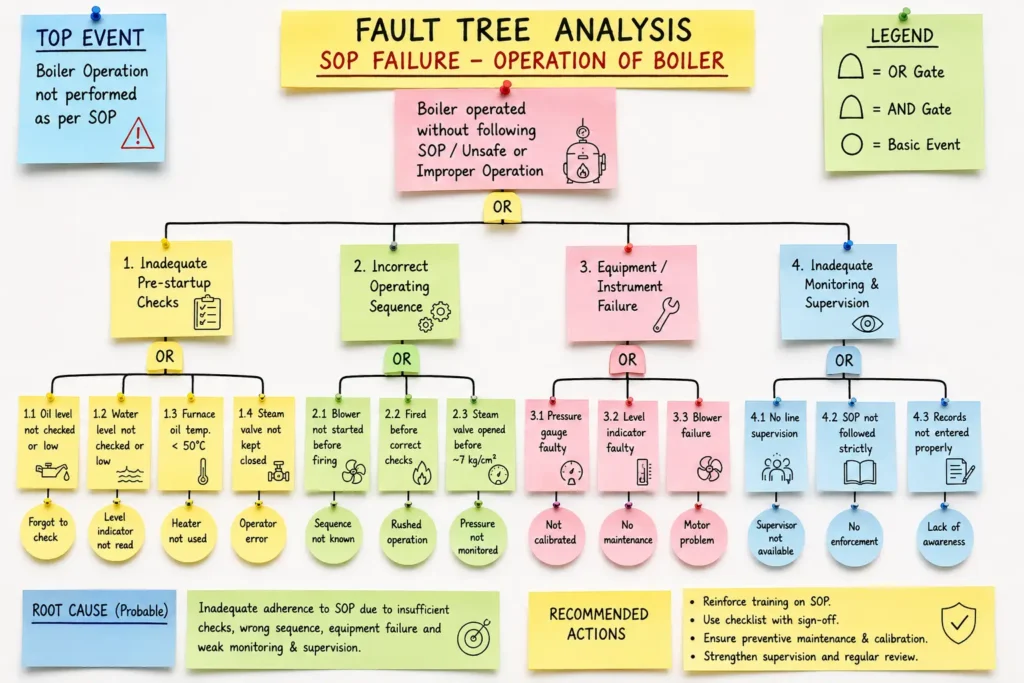
Possible basic causes include failure to check furnace oil or water level, furnace oil temperature below 50°C, incorrect steam valve position, blower failure, faulty pressure indication, lack of maintenance, poor supervision, and incomplete documentation. These factors may individually or collectively contribute to SOP failure. The SOP specifically requires pre-startup checks, blower operation, pressure monitoring, and correct steam valve operation. The probable root cause can then be investigated further, followed by CAPA such as retraining, checklists, preventive maintenance, calibration, and stronger supervision.
7. Impact Assessment – Failure of SOP for Operation of Boiler:
The SOP does not contain a formal impact-assessment section; therefore, the following assessment is derived from the operating controls defined in the document. Failure to follow the Boiler Operation SOP can affect safe and reliable boiler operation. Missing pre-startup checks such as furnace oil level, water level, steam valve position, or the required furnace oil temperature of not less than 50°C may result in improper startup conditions. Incorrect startup sequence, failure of the forced draft blower, or opening the steam valve before pressure reaches approximately 7 kg/cm² may lead to unstable boiler operation and interruption of steam supply. Failure to identify unusual noise or loose nuts and bolts may also allow equipment-related problems to remain unnoticed. Incomplete entries in the Boiler Operation Record can reduce traceability and make investigation of deviations more difficult. Overall, SOP failure may impact personnel safety, equipment reliability, utility availability, operational continuity, documentation compliance, and GMP control.
8. Questions & Answers:
- What is the objective of the Boiler Operation SOP?
Answer: To define the procedure for proper operation of the boiler. - Who is responsible for operating the boiler as per the SOP?
Answer: Officer / Executive – Engineering. - Who is accountable for boiler operation?
Answer: Head – Engineering. - What should be checked before starting the boiler?
Answer: Furnace oil level, water level, main steam valve position, and furnace oil temperature. - What should be the minimum furnace oil temperature before startup?
Answer: It should not be less than 50°C. - What should be the position of the main steam valve during pre-startup checks?
Answer: The main steam valve should be closed. - How is the boiler started?
Answer: Switch ON the main control panel, select Auto Mode, and press the START button. - Which equipment starts before boiler firing?
Answer: The forced draft blower. - At what pressure should the steam valve be opened?
Answer: When boiler pressure reaches approximately 7 kg/cm². - What mechanical checks should be performed during operation?
Answer: Check for unusual noises and loose nuts or bolts, and rectify or tighten them if required. - How is the boiler stopped?
Answer: Press the OFF button on the control panel. - Where are boiler operating details recorded?
Answer: In the Boiler Operation Record given in Annexure-I. - What is the recorded boiler outlet pressure limit in Annexure-I?
Answer: 6–7 kg/cm². - What information is recorded in the Boiler Operation Record?
Answer: Date, time, running hours, boiler outlet pressure and temperature, furnace oil level, operator signature, checker signature, and remarks. - Why is proper recording of boiler operation important?
Answer: The SOP requires operating details to be documented in Annexure-I so that boiler operation can be properly recorded and reviewed.