






1. Introduction – SOP for Quality Management:
The SOP for Quality Management establishes a systematic framework for managing and maintaining pharmaceutical quality across the organization. Its purpose is to define the principles, responsibilities, procedures, and controls required to ensure that pharmaceutical products are consistently manufactured and controlled to the quality standards appropriate for their intended use. The SOP integrates Quality Assurance, Good Manufacturing Practices (GMP), and Quality Control within the overall Quality Management System. The procedure covers key quality-system elements including sanitation and hygiene, qualification and validation, complaints, product recalls, contract manufacturing and analysis, self-inspection and quality audits, personnel, premises, equipment, materials, documentation, CAPA, training, specifications, testing procedures, and batch records. Effective implementation of this SOP supports regulatory compliance, consistent product quality, effective documentation, controlled manufacturing operations, continual improvement, and periodic Quality Management Review of deviations, incidents, change controls, CAPA effectiveness, and overall Quality System performance.
Skip to PDF content2. Flow Diagram – SOP for Quality Management:
The SOP for Quality Management defines the structured approach used to ensure that pharmaceutical products are consistently manufactured, tested, controlled, released, and maintained according to established quality requirements. It integrates Quality Assurance, Quality Control, Good Manufacturing Practices, documentation, qualification, validation, training, audits, complaints, recalls, CAPA, and management review within the overall Quality Management System.
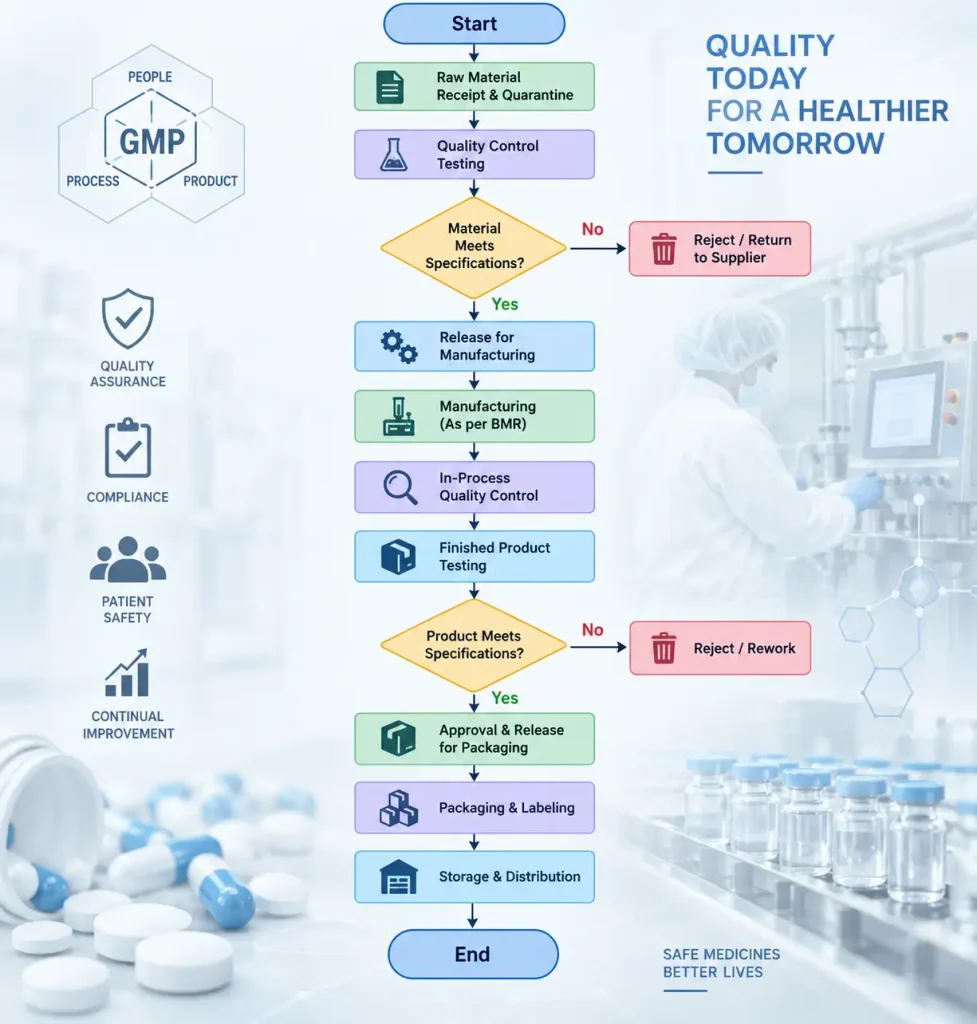
The flow diagram illustrates the practical quality pathway beginning with receipt and quarantine of raw materials, followed by quality-control testing and specification assessment. Conforming materials are released for manufacturing, while nonconforming materials are rejected or returned. Manufacturing is performed according to approved batch documentation with in-process controls, followed by finished-product testing. Products meeting specifications proceed to approval, packaging, labeling, storage, and distribution, whereas failures are subjected to rejection or rework as applicable. This systematic approach supports GMP compliance, patient safety, consistent product quality, controlled documentation, and continual improvement throughout pharmaceutical operations.
3. Benefits of Following SOP for Quality Management:
Following the SOP for Quality Management helps ensure that pharmaceutical operations are performed in a controlled, consistent, and documented manner. The SOP integrates key quality-system elements such as GMP, qualification and validation, documentation, complaints, recalls, audits, CAPA, training, personnel, premises, equipment, and quality control activities.
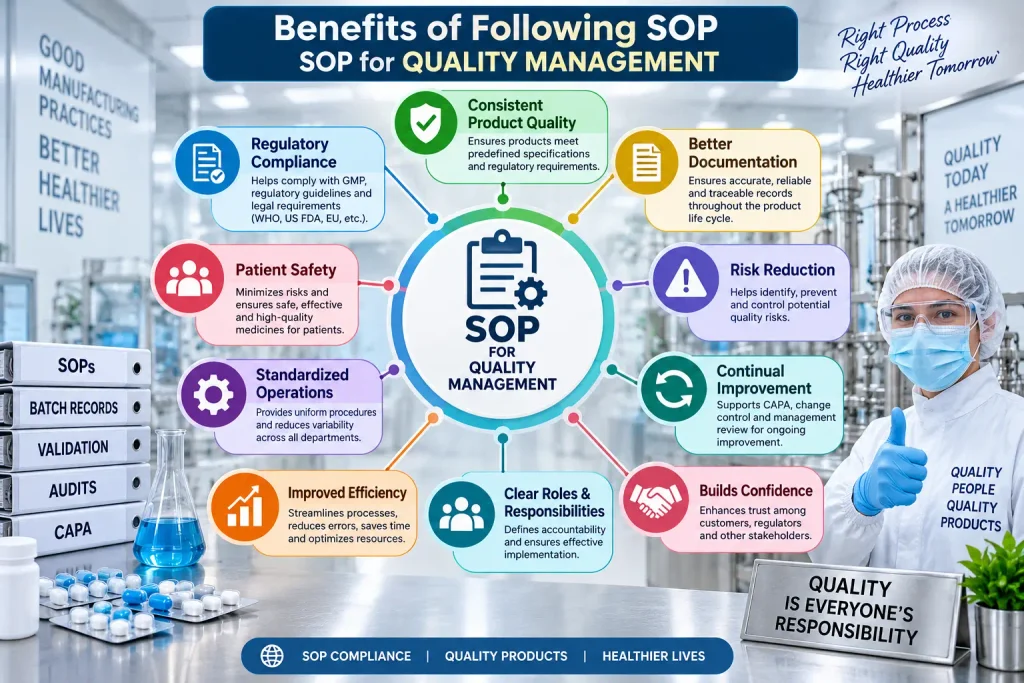
Effective compliance with this SOP supports consistent product quality, regulatory compliance, patient safety, standardized operations, better documentation, reduced quality risks, clear responsibilities, and continual improvement. It also strengthens control over manufacturing, testing, batch release, deviation handling, change control, CAPA effectiveness, and periodic quality-system review. Overall, proper implementation of the SOP promotes a strong pharmaceutical quality culture and helps ensure that products consistently meet established quality requirements and are suitable for their intended use.
4. Brainstorming for SOP Failure – SOP for Quality Management:
The Brainstorming for SOP Failure – SOP for Quality Management diagram identifies potential weaknesses that can interfere with effective implementation of the pharmaceutical Quality Management System in core manufacturing and critical processing areas. The SOP itself covers major quality-system elements such as GMP, sanitation and hygiene, qualification and validation, complaints, recalls, personnel, premises, equipment, documentation, CAPA, internal audits, and training.
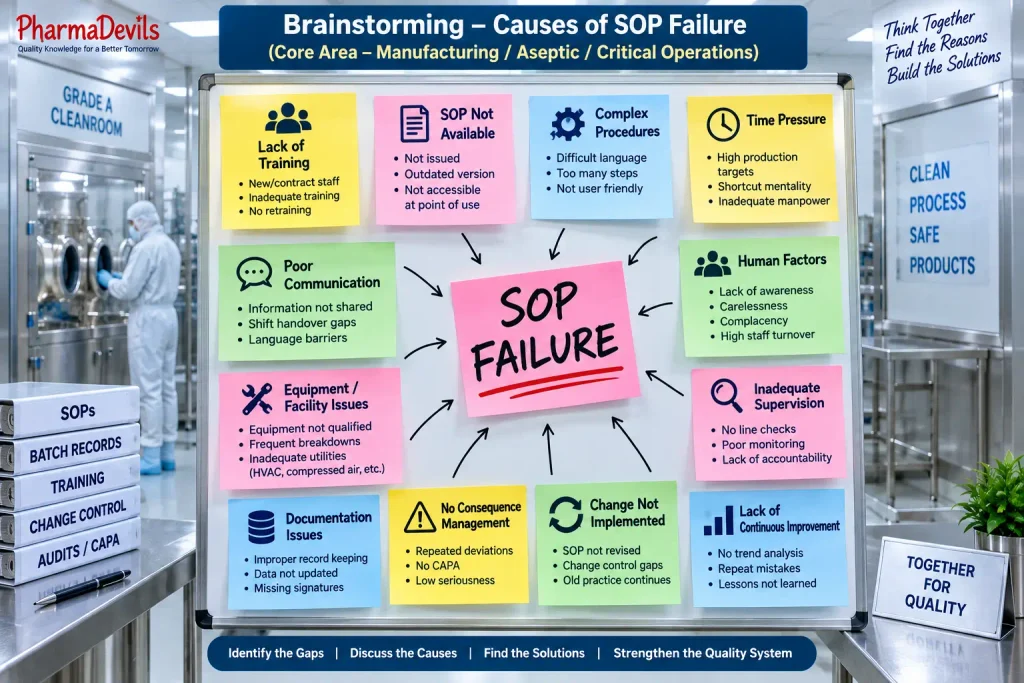
The brainstorming diagram groups possible SOP-failure causes around areas such as inadequate training, poor communication, unavailable or outdated procedures, documentation errors, equipment or facility issues, insufficient supervision, ineffective change implementation, repeated deviations, and lack of continual improvement. These themes help teams identify gaps that may weaken procedural compliance and Quality System effectiveness. Such brainstorming supports structured investigation by encouraging cross-functional teams to identify possible causes before proceeding to tools such as 5-Why Analysis, Fishbone Analysis, CAPA, and management review. The SOP specifically requires periodic Quality Management Review covering deviations, incidents, change control, CAPA effectiveness, and overall system performance.
5. 5-Why Analysis for SOP Failure – SOP for Quality Management:
The 5-Why Analysis for SOP Failure – SOP for Quality Management is a structured root-cause investigation tool used to identify why an approved SOP may not be effectively followed in a pharmaceutical core manufacturing or aseptic area. The Quality Management SOP requires an effective system covering GMP, personnel, equipment, documentation, CAPA, internal quality audits, and training, all of which can influence successful SOP implementation.
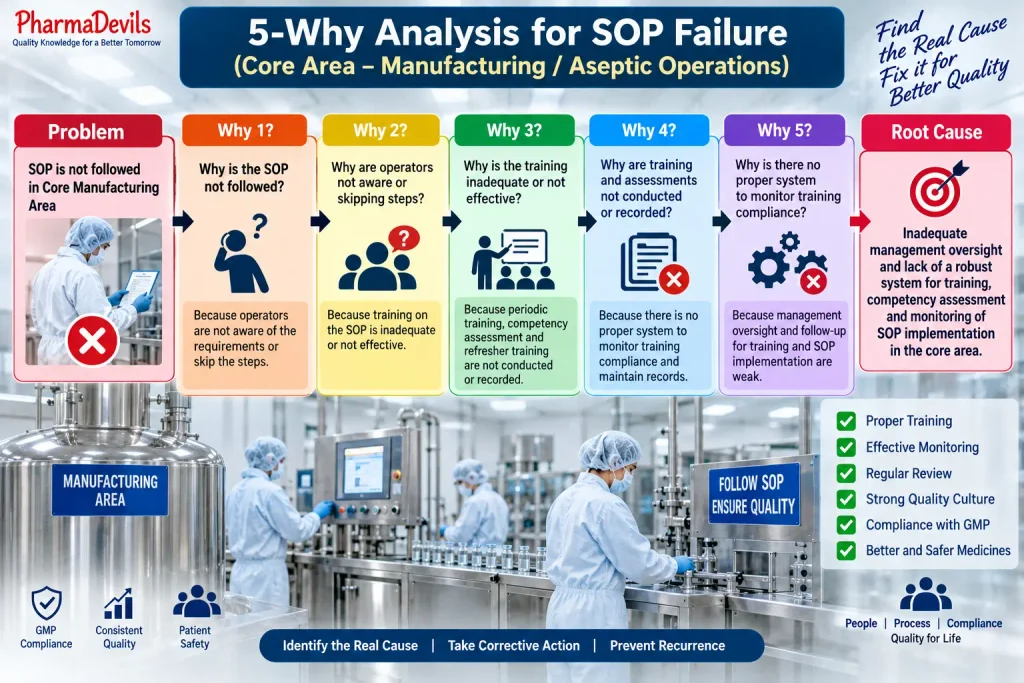
The illustrated 5-Why sequence starts with the problem of SOP noncompliance and progressively examines possible contributing factors such as inadequate operator awareness, ineffective training, missing competency assessment, weak monitoring of training records, and insufficient management follow-up. These causes are analytical examples used to guide investigation rather than specific failures stated in the SOP itself. The analysis ultimately helps identify a manageable root cause so that suitable corrective and preventive actions can be implemented. This supports the SOP requirement for Quality Management Review of deviations, incidents, change controls, CAPA effectiveness, and overall Quality System performance.
6. Fishbone Analysis for SOP Failure – SOP for Quality Management:
The Fishbone Analysis for SOP Failure – SOP for Quality Management is used to systematically identify possible causes that may lead to ineffective implementation or noncompliance with an approved SOP in pharmaceutical core manufacturing or aseptic areas. The Quality Management SOP itself covers major quality-system elements such as personnel, equipment, materials, documentation, qualification and validation, audits, CAPA, training, premises, and GMP controls. The fishbone diagram organizes potential causes under the major categories of Man, Machine, Method, Material, Measurement, and Environment. Examples include inadequate training, equipment qualification or maintenance gaps, outdated or unclear procedures, material mix-ups, weak compliance monitoring, incomplete documentation, production pressure, and poor area discipline. These causes are investigative possibilities represented in the diagram and are not specifically stated as failures in the SOP.
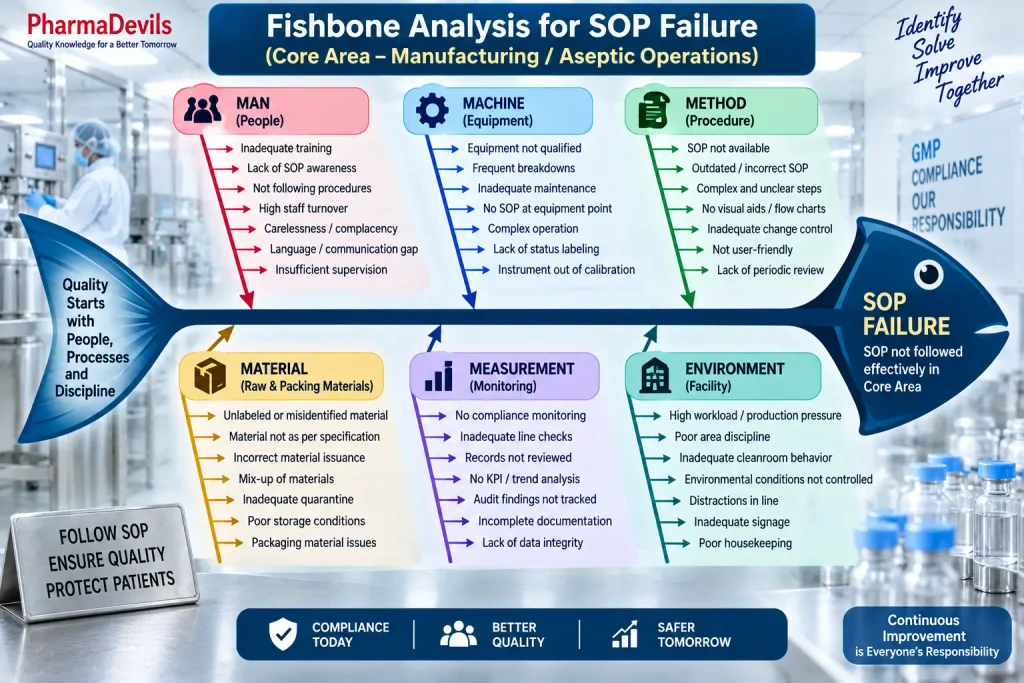
Using this analysis helps the investigation team evaluate contributing factors in a structured manner, identify the most probable root causes, and establish suitable corrective and preventive actions. This supports continual improvement and the SOP requirement for periodic review of deviations, incidents, change controls, CAPA effectiveness, and overall Quality Management System performance
7. Fault Tree Analysis for SOP Failure – SOP for Quality Management:
The Fault Tree Analysis for SOP Failure – SOP for Quality Management provides a structured method for evaluating how different failures can combine and lead to ineffective SOP implementation in pharmaceutical core manufacturing or aseptic areas. The Quality Management SOP covers essential quality-system elements including GMP, personnel, equipment, documentation, materials, qualification and validation, CAPA, internal audits, training, premises, and quality-control activities.
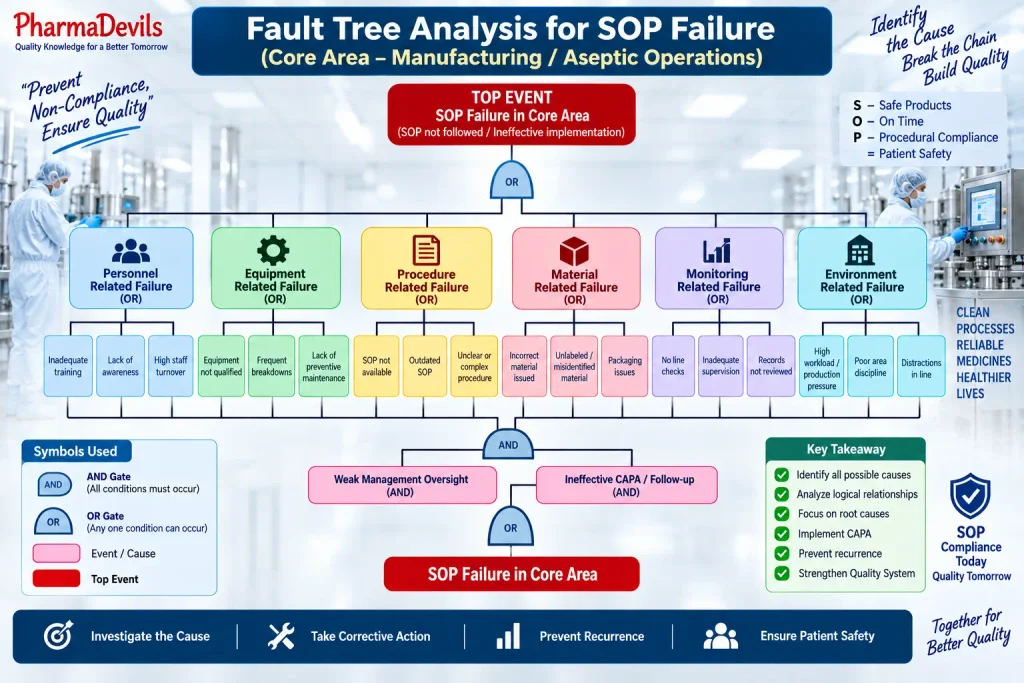
The diagram considers SOP failure in the core area as the top event and links it through logical pathways to possible causes such as personnel-related failures, equipment problems, procedural weaknesses, material-control issues, inadequate monitoring, and environmental or facility-related deficiencies. Contributing examples include inadequate training, outdated SOPs, equipment breakdowns, incorrect material issuance, poor supervision, incomplete record review, production pressure, and weak area discipline. Fault Tree Analysis helps the investigation team understand how individual and combined failures may contribute to the final event, identify critical root causes, establish appropriate CAPA, strengthen monitoring, and prevent recurrence. This approach also supports the SOP requirement for periodic Quality Management Review of deviations, incidents, change control, CAPA effectiveness, and overall Quality System performance.
8. Impact Assessment for SOP Failure – SOP for Quality Management:
The Impact Assessment for SOP Failure – SOP for Quality Management evaluates the potential consequences that may arise when approved quality procedures are not followed effectively in pharmaceutical manufacturing and core operational areas. The Quality Management SOP covers critical elements such as GMP, qualification and validation, complaints, product recalls, documentation, control of nonconforming products, CAPA, internal audits, and training.
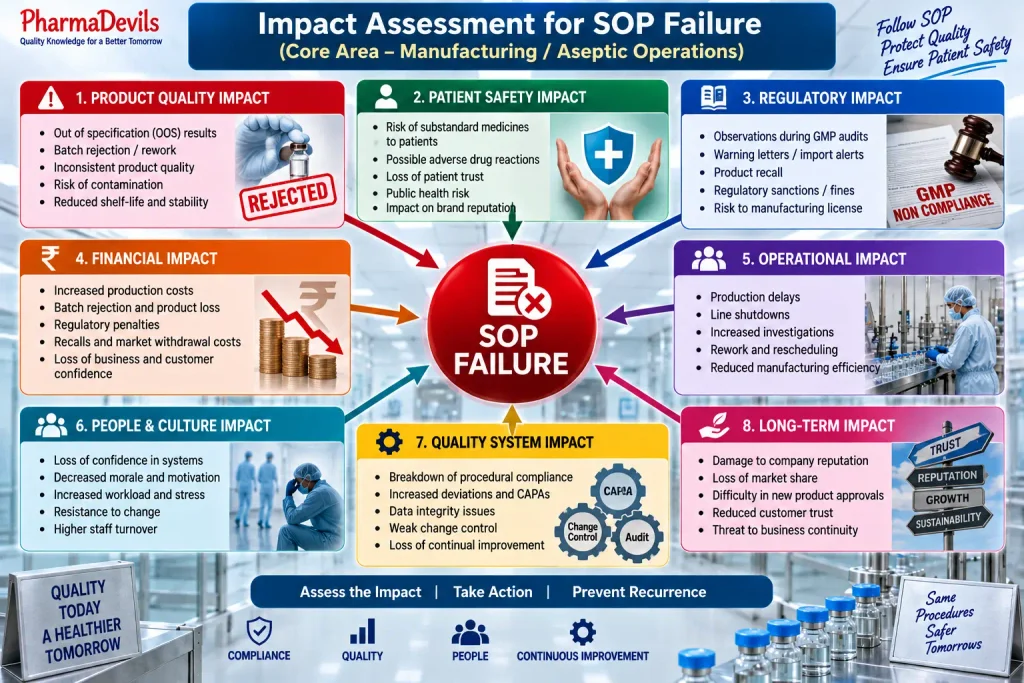
The illustrated assessment considers possible impacts on product quality, patient safety, regulatory compliance, financial performance, manufacturing operations, personnel and quality culture, the Quality Management System, and long-term organizational performance. These impact categories are analytical extensions of the SOP and are intended to support risk evaluation rather than represent specific failures stated in the source document. Proper impact assessment helps determine the severity and extent of an SOP failure, supports timely investigation and CAPA, and strengthens management oversight. The SOP specifically requires Quality Management Review of deviations, incidents, change control, CAPA effectiveness, and overall Quality System implementation.
Questions & Answers – SOP for Quality Management:
Q1. What is the objective of the SOP for Quality Management?
Answer: The objective is to establish the procedure for Quality Management within the organization.
Q2. What is the scope of this SOP?
Answer: The SOP provides guidelines for implementing and maintaining Quality Management within the pharmaceutical organization.
Q3. Who is responsible for execution of the Quality Management SOP?
Answer: The Chemist/Officer-QA is responsible for execution of the SOP, while the Asst. Manager-QA and Head-QA/QC are responsible for its effective implementation.
Q4. What is Quality Management in a pharmaceutical organization?
Answer: Quality Management is the management function that determines and implements the organization’s quality policy through an appropriate quality system comprising organizational structure, procedures, processes, and resources.
Q5. What is the main purpose of pharmaceutical Quality Management?
Answer: Its purpose is to ensure that pharmaceutical products consistently possess the quality required for their intended use.
Q6. Which major systems are covered under Quality Management?
Answer: The SOP includes GMP, sanitation and hygiene, qualification and validation, complaints, recalls, contract production and analysis, self-inspection, personnel, premises, equipment, documentation, CAPA, quality records, audits, and training.
Q7. What personnel-related information should be included in the Quality Management System?
Answer: It should address induction, cGMP, job-specific, safety and external training, health monitoring, illness reporting, gowning, and personnel entry procedures.
Q8. What should be covered regarding premises and equipment?
Answer: The system should describe manufacturing areas, HVAC systems, cross-contamination controls, water systems, production equipment, laboratory instruments, equipment qualification, maintenance, calibration, validation, and preventive maintenance.
Q9. What are the requirements for documentation under this SOP?
Answer: The documentation system should describe document preparation, distribution, retrieval, control, and destruction, along with product-quality documents such as specifications and Standard Test Procedures.
Q10. What does the SOP require for Batch Manufacturing Records?
Answer: Batch Manufacturing Records should describe production process controls, material handling, arrangements for rejected materials and finished products, and the general policy for process validation.
Q11. What Quality Control activities are addressed in the SOP?
Answer: QC activities include preparation, revision and distribution of specifications and test procedures, batch review and release, OOS handling, and release of printed packing materials.
Q12. How are complaints and product recalls addressed?
Answer: The SOP requires controls relating to warehouse security, environmental conditions, storage, labeling, distribution records, and a defined procedure for handling market complaints.
Q13. Why are self-inspections important in Quality Management?
Answer: Self-inspection is used to evaluate the effectiveness of Quality System implementation and identify areas requiring improvement.
Q14. What is reviewed during Quality Management Review?
Answer: The monthly review includes Quality Management System performance, deviations, incidents, change controls, CAPA effectiveness, and overall implementation of the Quality System.
Q15. How does effective Quality Management support pharmaceutical operations?
Answer: By integrating Quality Assurance, GMP, Quality Control, documentation, training, validation, auditing, and CAPA, the system helps maintain consistent product quality and controlled pharmaceutical operations.
Reference Guidelines – SOP for Quality Management:
- ICH Q10 – Pharmaceutical Quality System – Provides a comprehensive model for an effective pharmaceutical quality system across the product lifecycle. (ICH Database)
- ICH Q9(R1) – Quality Risk Management – Provides principles and tools for systematic quality-risk assessment, control, communication, and review. (ICH Database)
- WHO Technical Report Series No. 986, Annex 2 – Good Manufacturing Practices for Pharmaceutical Products: Main Principles – Covers core GMP and pharmaceutical quality-system expectations. (World Health Organization)
- EU GMP – EudraLex Volume 4, Part I, Chapter 1: Pharmaceutical Quality System – Addresses the pharmaceutical quality system, management responsibilities, GMP, continual improvement, and product quality review. (Public Health)
- US FDA – 21 CFR Parts 210 and 211 – Establishes CGMP requirements for manufacturing, processing, packing, holding, and control of finished pharmaceutical products. (U.S. Food and Drug Administration)
- US FDA – Quality Systems Approach to Pharmaceutical Current Good Manufacturing Practice Regulations – Provides guidance on integrating modern quality-system and risk-management approaches with CGMP requirements. (U.S. Food and Drug Administration)
- India – Drugs Rules, 1945, Revised Schedule M: Good Manufacturing Practices and Requirements of Premises, Plant and Equipment for Pharmaceutical Products – Requires a comprehensively designed and correctly implemented Pharmaceutical Quality System incorporating GMP and Quality Risk Management. (CDSCO)
- WHO Guidelines on Quality Assurance and Pharmaceutical Production – Additional WHO guidance covers validation, data integrity, pharmaceutical water systems, sterile manufacturing, HVAC and related quality-system controls. (World Health Organization)