






1. Introduction – SOP for Quality Technical Agreements:
The SOP for Quality Technical Agreements establishes a systematic and controlled procedure for the preparation, approval, implementation, review, and maintenance of technical agreements related to GMP activities and outsourced services. Its purpose is to ensure that the responsibilities, quality requirements, communication processes, and obligations of the contract giver and contract acceptor are clearly defined and understood. The SOP ensures that external service providers are appropriately evaluated for their competence, facilities, equipment, technical knowledge, qualified personnel, and ability to perform assigned activities in accordance with applicable requirements. It also provides provisions for auditing service providers and monitoring their performance. Each technical agreement should clearly define the scope, responsibilities of both parties, validity period, and conditions for termination. Quality Assurance maintains overall control of GMP-related agreements, retains relevant documentation, and ensures that agreements are periodically reviewed and revised when required.
Skip to PDF content2. Flow Diagram – SOP for Quality Technical Agreements:
The Flow Diagram for SOP for Quality Technical Agreements illustrates the systematic process for preparing, approving, implementing, monitoring, and maintaining technical agreements with external service providers or contract acceptors. The process begins by identifying activities related to GMP that require a formal agreement and clearly defining the scope, responsibilities, and communication requirements of both parties.
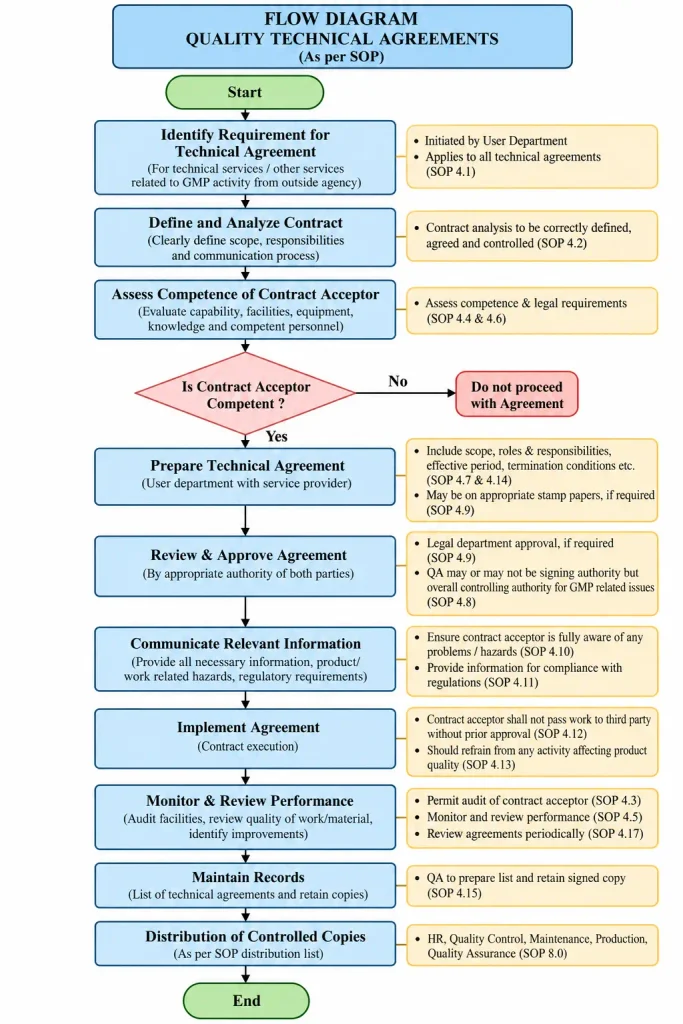
The competency of the contract acceptor is assessed based on facilities, equipment, technical knowledge, personnel, and applicable legal requirements. After satisfactory assessment, the agreement is prepared by the user department and service provider, reviewed, and approved by appropriate authorities. Necessary technical and regulatory information is communicated, followed by implementation, performance monitoring, periodic review, and retention of signed agreement records by QA. This structured workflow helps maintain clear responsibilities, GMP compliance, traceability, and effective control of outsourced activities.
3. Benefits of Following SOP – Quality Technical Agreements:
Following the SOP for Quality Technical Agreements provides a structured and controlled approach for managing GMP-related activities performed by external agencies. It ensures that the scope, roles, responsibilities, communication processes, and duration of the agreement are clearly defined, reducing the possibility of misunderstanding between the contract giver and contract acceptor.
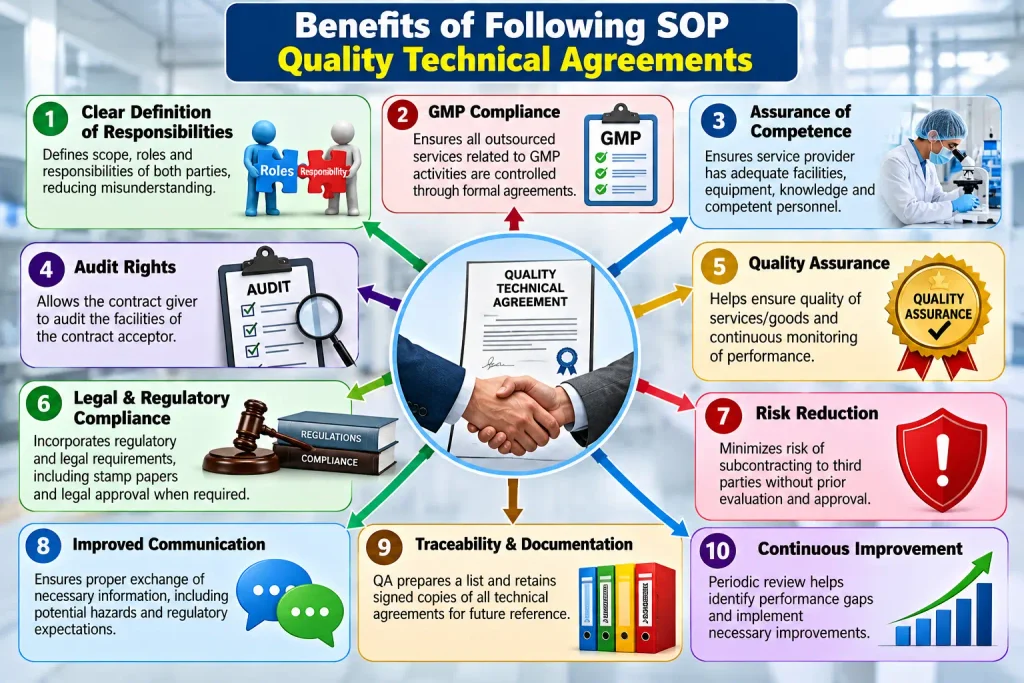
The SOP also supports assessment of the service provider’s competence, facilities, equipment, knowledge, and personnel before work is assigned. It gives the contract giver the right to audit the contract acceptor and requires ongoing monitoring and review of performance and material or service quality. Additional benefits include better regulatory compliance, controlled subcontracting, improved communication of product or process hazards, proper retention of signed agreements, periodic review, traceability, and identification of necessary improvements. Overall, the SOP strengthens quality assurance, accountability, documentation control, GMP compliance, and continuous improvement for outsourced activities.
4. Corrective and Preventive Action (CAPA) – SOP for Quality Technical Agreements:
The CAPA for Quality Technical Agreements provides a structured approach for identifying, correcting, and preventing deficiencies associated with preparation, approval, implementation, monitoring, and review of technical agreements. Typical issues may include missing agreements, unclear scope or responsibilities, overdue reviews, inadequate monitoring of contract acceptors, unauthorized subcontracting, or failure to retain signed agreement copies. The SOP requires responsibilities and communication processes to be clearly defined and the contract acceptor’s performance to be monitored and reviewed.
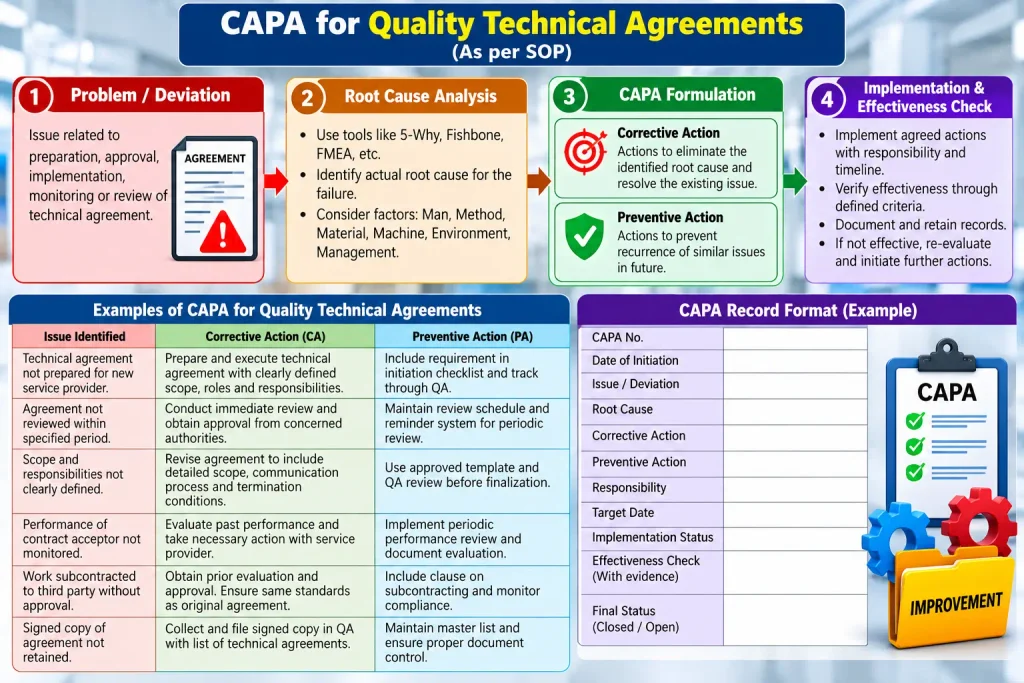
Corrective actions may include preparation or revision of agreements, obtaining required approvals, completing pending reviews, and securing controlled records. Preventive actions can include approved templates, master agreement registers, periodic review schedules, reminders, personnel training, and QA verification. The SOP also requires prior approval before work is passed to a third party and retention of signed technical-agreement records. CAPA effectiveness should be documented and verified to ensure sustained GMP compliance and continual improvement.
5. Brainstorming Analysis for SOP Failure – Quality Technical Agreements:
The Brainstorming Analysis for SOP Failure – Quality Technical Agreements identifies potential causes that may lead to ineffective preparation, implementation, monitoring, or control of technical agreements in the manufacturing environment. Key concerns include unclear scope and responsibilities, poor communication, inadequate evaluation of the contract acceptor, insufficient SOP training, missing or outdated agreement templates, delayed review and approval, and inadequate performance monitoring.
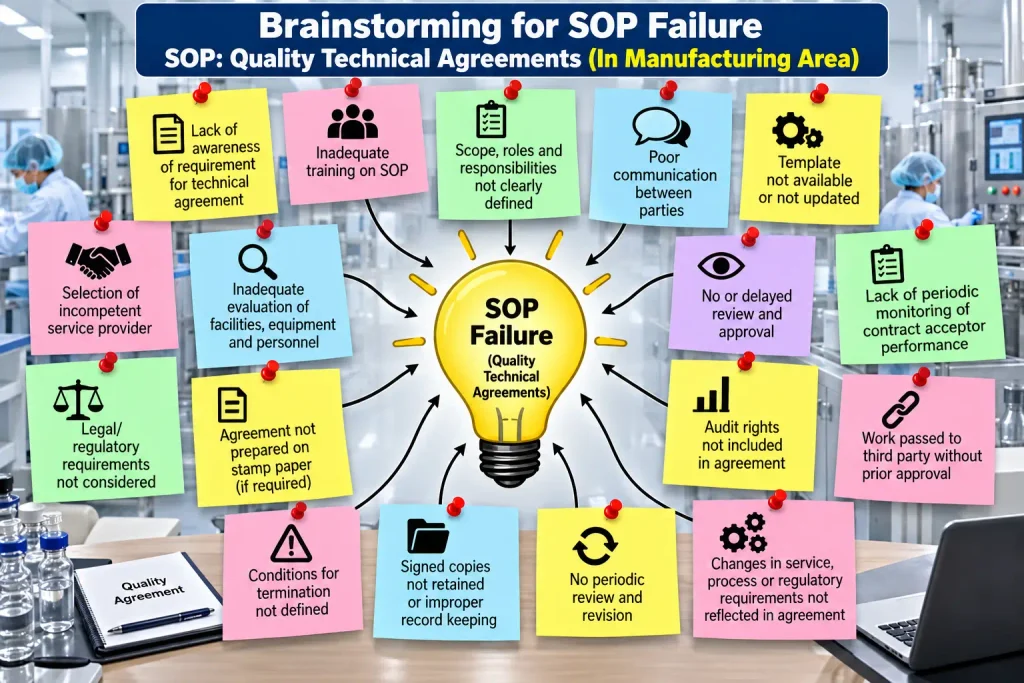
The SOP requires technical agreements to clearly define the scope, roles, responsibilities, effective period, and termination conditions of both parties. It also requires the contract giver to assess the competence of the contract acceptor and continuously monitor its performance. Other possible failure causes include unauthorized subcontracting, missing audit provisions, poor record retention, and failure to periodically review agreements. The SOP specifies that third-party work requires prior approval and that QA should retain signed copies and periodically review agreements. This brainstorming exercise helps identify weaknesses early and supports appropriate CAPA and stronger GMP compliance.
6. 5-Why Analysis for SOP Failure – Quality Technical Agreements:
The 5-Why Analysis for SOP Failure – Quality Technical Agreements is used to identify the underlying reason why a required technical agreement may not be prepared, implemented, reviewed, or controlled properly in the manufacturing area. The analysis begins with the problem of a technical agreement not being prepared or implemented as required and then progressively examines contributing causes such as failure to identify the requirement, lack of awareness regarding outsourced GMP activities, inadequate SOP training, weak training planning, and insufficient management follow-up.
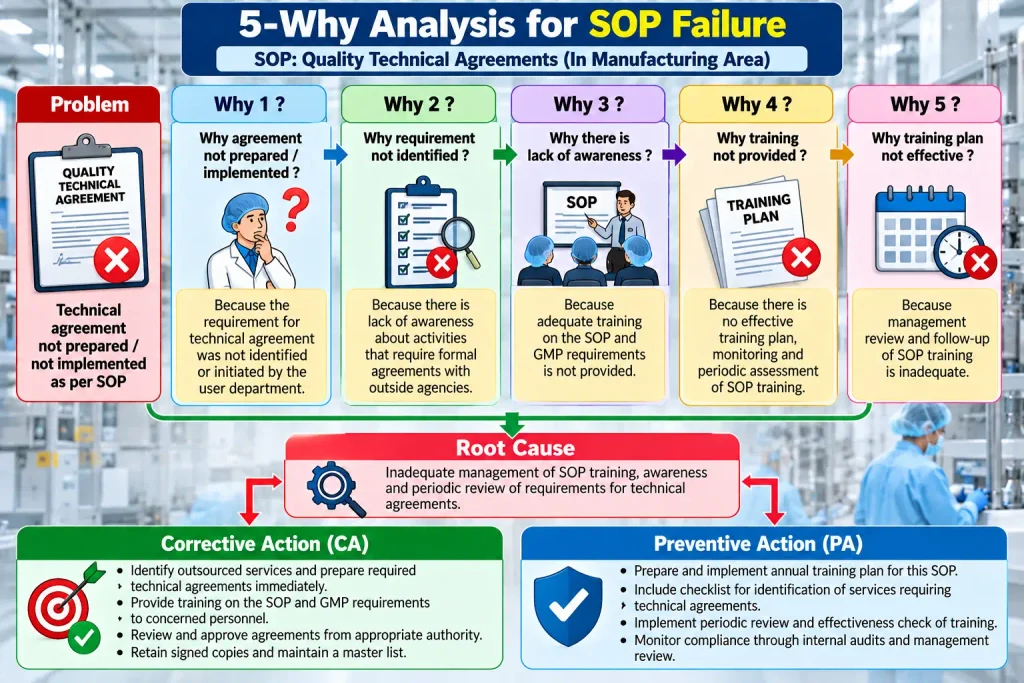
The SOP requires formal agreements for GMP-related services obtained from outside agencies, with clearly defined responsibilities and communication processes. It also requires assessment of the contract acceptor’s competence and continued monitoring of performance. The analysis indicates that inadequate awareness, training, and periodic review can contribute to SOP failure. Corrective and preventive measures should therefore focus on identifying applicable outsourced services, preparing and approving required agreements, retaining signed copies, maintaining an agreement list, and periodically reviewing agreements as required by the SOP.
7. Fishbone Analysis for SOP Failure – Quality Technical Agreements:
The Fishbone Analysis for SOP Failure – Quality Technical Agreements identifies possible causes that may lead to ineffective preparation, implementation, control, or review of technical agreements in the manufacturing area. The causes can be grouped under major categories such as Man, Method, Machine/System, Material/Documentation, Measurement/Monitoring, and Management/Environment.
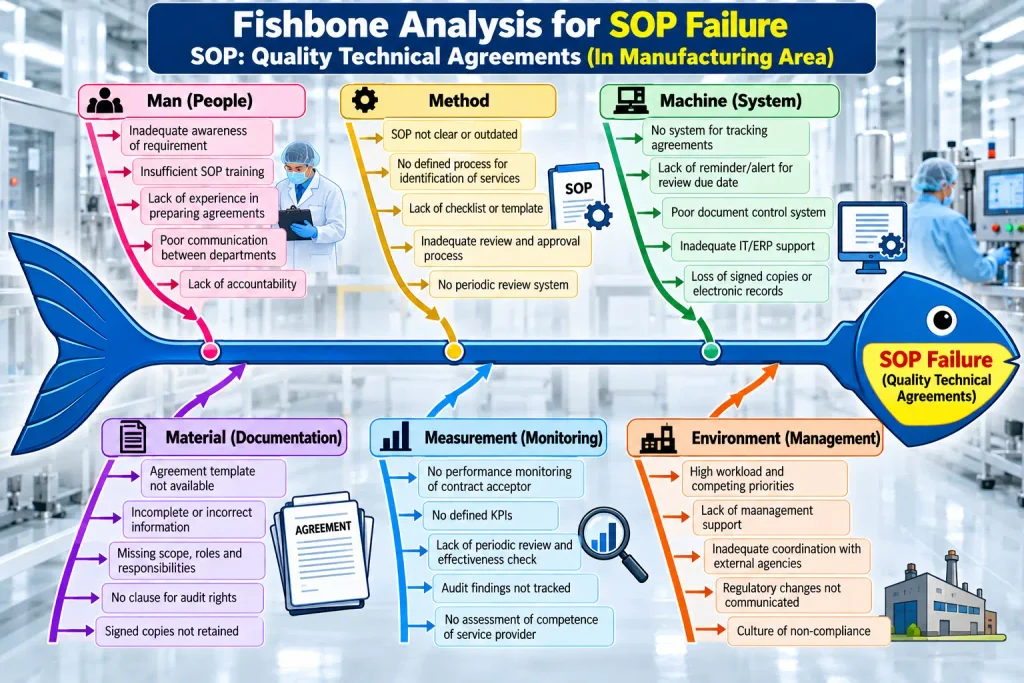
Human-related causes may include inadequate awareness, insufficient SOP training, poor communication, and lack of accountability. Method-related causes may involve unclear procedures, missing checklists, inadequate approval processes, or absence of periodic review. Documentation-related failures can include incomplete agreements, unclear scope and responsibilities, missing audit clauses, or failure to retain signed copies. The SOP specifically requires clear definition of responsibilities, assessment of contract acceptor competence, and monitoring of performance. The analysis also highlights weaknesses in tracking systems, review mechanisms, regulatory communication, and management oversight. Periodic review and retention of signed technical agreements by QA are required to maintain effective control and compliance.
8. Fault Tree Analysis for SOP Failure – Quality Technical Agreements:
The Fault Tree Analysis for SOP Failure – Quality Technical Agreements identifies the possible pathways that can lead to failure of the technical agreement system in the manufacturing area. The top event is considered as a technical agreement not being prepared, implemented, monitored, or controlled as required. Major contributing branches include agreement not prepared or incomplete, agreement not approved or implemented, agreement not monitored or reviewed, and non-compliance with technical agreement requirements. These failures may originate from lack of awareness, absence of standard templates, unclear scope and responsibilities, inadequate approval, unauthorized subcontracting, missing periodic review, poor performance monitoring, or failure to retain signed copies.
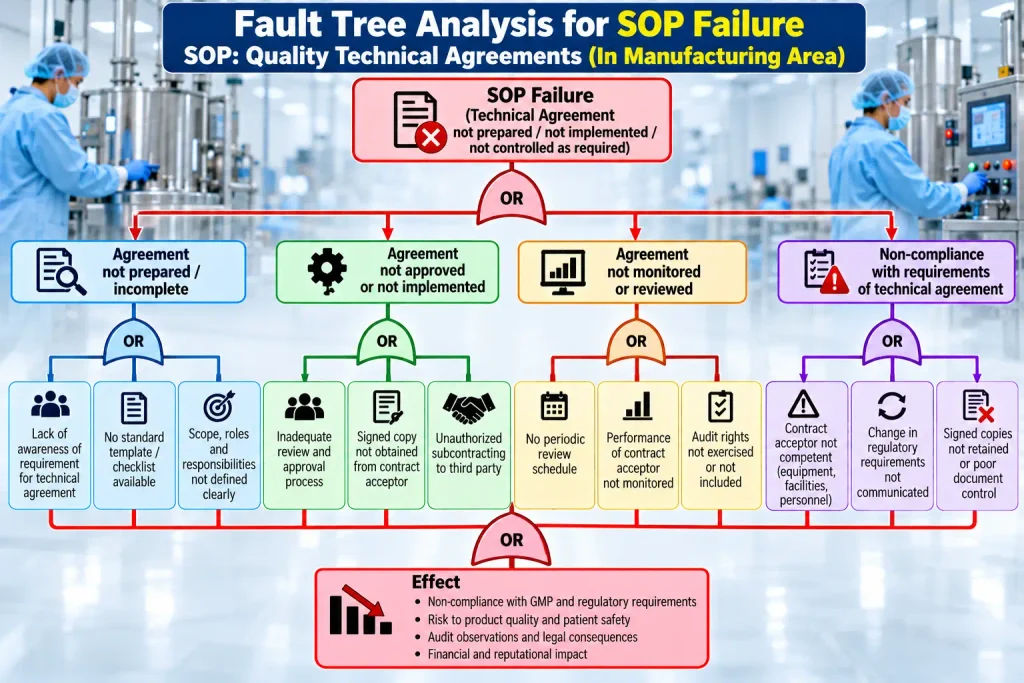
The SOP requires formal agreements for GMP-related outsourced activities, clear definition of responsibilities, assessment of contract acceptor competence, and monitoring of performance. It also requires control of third-party work, retention of signed agreements, and periodic review. This analysis helps identify critical failure points and supports timely CAPA to strengthen GMP compliance, document control, service-provider oversight, product quality, and regulatory readiness.
9. Impact Assessment on Process – SOP Failure: Quality Technical Agreements:
Failure to properly prepare, approve, implement, monitor, or review Quality Technical Agreements can have a significant impact on pharmaceutical manufacturing operations. The SOP requires formal agreements for outsourced GMP-related activities and clearly defined responsibilities between the contract giver and contract acceptor.
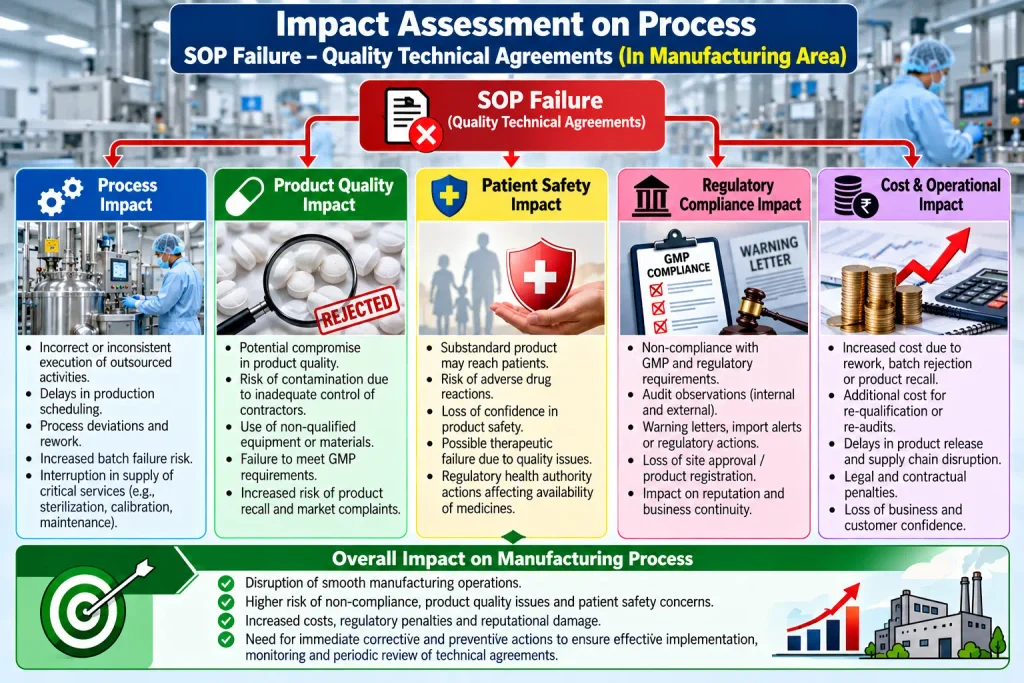
Process-related impacts may include incorrect execution of outsourced activities, production delays, deviations, rework, interruption of critical services, and increased risk of batch failure. Product quality may also be affected when the competence of the contract acceptor, facilities, equipment, personnel, or supplied services is not adequately assessed and monitored. The SOP further requires controlled subcontracting, proper communication of relevant information, retention of signed agreements, and periodic review. Failure in these controls can therefore increase the risk of GMP non-compliance, audit observations, documentation gaps, operational disruption, additional costs, and potential quality concerns. A timely CAPA, effective monitoring system, and scheduled agreement review help minimize these impacts and maintain reliable manufacturing operations.
Questions & Answers – SOP for Quality Technical Agreements:
- What is the objective of the SOP for Quality Technical Agreements?
The objective is to describe the procedure for preparation and handling of all technical agreements. - What is the scope of this SOP?
The SOP applies to the handling of all technical agreements at the organization. - Who is responsible for execution of this SOP?
The QA Chemist is responsible for execution of the SOP. - Who is responsible for effective implementation of the SOP?
The Assistant Manager-QA and Head QA/QC are responsible for effective implementation. - When is a formal technical agreement required?
A formal agreement is required when technical or other services related to GMP activities are obtained from an outside agency. - Why should contract analysis be clearly defined and controlled?
It should be defined, agreed, and controlled to avoid misunderstandings and to establish responsibilities and communication processes for quality-related activities. - Can the contract giver audit the contract acceptor?
Yes. The contract should permit the contract giver to audit the facilities of the contract acceptor. - Who assesses the competence of the contract acceptor?
The contract giver is responsible for assessing the competence of the contract acceptor to perform the required work or tests and meet applicable legal requirements. - What should be monitored after the agreement is implemented?
The contract giver should monitor and review the performance of the contract acceptor and the quality of material or services provided, and identify any required improvements. - What basic requirements should the contract acceptor possess?
The contract acceptor should have adequate premises, equipment, analytical instruments, knowledge, experience, and competent personnel. - What information should be clearly defined in a technical agreement?
The agreement should define the scope, roles and responsibilities of both parties, effective period, and conditions for automatic cessation or termination. - Who prepares and signs the technical agreement?
The technical agreement is prepared by the user department and the representative of the service provider and is signed by appropriate authorities of both parties. - What is QA’s role in technical agreements?
QA acts as the overall controlling authority for GMP-related issues, even when QA is not the signing authority. - When may legal department approval be required?
Legal approval may be obtained when required, including where agreements are prepared on appropriate stamp papers. - Can the contract acceptor subcontract the assigned work to a third party?
Not without prior evaluation and approval by the contract giver. - What activities should the contract acceptor avoid?
The contract acceptor should avoid any activity that may adversely affect the quality of the product manufactured or analyzed for the contract giver. - Who maintains records of technical agreements?
QA prepares the list of technical agreements, reviews and signs the agreement copy, and retains the relevant records. - What types of services may require technical agreements?
Examples include HVAC qualification, compressed air validation, thermal validation, pollution control, medical checkups, pest and rodent control, equipment servicing and calibration, contract analysis, and agreements with approved raw and packing material manufacturers. - Should technical agreements be reviewed periodically?
Yes. The list should be reviewed periodically, and agreements becoming due should be reviewed and revised. - What annexures are listed in the SOP?
Annexure-I is the Quality Technical Agreement for Raw Material, and Annexure-II is the Quality Technical Agreement for Packing Material.
Reference Guideline – SOP for Quality Technical Agreements:
Reference: In-House.
The SOP itself does not cite any specific external regulatory guideline such as WHO GMP, EU GMP, PIC/S, FDA, or ICH. Its requirements are internally defined for preparation, approval, monitoring, control, and periodic review of Quality Technical Agreements.