







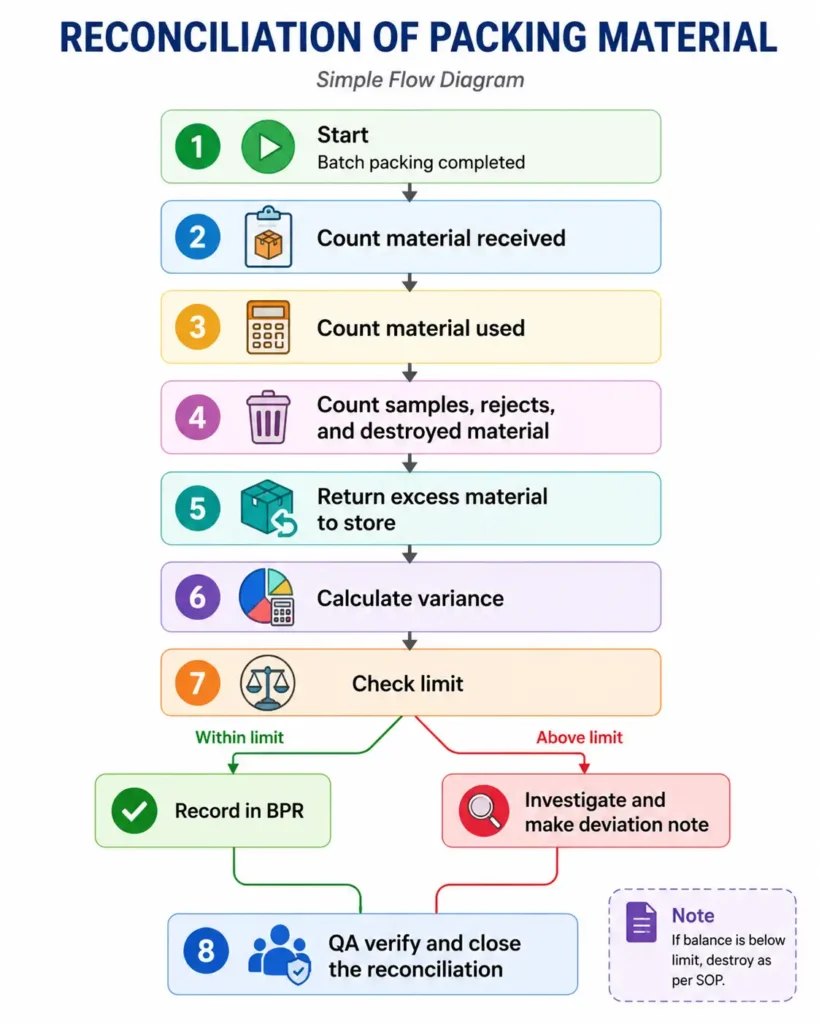
Reconciliation of packing material is an important activity performed after completion of a packing batch. Its purpose is to make sure that all packing materials received for the batch are properly accounted for. The packing staff records the quantity used during packing, samples taken for BPR, QC and in-process testing, rejected material, destroyed material, and unused material returned to stores. The final quantity is checked by comparing the total material received with the quantity used, rejected, destroyed, and returned.
The calculated variance should remain within the approved limit for each packing material. If the variance is higher than the specified limit, it must be investigated and a deviation should be attached with the Batch Packing Record. Excess material is returned to stores through an Excess Material Return Memo. The completed reconciliation is cross-checked by Production and verified by Quality Assurance to ensure correct material control and proper documentation.
Impact Assessment
The reconciliation of packing material has a direct impact on product quality, material control, and GMP compliance. It ensures that all packing materials received for a batch are properly counted and matched with the quantity used, rejected, destroyed, sampled, or returned to stores. This helps prevent mix-ups, misuse, loss, or unaccounted packing material. Proper reconciliation also supports correct batch documentation and reduces the risk of wrong labels, cartons, foils, bottles, or other components being used in another batch. If the calculated variance is above the approved limit, the issue must be investigated and documented through a deviation. This helps identify the reason for the difference and prevents recurrence. Verification by Production and Quality Assurance provides an additional check on the accuracy of the records. Overall, this procedure improves traceability, strengthens inventory control, supports batch release decisions, and helps maintain a reliable and compliant pharmaceutical packing process for every manufactured batch.
Question & Answers – Reconciliation of Packing Material
- What is packing material reconciliation?
Packing material reconciliation is the process of checking that all packing materials received for a batch are properly accounted for after packing is completed. - When should packing material reconciliation be performed?
It should be performed after completion of the packing batch. - What quantities are considered during reconciliation?
The quantity used, samples taken, rejected material, destroyed material, and excess material returned are considered. - How is variance calculated?
Variance can be calculated as:
A – (B + C + D)
where A = quantity received, B = quantity used, C = quantity returned, and D = rejects/unused material destroyed. - What should be done with excess packing material?
Excess packing material should be returned to Stores using an Excess Material Return Memo after QA verification. - Where should reconciliation details be recorded?
Reconciliation details should be recorded in the Batch Packing Record. - What happens if the variance exceeds the approved limit?
The reason should be investigated, and a deviation note should be attached to the Batch Packing Record. - Who verifies the final packing material reconciliation?
It is cross-checked by a second Production Officer and verified by a QA Officer. - What should be done with a small balance quantity below the standard return limit?
It should not be returned to Stores and should be destroyed as per the applicable procedure. - Why is packing material reconciliation important?
It helps ensure proper control of packing materials, correct documentation, and identification of any unexplained difference before batch closure.