






1. Introduction – Risk Management:
Risk Management is a systematic approach used within the pharmaceutical quality system to identify, assess, control, communicate, and review risks that may affect the quality of a drug product throughout its lifecycle. The SOP establishes a structured procedure for identifying hazards, evaluating their potential impact, and ensuring that appropriate controls are implemented to reduce risks to an acceptable level.Quality Risk Management involves knowledgeable personnel from relevant departments and considers key factors such as severity, probability of occurrence, and detectability. Risk assessment focuses on three fundamental questions: What might go wrong? What is the probability that it will go wrong? What are the consequences. A properly implemented risk management system supports scientifically justified decision-making, strengthens GMP compliance, improves process understanding, and provides a documented basis for controlling risks associated with pharmaceutical operations, equipment, systems, materials, and product quality.
Skip to PDF content2. Flow Diagram – Risk Management:
The Risk Management Flow Diagram presents a systematic sequence for identifying, assessing, controlling, and reviewing risks within the pharmaceutical quality system. The process starts with risk identification, where potential hazards and possible failures are recognized. This is followed by risk analysis, which evaluates the likelihood of occurrence and the severity of potential consequences. The identified risk is then compared against defined acceptance criteria during risk evaluation.
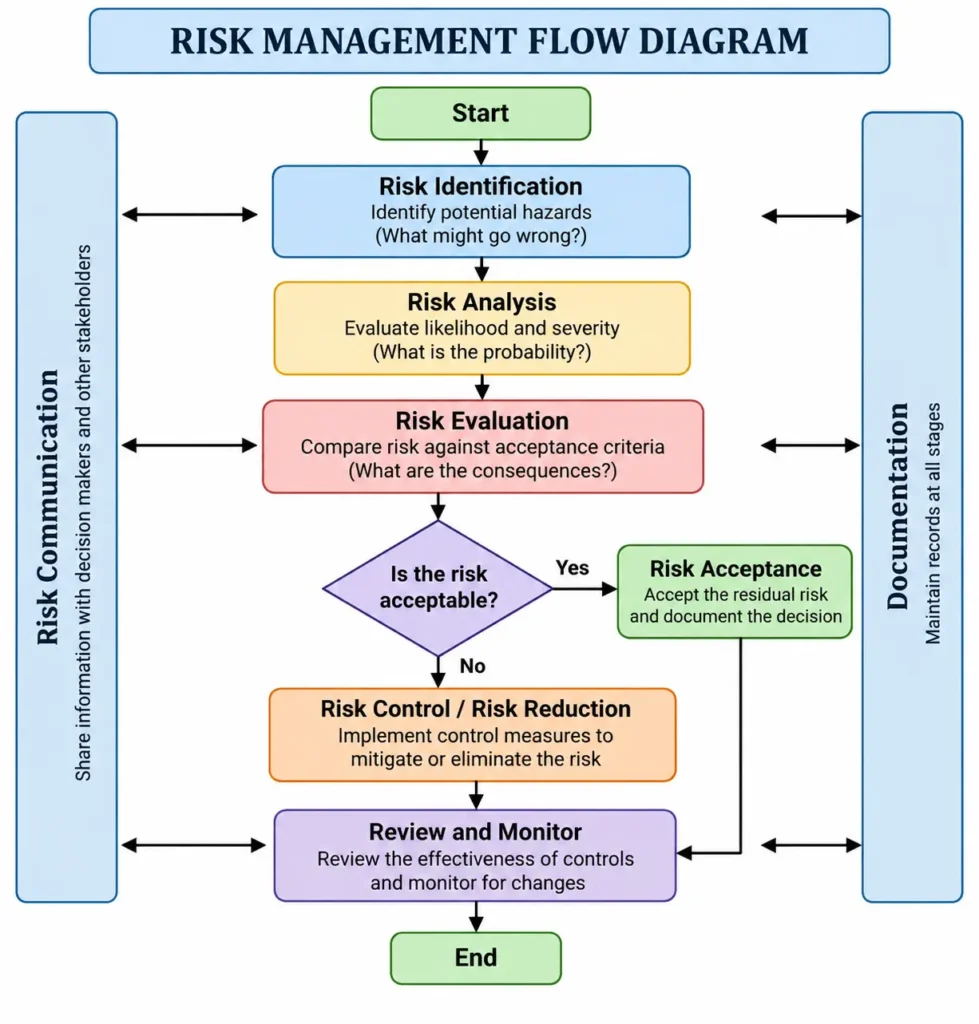
If the risk is acceptable, it may proceed to risk acceptance with appropriate documentation. If the risk is not acceptable, suitable risk control or risk-reduction measures are implemented to reduce it to an acceptable level. The effectiveness of these controls is subsequently reviewed and monitored. The SOP also emphasizes risk communication among decision-makers and concerned personnel throughout the process. This flow ensures that risks are managed in a structured, documented, and scientifically justified manner throughout the product lifecycle.
3. Benefits of Following SOP – Risk Management:
Following the Risk Management SOP helps ensure that risks affecting pharmaceutical operations and product quality are identified, evaluated, controlled, communicated, and reviewed in a consistent and documented manner. The SOP establishes a systematic approach to risk management across the product lifecycle and defines key elements such as severity, occurrence, and detection for assessing potential failures. As illustrated in the diagram, adherence to the SOP supports standardized operations, reduction of human errors, improved product quality, regulatory compliance, personnel and product safety, effective training, investigation support, and continuous improvement. These benefits follow from consistently applying approved procedures and maintaining appropriate documentation.
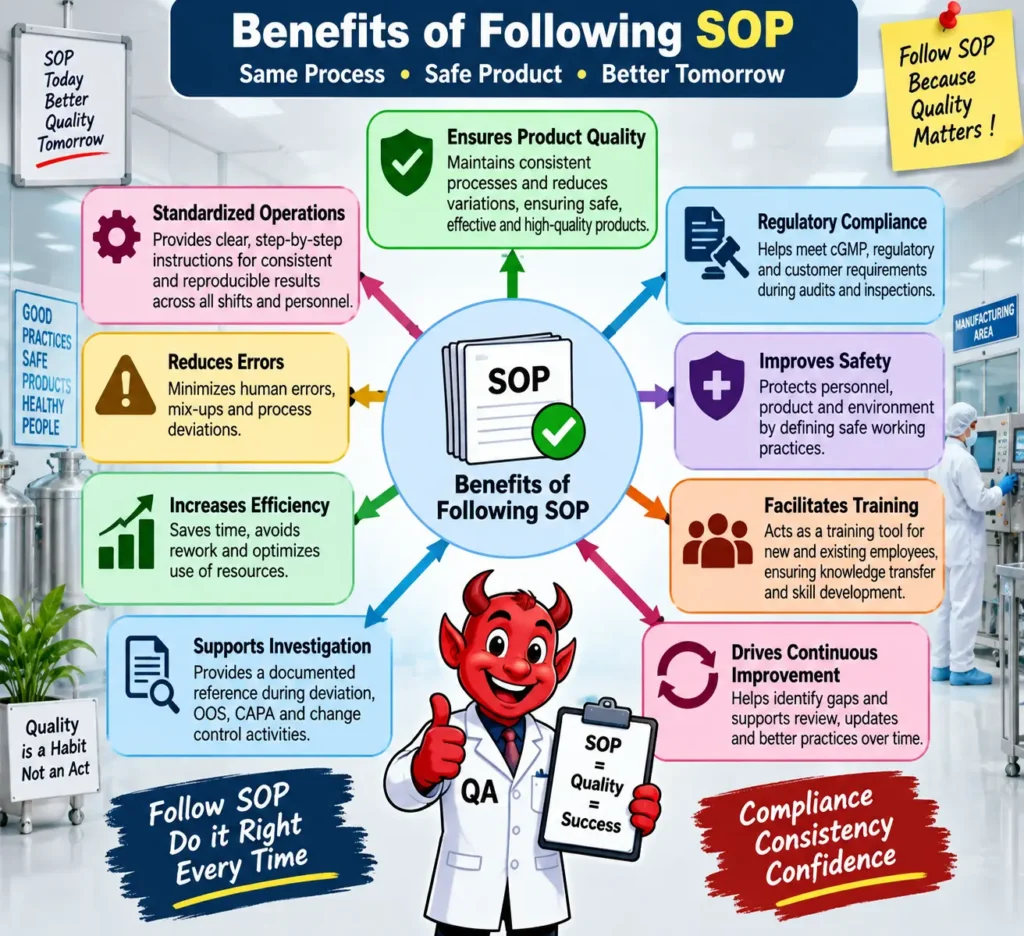
The SOP also requires knowledgeable personnel from relevant departments to participate in risk-management activities and emphasizes identification of hazards, probability of occurrence, and potential consequences. Overall, following the SOP promotes consistency, traceability, accountability, effective risk control, and reliable GMP decision-making throughout pharmaceutical operations.
4. Brainstorming for SOP Failure – Risk Management:
Brainstorming for SOP failure in the manufacturing equipment area is a structured team activity used to identify possible reasons why an approved procedure may not be followed correctly or may fail to achieve its intended purpose. The Risk Management SOP emphasizes using knowledgeable personnel from appropriate areas to identify hazards and consider what might go wrong, the probability of occurrence, and the possible consequences.
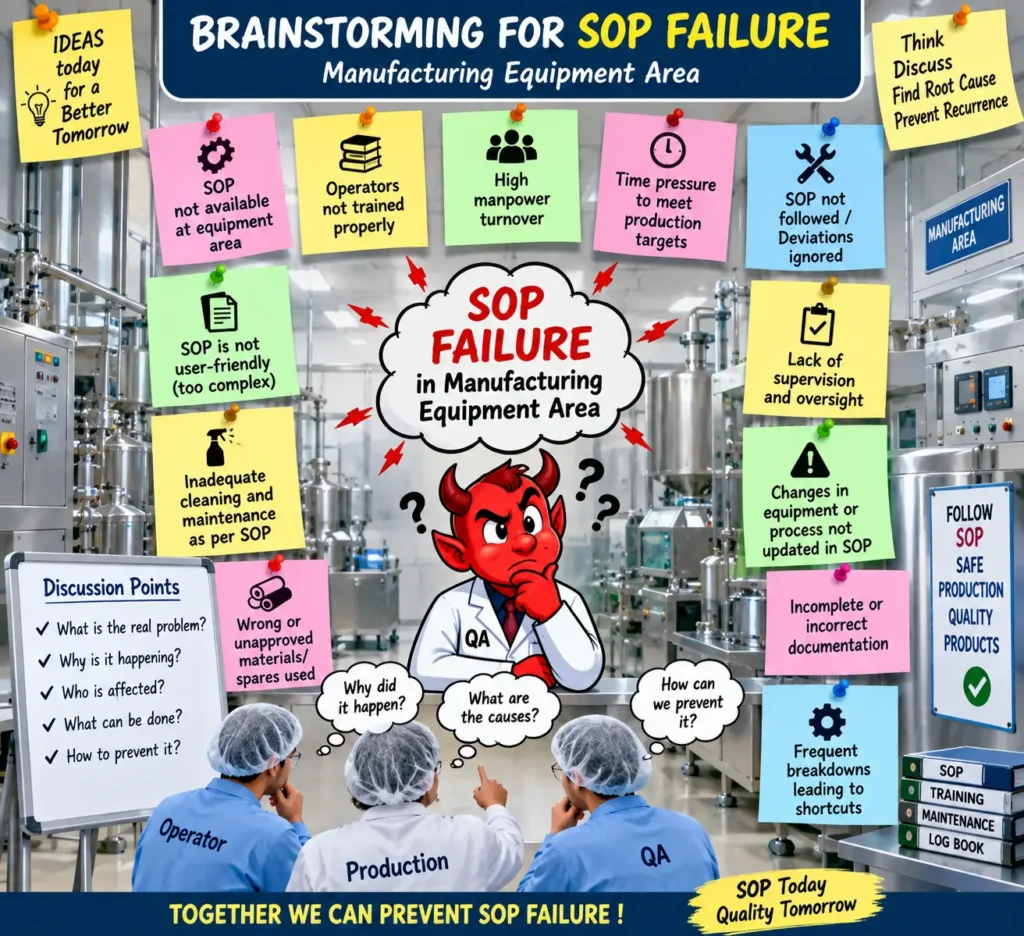
During brainstorming, the team may consider causes such as SOP not available near the equipment, inadequate operator training, complicated instructions, weak supervision, production time pressure, equipment or process changes not incorporated into the SOP, incomplete documentation, improper cleaning or maintenance, use of incorrect materials or spare parts, and repeated equipment breakdowns. The purpose is to collect all reasonable causes without immediately rejecting any idea. These inputs can then be evaluated through risk assessment, root-cause analysis, CAPA, training improvement, SOP revision, and strengthened operational controls.
5. 5-Why Analysis for SOP Failure – Risk Management:
The 5-Why Analysis shown in the diagram is used to trace an SOP failure from the visible problem to its underlying root cause. The starting problem is that the approved SOP was not followed during operation of manufacturing equipment. The analysis then repeatedly asks “Why?” to move beyond the immediate operator error.
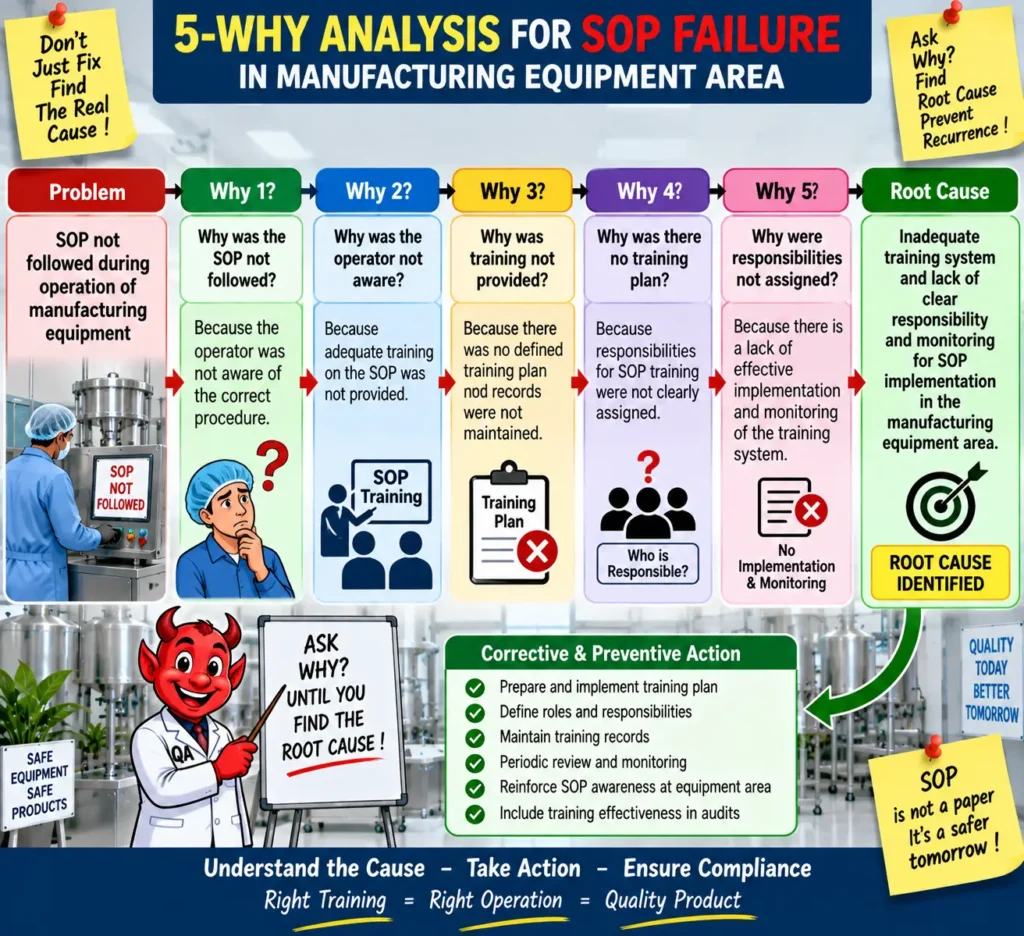
The sequence identifies that the operator was not fully aware of the correct procedure, adequate SOP training had not been provided, a defined training plan and associated records were lacking, responsibilities for training were not clearly assigned, and implementation and monitoring of the training system were ineffective. The resulting root cause is therefore an inadequate training and oversight system with unclear responsibility for SOP implementation. This approach supports the SOP’s broader risk-management principle of systematically identifying potential failures, their causes, and consequences through knowledgeable personnel. Corrective actions should include structured training, defined responsibilities, training records, periodic effectiveness checks, SOP awareness, and continued monitoring to prevent recurrence.
6. Fishbone Analysis for SOP Failure – Risk Management:
The Fishbone Analysis is used to systematically identify the possible causes contributing to an SOP failure in the manufacturing equipment area. The diagram groups potential causes into major categories such as Man, Machine, Method, Material, Measurement, Environment, and Management, making it easier to investigate the problem in a structured manner.
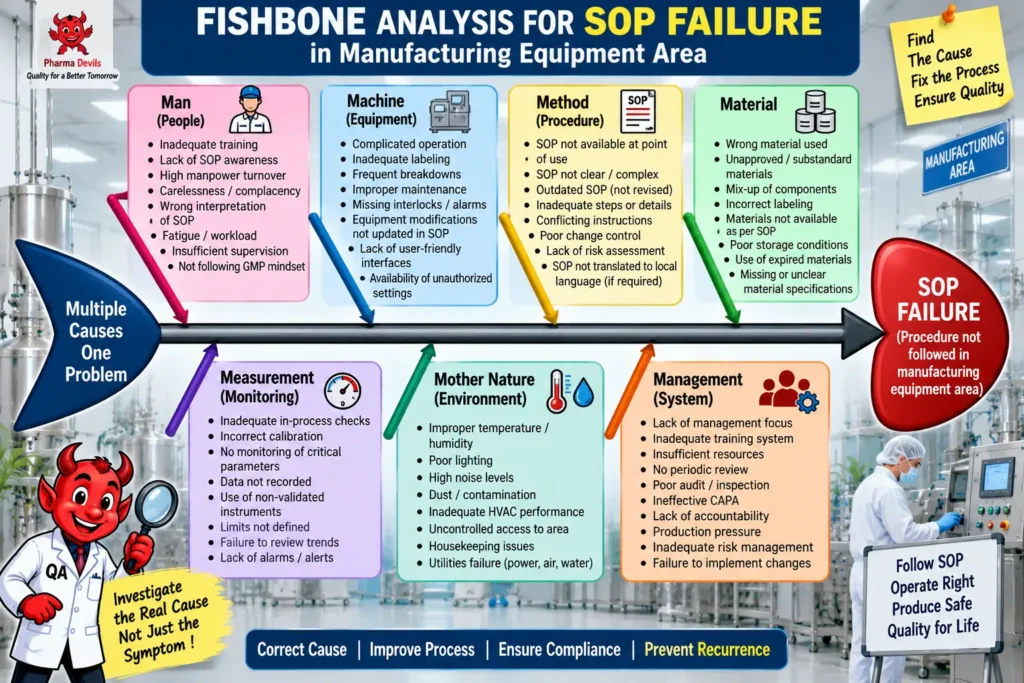
Under Man, possible causes include inadequate training, lack of SOP awareness, fatigue, high workload, and insufficient supervision. Machine-related causes may include equipment breakdowns, poor maintenance, missing interlocks or alarms, and equipment modifications not updated in the SOP. Method factors can involve unclear or unavailable SOPs, conflicting instructions, and poor change control. Material, monitoring, environmental, and management factors may also contribute through incorrect materials, inadequate checks, poor area conditions, insufficient resources, weak review, or ineffective CAPA. This analysis supports the SOP requirement to identify hazards systematically and evaluate what might go wrong before determining suitable controls. The Fishbone approach helps the investigation team move beyond symptoms, identify contributing causes, and establish effective corrective and preventive actions.
7. Fault Tree Analysis for SOP Failure – Risk Management:
The Fault Tree Analysis (FTA) diagram evaluates an SOP failure by starting with the top event: “SOP Failure – Procedure not followed in the manufacturing equipment area.” The event is then broken into major contributing branches using logical relationships. The diagram identifies four main intermediate causes: human error, equipment-related failure, procedure/system-related failure, and external or environmental factors.
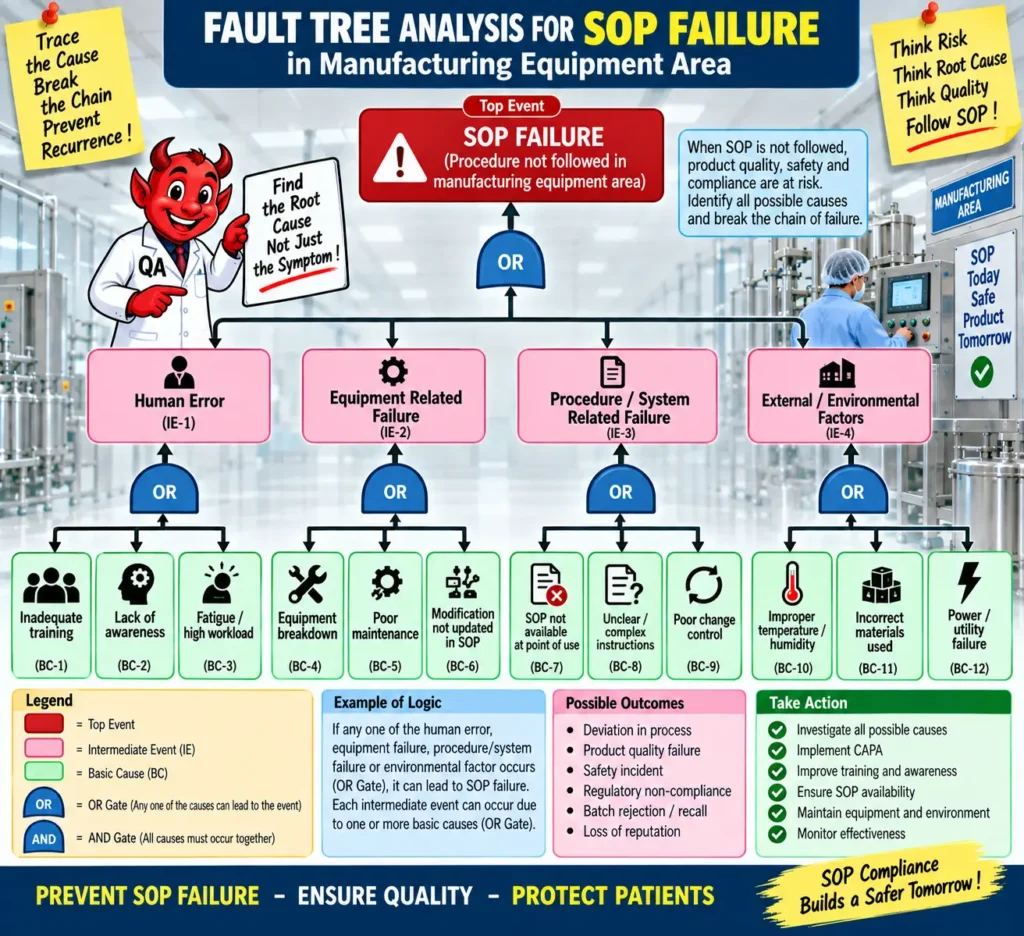
Human-related causes include inadequate training, lack of awareness, and fatigue or high workload. Equipment-related causes include breakdowns, poor maintenance, and equipment modifications not reflected in the SOP. Procedure-related causes include SOP unavailability at the point of use, unclear instructions, and weak change control. Environmental causes may include improper temperature or humidity, incorrect materials, or utility failure. The FTA helps the investigation team trace how individual basic causes can combine or independently lead to SOP failure. This supports the Risk Management SOP’s requirement to systematically identify potential hazards, failure modes, and their possible causes before selecting suitable controls. The analysis provides a logical basis for CAPA, training improvement, equipment maintenance, SOP revision, monitoring, and prevention of recurrence.
8. Impact Assessment – Risk Management:
The Impact Assessment evaluates the possible consequences when an approved SOP is not properly followed during operation of manufacturing equipment. Such failure can directly affect product quality, patient safety, personnel safety, data integrity, equipment performance, environmental control, regulatory compliance, and business continuity. Potential quality impacts include product contamination, OOS results, batch rejection, reduced yield, and inconsistent product quality.
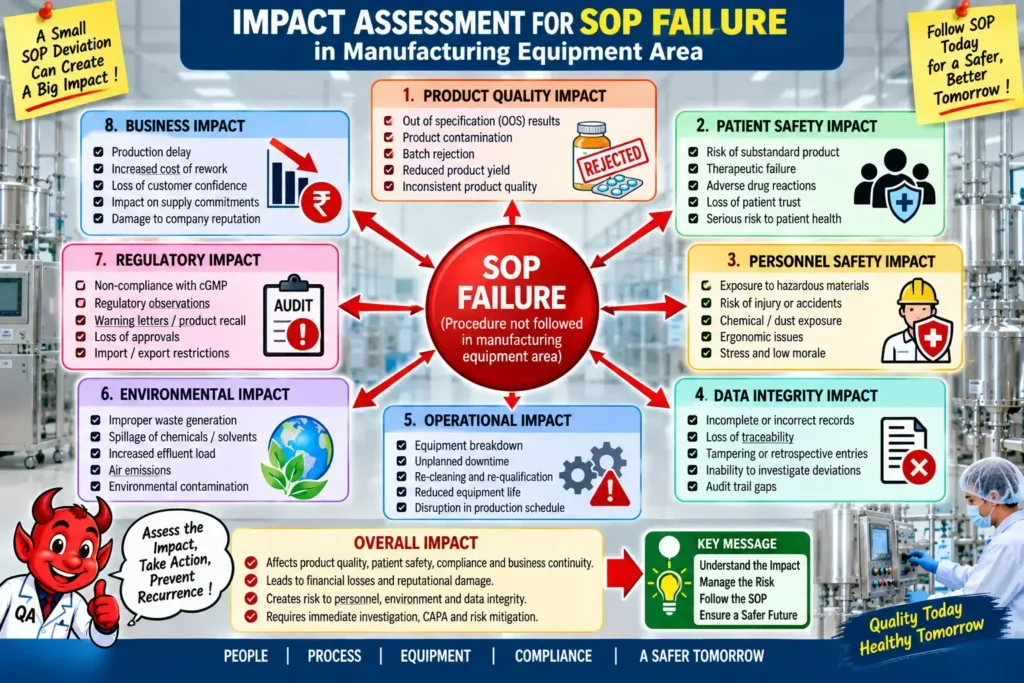
From an operational perspective, SOP failure may lead to equipment breakdown, unplanned downtime, re-cleaning, requalification, production delays, and increased cost. Incomplete or incorrect documentation may also cause loss of traceability and difficulties during deviation investigations. Regulatory consequences can include GMP observations, recalls, warning actions, and loss of regulatory confidence. The assessment helps determine the severity and significance of the failure, ensuring appropriate investigation, risk mitigation, CAPA, training, and monitoring are implemented. Overall, impact assessment supports timely decision-making and helps protect product quality, patient safety, personnel, equipment, compliance, and organizational reliability.
Questions & Answers – Risk Management and SOP Failure:
Q1. What is Quality Risk Management?
Answer: Quality Risk Management is a systematic process for the assessment, control, communication, and review of risks affecting the quality of a drug product throughout its lifecycle.
Q2. What are the main factors considered during risk assessment?
Answer: The major factors are Severity, Occurrence/Probability, and Detection, which help determine the significance of a potential failure.
Q3. What basic questions should be asked during risk assessment?
Answer: The assessment should consider: What might go wrong? What is the probability that it will go wrong? What are the consequences?
Q4. Who should participate in risk-management activities?
Answer: Personnel knowledgeable about the risk-management process, together with experts from the appropriate functional areas, should participate in the assessment.
Q5. What is risk identification?
Answer: Risk identification is the systematic use of available information to identify hazards, possible failures, and their potential consequences.
Q6. What is risk control?
Answer: Risk control involves making decisions to reduce or accept risks, with the objective of reducing risk to an acceptable level.
Q7. What should be done when a risk is above the acceptable level?
Answer: Risk-reduction measures should be implemented to reduce the severity and/or probability of harm or improve the ability to detect the hazard.
Q8. What is risk acceptance?
Answer: Risk acceptance is the decision to accept the remaining or residual risk after suitable risk-management measures have been applied.
Q9. Why should an SOP failure in the manufacturing equipment area be investigated?
Answer: An SOP failure may represent a potential failure mode or hazard. Investigation helps determine what went wrong, its probability, its consequences, and the controls required to prevent recurrence.
Q10. What should happen after risk-control actions are completed?
Answer: The risk assessment should be reviewed again after completion of defined actions, and the overall effect of those actions on the failure mode or risk should be reassessed.
Q11. What is the Risk Priority Number (RPN)?
Answer: RPN is calculated by multiplying Severity × Probability of Occurrence × Detection, i.e., RPN = SEV × PF × DET. It assists in prioritizing risks requiring additional action.
Q12. What should be done when a high RPN is identified?
Answer: High-risk failure modes require appropriate actions such as inspection, testing, monitoring, redesign, preventive maintenance, or process optimization, followed by reassessment of the risk.
Q13. Why is risk communication important?
Answer: Risk communication ensures that information about identified risks and their management is shared between decision-makers and other concerned personnel.
Q14. How can recurrence of an SOP failure be prevented?
Answer: The identified causes should be addressed through suitable controls, followed by documented implementation, effectiveness review, and reassessment of the remaining risk.
Reference Guidelines – Risk Management:
- ICH Q9 – Quality Risk Management
Provides principles and tools for systematic risk assessment, risk control, risk communication, and risk review throughout the pharmaceutical product lifecycle. - WHO Technical Report Series (TRS) No. 908
Provides WHO guidance related to Good Manufacturing Practices (GMP) and supports the implementation of quality systems and risk-based controls in pharmaceutical manufacturing.