







1. INTRODUCTION-SOP FOR ROUNDING OFF THE QUANTITY OF INGREDIENTS IN FORMULA/ANALYTICAL REPORTS
The SOP for Rounding Off the Quantity of Ingredients in the Formula / Analytical Reports establishes a standardized method for rounding numerical quantities used during pharmaceutical batch calculations and analytical reporting. Its purpose is to ensure that calculated ingredient quantities are recorded consistently and accurately during formulation activities. The SOP is applicable to all formulations and assigns responsibility for execution to personnel from Production, Warehouse, and Quality Assurance, with departmental management responsible for effective implementation. The procedure defines how quantities containing more than three decimal places should be rounded by considering the next digit. It also specifies requirements for balances having different least counts, rounding of solvents, active ingredients, and excipients, while ensuring that the final rounded quantities remain consistent with the theoretical batch quantity. The SOP further provides corresponding rounding principles for analytical reports, helping maintain uniformity, accuracy, traceability, and consistency in pharmaceutical calculations and documentation.
Skip to PDF content2. FLOW DIAGRAM-SOP FOR ROUNDING OFF THE QUANTITY OF INGREDIENTS IN FORMULA/ANALYTICAL REPORTS
The flow diagram presents a systematic approach for rounding off the quantity of ingredients in pharmaceutical formulas and analytical reports. The process begins with calculation of the required ingredient quantity for the batch. When a calculated value contains more than three decimal places, the fourth digit is evaluated. If the fourth digit is 5 or greater, the third digit is rounded upward; if it is less than 5, the third digit remains unchanged.
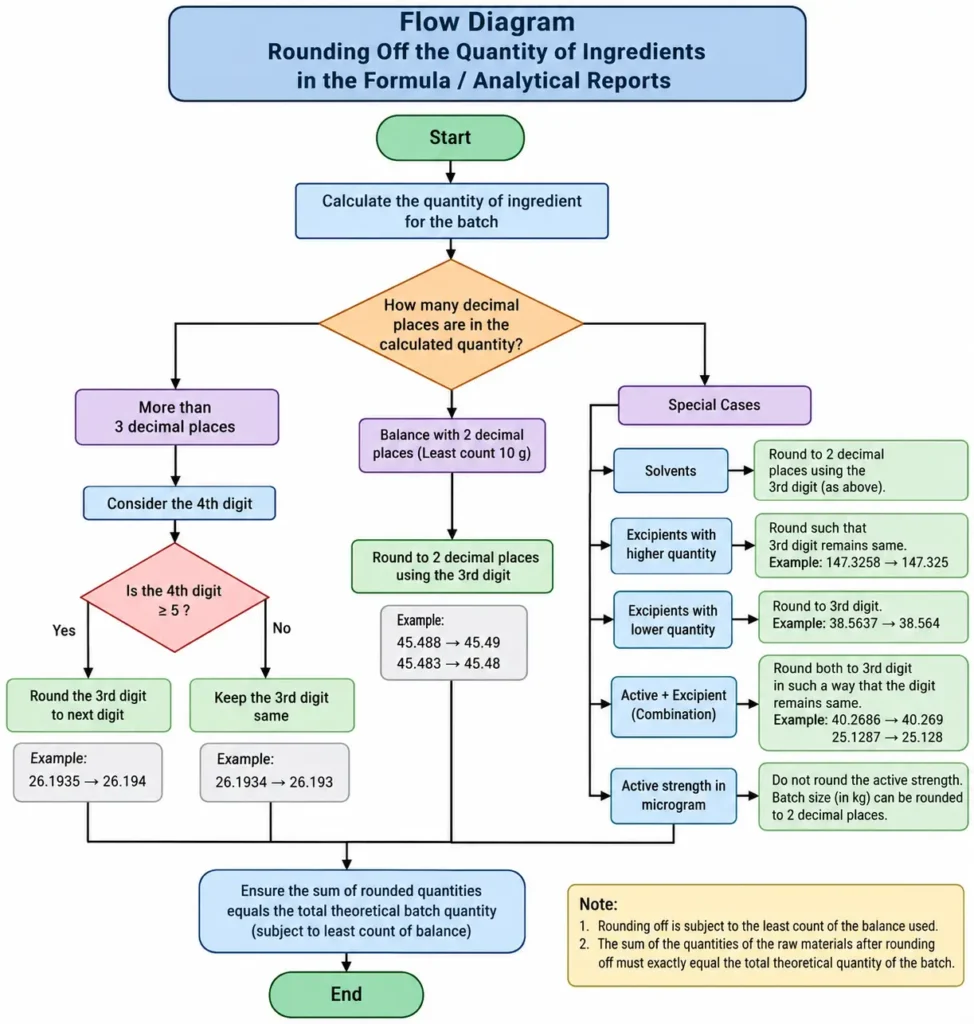
The diagram also covers special situations involving balances with a 10 g least count, solvents, excipients, combinations of active ingredients and excipients, and active strengths expressed in micrograms. Finally, the rounded quantities must be compatible with the least count of the balance, and the total of all rounded raw-material quantities should exactly match the theoretical batch quantity. This ensures consistency, accuracy, and standardized documentation of pharmaceutical calculations.
BENEFITS OF Following SOP-SOP FOR ROUNDING OFF THE QUANTITY OF INGREDIENTS IN FORMULA/ANALYTICAL REPORTS
Following the SOP for Rounding Off the Quantity of Ingredients in the Formula / Analytical Reports helps ensure that pharmaceutical calculations are performed in a uniform, accurate, and controlled manner. The SOP provides clear rules for rounding quantities based on decimal places and the least count of the balance, reducing the possibility of inconsistent calculations during batch preparation. Consistent application of the procedure supports correct handling of active ingredients, excipients, solvents, and analytical values. It also helps maintain the intended theoretical batch quantity by requiring that the total of rounded raw-material quantities exactly matches the calculated batch total.
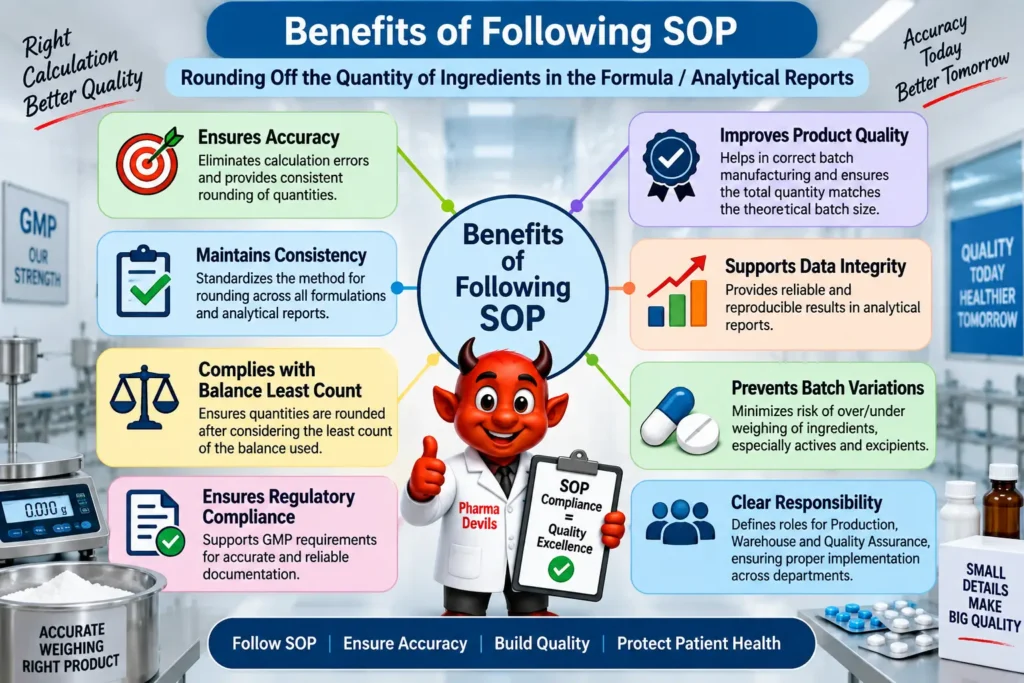
The SOP also establishes defined responsibilities for Production, Warehouse, and Quality Assurance personnel, supporting proper execution and implementation of the rounding procedure. Overall, following the SOP promotes calculation consistency, reliable documentation, better batch control, and standardized practices across formulation and analytical activities.
BRAINSTORMING FOR SOP FAILURE-SOP FOR ROUNDING OFF THE QUANTITY OF INGREDIENTS IN FORMULA/ANALYTICAL REPORTS
The brainstorming diagram identifies potential reasons why the SOP for Rounding Off the Quantity of Ingredients in the Formula / Analytical Reports may not be followed correctly in the manufacturing area. The sticky notes highlight possible failure factors such as inadequate personnel training, lack of SOP awareness, unclear understanding of rounding rules, confusion regarding the least count of balances, calculation errors, high workload, frequent personnel changes, and inconsistent interpretation between departments.
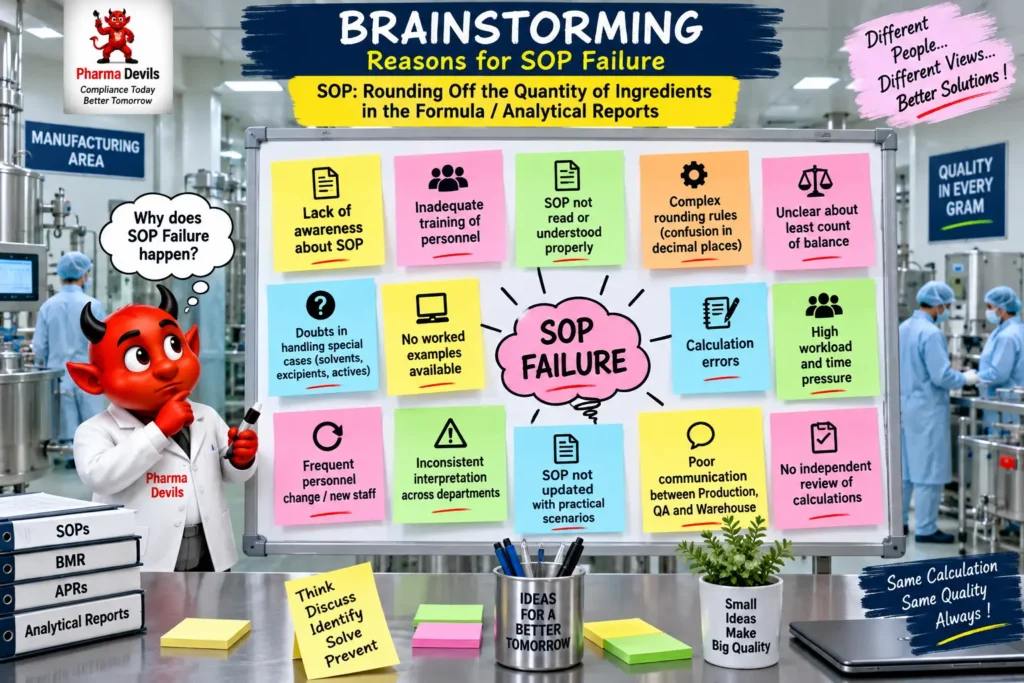
The diagram also highlights possible communication gaps between Production, Warehouse, and Quality Assurance, along with insufficient independent review of calculations and lack of practical worked examples. These are brainstorming considerations rather than causes explicitly listed in the SOP. The SOP itself assigns execution responsibilities to Production, Warehouse, and QA personnel and defines specific rounding requirements based on decimal places and balance precision. Overall, the brainstorming exercise helps teams identify weaknesses, discuss possible causes, and plan preventive improvements before they result in calculation or documentation errors.
5-WHY ANALYSIS FOR SOP FAILURE-SOP FOR ROUNDING OFF THE QUANTITY OF INGREDIENTS IN FORMULA/ANALYTICAL REPORTS
The 5-Why Analysis for SOP Failure identifies possible underlying reasons for incorrect application of the SOP for rounding off ingredient quantities in the manufacturing area. The observed problem is that personnel may not correctly follow the defined rounding procedure, leading to calculation or documentation errors. The analysis progresses from an immediate error in rounding calculations to deeper potential causes: incomplete understanding of rounding rules and special cases, inadequate practical training, weak communication among Production, Warehouse, and Quality Assurance, and absence of a robust system for periodic review and independent verification. These are investigative hypotheses shown in the diagram rather than causes stated in the SOP.
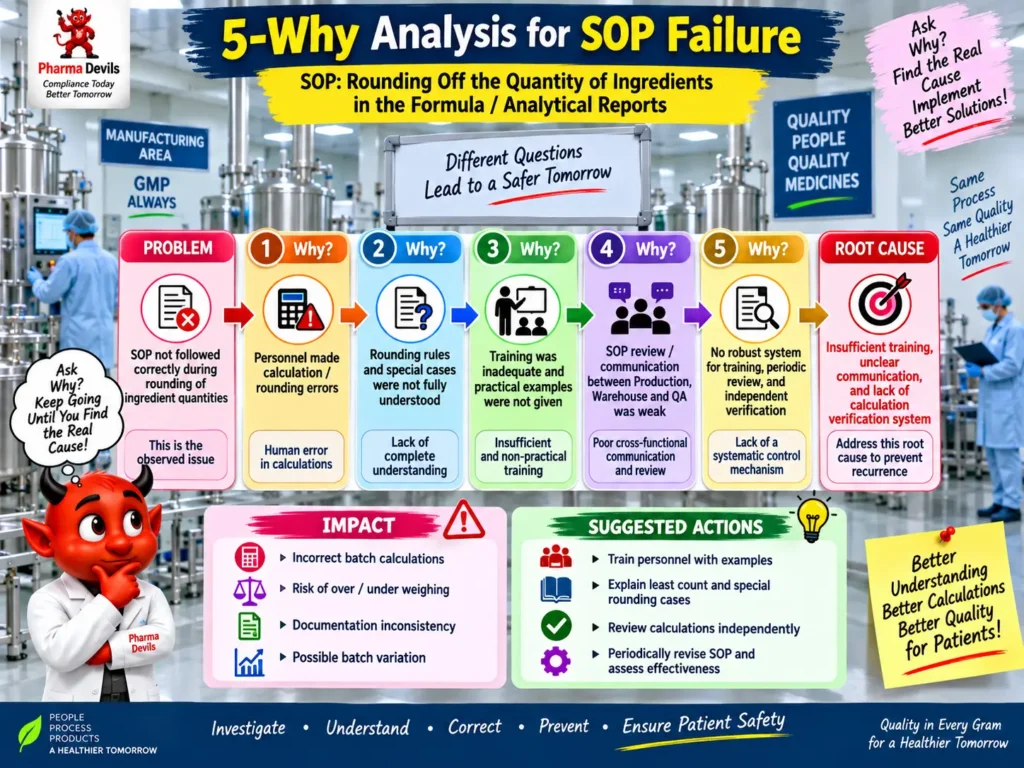
The SOP itself specifies rounding rules based on decimal positions, balance least count, and special handling of ingredients and solvents. It also assigns responsibility for execution and implementation to Production, Warehouse, and QA personnel. The analysis therefore supports targeted training, clearer communication, independent checking, and periodic effectiveness review.
FISHBONE ANALYSIS FOR SOP FAILURE-SOP FOR ROUNDING OFF THE QUANTITY OF INGREDIENTS IN FORMULA/ANALYTICAL REPORTS
The Fishbone Analysis for SOP Failure presents a structured investigation of potential causes that may lead to incorrect or inconsistent rounding of ingredient quantities in the manufacturing area. The causes are grouped under six major categories: People, Process, Equipment, Materials, Environment, and Management. Under People, possible causes include inadequate training, lack of SOP awareness, high workload, frequent personnel changes, and human calculation errors. Process factors include poor understanding of the SOP, lack of practical examples, inadequate review of calculations, and deviation from the defined rounding procedure. Equipment factors focus mainly on balance least count, different balance precision, calibration status, and display limitations. These areas are particularly relevant because the SOP states that rounding is subject to the least count of the balance used.
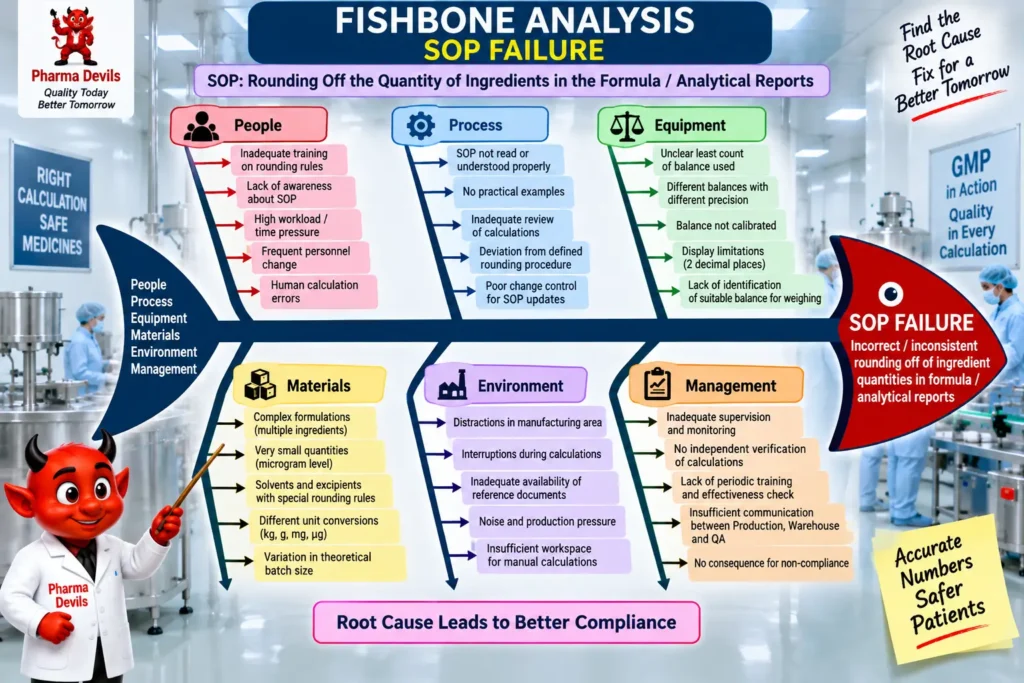
The Materials branch considers complex formulations, small quantities, solvents, and excipients requiring specific rounding approaches, while Environment and Management cover distractions, production pressure, insufficient supervision, weak communication, and lack of independent verification. The SOP itself defines specific rounding rules for solvents, active ingredients, and excipients and requires the total rounded quantities to equal the theoretical batch quantity. The fishbone causes are investigative possibilities rather than causes explicitly stated in the SOP.
FAULT TREE ANALYSIS FOR SOP FAILURE-SOP FOR ROUNDING OFF THE QUANTITY OF INGREDIENTS IN FORMULA/ANALYTICAL REPORTS
The Fault Tree Analysis for SOP Failure identifies the major pathways that can lead to incorrect or inconsistent rounding of ingredient quantities in pharmaceutical manufacturing and analytical documentation. The top event is failure to correctly apply the SOP for rounding quantities in the formula or analytical reports. The diagram groups possible contributing causes into four main branches: Personnel Failure, Procedure Failure, Equipment/Balance Failure, and System/Management Failure. Personnel-related causes include inadequate training, lack of SOP awareness, human calculation errors, and confusion in special cases. Procedure-related causes include incomplete understanding of the SOP, lack of practical examples, improper handling of solvents, excipients, and microgram-level strengths, and insufficient independent review.
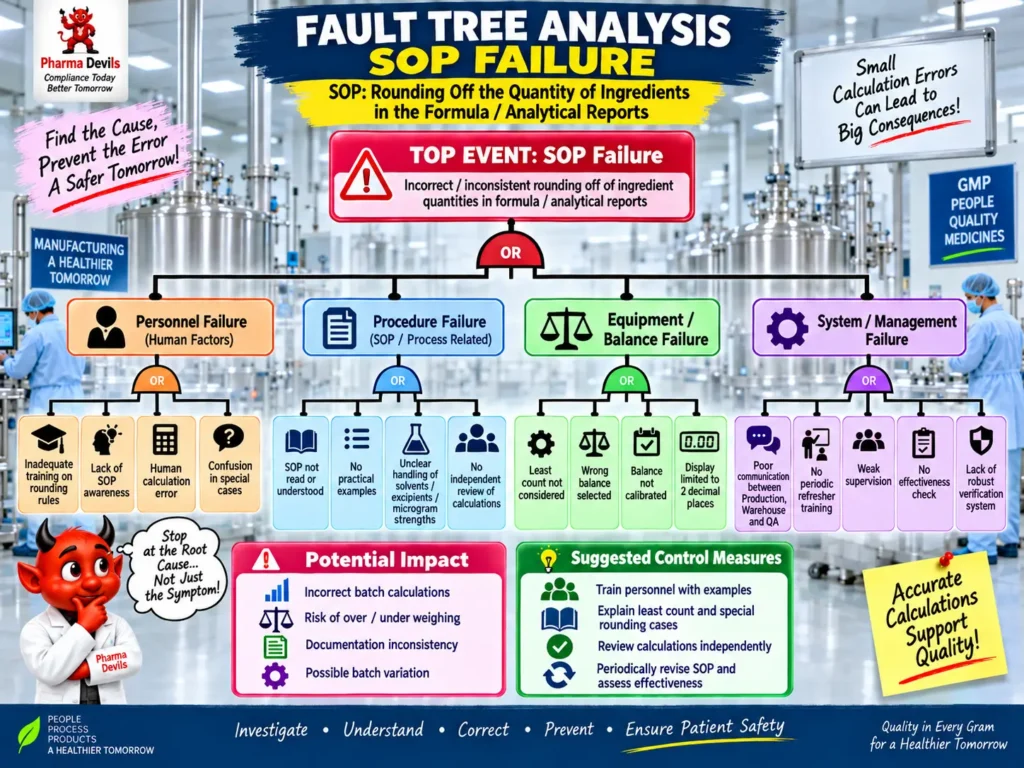
Equipment-related causes focus on inappropriate balance selection, calibration issues, display limitations, and failure to consider the balance least count. This is especially relevant because the SOP states that rounding is subject to the least count of the balance used. System and management causes include weak supervision, inadequate refresher training, poor interdepartmental communication, and insufficient verification controls. The diagram helps identify potential root causes and supports targeted corrective and preventive actions to improve calculation accuracy and SOP compliance.
IMPACT ASSESSMENT-SOP FOR ROUNDING OFF THE QUANTITY OF INGREDIENTS IN FORMULA/ANALYTICAL REPORTS
The Impact Assessment for SOP Failure illustrates the potential consequences of incorrect or inconsistent rounding of ingredient quantities during pharmaceutical manufacturing and analytical reporting. The diagram evaluates impacts across product quality, patient safety, regulatory compliance, financial performance, operations, data integrity, reputation, personnel, and the environment. Failure to apply the defined rounding rules may contribute to inaccurate ingredient quantities, inconsistent calculations, documentation discrepancies, additional investigation, rework, or batch-related concerns. The SOP specifically requires rounding according to defined decimal rules and the least count of the balance, while ensuring that the total rounded raw-material quantity remains equal to the theoretical batch quantity.
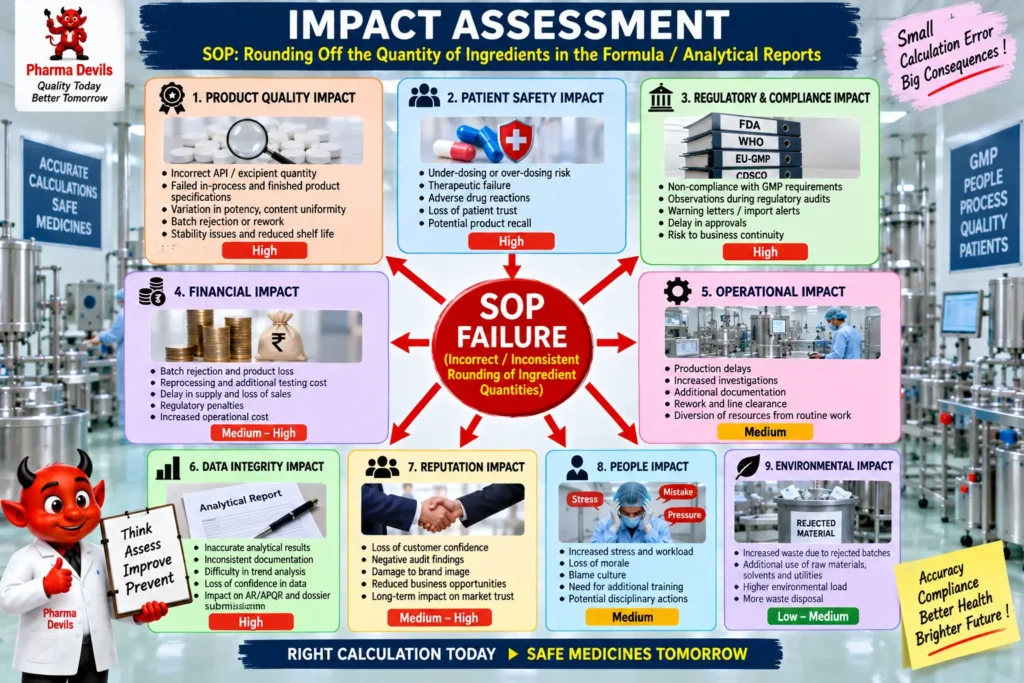
The SOP also provides specific requirements for analytical-report rounding, supporting consistency in reported numerical results. The wider quality, regulatory, financial, and operational effects shown in the diagram are risk-assessment considerations, not impacts explicitly stated in the SOP. Overall, the assessment emphasizes that accurate rounding supports reliable calculations, consistent documentation, and controlled pharmaceutical operations.
QUESTION & ANSWER-SOP FOR ROUNDING OFF THE QUANTITY OF INGREDIENTS IN FORMULA/ANALYTICAL REPORTS
Q1. What is the objective of this SOP?
The objective is to provide a standardized guideline for rounding off ingredient quantities calculated for a pharmaceutical batch.
Q2. What is the scope of the SOP?
The SOP is applicable to all formulations.
Q3. Who is responsible for execution of this SOP?
Chemist/Officer from Production, Warehouse, and Quality Assurance are responsible for execution of the SOP.
Q4. Who is responsible for effective implementation of the SOP?
The SOP assigns implementation responsibility to Sr. Manager–Production, Store Head, Asst. Manager–QA, and Head–QA/QC.
Q5. How is a quantity rounded when it has more than three digits after the decimal?
The quantity is rounded to the third decimal place by considering the fourth digit.
Q6. What happens when the fourth decimal digit is 5 or greater?
The third decimal digit is increased to the next value. For example, 26.1935 kg becomes 26.194 kg.
Q7. What happens when the fourth decimal digit is less than 5?
The third decimal digit remains unchanged. For example, 26.1934 kg becomes 26.193 kg.
Q8. How should quantities be rounded when a balance displays two decimal places with a least count of 10 g?
The value is rounded to two decimal places by considering the third decimal digit. For example, 45.488 kg becomes 45.49 kg, while 45.483 kg becomes 45.48 kg.
Q9. How are solvent quantities rounded?
Solvent quantities are rounded to two decimal places by considering the third decimal digit.
Q10. What special consideration applies when rounding excipients of different quantities?
For excipients, the SOP provides specific rounding instructions so that the higher-quantity excipient may retain the third digit while the lower quantity is rounded accordingly. The example given is 147.3258 kg → 147.325 kg and 38.5637 kg → 38.564 kg.
Q11. How are an active ingredient and an excipient rounded when calculated together?
The active ingredient is rounded to the third decimal place, while the excipient is rounded in a manner described in the SOP to maintain the required calculation balance. The SOP example is 40.2686 kg → 40.269 kg for Paracetamol and 25.1287 kg → 25.128 kg for Starch.
Q12. What is the most important balance-related requirement?
Rounding must always be performed considering the least count of the balance used.
Q13. What should be checked after rounding all raw-material quantities?
The sum of the rounded raw-material quantities should exactly equal the total theoretical quantity of the batch.
Q14. What is the requirement when the active strength is in micrograms?
When active strength is in micrograms, the SOP states that rounding off is not performed for the active strength, while the batch size in kilograms may be rounded to two decimal places.
Q15. How are values rounded in analytical reports?
For analytical reports, the same principle is applied: if the fourth digit is 5 or more, the third digit is increased; if it is below 5, the third digit remains unchanged.
Q16. What reference is mentioned in the SOP?
The reference stated in the SOP is In House.
REFERENCE GUIDELINE-SOP FOR ROUNDING OFF THE QUANTITY OF INGREDIENTS IN FORMULA/ANALYTICAL REPORTS
Supporting internal documents, where applicable: approved Master Formula/BMR, balance calibration and usage SOP, analytical data-recording procedure, and Good Documentation Practices procedure. These supporting references are suggestions and are not explicitly listed in the uploaded SOP.