







1. INTRODUCTION-SOP FOR SIGNATURE AUTHORIZATION:
Signature authorization is an important part of pharmaceutical documentation control because it provides clear identification and traceability of personnel who sign GMP-related records. This SOP establishes the requirements for maintaining authorized specimen signatures for personnel involved in manufacturing, warehousing, dispensing, production, packaging, quality control, quality assurance, and maintenance activities. Under the procedure, each employee is required to provide both a full signature and a short or initial signature in the Specimen Signature List. These signatures serve as documentary evidence when personnel sign master or controlled documents and help trace completed activities and records back to the responsible employee. Employees are expected to use their approved specimen signatures consistently. Any change in signature must be communicated to the Quality Assurance department for prior approval. Records must also be appropriately updated when an employee joins, resigns, transfers, or changes location. The specimen signature list maintained as Annexure-I therefore supports reliable personnel identification, document traceability, and controlled pharmaceutical documentation practices.
Skip to PDF content2. Flow Diagram:
The flow diagram explains the Signature Authorization process used to maintain proper identification and traceability of employees signing pharmaceutical documents. The process begins when an employee enters their full signature and short/initial signature in the Specimen Signature List. These approved signatures provide documentary evidence of who has signed controlled or master documents and help trace activities back to the responsible employee.
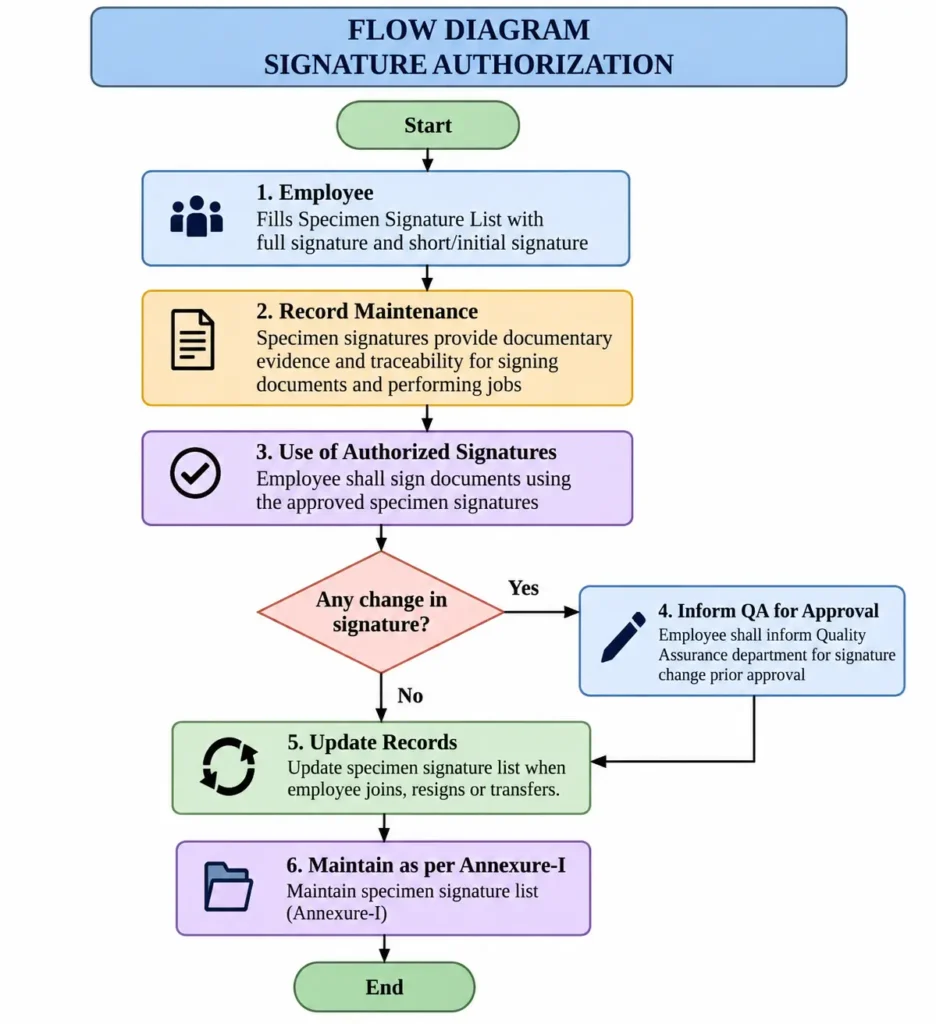
Employees are required to use the authorized specimen signature consistently while signing documents. If an employee intends to change their signature, the Quality Assurance department must be informed and prior approval obtained. The signature record is also updated whenever an employee joins, resigns, or transfers to another location. Finally, the specimen signature details are maintained in Annexure-I, which records the employee’s name, designation, initial signature, full signature, and remarks, supporting effective document control and traceability.
3. Benefits of Following the SOP:
Following the Signature Authorization SOP helps ensure that signatures used in pharmaceutical documentation are controlled, identifiable, and traceable to the responsible employee. The SOP requires employees to provide approved full and short/initial signatures in the specimen signature list, allowing signed records to be linked to the correct person.
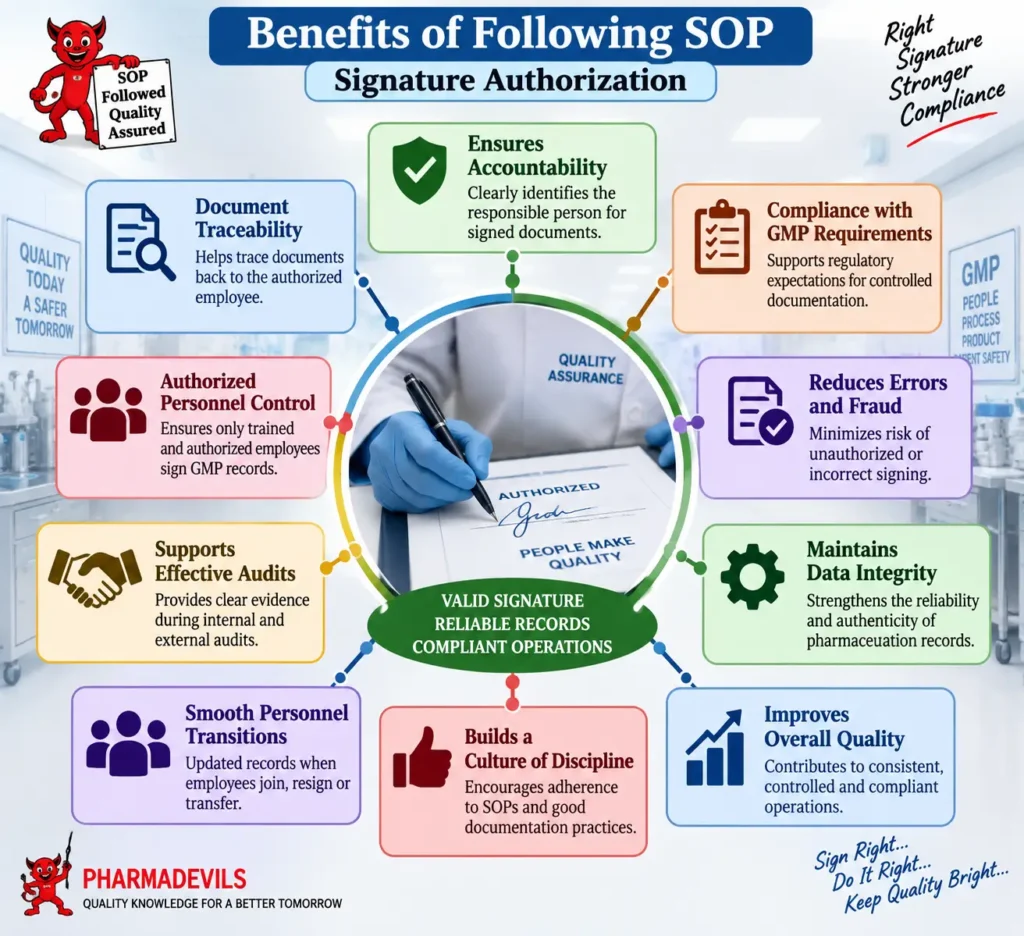
The main benefits include improved document traceability, accountability, authorized personnel control, consistency in signatures, and stronger documentation practices. Employees are expected to use the approved specimen signature without unauthorized changes, and any signature change must be communicated to Quality Assurance for prior approval. The SOP also supports effective record maintenance when an employee joins, resigns, or transfers. Maintaining these details in the Specimen Signature List (Annexure-I) provides a reliable reference for reviewing signed documents and identifying the person responsible for an activity.
4. Brainstorming for SOP Failure:
The brainstorming diagram illustrates the possible reasons for SOP failure in a pharmaceutical manufacturing area. At the center, “SOP Failure” represents the main problem, while surrounding sticky notes show potential contributing causes. These include lack of training, SOP not available at the workstation, unclear or difficult SOP language, high production pressure, frequent manpower changes, inadequate supervision, poor communication between shifts, lack of accountability, outdated documents, insufficient GMP awareness, and absence of periodic SOP review.
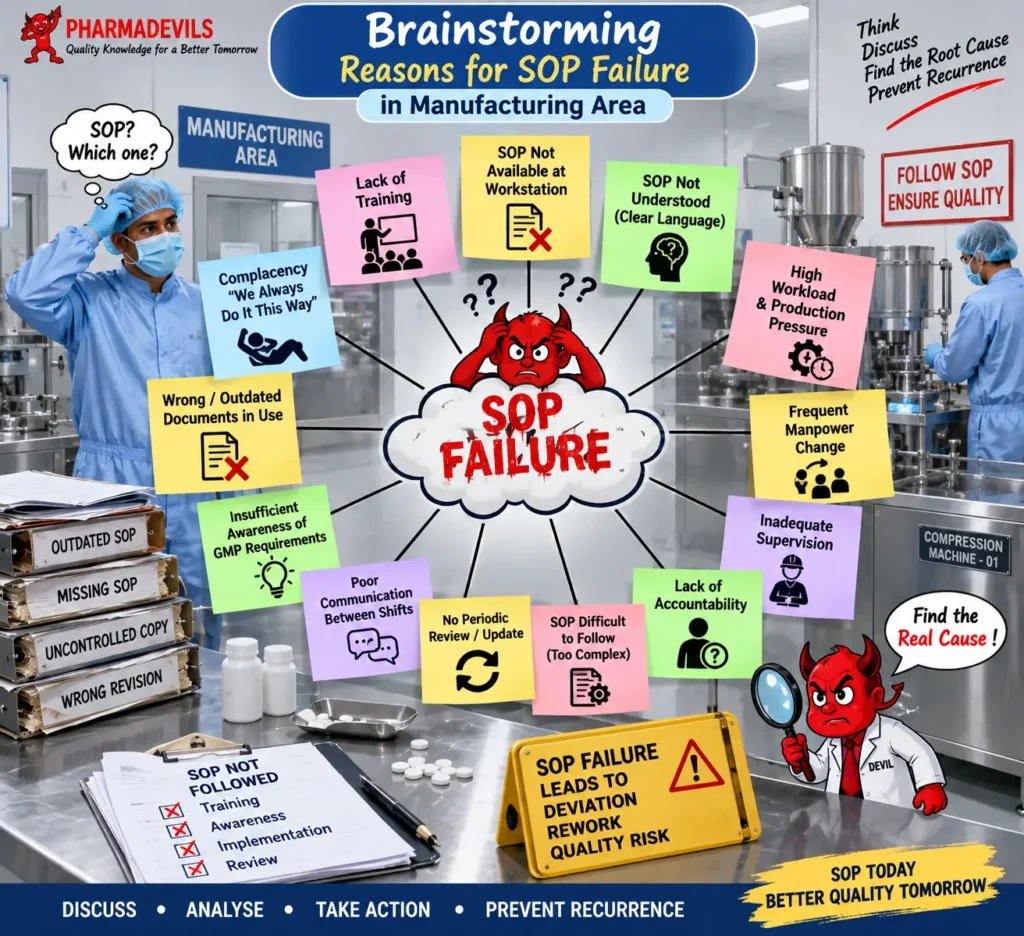
The manufacturing-area background highlights how such failures can occur during routine production activities. The image also emphasizes that complacency and using uncontrolled or incorrect SOP copies may increase the risk of deviations. The overall brainstorming approach encourages the investigation team to collect ideas from operators, supervisors, QA personnel, and other concerned departments before selecting the actual root cause. This supports systematic investigation, corrective action, preventive action, and reduction of repeat SOP failures.
5. 5-Why Analysis for SOP Failure:
The 5-Why Analysis identifies the underlying reasons for failure to follow the Signature Authorization SOP. The investigation begins with a document being signed by an unauthorized person. Further questioning shows that the specimen signature list was not verified before signing, employees were not fully aware of the latest authorized signatory list, and updated information was not readily available at the workplace. The analysis ultimately identifies the root cause as an ineffective system for timely updating, communicating, distributing, and periodically reviewing the specimen signature list.
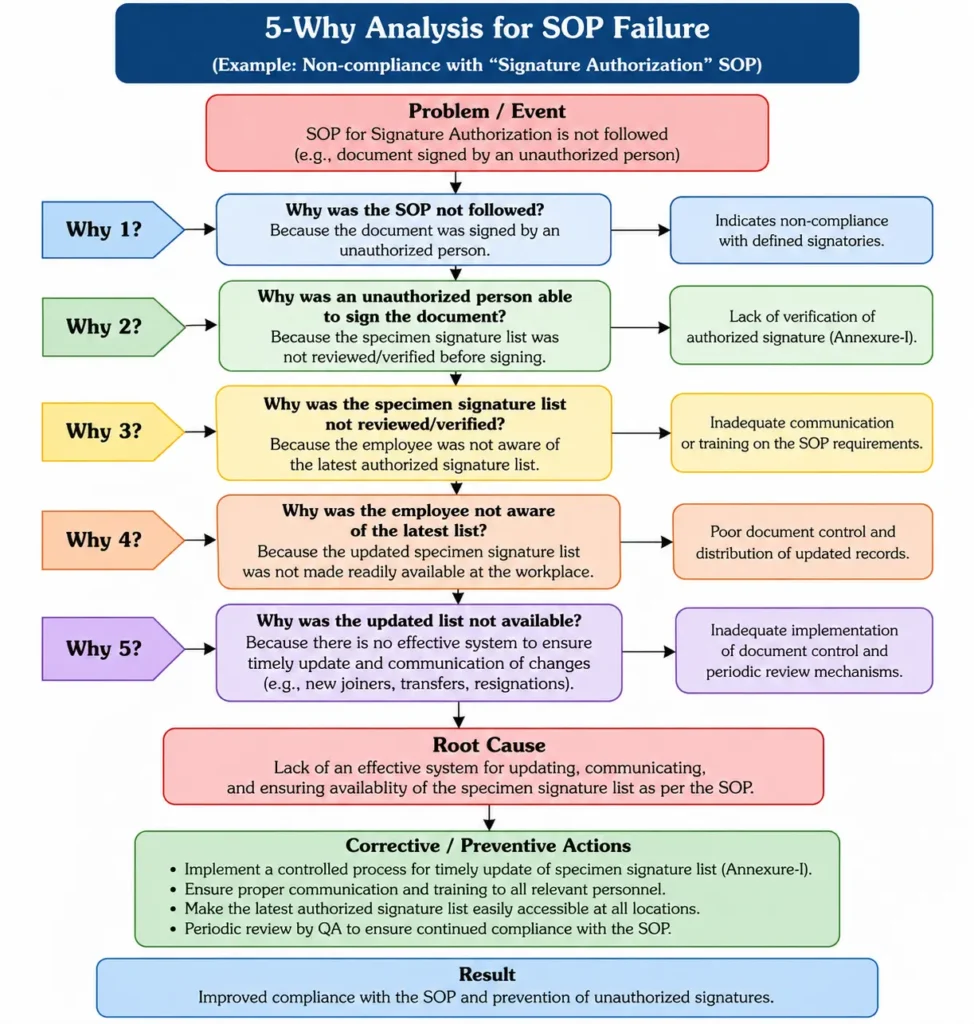
The SOP requires employees to maintain approved specimen signatures to ensure document traceability and requires changes in signatures to be communicated to Quality Assurance for prior approval. Corrective actions include controlled updating of the list, employee training, easy access to current records, and periodic QA review to prevent unauthorized signatures and improve GMP documentation compliance.
6. Fishbone Analysis for SOP Failure:
The fishbone diagram identifies possible root causes of SOP failure in a pharmaceutical manufacturing area by organizing them into six major categories: Man, Method, Machine, Material, Measurement, and Environment. Under Man, causes include inadequate SOP training, lack of accountability, manpower changes, and poor supervision. Method-related causes include SOPs not being available at the workstation, difficult language, poor understanding, and lack of periodic review. Machine factors include equipment breakdowns, distractions, poor maintenance, and inadequate line-clearance support.
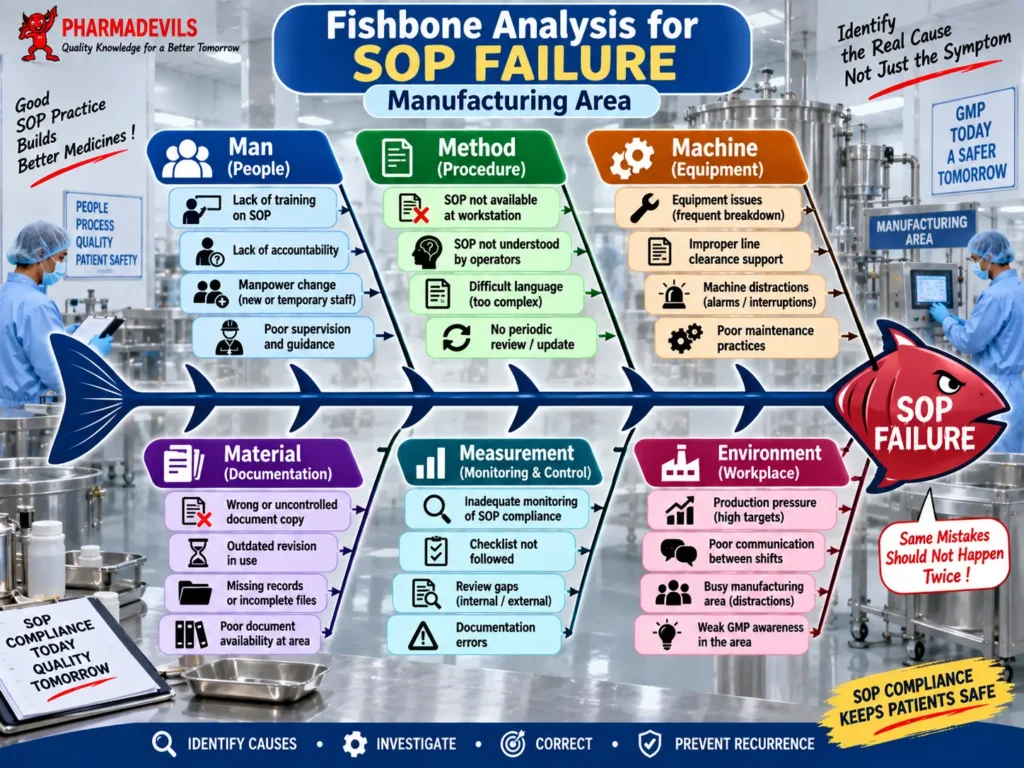
Material/Documentation issues include uncontrolled copies, outdated revisions, missing records, and poor document availability. Measurement factors include weak monitoring, incomplete checklists, review gaps, and documentation errors. Environmental causes include production pressure, poor shift communication, workplace distractions, and weak GMP awareness. The analysis helps investigation teams systematically identify contributing factors, determine the actual root cause, implement suitable CAPA, and prevent recurrence of SOP failures.
7. Fault Tree Analysis for SOP Failure:
The Fault Tree Analysis diagram explains how SOP failure in a pharmaceutical manufacturing area can result from several interconnected causes. The main event, “SOP Failure – SOP not followed/not implemented,” is linked through logical OR and AND gates to major contributing events such as SOP not being available or accessible, SOP not being properly understood by personnel, and SOP not being followed during operations.
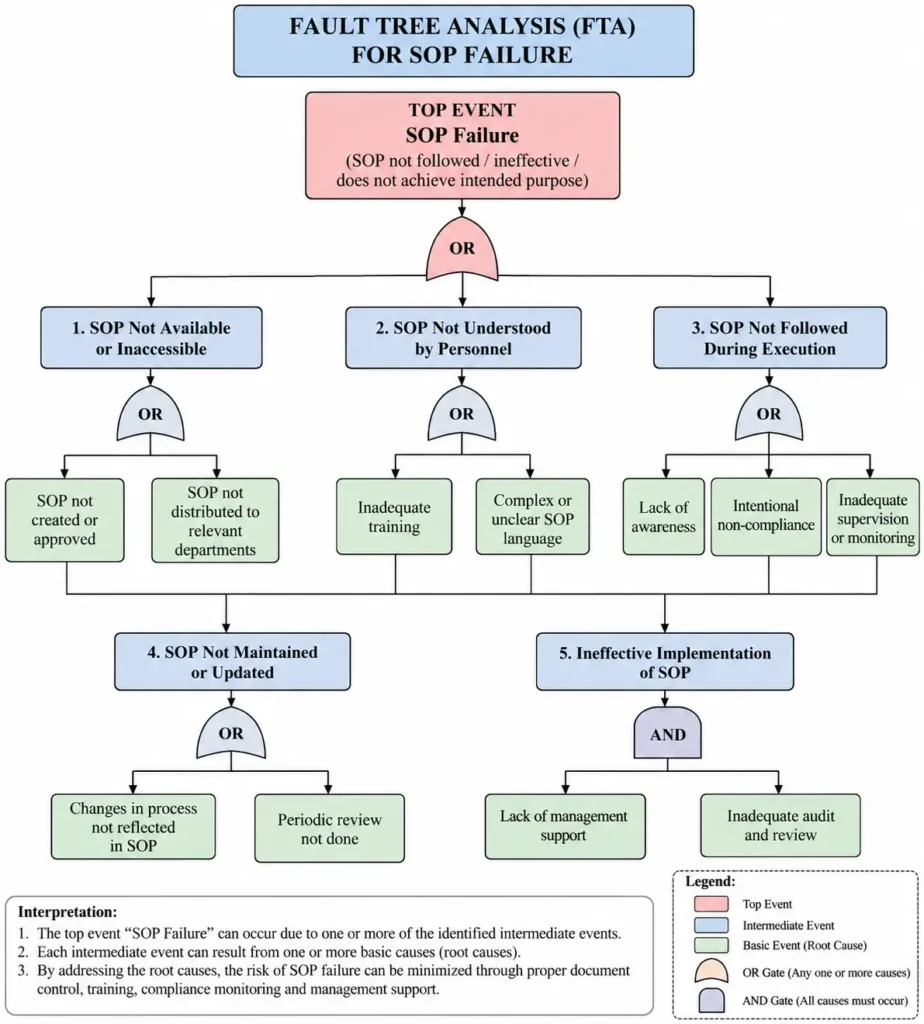
The underlying root causes include inadequate training, complex SOP language, lack of GMP awareness, high production pressure, insufficient supervision, lack of accountability, outdated or uncontrolled SOP copies, poor communication between shifts, equipment-related distractions, weak monitoring, incomplete checklists, and poor workplace conditions. The diagram also highlights possible consequences such as product quality risk, regulatory non-compliance, deviations, investigations, batch rejection or recall, and increased audit observations. It supports systematic root-cause identification and helps develop effective CAPA to prevent recurrence.
8. Impact Assessment:
The impact assessment evaluates the consequences of failure to follow the Signature Authorization SOP. The SOP requires employees to use approved specimen signatures and maintains these records to provide traceability of documents signed by each employee. If an unauthorized person signs a GMP document, the reliability and authenticity of the record may become questionable. The main potential impacts include loss of traceability, data integrity concerns, weak accountability, and non-compliance with approved documentation practices.
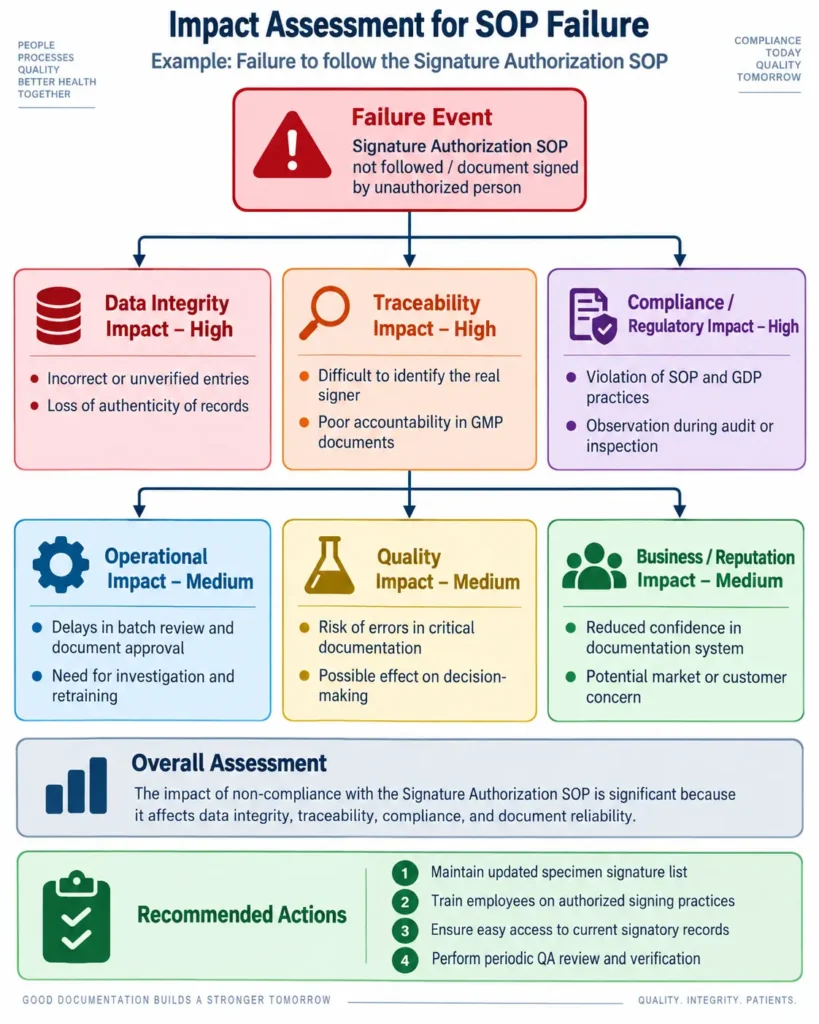
Such a failure may also lead to delays in document review, additional investigation, retraining, and corrective actions. During audits or inspections, unauthorized signatures may result in observations because the organization may be unable to demonstrate that activities were performed, checked, or approved by appropriately authorized personnel. Overall, the impact can be considered significant for documentation control. Maintaining an updated specimen signature list, ensuring employee awareness, and performing periodic QA verification can reduce the risk of recurrence.
Questions & Answers:
- What is the main SOP failure identified in the analysis?
The Signature Authorization SOP was not followed, resulting in a document being signed by an unauthorized person. - Why was an unauthorized person able to sign the document?
Because the specimen signature list was not reviewed or verified before signing. - Why was the specimen signature list not verified?
The employee was not aware of the latest authorized signature list. - Why was the employee unaware of the latest list?
The updated specimen signature list was not readily available at the workplace. - Why was the updated list not available?
There was no effective system for timely updating, communicating, and distributing changes in authorized personnel. - What is the root cause identified by the 5-Why analysis?
Ineffective control over updating, communication, availability, and periodic review of the specimen signature list. - What document-control weakness contributed to the failure?
Poor distribution and control of updated authorized-signature records. - How can this SOP failure affect traceability?
It may become difficult to confirm who actually performed, reviewed, or approved a documented activity. - What corrective action should be implemented?
The specimen signature list should be updated promptly through a controlled process and made available at relevant locations. - What preventive action is required?
Employees should be trained on signature-authorization requirements and informed whenever authorized signatories change. - What is QA’s role in preventing recurrence?
QA should periodically review the authorized signature list, verify its availability, and check compliance during document review. - How can CAPA effectiveness be verified?
Effectiveness can be checked by reviewing recent GMP documents, confirming that only authorized personnel have signed them, and ensuring no recurrence of unauthorized signatures. - Why is periodic review of the specimen signature list important?
It ensures that new joiners, transfers, resignations, and signature changes are reflected in the current controlled record. - What is the expected result after implementing the CAPA?
Improved SOP compliance, better document traceability, stronger data integrity, and prevention of unauthorized signatures.
Reference Guidelines – Signature Authorization SOP:
- Revised Schedule M, Drugs Rules, 1945 – India (G.S.R. 922(E), 28 December 2023)
Covers pharmaceutical quality systems, documentation, authorized personnel, responsibilities, and controlled GMP records. (CDSCO)
CDSCO Revised Schedule M - EU GMP – EudraLex Volume 4, Chapter 4: Documentation
Provides requirements for generation, control, approval, recording, traceability, and signatures in GMP documentation. (Public Health)
EU GMP Chapter 4 – Documentation - WHO Technical Report Series No. 996, Annex 5 – Good Data and Record Management Practices
Supports attributable, traceable, accurate, and controlled GMP records and is relevant to identification of personnel making or approving entries. (WHO Extranet)
WHO TRS 996 - Drugs and Cosmetics Rules, 1945 – Documentation and Records
Requires GMP documents to be approved, signed and dated by appropriate authorized persons and records to provide traceability of significant manufacturing activities. (CDSCO)