







1. Brief Description:
This SOP for SOP defines the system for preparation, review, approval, training, distribution, implementation, revision, control, retrieval, discontinuation, and destruction of SOPs used in the pharmaceutical plant. Its purpose is to ensure that all activities are performed in a consistent, controlled, safe, and cGMP-compliant manner. The originating department is responsible for drafting and technically reviewing the SOP, while Quality Assurance reviews it for regulatory and cGMP compliance and controls the approved master copy. The SOP also describes requirements for document formatting, numbering, departmental codes, effective dates, review dates, revision history, and controlled-copy management. Training must be provided to concerned personnel before implementation, and records must be maintained. Superseded copies are retrieved and destroyed, while obsolete master copies are archived appropriately. SOPs are reviewed within 24 months or earlier when changes, deviations, audits, complaints, or regulatory requirements demand revision.
Skip to PDF content2. Flow Diagram:
The flow diagram explains the complete life cycle of a Standard Operating Procedure (SOP) in a simple step-by-step manner. The process starts when the originating department identifies the need for a new SOP or revision and prepares the draft. The department head reviews the draft for technical accuracy, procedural correctness, and cGMP compliance. After departmental acceptance, Quality Assurance reviews the SOP for regulatory and cGMP requirements and forwards it for final approval by Head-QA.
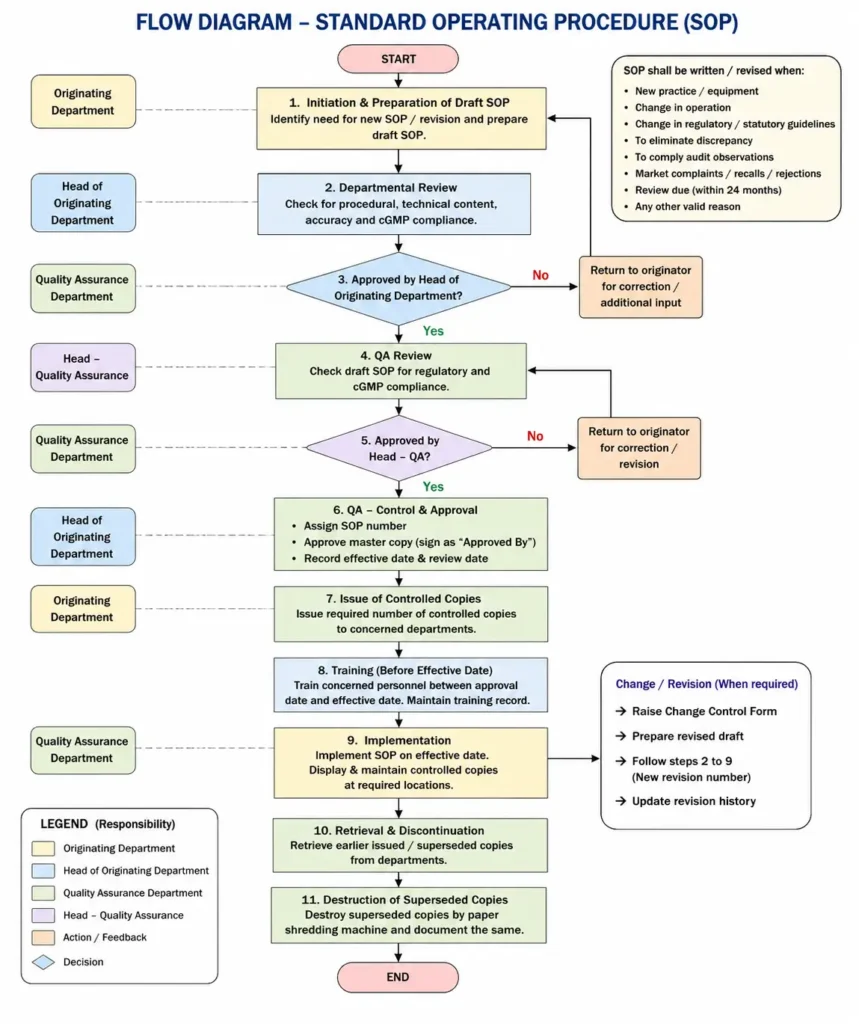
After approval, QA controls the master copy, issues controlled copies, and ensures concerned personnel are trained before the effective date. The SOP is then implemented and maintained at required locations. Superseded copies are retrieved, documented, and destroyed. When changes are required, the SOP enters the revision process, receives a new revision number, and follows the review and approval cycle again.
3. Brainstorming:
Brainstorming is used to identify all possible reasons why an SOP may fail or may not be followed correctly during routine work. The team discusses potential causes without immediately judging them and groups the ideas into key areas such as People, Process, Equipment/Material, Environment, Management, and Documentation.
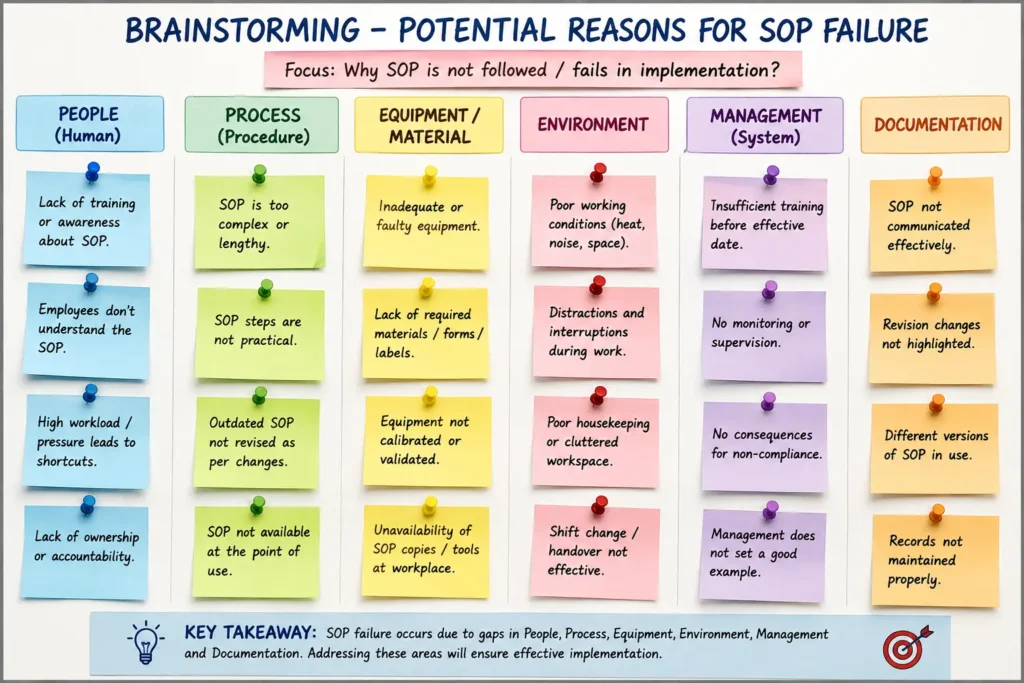
Common causes may include inadequate training, poor understanding of the SOP, excessive workload, complicated procedures, outdated instructions, unavailable SOP copies, faulty equipment, missing materials, workplace distractions, weak supervision, poor communication, use of different SOP versions, and incomplete records. The purpose of brainstorming is to collect different viewpoints from employees and quickly identify possible gaps in the SOP system. These ideas can then be evaluated using investigation tools such as 5-Why Analysis, Fishbone Diagram, FMEA, or Fault Tree Analysis to determine the actual root cause and implement suitable corrective and preventive actions.
4. 5-Why Analysis:
The 5-Why Analysis is used to identify the root cause of failure in the SOP for SOP system by repeatedly asking “Why?” until the underlying reason is found. The analysis begins with the problem that the approved SOP was not followed or implemented correctly. It then examines possible reasons such as inadequate training, use of incorrect or outdated controlled copies, poor coordination of SOP distribution and retrieval, insufficient monitoring of training and revision status, and weak enforcement of responsibilities.
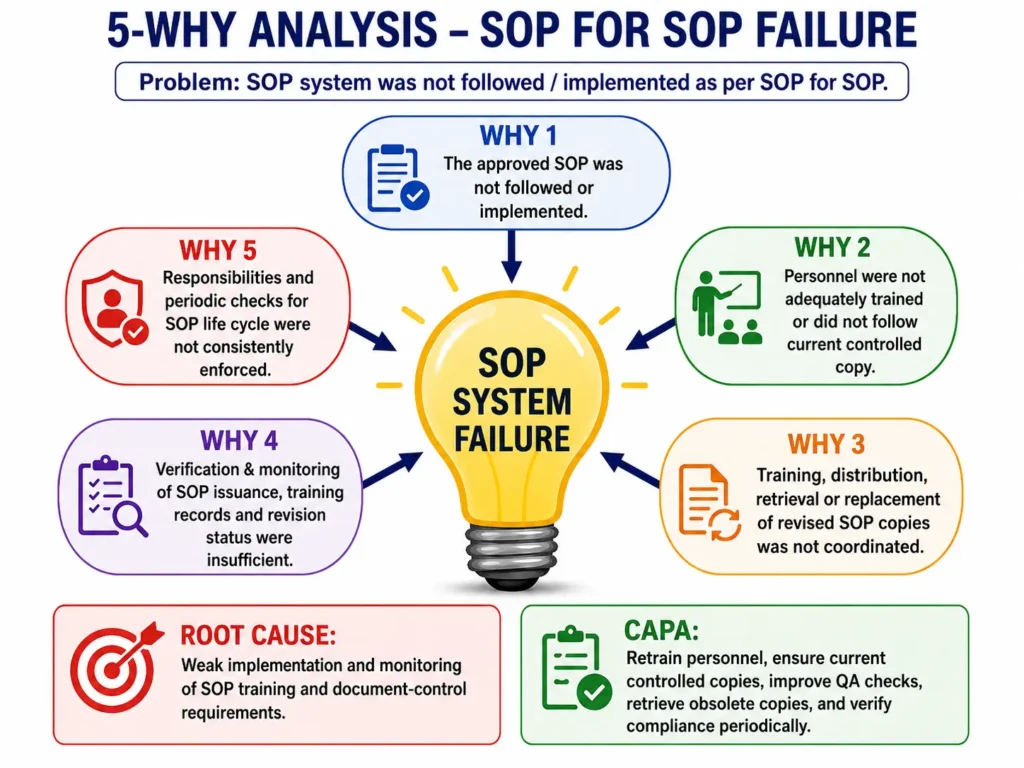
The SOP requires concerned personnel to be trained before the effective date and requires QA to control master and controlled copies. Superseded copies must also be retrieved and destroyed when revised SOPs become effective. The likely root cause is weak implementation and monitoring of SOP training and document-control requirements. Appropriate CAPA includes retraining personnel, strengthening QA checks, removing obsolete copies, and performing periodic compliance verification.
5. Fishbone Diagram:
The Fishbone Diagram (Ishikawa Diagram) is used to systematically identify possible causes of failure in the SOP for SOP system. The problem is placed at the head of the fish, while potential causes are grouped into major categories such as People, Method/Process, Documentation, Management, Equipment/Resources, and Environment.
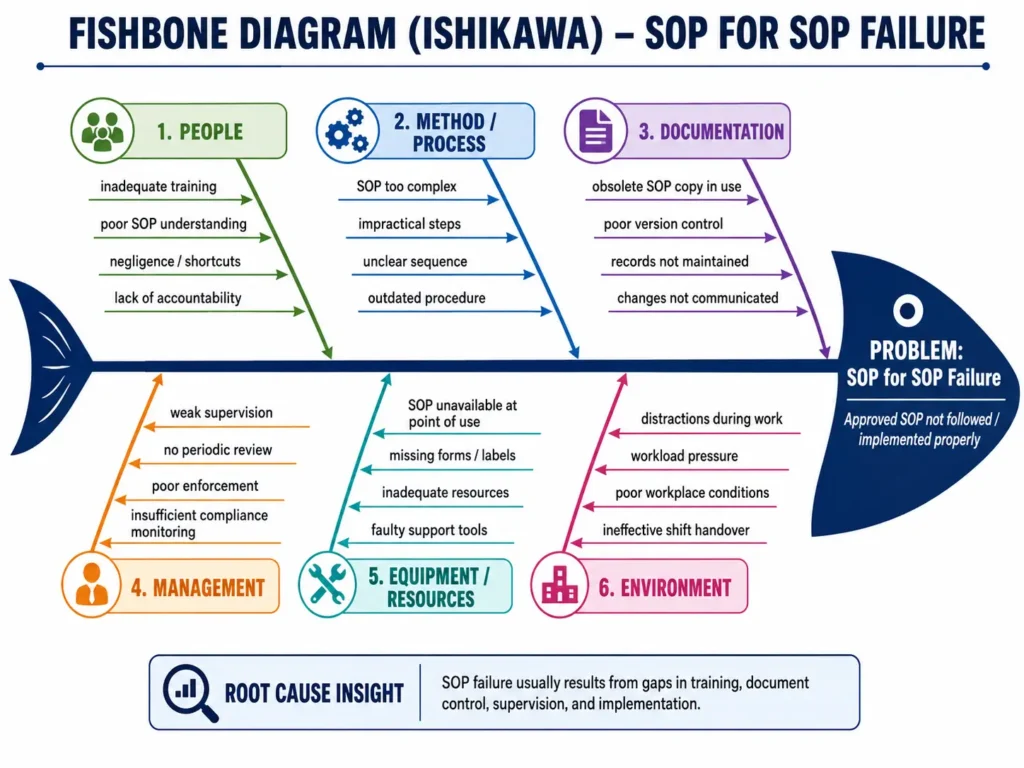
Typical causes include inadequate training, poor understanding of the SOP, complex or outdated procedures, use of obsolete SOP copies, poor version control, incomplete records, weak supervision, lack of periodic review, unavailable forms or SOP copies, workload pressure, distractions, and poor workplace conditions. This diagram helps the investigation team organize different possible causes in a structured manner and ensures that no important area is missed. After reviewing all branches, the most likely causes can be further investigated using tools such as 5-Why Analysis or FMEA. The key focus is to identify the actual root cause and implement suitable corrective and preventive actions.
6. Fault Tree Analysis (FTA):
Fault Tree Analysis (FTA) is a structured method used to identify the possible causes that can lead to failure of the SOP for SOP system. The analysis starts with the top event, such as the approved SOP not being followed or implemented properly, and then breaks the problem into different contributing branches.
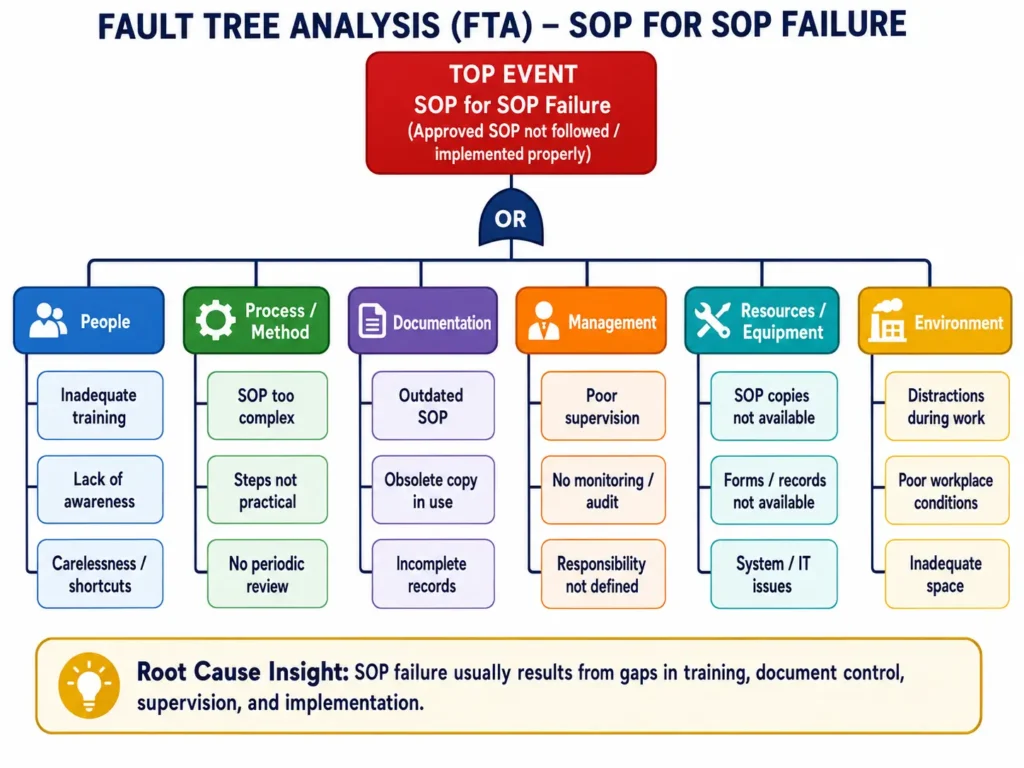
The main cause categories may include People, Process/Method, Documentation, Management, Resources/Equipment, and Environment. Possible causes include inadequate training, lack of awareness, complex SOP steps, outdated or obsolete SOP copies, incomplete records, poor supervision, lack of monitoring, unavailable SOP copies or forms, system issues, distractions, and poor workplace conditions. FTA helps the investigation team understand how individual failures or combinations of failures can contribute to the main problem. It supports systematic root cause identification and helps determine suitable corrective and preventive actions (CAPA) to strengthen SOP implementation and document control.
7. FMEA (Heat Map):
Failure Mode and Effects Analysis (FMEA) is a risk-assessment tool used to identify possible failures in the SOP for SOP system, understand their causes and effects, and prioritize corrective actions. In this analysis, major process steps such as SOP preparation, review and approval, distribution, training, and implementation/control are evaluated for potential failure modes.
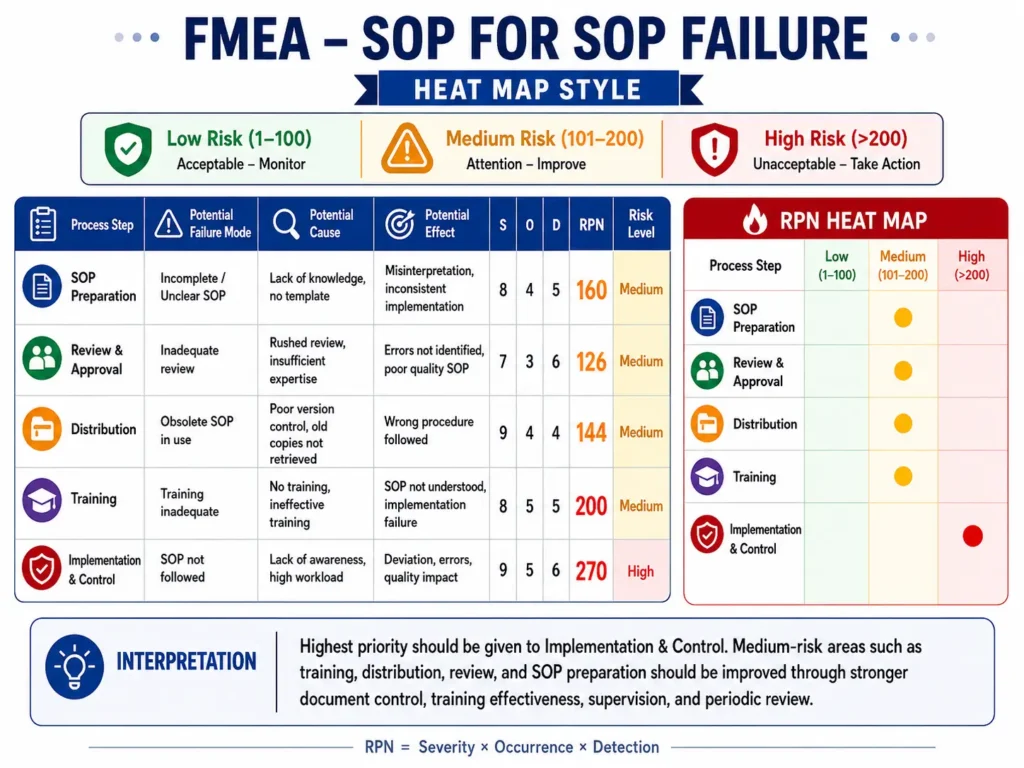
Each failure is rated for Severity (S), Occurrence (O), and Detection (D). These ratings are multiplied to calculate the Risk Priority Number (RPN = S × O × D). A higher RPN indicates a higher priority for corrective action. Typical risks include unclear SOP preparation, inadequate review, use of obsolete copies, ineffective training, and failure to follow the approved SOP. The heat-map presentation makes it easy to identify low, medium, and high-risk areas. The highest-risk activities should receive priority through stronger document control, effective training, supervision, periodic review, and compliance monitoring.
8. Human Error Analysis:
Human Error Analysis is a systematic method used to identify and understand mistakes made by personnel while performing SOP-related activities. It helps determine whether an error occurred due to incorrect action, memory failure, poor decision-making, inadequate understanding, or deliberate deviation from an approved procedure.
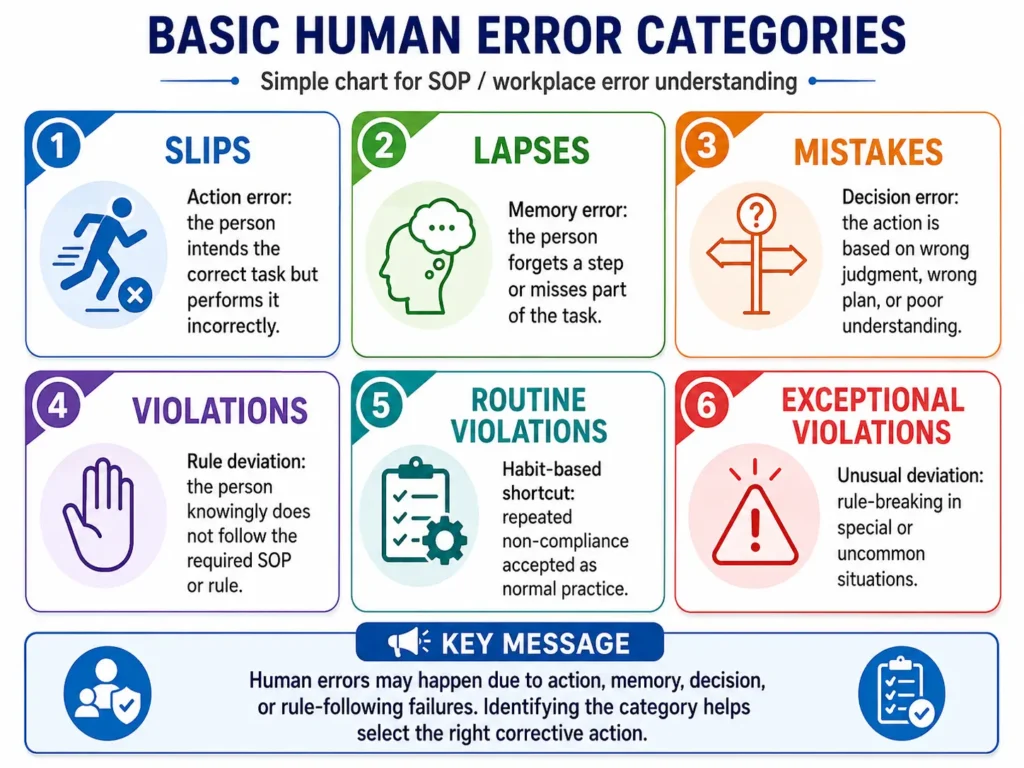
Human errors can generally be classified as slips, lapses, mistakes, violations, routine violations, and exceptional violations. Slips occur when the correct action is intended but performed incorrectly, while lapses involve forgetting a step. Mistakes arise from wrong decisions or poor understanding. Violations occur when an approved SOP or rule is knowingly not followed. Human Error Analysis also considers contributing factors such as inadequate training, workload, fatigue, time pressure, poor communication, unclear procedures, supervision, and workplace conditions. Identifying the correct type and cause of human error helps establish effective CAPA, improve training, strengthen SOP compliance, and prevent recurrence.
IMPACT ASSESSMENT
Failure to follow the SOP for SOP can have a significant impact on the pharmaceutical quality system because SOPs control how activities are prepared, reviewed, approved, trained, distributed, revised, and implemented. If this system fails, employees may use outdated, uncontrolled, or incorrect procedures, which can lead to inconsistent working practices, documentation errors, deviations, and cGMP non-compliance. The SOP requires QA review for regulatory and cGMP compliance and proper control of approved master and controlled copies. Inadequate training before the effective date may result in personnel performing activities without proper understanding. Poor retrieval of superseded copies may allow obsolete procedures to remain in use. The overall impact may include audit observations, repeat deviations, incorrect records, process inconsistency, regulatory risk, and possible impact on product quality. Therefore, strong document control, training, periodic review, and QA monitoring are essential.
Questions & Answers
Q1. What is the purpose of the SOP for SOP?
The purpose of the SOP for SOP is to provide written guidelines for preparation, revision, review, approval, training, distribution, implementation, retrieval, control, discontinuation, and destruction of SOPs.
Q2. Who prepares a new SOP?
A knowledgeable and experienced person from the originating department prepares the draft SOP under the responsibility of the department head.
Q3. Who reviews the SOP for technical correctness?
The Head of the originating department reviews the SOP for procedural and technical content, accuracy, and cGMP compliance.
Q4. Who gives final approval to an SOP?
The Head of Quality Assurance gives final approval to the SOP by signing in the approved-by section.
Q5. When should SOP training be completed?
Training must be provided to all concerned personnel before the SOP becomes effective and within 15 days from the approval date.
Q6. Who controls the master copy of an SOP?
Quality Assurance controls and maintains the approved master copy of the SOP.
Q7. What happens to superseded SOP copies?
Superseded controlled copies are retrieved by Quality Assurance and destroyed when the revised SOP becomes effective.
Q8. Can a controlled SOP copy be photocopied?
No, photocopying of a controlled SOP copy is not permitted, and any such photocopy is treated as an uncontrolled copy.
Q9. How often should an SOP be reviewed?
An SOP must be reviewed within 24 months from its effective date or earlier if a revision is required.
Q10. When can an SOP be revised before its scheduled review date?
An SOP may be revised earlier due to new practices, equipment changes, regulatory updates, audit observations, complaints, recalls, repeated rejections, discrepancies, or other justified reasons.
Q11. What is the first version number of a new SOP?
The first version number of a new SOP is “00,” and subsequent revisions are numbered 01, 02, and so on.
Q12. Who assigns a new SOP number?
Quality Assurance is the only department authorized to assign a new SOP number based on the approved SOP initiation process.
Q13. What type of language should be used in an SOP?
An SOP should use clear and directive language, using words such as “shall” and “must” instead of “should,” “may,” or “might.”
Q14. What happens when an SOP is discontinued?
When an SOP is discontinued, the controlled copies are retrieved and destroyed, while the master copy is marked obsolete, stamped “VOID,” and archived by Quality Assurance.
Q15. Why is revision history maintained in an SOP?
Revision history is maintained to record all changes made from the first version up to the current version of the SOP.