






1. Brief Description:
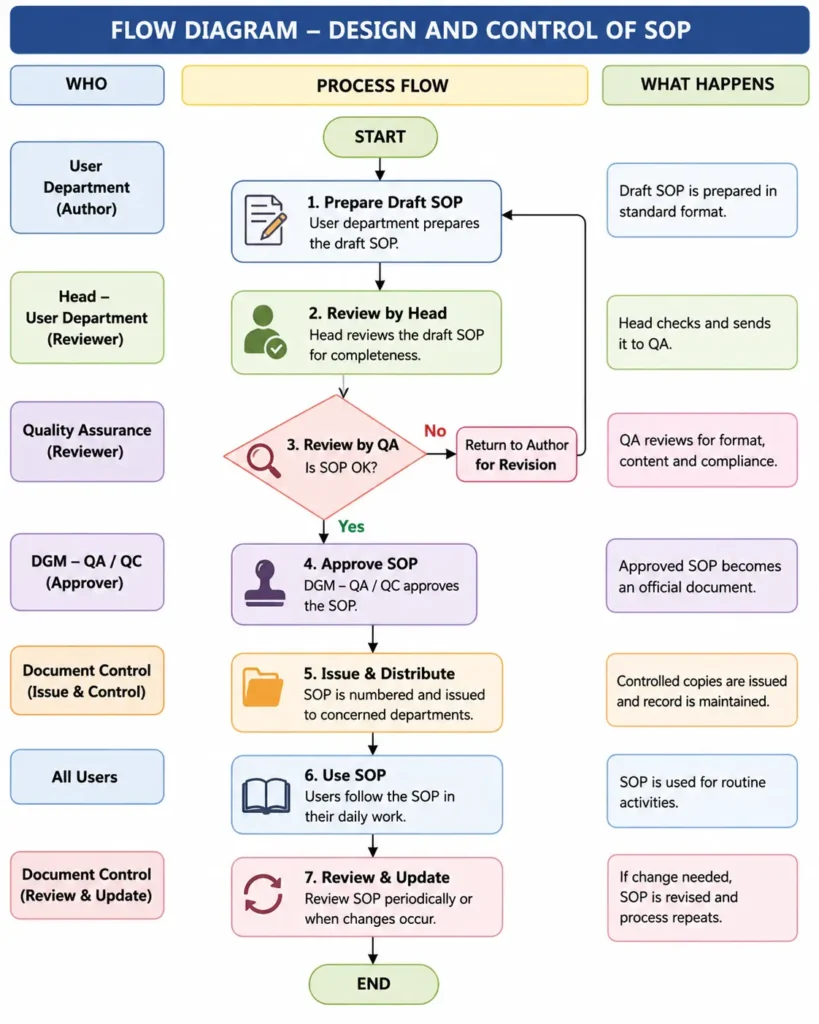
This SOP for SOP explains how Standard Operating Procedures are prepared, checked, approved, issued, revised, distributed, and controlled in the company. It applies to departments such as Quality Assurance, Quality Control, Production, Stores, Maintenance, and Administration. The SOP defines a standard format, including objective, scope, responsibility, procedure, references, annexures, abbreviations, distribution, and revision history. It also explains how SOP numbers, formats, and annexures should be identified and controlled. Draft SOPs are reviewed by the concerned department and Quality Assurance before final approval. Approved copies are managed as Master Copy, Controlled Copy, Training Copy, or Uncontrolled Copy. Only authorized persons may issue or copy SOPs. Superseded SOPs are withdrawn, marked obsolete, and properly recorded. The SOP also requires periodic review, change control, safe document storage, and restricted access to electronic copies. Overall, it ensures that only correct, approved, and updated SOPs are used for routine work across all departments in a consistent manner.
2. Process Mapping:
3. Brainstorming in Case of SOP Failure:
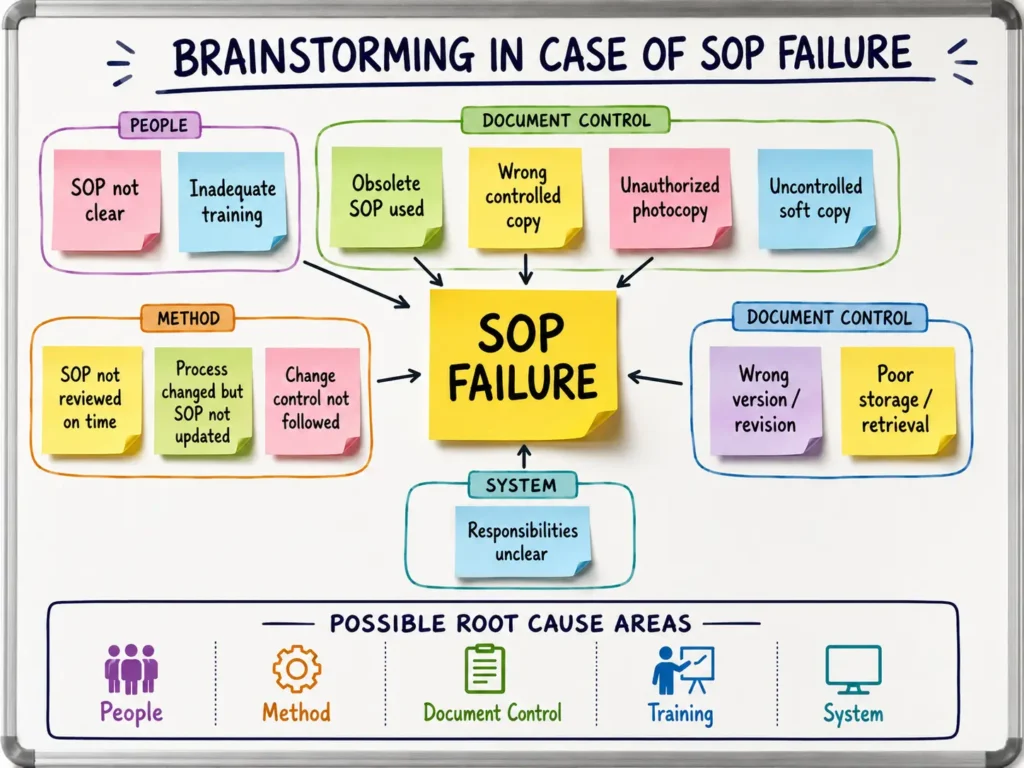
If an SOP is not followed properly or the SOP system fails, the investigation team can brainstorm the following possible causes:
- SOP not clear or difficult to understand – instructions may be confusing or incomplete. The SOP requires simple, easy-to-follow language.
- Inadequate training – employees may not have been properly trained before implementation.
- Wrong or obsolete SOP used – old copies may still be available in the department.
- Controlled copy not properly issued – document distribution may not have been correctly maintained.
- Unauthorized photocopy used – copies made without document control may create confusion.
- SOP not reviewed on time – required periodic review may have been missed.
- Process changed but SOP not updated – actual practice may differ from written instructions.
- Change control not followed – revisions may have been implemented without proper approval.
- Responsibilities not clearly understood – employees may not know who prepares, checks, approves, or performs the activity.
- Poor document storage or retrieval – correct SOP may not be readily available.
- Incorrect version or revision number – document identification may be wrong.
- Soft copy accessed without authorization – uncontrolled electronic versions may be used.
Simple brainstorming flow:
SOP Failure → People → Training → SOP Content → Approval → Distribution → Correct Version → Actual Practice → Review/Revision → Document Control → Root Cause
4. 5 Why Analysis – SOP Failure:
Problem: An employee followed the wrong or outdated SOP during routine work.
| Why | Question | Answer |
|---|---|---|
| Why 1 | Why was the wrong SOP followed? | The employee used an outdated SOP copy. |
| Why 2 | Why was an outdated SOP available? | The old controlled copy was not removed after SOP revision. |
| Why 3 | Why was the old copy not removed? | Document Control did not properly retrieve the superseded copy. |
| Why 4 | Why was retrieval not completed? | SOP distribution and withdrawal records were not adequately checked. |
| Why 5 | Why were the records not checked? | There was inadequate follow-up and responsibility for document control activities. |
The SOP requires superseded controlled copies to be withdrawn when a revised SOP is issued, while obsolete master copies are marked “OBSOLETE” and other copies are destroyed.
Root Cause
Inadequate control and verification of SOP distribution and retrieval.
Corrective & Preventive Actions
- Retrieve and destroy all obsolete SOP copies.
- Issue the latest approved controlled copy.
- Update the SOP distribution record.
- Retrain concerned employees.
- Periodically verify that only current SOPs are available at the workplace.
- Strengthen Document Control responsibility and follow-up.
The SOP also requires distribution records to be maintained and unauthorized copies to be prevented.
5. Detailed Fishbone Diagram (Ishikawa) – SOP Failure
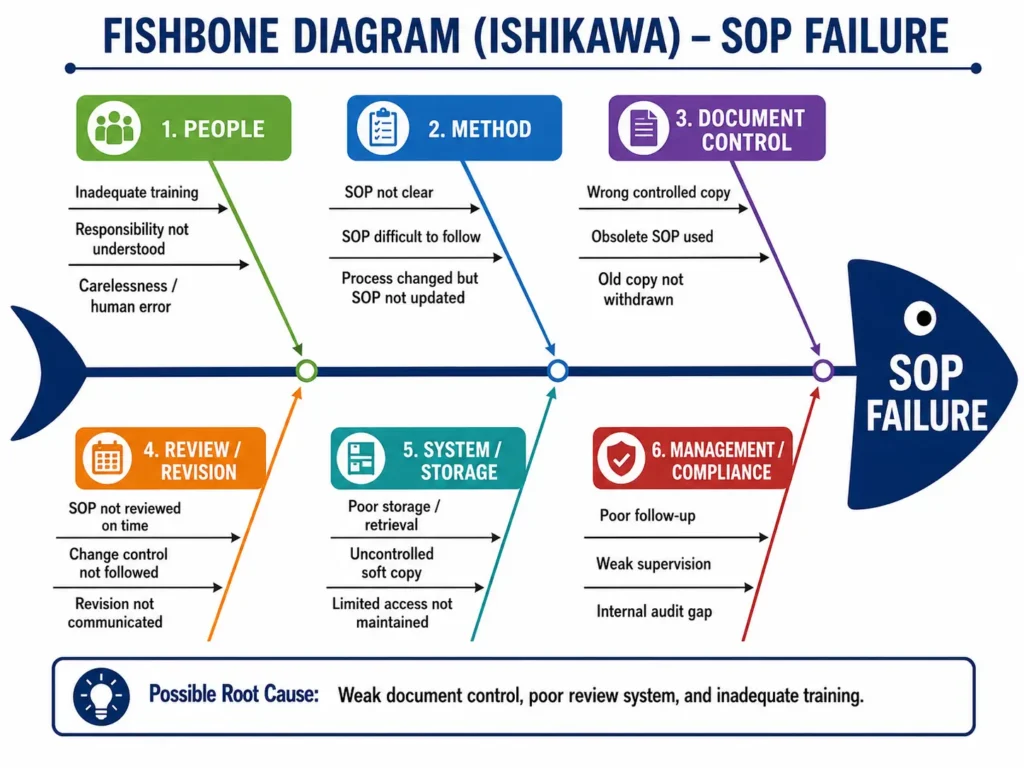
The effect/problem at the head of the fishbone is:
SOP FAILURE
This may mean the wrong SOP is used, the SOP is not followed correctly, an obsolete version remains available, training is inadequate, or the written SOP does not match the actual activity.
1. PEOPLE / MANPOWER
Possible causes related to employees:
- Employee did not receive proper SOP training.
- Employee did not understand the SOP instructions.
- Responsibility for the activity was not clearly understood.
- User did not check the SOP number or revision before use.
- Employee continued following an old working practice.
- Training effectiveness was not properly verified.
- New or transferred employees were not adequately trained.
- Human error occurred while selecting or following the SOP.
2. METHOD / SOP CONTENT
Possible causes related to the written procedure:
- SOP instructions are difficult to understand.
- Steps are not written in proper sequence.
- Important activity steps are missing.
- Responsibilities are not clearly defined.
- Actual process changed but the SOP remained unchanged.
- Required equipment, material, safety instructions, records, or controls are not properly described.
- SOP contains unclear or confusing wording.
- Procedure does not reflect current working practice.
3. DOCUMENT CONTROL
Possible causes include:
- Wrong controlled copy issued.
- Obsolete SOP remained at the workplace.
- Latest revision was not distributed.
- Old controlled copy was not retrieved.
- Unauthorized photocopy was being used.
- Copy number was not properly controlled.
- Distribution register was incomplete.
- Master copy and controlled copies were not properly identified.
- Uncontrolled copy was mistakenly used for routine work.
4. REVIEW / REVISION / CHANGE CONTROL
Possible causes include:
- SOP was not reviewed within the defined period.
- Revision requirement was not identified.
- Process change was implemented before SOP revision.
- Change control was not initiated.
- Revised SOP was not communicated to users.
- Revision history was incomplete.
- Minor changes were made without proper approval.
- Revised SOP was issued before completion of required controls.
5. STORAGE / SYSTEM / ELECTRONIC CONTROL
Possible causes include:
- SOP was not easily available when required.
- Wrong SOP was retrieved from storage.
- Documents were damaged or lost.
- Electronic SOP access was not properly restricted.
- Old soft copies remained available after revision.
- Employee printed an uncontrolled electronic copy.
- Backup or electronic-document control was inadequate.
- File naming or folder management created confusion.
6. APPROVAL / IMPLEMENTATION / FOLLOW-UP
Possible investigation causes include:
- SOP was used before final approval.
- Required signatures were missing.
- Effective date was not properly assigned.
- Training was incomplete before routine implementation.
- Document Control did not verify withdrawal of previous copies.
- Follow-up after SOP issuance was inadequate.
- Department did not confirm receipt of the revised SOP.
- Routine compliance verification was not performed.
6. Fault Tree Analysis (FTA) – SOP Failure:
Fault Tree Analysis is a top-down investigation tool used to identify all possible reasons that can lead to a particular failure. In this case, the Top Event is SOP Failure. The uploaded SOP does not itself contain an FTA; the analysis below is developed from the SOP requirements for preparation, approval, training, distribution, revision, storage, and document control.
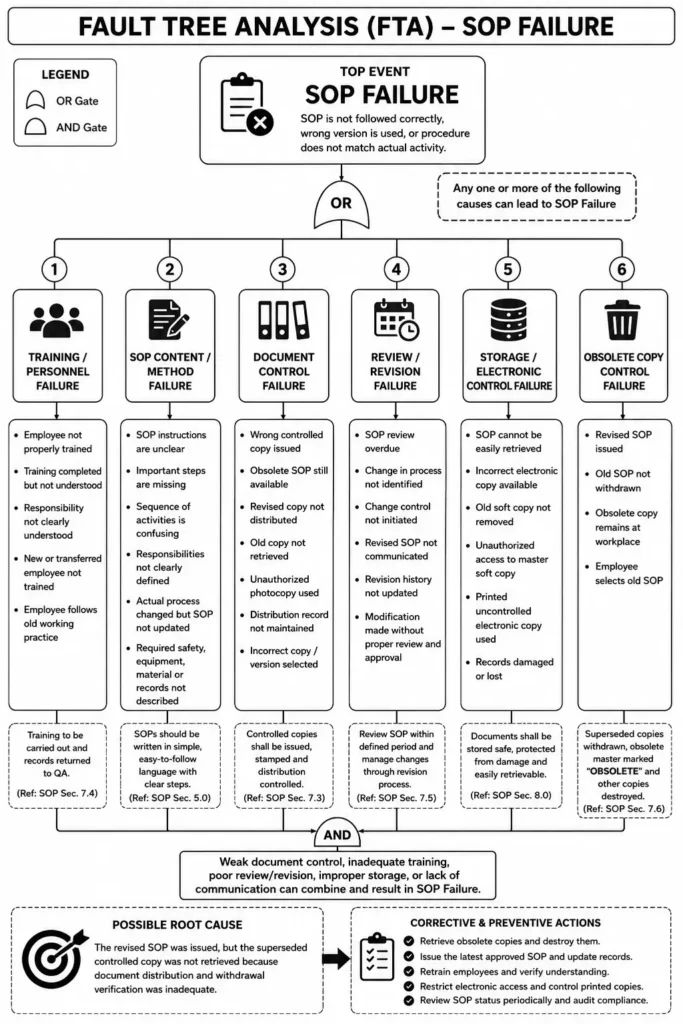
FTA Conclusion
The FTA shows that SOP Failure is generally not limited to one reason. It can originate from people, SOP content, training, document control, revision management, storage, electronic control, or obsolete-copy handling.
7. Failure Mode and Effects Analysis (FMEA) – SOP Failure:
The following FMEA is based on the SOP requirements for preparation, approval, distribution, review, revision, storage, and control of SOPs. The S/O/D scores are proposed risk-assessment values for illustration; the uploaded SOP itself does not define an FMEA scoring scale.
| S.No. | Failure Mode | Possible Effect | Possible Cause | S | O | D | RPN | Recommended Action |
|---|---|---|---|---|---|---|---|---|
| 1 | Wrong/obsolete SOP used | Activity performed incorrectly | Old SOP not withdrawn | 5 | 3 | 3 | 45 | Remove obsolete copies and verify current SOP |
| 2 | SOP not properly reviewed | Incorrect or incomplete instructions remain | Review step missed | 4 | 2 | 3 | 24 | Ensure departmental and QA review before approval |
| 3 | Employee not trained | SOP may not be followed correctly | Training copy/training not completed | 5 | 3 | 2 | 30 | Complete and document training before implementation |
| 4 | Uncontrolled copy used | Wrong version may be followed | Unauthorized photocopying | 4 | 3 | 3 | 36 | Control copying and maintain issue records |
| 5 | SOP not reviewed on time | SOP may become outdated | Periodic review missed | 4 | 3 | 3 | 36 | Track review due dates and issue alerts |
| 6 | Process changed but SOP not revised | Written procedure differs from actual practice | Change control not initiated | 5 | 3 | 4 | 60 | Revise SOP through approved change control |
| 7 | Poor SOP storage/retrieval | Correct document may not be available | Weak document storage system | 3 | 2 | 3 | 18 | Maintain secure and easily retrievable records |
| 8 | Uncontrolled electronic copy accessed | Outdated information may be used | Soft-copy access not restricted | 4 | 2 | 4 | 32 | Restrict electronic access to Document Control |
The SOP requires drafts to be reviewed, corrected and approved before controlled copies are issued. It also requires periodic SOP review and formal control of changes. Superseded controlled copies must be withdrawn, obsolete master copies identified, and other superseded copies destroyed. Records must also be protected, retrievable, and electronic master documents should have restricted access.
Risk Priority
High Risk: Process changed but SOP not revised — RPN 60
Medium Risk: Obsolete SOP used — RPN 45
Medium Risk: Uncontrolled copy / review delay / electronic copy issues
Lower Risk: Storage and retrieval issues
8. Is / Is-Not Analysis – SOP Failure:
Problem Statement: An outdated or incorrect SOP was available and used during routine work.
| Area | IS | IS NOT |
|---|---|---|
| What | Wrong / obsolete SOP was used | Not a product or equipment failure |
| Where | At the user department / workplace | Not observed in all departments |
| When | After SOP revision or replacement | Not during initial SOP preparation |
| Who | Concerned user and Document Control are involved | Not related only to QA approval |
| Which Document | Old controlled copy / previous revision | Not the latest approved Master Copy |
| Extent | Limited to locations where obsolete copies remained | Not confirmed across the complete site |
| System Issue | SOP withdrawal and distribution control may be weak | SOP preparation format itself is not confirmed as the cause |
The SOP requires controlled copies to be distributed through Document Control and distribution records to be maintained.
It also requires superseded controlled copies to be withdrawn when revised documents are issued, while obsolete Master Copies are marked “OBSOLETE” and other superseded copies are destroyed.
Likely Investigation Focus
IS:
Obsolete SOP remained available
Withdrawal was not fully verified
Distribution/retrieval record needs checking
Users may not have confirmed the current revision
IS NOT:
Evidence of failure in every department
Evidence that the approved Master Copy itself was incorrect
Evidence that document numbering alone caused the event
Possible Root Cause: Failure to effectively retrieve and verify obsolete SOP copies after revision and issue of the new controlled copy.
9. Pareto Chart – Detailed Analysis for SOP Failure:
A Pareto Chart is used during an investigation to identify which SOP-related problems are occurring most frequently. It helps the investigation team focus first on the few major causes that contribute to most of the failures. The frequencies shown in the chart above are illustrative example data; the uploaded SOP does not provide actual deviation or failure counts.
Example Data Used in the Pareto Chart
| Rank | SOP-Related Issue | No. of Findings | Cumulative Findings | Cumulative % |
|---|---|---|---|---|
| 1 | Outdated SOP available/used | 28 | 28 | 28% |
| 2 | SOP not reviewed on time | 20 | 48 | 48% |
| 3 | SOP not updated after process change | 15 | 63 | 63% |
| 4 | Uncontrolled copy used | 10 | 73 | 73% |
| 5 | SOP not followed by employee | 8 | 81 | 81% |
| 6 | SOP training not completed | 5 | 86 | 86% |
| 7 | SOP not readily available | 4 | 90 | 90% |
| 8 | Other issues | 10 | 100 | 100% |
How to Read the Pareto Chart
The bars show the number of times each problem occurred. A taller bar means that issue occurred more frequently.
The cumulative percentage line shows how much of the total problem is covered when causes are added one by one.
For example:
Outdated SOP used = 28%
Add SOP not reviewed on time:
28% + 20% = 48%
Add SOP not updated after process change:
48% + 15% = 63%
Continue until the cumulative total reaches 100%.
Main Interpretation
The first three major issues account for 63% of the example findings:
Outdated SOP available/used – 28%
SOP not reviewed on time – 20%
SOP not updated after process change – 15%
Therefore, these three areas should receive high investigation priority.
However, when applying the traditional approximately 80% Pareto principle, the first five listed causes reach 81%. Therefore, the main improvement program should preferably address these five causes.
a. Outdated SOP Available or Used – 28%
This is the highest-frequency example failure.
Possible reasons include:
- Superseded SOP was not withdrawn.
- Old controlled copy remained in the department.
- Employee did not verify the revision number.
- New SOP was issued but the previous copy was not retrieved.
- Unauthorized photocopies were available.
The uploaded SOP specifically requires controlled copies of superseded documents to be withdrawn when amended documents are issued. The obsolete Master Copy is to be marked “OBSOLETE,” while other superseded copies are destroyed.
Recommended action: Verify all SOP locations, retrieve obsolete copies and introduce periodic SOP version checks.
b. SOP Not Reviewed on Time – 20%
A delayed review may allow outdated instructions to remain effective even when processes, equipment or regulatory requirements have changed.
The uploaded procedure states that SOPs should be reviewed within the defined review period or whenever an intermittent change is required.
Possible causes:
- No review-date tracking system.
- Responsible person missed the review date.
- No reminder or escalation system.
- High workload.
- Weak QA follow-up.
Recommended action: Maintain an SOP review tracker with advance alerts and escalation for overdue documents.
c. SOP Not Updated After Process Change – 15%
The actual activity may change while the written SOP remains unchanged.
This creates a serious GMP risk because employees may either follow an outdated instruction or follow actual practice that is not documented.
The uploaded SOP requires changes to be managed through the defined revision/change-control process.
Recommended action: Link SOP impact assessment with every relevant change control.
d. Uncontrolled Copy Used – 10%
Uncontrolled or unauthorized photocopies can remain in circulation after the official SOP has been revised.
The SOP states that documents should not be copied by persons other than Document Control and unauthorized copies are considered unofficial.
Recommended action: Control printing, photocopying, distribution and retrieval of SOPs.
e. SOP Not Followed by Employee – 8%
This may occur even when the SOP itself is correct.
Possible causes include:
- Employee did not understand the SOP.
- Training was ineffective.
- SOP instructions were difficult to follow.
- Employee relied on experience instead of written instructions.
- Supervisory monitoring was inadequate.
The SOP requires procedures to be written in simple, easy-to-follow language.
Recommended action: Conduct retraining and verify effectiveness through observation or assessment.
f. SOP Training Not Completed – 5%
An approved SOP should be communicated and trained before routine implementation where required.
The document describes issuance of a training copy and subsequent completion of the training process before effective-date control and distribution activities.
Recommended action: Do not permit independent activity until required SOP training is completed and documented.
g. SOP Not Readily Available – 4%
Employees may perform work from memory if the correct SOP is difficult to locate.
The SOP requires records to be stored in a way that protects them and makes them easily retrievable.
Recommended action: Ensure current controlled SOPs are available at appropriate points of use.
Recommended CAPA
Corrective Actions: Retrieve obsolete SOPs, issue the latest approved copies, complete overdue reviews, update affected SOPs, retrain employees and correct distribution records.
Preventive Actions: Introduce an electronic review-date tracker, periodic SOP verification, controlled-printing system, change-control/SOP linkage, training effectiveness checks and routine Document Control audits.
10. Cause-and-Effect Matrix – SOP Failure:
A Cause-and-Effect Matrix helps identify which possible causes have the strongest relationship with important SOP failures. The uploaded SOP requires clear instructions, controlled distribution, periodic review, withdrawal of superseded copies, proper storage, and restricted access to electronic master documents.
Example scoring: 9 = Strong relationship | 3 = Medium | 1 = Weak | 0 = No direct relationship
These scores are illustrative; the uploaded SOP does not define a Cause-and-Effect Matrix scoring system.
| Possible Cause | Wrong SOP Used | Activity Performed Incorrectly | Document Control Failure | Training / Understanding Issue | SOP Not Updated | Total Score |
|---|---|---|---|---|---|---|
| Obsolete SOP not withdrawn | 9 | 9 | 9 | 1 | 3 | 31 |
| SOP not reviewed on time | 3 | 9 | 3 | 1 | 9 | 25 |
| Process changed but SOP not revised | 3 | 9 | 3 | 3 | 9 | 27 |
| Inadequate employee training | 1 | 9 | 1 | 9 | 1 | 21 |
| Uncontrolled photocopy available | 9 | 3 | 9 | 1 | 1 | 23 |
| Wrong revision/version issued | 9 | 9 | 9 | 1 | 3 | 31 |
| Poor SOP storage/retrieval | 3 | 3 | 9 | 1 | 1 | 17 |
| Uncontrolled electronic copy used | 9 | 3 | 9 | 1 | 1 | 23 |
| Responsibilities not clearly understood | 1 | 3 | 3 | 9 | 3 | 19 |
| Change control not followed | 3 | 9 | 3 | 1 | 9 | 25 |
High Priority
1. Obsolete SOP not withdrawn — Score 31
Superseded controlled copies are required to be withdrawn when amended documents are issued.
2. Wrong revision/version issued — Score 31
This can directly result in employees following outdated instructions and indicates weakness in document distribution and control.
3. Process changed but SOP not revised — Score 27
The SOP requires changes and revisions to be managed through the defined procedure and change-control system.
Medium Priority
- SOP not reviewed on time — 25
- Change control not followed — 25
- Uncontrolled photocopy available — 23
- Uncontrolled electronic copy used — 23
- Inadequate training — 21
The SOP requires periodic review and maintenance of review/change records. It also restricts unauthorized copying and requires control of document distribution.
11. Timeline Analysis – SOP Failure:
Timeline Analysis is used to arrange events in the exact order in which they happened. It helps investigators identify when the SOP control failed, what happened before the failure, and where the system broke down.
Since the uploaded SOP does not contain an actual deviation with dates and times, the timeline below is an illustrative investigation example based on its document-control process.
| Sequence | Event | Expected Activity | Possible Failure / Observation |
|---|---|---|---|
| 1 | SOP revision initiated | SOP should be revised through the defined change process | Change initiated |
| 2 | Revised SOP reviewed | User Department and QA should review the SOP | Review completed |
| 3 | SOP approved | Authorized person approves the final SOP | New version approved |
| 4 | Training copy issued | Concerned employees should receive training | Training may be delayed/incomplete |
| 5 | New SOP becomes effective | Latest controlled copies should be distributed | New SOP issued |
| 6 | Old SOP withdrawal | Superseded controlled copies should be retrieved | Old copy not withdrawn |
| 7 | Routine activity performed | Employee should use latest approved SOP | Employee uses old SOP |
| 8 | Failure detected | QA identifies use of obsolete SOP | Deviation/investigation initiated |
| 9 | Investigation performed | Distribution, training and retrieval records checked | Document-control gap identified |
| 10 | CAPA implemented | Obsolete copies removed and employees retrained | Control system strengthened |
The SOP states that after authorization and training, controlled copies are prepared and distributed to authorized document holders.
It also requires all controlled copies of superseded documents to be withdrawn when amended documents are issued. The obsolete Master Copy is marked “OBSOLETE,” and other superseded copies are destroyed.
CAPA
- Retrieve all obsolete SOP copies.
- Verify the latest revision at every point of use.
- Update distribution and retrieval records.
- Retrain concerned employees.
- Introduce a checklist for new SOP issuance and old SOP withdrawal.
- Periodically verify controlled copies during internal audits.
12. Barrier Analysis – SOP Failure:
Barrier Analysis is used to identify the controls that should prevent an SOP failure, check whether those controls were present, and determine which barrier failed.
Based on the uploaded SOP, the main control barriers are related to review, approval, training, distribution, withdrawal of obsolete copies, storage, and access control.
| Barrier / Control | Expected Requirement | Possible Failure | Effect |
|---|---|---|---|
| SOP Review | SOP should be checked before approval | Review not effective | Incorrect/incomplete SOP may be issued |
| QA Approval | SOP should be approved before issue | Approval step missed or weak | Unauthorized SOP may be used |
| Training | Training copy should be issued before routine use | Training incomplete | Employee may not understand the SOP |
| Controlled Distribution | Controlled copies should be issued by Document Control | Wrong copy issued | Incorrect version may reach users |
| Obsolete Copy Withdrawal | Superseded copies should be retrieved | Old copy remains at workplace | Obsolete SOP may be used |
| Copy Control | Unauthorized copying should be prevented | Photocopy made without control | Uncontrolled SOP may remain in circulation |
| Periodic Review | SOP should be reviewed at defined intervals | Review overdue | SOP may become outdated |
| Change Control | Required changes should be formally controlled | Process changed without SOP revision | Actual practice differs from written SOP |
| Storage & Retrieval | Documents should be protected and retrievable | Poor storage system | Correct SOP may not be available |
| Electronic Access Control | Soft copies should have limited access | Uncontrolled soft copy used | Old or unauthorized version may be followed |
The SOP requires the draft to be reviewed, corrected, finalized and controlled before distribution. It also states that SOPs should not be copied by unauthorized persons and that distribution records should be maintained. For revised SOPs, superseded controlled copies are required to be withdrawn, obsolete Master Copies marked “OBSOLETE,” and other superseded copies destroyed.
Recommended Actions
- Retrieve all obsolete SOP copies immediately.
- Verify current revision at every point of use.
- Maintain issue and retrieval records.
- Use an SOP replacement checklist.
- Retrain concerned employees.
- Include SOP version checks in routine QA inspections.
- Restrict unauthorized photocopying and electronic access.
- Verify effectiveness after CAPA implementation.
13. Human Error Analysis – SOP Failure:
Human Error Analysis is used to understand whether an SOP failure happened because of a person’s mistake, lack of knowledge, unclear instructions, workload, poor supervision, or weakness in the document-control system.
The uploaded SOP requires procedures to be written in simple, easy-to-follow language and in a way that supports correct understanding by users.
| Human Error Type | Example in SOP Failure | Possible Cause | Recommended Action |
|---|---|---|---|
| Knowledge Error | Employee did not know the latest SOP | Inadequate training | Retraining and effectiveness check |
| Memory Error | Employee forgot a required SOP step | Activity performed from memory | Use checklist / SOP at point of use |
| Attention Error | Revision number was not checked | Distraction or workload | Require version verification before use |
| Selection Error | Wrong SOP copy selected | Similar copies or poor identification | Improve document identification |
| Procedure Error | Employee followed an old work practice | Habit or inadequate understanding | Practical training and supervision |
| Communication Error | Revised SOP was not communicated | Weak information flow | Improve training and notification process |
| Supervision Error | Wrong SOP remained in use | Inadequate routine checking | Periodic QA verification |
| Document-Control Error | Obsolete SOP not removed | Retrieval step missed | Strengthen issue and withdrawal control |
The SOP requires training copies to be issued and training to be completed before controlled copies are prepared for routine use. It also requires superseded controlled copies to be withdrawn when revised SOPs are issued.
CAPA
- Retrain concerned employees.
- Remove all obsolete SOP copies.
- Verify the latest revision at each point of use.
- Introduce SOP revision/version checking before activity.
- Strengthen QA and Document Control inspections.
- Use training-effectiveness assessments.
- Improve communication whenever an SOP is revised.
- Include human-error factors during deviation investigation.