






1. Introduction to Temperature, Relative Humidity and Pressure Difference Monitoring
Temperature, relative humidity, and pressure differential are important environmental parameters that must be controlled and monitored in pharmaceutical areas to maintain suitable conditions for manufacturing, testing, storage, and handling of materials and products. This SOP provides a standardized procedure for monitoring and recording these parameters in controlled areas of the Production, Quality Control, and Warehouse departments using digital hygrometers, wet-and-dry bulb hygrometers, and manometers, as applicable. Regular monitoring helps ensure that environmental conditions remain within specified limits and that any deviation is identified promptly. If temperature or relative humidity exceeds the established limit, the activity is stopped and Quality Assurance and Maintenance are informed for investigation and corrective action. Similarly, pressure differential monitoring supports controlled airflow between adjacent areas. The SOP defines monitoring frequency, instrument handling, calibration, recording requirements, and a pressure differential limit of 5–15 Pascal with respect to the passage, thereby supporting consistent environmental control and reliable documentation.
Skip to PDF content2. Flow Diagram for Temperature, Relative Humidity and Pressure Difference Monitoring
The flow diagram illustrates the systematic process for monitoring temperature, relative humidity, and pressure difference in pharmaceutical controlled areas. The process begins with preparation and verification of the monitoring instruments, including manual or digital hygrometers for temperature and relative humidity and manometers for pressure differential.After instrument preparation, the required environmental parameters are measured and recorded at the defined frequency. Temperature and relative humidity readings are recorded at the start of the shift and subsequently at specified intervals, while pressure differential readings are recorded at the start of the shift and every two hours during activity.
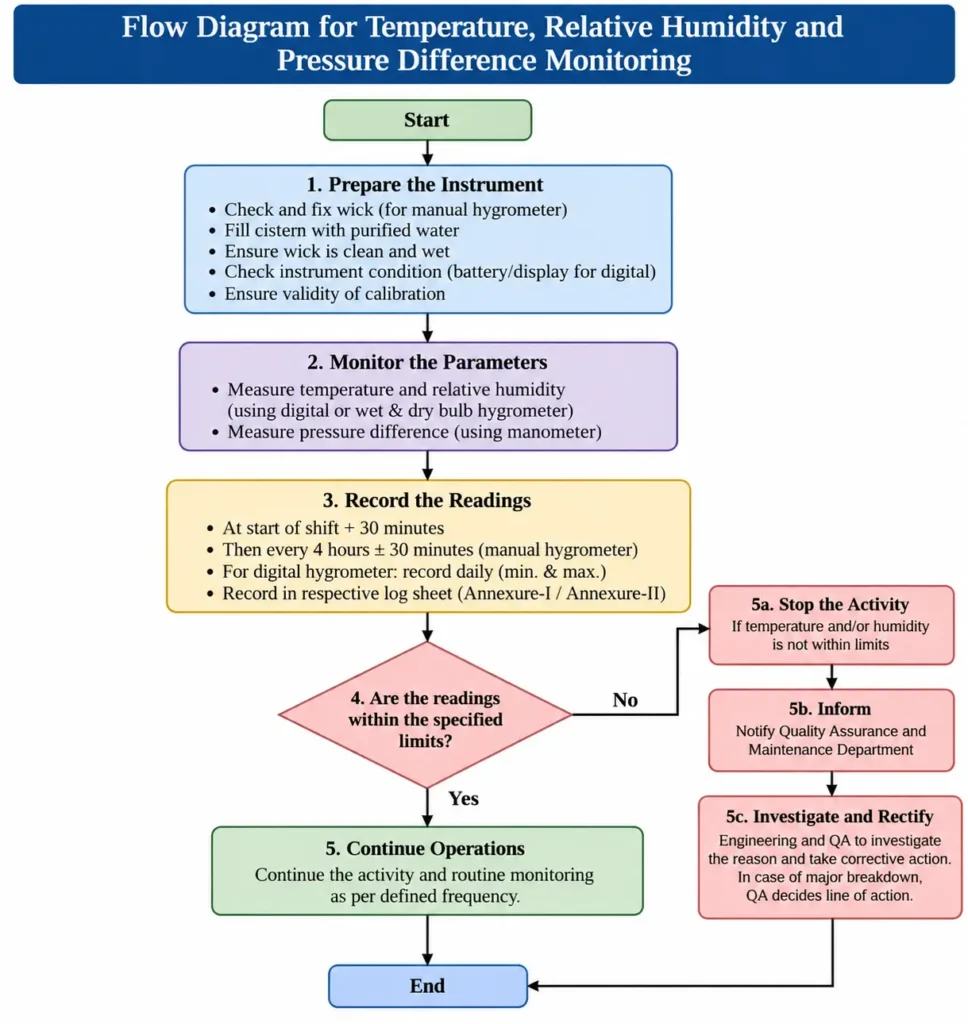
The recorded values are then compared with the established acceptance limits. If the readings are within limits, routine operations and monitoring continue. If any temperature, humidity, or pressure differential value is outside the specified limit, the activity is stopped and Quality Assurance and Maintenance/Engineering are informed. The deviation is investigated, corrective action is taken, and normal operations are resumed only after restoration of acceptable environmental conditions.
3. Benefits of Following SOP for Temperature, Relative Humidity and Pressure Difference Monitoring
Following the SOP for temperature, relative humidity, and pressure difference monitoring helps maintain appropriate environmental conditions in pharmaceutical controlled areas. Proper monitoring supports consistent manufacturing, testing, storage, and handling conditions and helps protect product quality throughout operations. The SOP also enables timely detection of out-of-limit temperature, humidity, or pressure differential conditions. When such deviations occur, activities are stopped and Quality Assurance and Maintenance/Engineering are informed so that the cause can be investigated and corrected before work continues.
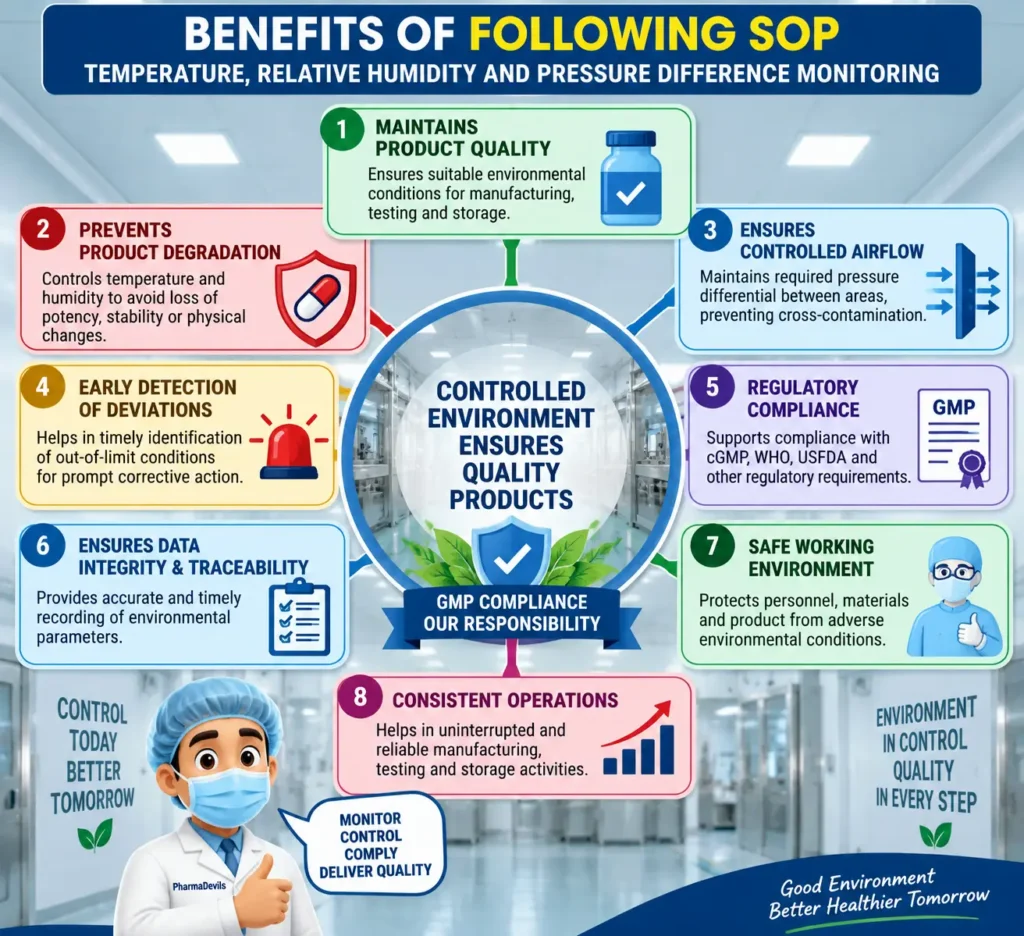
Regular recording at defined intervals improves traceability and provides documented evidence that environmental conditions are being monitored as required. The procedure also supports reliable instrument use through defined handling, maintenance, calibration, and recording practices. Overall, effective implementation of this SOP helps maintain environmental control, supports product protection, improves deviation response, promotes consistent operations, and strengthens compliance with established pharmaceutical quality-system requirements.
4. Brainstorming for SOP Failure – Temperature, Relative Humidity and Pressure Difference Monitoring
The brainstorming diagram highlights the major factors that can contribute to failure in following the SOP for temperature, relative humidity, and pressure difference monitoring in a pharmaceutical manufacturing area. Potential causes include inadequate training, weak QA oversight, lack of supervision, poor documentation, unclear SOP instructions, communication gaps, human error, manpower shortages, equipment problems, time pressure, poor housekeeping, and inadequate monitoring. These factors can result in missed environmental checks, incorrect readings, delayed recording, failure to identify out-of-limit conditions, or inadequate response to deviations. The SOP requires monitoring at defined frequencies and escalation to Quality Assurance and Maintenance/Engineering when environmental parameters are outside specified limits.
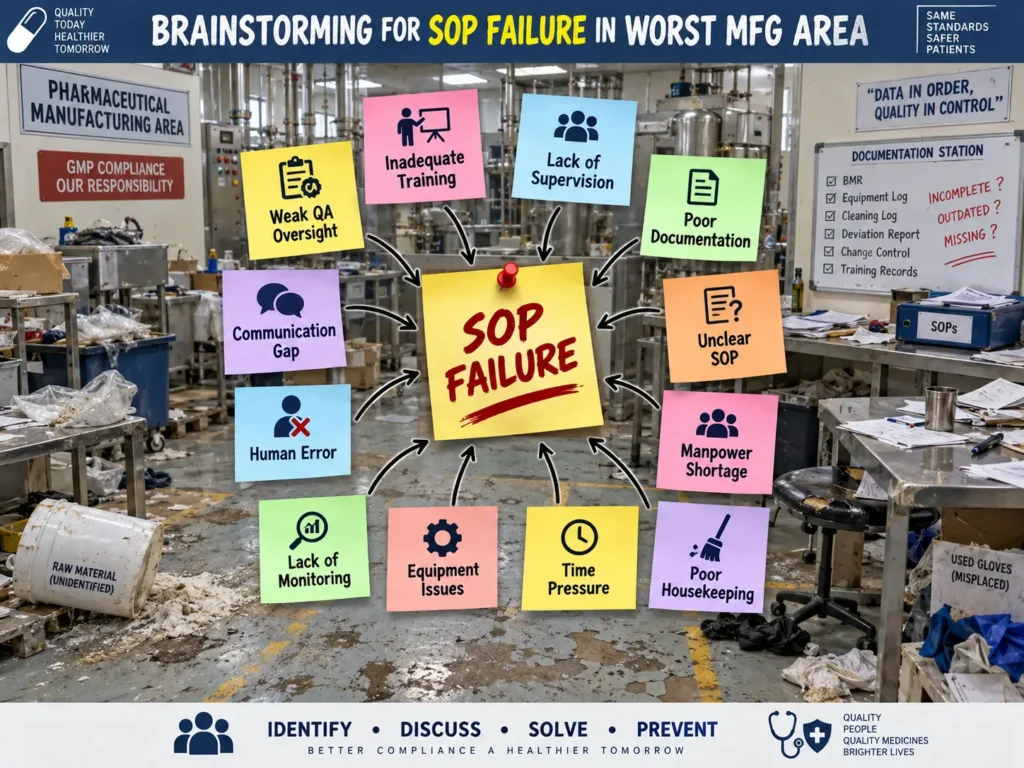
Brainstorming helps the team identify possible weaknesses from personnel, equipment, procedure, documentation, supervision, and workplace-condition perspectives. Addressing these causes through training, clear responsibilities, equipment maintenance, timely documentation, effective supervision, and routine compliance checks helps reduce SOP failures and strengthens environmental control within manufacturing areas.
5. 5-Why Analysis for SOP Failure – Temperature, Relative Humidity and Pressure Difference Monitoring
The 5-Why Analysis identifies the underlying causes of SOP failure in a poorly controlled pharmaceutical manufacturing area. The problem begins when required monitoring and recording activities are not performed on time. The second “Why” shows that the operator missed environmental checks and related documentation. The third level indicates that inadequate training and weak supervision contributed to the missed activities.
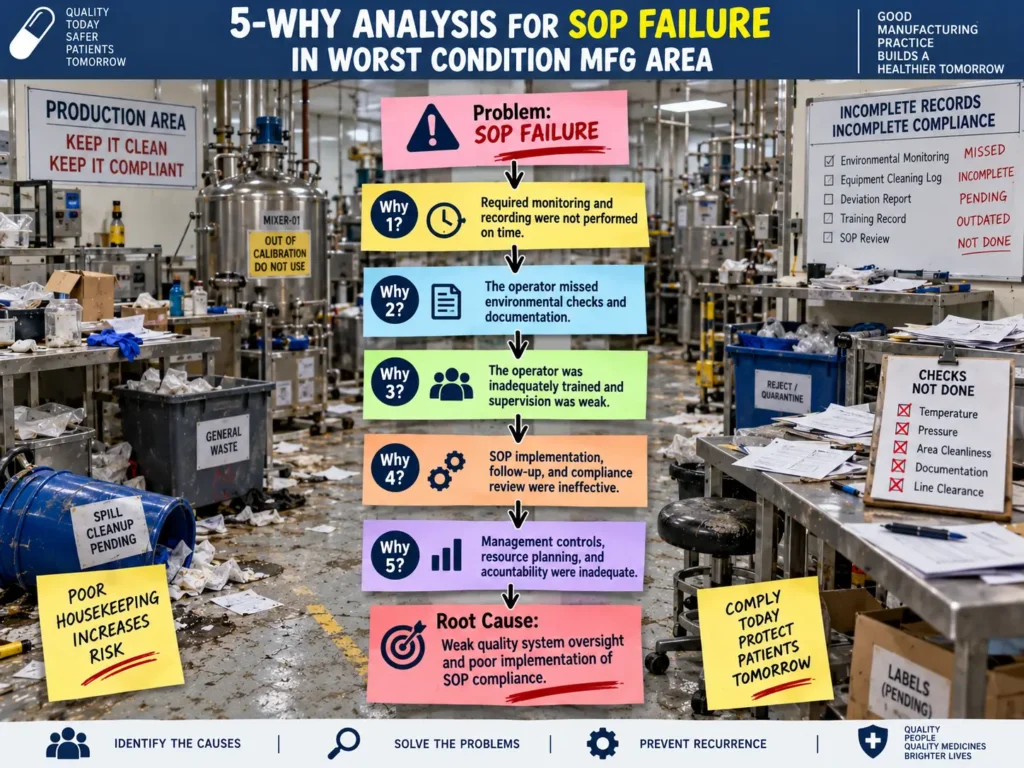
The fourth “Why” points to ineffective SOP implementation, follow-up, and compliance review, while the fifth identifies weaknesses in management controls, resource planning, and accountability. These successive causes indicate that the problem is not limited to individual operator error but is linked to broader quality-system weaknesses. The analysis concludes that the likely root cause is weak quality-system oversight and inadequate implementation of SOP compliance requirements. Corrective measures should therefore focus on strengthening training, supervision, environmental monitoring, documentation practices, management review, equipment status control, and accountability to prevent recurrence.
6. Fishbone Analysis for SOP Failure – Temperature, Relative Humidity and Pressure Difference Monitoring
The Fishbone Analysis diagram identifies the major causes that can lead to failure of the SOP for temperature, relative humidity, and pressure difference monitoring in a poorly controlled pharmaceutical manufacturing area. The causes are grouped into Man, Machine, Method, Material, Measurement, Environment, and Management categories. Personnel-related causes include inadequate training, lack of awareness, missed monitoring, human error, and weak supervision. Equipment-related causes include faulty hygrometers or manometers, overdue calibration, poor maintenance, inaccurate readings, and lack of backup instruments. Method-related causes include unclear SOP instructions, incorrect monitoring frequency, improper documentation, and weak deviation handling.
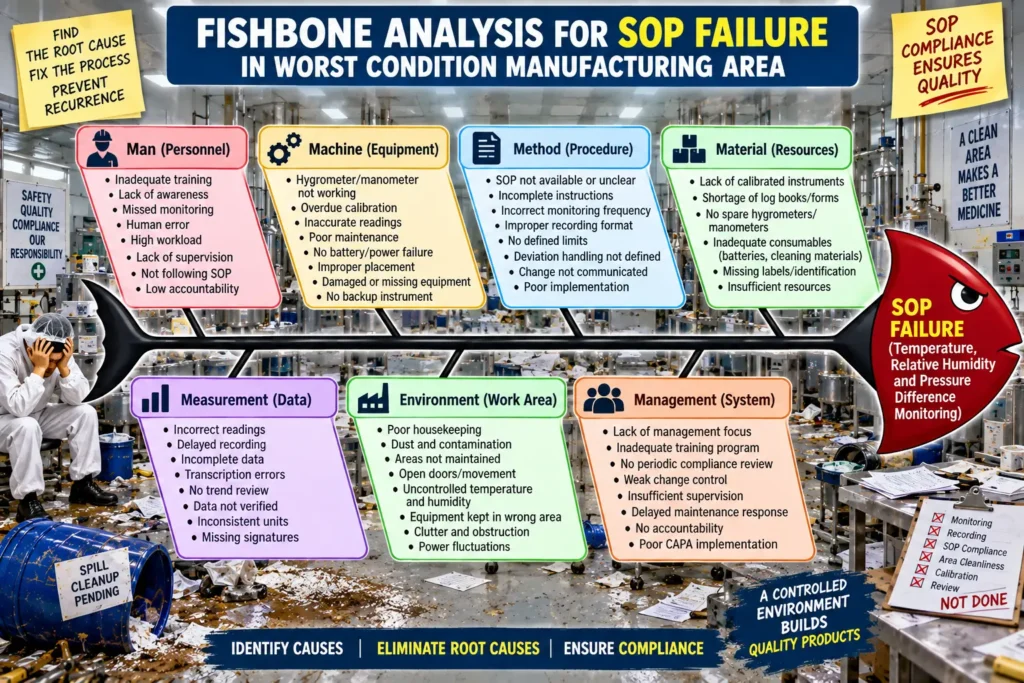
Measurement problems such as delayed recording, incomplete data, transcription errors, and missing signatures can further weaken compliance. Poor housekeeping, uncontrolled environmental conditions, clutter, and equipment placement issues also increase risk. Management failures such as inadequate oversight, weak training programs, delayed maintenance response, poor CAPA implementation, and lack of accountability can ultimately result in recurring SOP failures.
7. Fault Tree Analysis for SOP Failure – Temperature, Relative Humidity and Pressure Difference Monitoring
The Fault Tree Analysis illustrates how failures in temperature, relative humidity, and pressure difference monitoring can develop from multiple contributing causes within a pharmaceutical manufacturing area. The top event is failure of the environmental monitoring SOP, which may arise when required monitoring is missed, out-of-limit conditions are not detected or reported, instruments provide inaccurate readings, or documentation is incomplete. The SOP requires temperature and relative humidity to be monitored at defined intervals and requires pressure differential readings to be recorded routinely during operations.
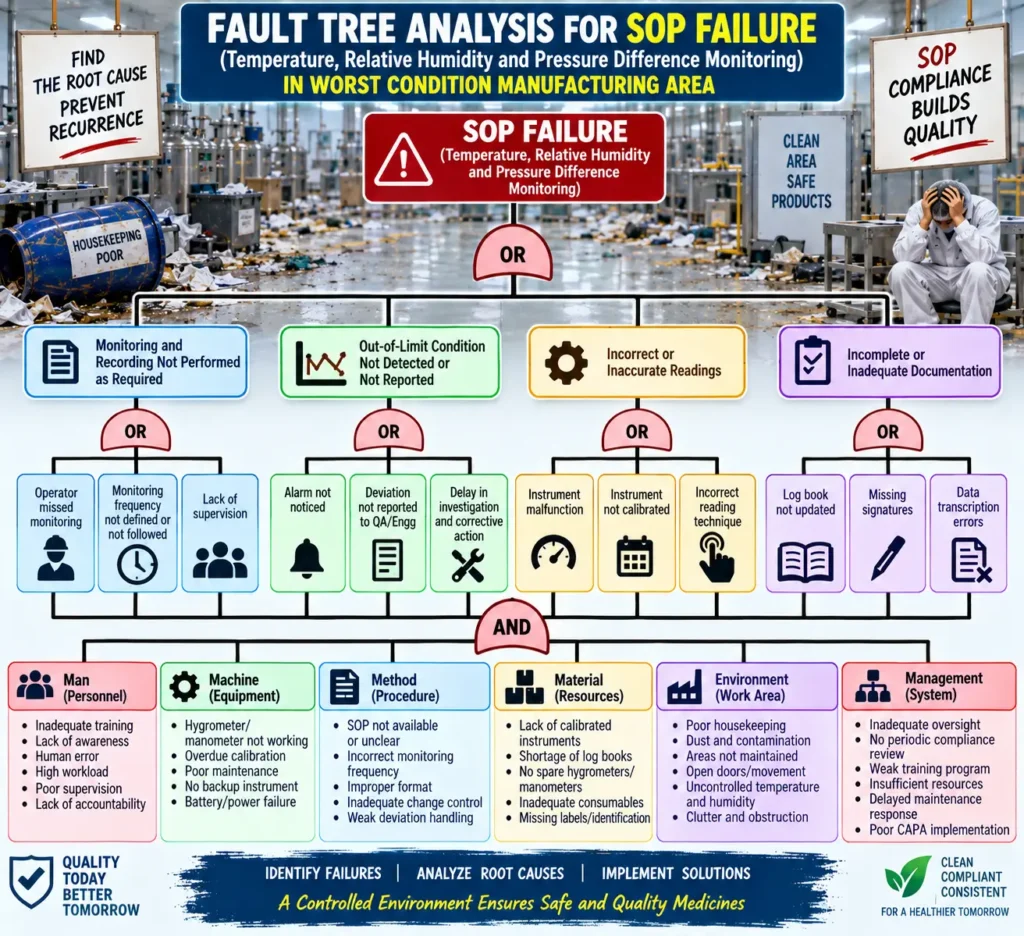
Potential basic causes include inadequate training, lack of supervision, incorrect monitoring frequency, instrument malfunction, overdue calibration, poor maintenance, incomplete logbooks, missing signatures, and delayed response to deviations. The SOP specifically requires escalation to Quality Assurance and Maintenance/Engineering when environmental parameters are outside specified limits. This analysis helps identify the pathways leading to SOP failure so that targeted corrective and preventive actions can strengthen monitoring reliability, documentation, equipment control, and overall environmental compliance.
8. Impact Assessment – Temperature, Relative Humidity and Pressure Difference Monitoring
The impact assessment evaluates the consequences of failure to follow the SOP for temperature, relative humidity, and pressure difference monitoring in pharmaceutical controlled areas. Poor environmental monitoring can affect product quality, manufacturing continuity, documentation reliability, and overall GMP control.Failure to detect or respond to out-of-limit temperature or humidity conditions may require production activities to be stopped and investigated, as specified in the SOP. Similarly, pressure differential deviations require immediate notification to Quality Assurance and Engineering, followed by investigation and rectification.
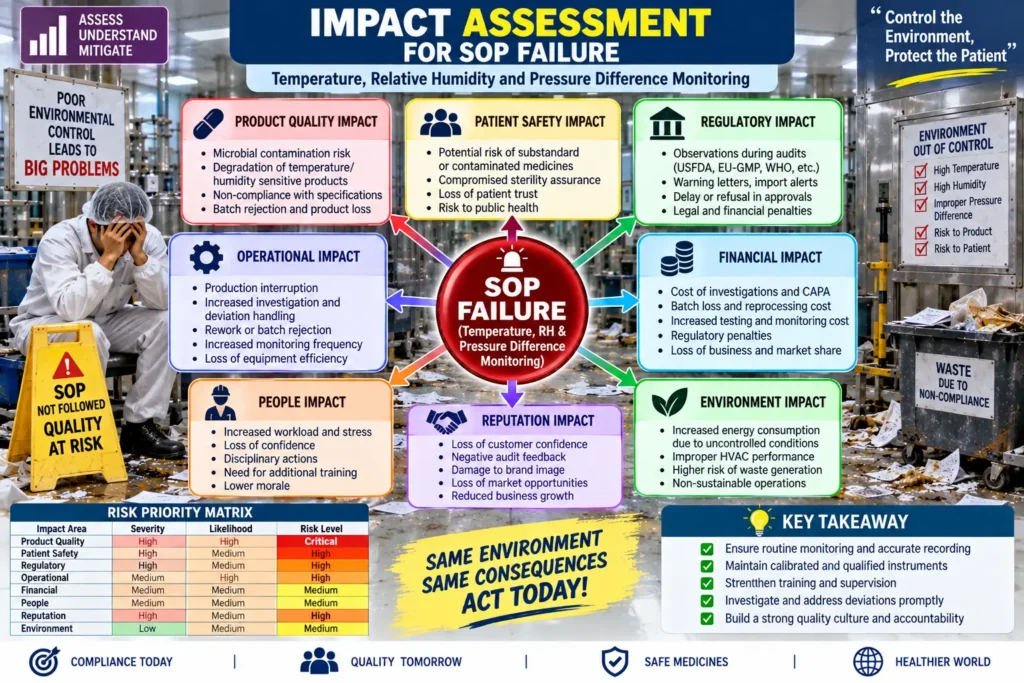
The potential impact includes increased deviation investigations, production interruption, additional monitoring, possible batch assessment, and greater workload for QA, Production, and Engineering. Incomplete or delayed environmental records may also weaken traceability and make it difficult to demonstrate that required conditions were maintained throughout processing. Therefore, routine monitoring, timely recording, calibrated instruments, effective supervision, and prompt investigation of deviations are essential to minimize risk and maintain reliable environmental control.
Questions & Answers – Temperature, Relative Humidity and Pressure Difference Monitoring
Q1. What is the objective of this SOP?
Answer: The objective is to provide a procedure for monitoring temperature, relative humidity, and pressure difference in controlled areas.
Q2. Where is this SOP applicable?
Answer: It is applicable to controlled areas of Production, Quality Control, and Warehouse departments where temperature, relative humidity, and pressure differential are monitored and recorded.
Q3. Which instruments are used for environmental monitoring?
Answer: The SOP specifies use of digital hygrometers, wet-and-dry bulb hygrometers (sling type), and manometers.
Q4. Who is responsible for execution of the SOP?
Answer: Production, Warehouse, Quality Control, and Maintenance departments are responsible for execution, while the Assistant Manager and Head-QA/QC are responsible for effective implementation.
Q5. How is relative humidity determined using a manual hygrometer?
Answer: The wet and dry bulb readings are taken, the wet-bulb temperature is subtracted from the dry-bulb temperature to obtain the depression value, and the relative humidity is then determined from the temperature and humidity chart.
Q6. What is the monitoring frequency for temperature and relative humidity using a wet-and-dry bulb hygrometer?
Answer: Readings are recorded at the start of the shift +30 minutes and every 4 hours ±30 minutes until completion of the activity.
Q7. What should be done if temperature or humidity is outside the specified limit?
Answer: The activity should be stopped and Quality Assurance and Maintenance should be informed. Engineering and QA must investigate the reason and rectify the condition.
Q8. What are the temperature and relative humidity limits for the production core area?
Answer: The acceptance criteria are temperature NMT 27°C and relative humidity NMT 60%.
Q9. What are the limits for liquid manufacturing and filling/sealing areas?
Answer: For these areas, the SOP specifies temperature NMT 30°C and relative humidity NMT 75%.
Q10. When should the HVAC be started before activity?
Answer: HVAC should be started 20 to 30 minutes before starting the activity in the area.
Q11. What is the monitoring frequency for pressure difference?
Answer: Pressure difference should be recorded at the start of the shift +30 minutes and every 2 hours ±30 minutes until completion of the activity or end of the shift.
Q12. What is the specified pressure differential limit?
Answer: The SOP specifies a pressure differential of 5–15 Pascal with respect to the passage.
Q13. What should be done if the pressure differential is not within limit?
Answer: The activity should be stopped and QA and Engineering should be informed. The cause should be investigated and rectified, and QA decides the line of action in case of major breakdown.
Q14. How often should the hygrometer and manometer be calibrated?
Answer: The SOP states that the hygrometer and manometer should be calibrated once yearly by an approved external party.
Q15. Why is zero checking of the manometer important?
Answer: The SOP requires checking the zero reading at the start of the shift before starting the AHU so that variation can be identified and Maintenance can be informed for rectification.
Reference Guideline – Temperature, Relative Humidity and Pressure Difference Monitoring
1. In-House Procedure / Standard Operating Procedure – The SOP itself specifies “In House” as the reference for temperature, relative humidity, and pressure difference monitoring. The supplied document does not cite any specific WHO, EU-GMP, USFDA, PIC/S, or ISO guideline as an official reference.