





1. Introduction – Wash Water / Swab Sampling and Analysis:
The Wash Water / Swab Sampling and Analysis procedure is established to verify the effectiveness of equipment cleaning by evaluating residues remaining on product-contact surfaces after cleaning. The SOP applies to wash water and swab sampling associated with batch-to-batch and product-to-product changeovers, as well as cleaning of new equipment used in production and warehouse areas. Under this procedure, Production initiates the sampling request and QC personnel collect appropriately identified wash water or swab samples. Wash water samples are collected from the final washing of equipment contact parts, while swab samples are obtained using pre-wetted polyester swabs over a defined 4 sq. inch surface area. Samples are subsequently evaluated by visual examination and, where required, chemical analysis using HPLC or UV spectrophotometry. The results provide documented evidence of equipment cleanliness and support appropriate equipment clearance before subsequent manufacturing activities.
Skip to PDF content2. Flow Diagram – Wash Water / Swab Sampling and Analysis:
The flow diagram illustrates the systematic process for wash water and swab sampling and analysis after equipment cleaning. The process begins when Production informs QC and generates the Wash Water/Swab Analysis Request-cum-Report. The details are entered in the relevant register and a unique serial number is allotted before QC personnel collect the samples.
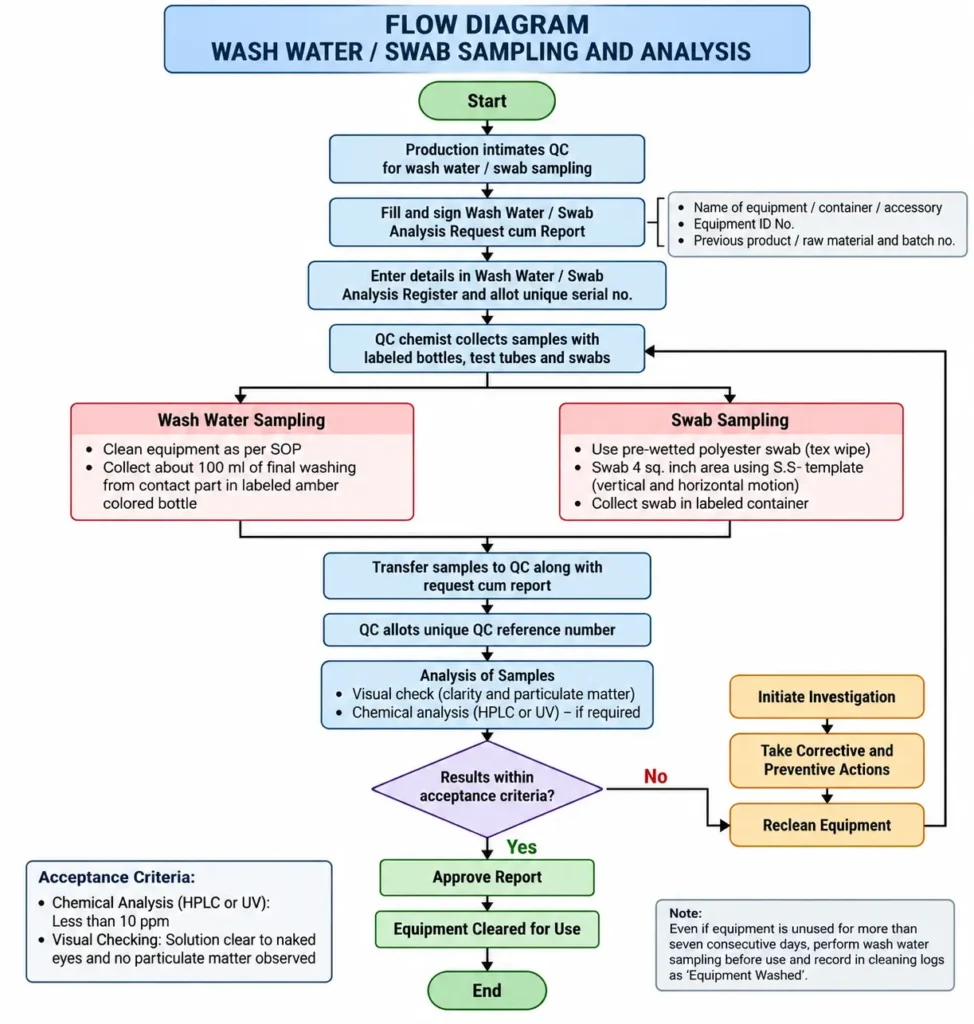
For wash water sampling, approximately 100 mL of the final washing is collected from equipment contact parts in a labelled amber-coloured bottle. For swab sampling, a pre-wetted polyester swab is used over a defined 4 sq. inch surface area using vertical and horizontal strokes. The samples are transferred to QC, assigned a QC reference number, and evaluated visually and/or chemically by HPLC or UV spectrophotometry. Results meeting acceptance criteria lead to equipment clearance, while failures require investigation and corrective and preventive action.
3. Benefits of Following SOP – Wash Water / Swab Sampling and Analysis:
Following the SOP for Wash Water / Swab Sampling and Analysis provides a standardized system for confirming the effectiveness of equipment cleaning after batch-to-batch or product-to-product changeover and for newly cleaned equipment. It helps ensure that sampling is performed consistently using defined wash-water and swab techniques, including controlled sampling locations, suitable containers, proper solvents, and specified surface areas.
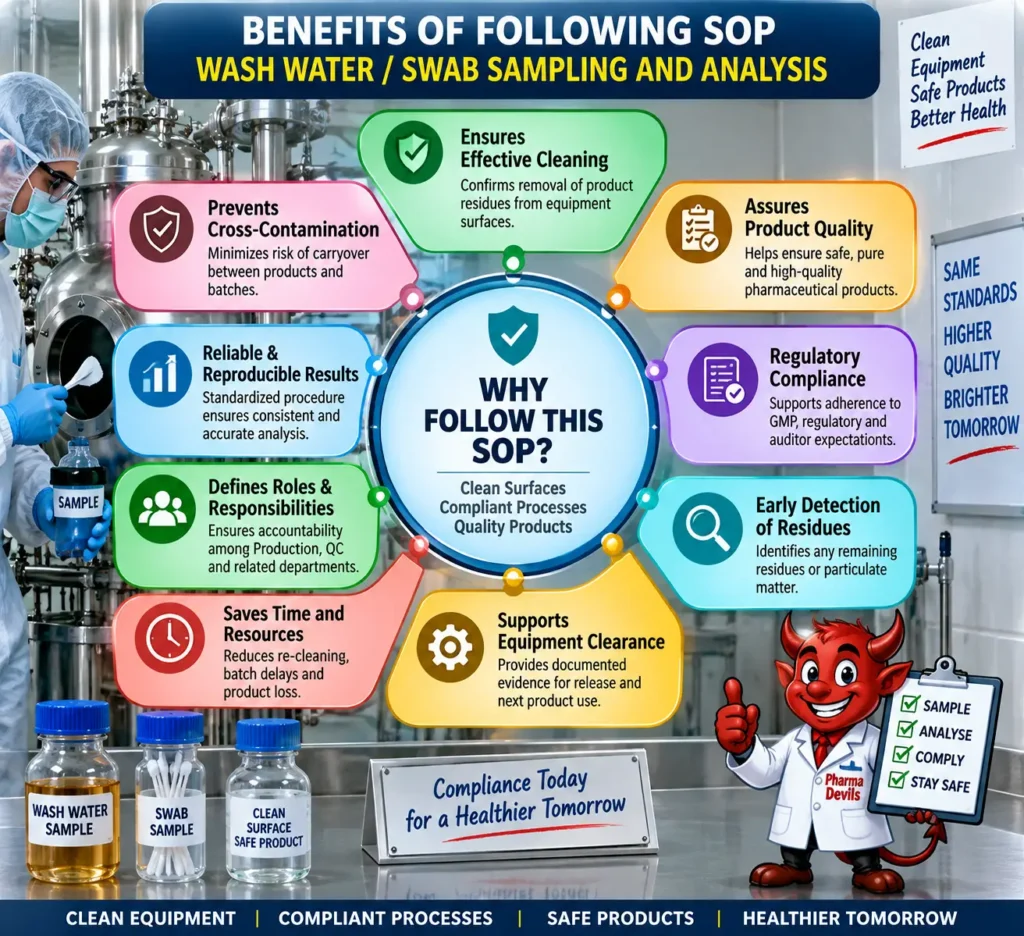
Compliance with this SOP supports reliable visual and chemical evaluation of residues using HPLC or UV spectrophotometry and helps verify that samples meet established acceptance criteria before equipment clearance. It also improves traceability through documented requests, serial numbers, QC reference numbers, registers, and approved reports. When results fail to meet requirements, the SOP requires investigation and corrective and preventive actions, supporting controlled resolution of cleaning failures. Overall, adherence promotes consistent documentation, effective cleaning verification, equipment readiness, and better control of potential residue carryover.
4. Brainstorming for SOP Failure – Wash Water / Swab Sampling and Analysis:
Brainstorming for SOP failure in the core area helps identify possible causes of non-compliance with the procedure for wash water and swab sampling and analysis. The SOP requires proper production intimation, completion of the sampling request, entry in the analysis register, allocation of a unique serial number, and collection of appropriately labelled samples by QC personnel. Potential causes of failure may include inadequate personnel training, incomplete documentation, incorrect sample labelling, improper swabbing technique, use of unsuitable solvent, incorrect sampling area, delayed transfer of samples, equipment cleaning deficiencies, and poor coordination between Production, IPQA, and QC.
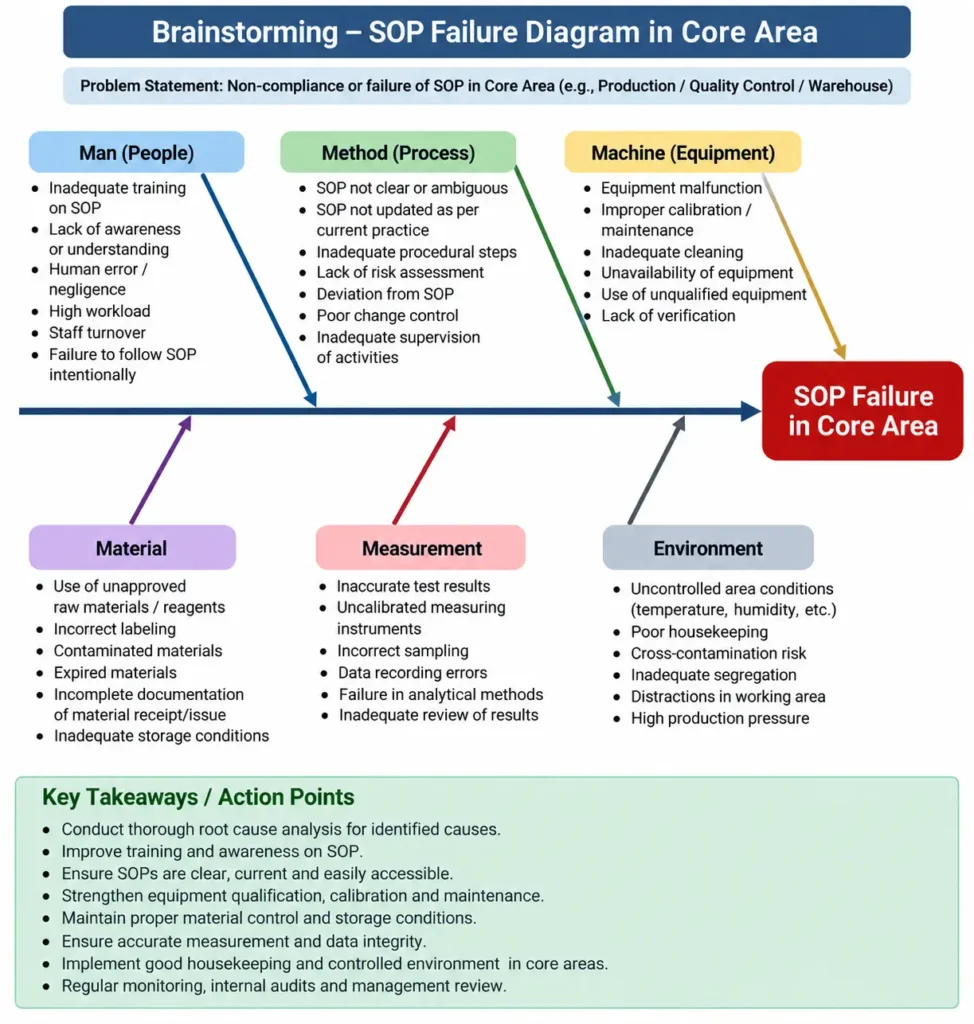
Analytical failures may also result from incorrect HPLC/UV testing, calculation errors, uncalibrated instruments, or improper recording of results. The brainstorming process should also consider environmental conditions, supervision, workload, and communication gaps. Identified causes should be investigated systematically, followed by appropriate corrective and preventive actions to prevent recurrence.
5. 5-Why Analysis for SOP Failure – Wash Water / Swab Sampling and Analysis:
The 5-Why Analysis is used to identify the root cause of failure in following the Wash Water / Swab Sampling and Analysis SOP within the core area. The first “Why” identifies that required sampling or analysis steps were not performed according to the approved procedure. The second “Why” may indicate inadequate training or lack of awareness among personnel. The third “Why” can reveal ineffective training assessment, insufficient supervision, or poor monitoring of SOP compliance. The fourth “Why” may highlight inadequate QA oversight, weak review of records, or insufficient internal checks.
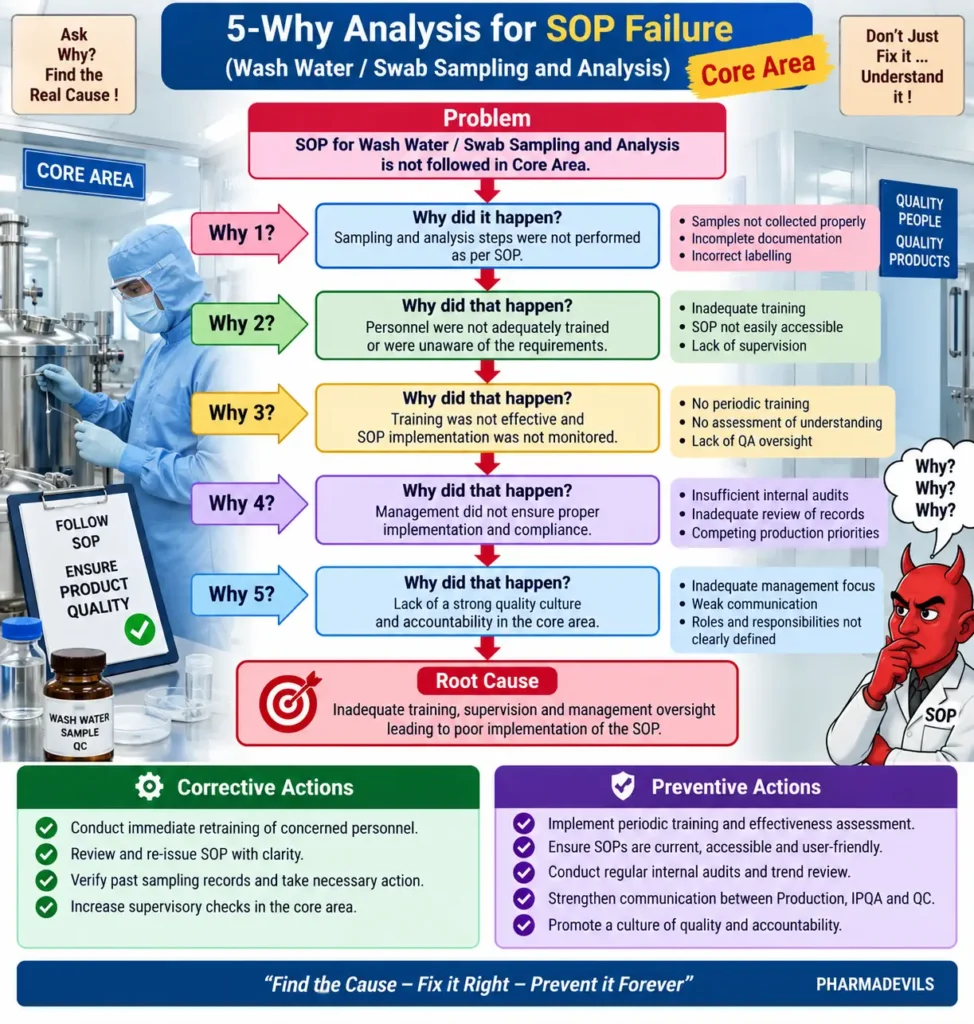
The fifth “Why” can identify gaps in management control, communication, and quality culture. The SOP requires correct sample collection, proper documentation, QC reference allocation, visual or chemical analysis, and compliance with defined acceptance criteria. Identifying the true root cause enables appropriate CAPA, retraining, stronger supervision, improved documentation control, and prevention of recurrence.
6. Fishbone Analysis for SOP Failure – Wash Water / Swab Sampling and Analysis:
Fishbone Analysis is used to identify and organize the potential causes responsible for failure of the Wash Water / Swab Sampling and Analysis SOP in the core area. The causes can be grouped under major categories such as Man, Method, Machine, Material, Measurement, and Environment. Personnel-related causes may include inadequate training, lack of awareness, human error, and insufficient supervision. Method-related causes may involve unclear procedures, incorrect sampling technique, improper solvent selection, or deviation from approved instructions.
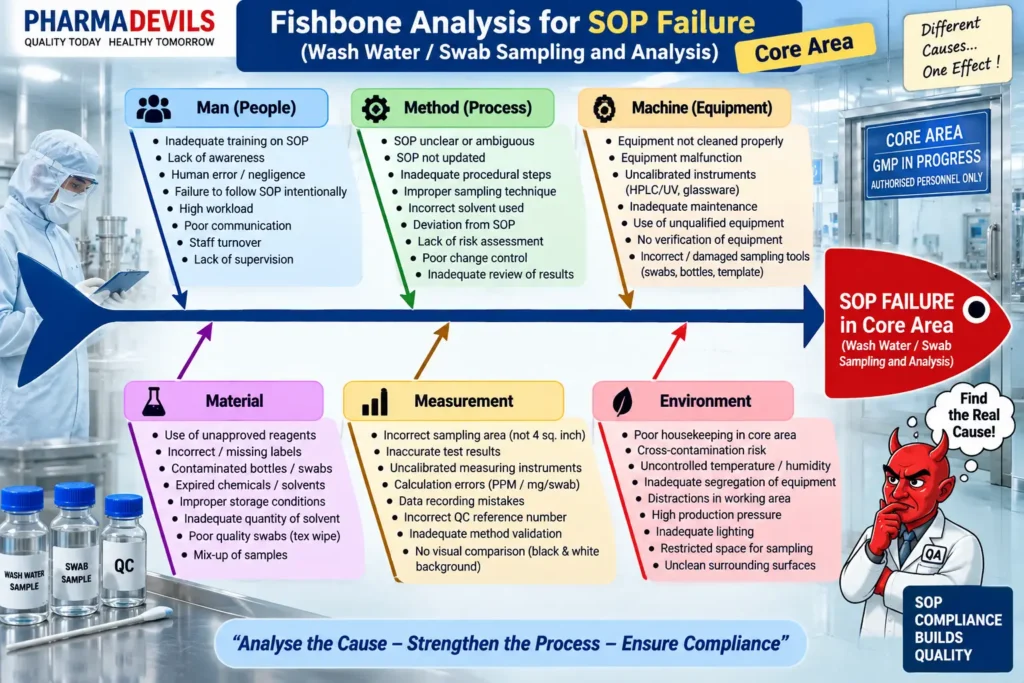
The SOP specifies use of pre-wetted polyester swabs and a defined 4 sq. inch sampling area, making correct technique essential. Equipment and measurement-related causes may include uncalibrated instruments, incorrect HPLC/UV analysis, or calculation errors. Material-related causes may involve incorrect labels, contaminated sampling tools, or unsuitable solvents. Environmental causes such as poor housekeeping, cross-contamination, and inadequate segregation can also contribute to SOP failure and should be controlled through appropriate CAPA.
7. Fault Tree Analysis for SOP Failure – Wash Water / Swab Sampling and Analysis:
Fault Tree Analysis evaluates the possible causes leading to the top event, failure of the Wash Water / Swab Sampling and Analysis SOP in the core area. Major contributing branches may include documentation failure, sampling failure, analytical failure, equipment or instrument issues, and inadequate personnel control. Sampling-related causes can include incorrect sample identification, improper pre-wetting of swabs, failure to use the defined 4 sq. inch sampling area, or improper wash-water collection.
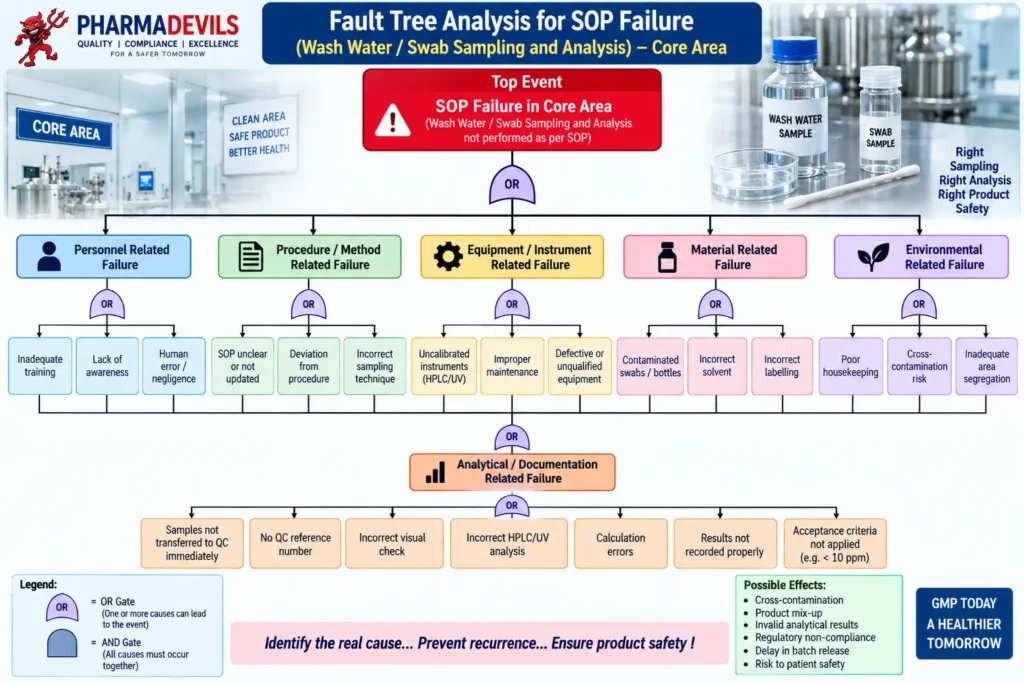
Analytical failures may result from incorrect visual examination, improper HPLC or UV analysis, calculation errors, or failure to apply specified acceptance criteria. Additional basic causes include inadequate training, weak supervision, incomplete records, incorrect QC reference allocation, and poor communication between Production, IPQA, and QC. The analysis helps identify critical failure paths so that investigation, CAPA, retraining, verification, and stronger procedural controls can be implemented to prevent recurrence.
8. Impact Assessment for SOP Failure – Wash Water / Swab Sampling and Analysis:
Impact assessment evaluates the consequences of failure to follow the Wash Water / Swab Sampling and Analysis SOP in the core area. Improper sampling, testing, or documentation may lead to unreliable cleaning verification and failure to demonstrate adequate removal of product residues. The SOP requires visual examination and chemical analysis by HPLC or UV, with defined acceptance criteria for sample clearance.
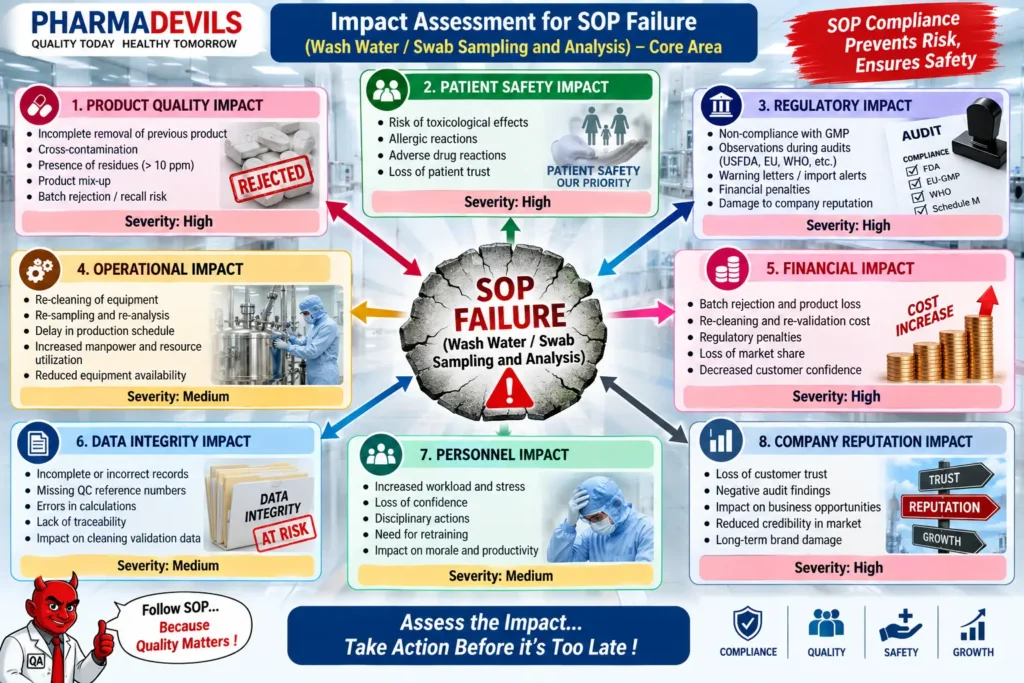
Failure may therefore result in repeat sampling, re-analysis, equipment re-cleaning, delayed equipment release, and interruption of production activities. Incorrect records, missing QC reference numbers, calculation errors, or incomplete reports may also affect data traceability and the reliability of cleaning-validation documentation. Where samples do not meet acceptance criteria, the SOP requires investigation and implementation of corrective and preventive actions. From a quality-risk perspective, unresolved failures may increase the risk of cross-contamination, regulatory observations, batch-release delays, additional operational cost, and reduced confidence in the cleaning-control system.
Questions & Answers – Wash Water / Swab Sampling and Analysis:
- What is the objective of this SOP?
To provide a procedure for analysis of wash-water and swab samples after cleaning of equipment. - Where is this SOP applicable?
It applies to wash-water and swab sampling and analysis during batch-to-batch or product-to-product changeovers and cleaning of new equipment used in production and warehouse areas. - Who is responsible for execution of the SOP?
The Chemist/Executive-QA is responsible for execution, while Asst. Manager-QA, Head-QA/QC and related departments are responsible for effective implementation. - How much wash-water sample should be collected?
About 100 mL for each active ingredient to be estimated, collected in a labelled amber-coloured bottle from the final washing of equipment contact parts. - Which type of swab is used for sampling?
A polyester swab, specified in the SOP as Texwipe, is used. - What surface area should be swabbed?
The defined swabbing area is 4 square inches, using an SS template. - How should swabbing be performed?
The surface is swabbed first in a vertical motion and then horizontally after rotating the swab by 90°. - Where are samples transferred after collection?
Samples are immediately transferred to the Quality Control department along with the wash-water/swab analysis request-cum-report. - How are chemical samples analyzed?
Samples requiring chemical analysis are analyzed using HPLC or UV Spectrophotometer according to the prescribed analytical method. - What is the chemical-analysis acceptance criterion given in the SOP?
The SOP specifies less than 10 ppm for chemical analysis by HPLC or UV Spectrophotometer. - What is the visual acceptance criterion?
The solution should be clear to the naked eye and no particulate matter should be observed. - What should be done if the sample fails the acceptance criteria?
An investigation should be carried out, followed by appropriate corrective and preventive actions.
Reference Guidelines – Wash Water / Swab Sampling and Analysis:
- EU Guidelines for GMP – Annex 15: Qualification and Validation — principles for cleaning validation, sampling, acceptance criteria, and documented evidence of cleaning effectiveness.
- U.S. FDA – Guide to Inspections of Validation of Cleaning Processes — guidance on establishing cleaning procedures, sampling approaches, analytical methods, and residue evaluation.
- PIC/S PI 006 – Recommendations on Validation Master Plan, Installation and Operational Qualification, Non-Sterile Process Validation and Cleaning Validation — guidance for cleaning-validation strategy and verification.
- WHO GMP Guidelines — requirements concerning prevention of contamination/cross-contamination, equipment cleaning, documentation, and validated cleaning procedures.
- ICH Q9 – Quality Risk Management — risk-based evaluation of cleaning failures, sampling locations, controls, investigations, and CAPA.
- ICH Q10 – Pharmaceutical Quality System — supports deviation management, CAPA, change management, training, and continual improvement associated with cleaning controls.
- Approved site Cleaning Validation Protocol/Report, Analytical Method, Equipment Cleaning SOP, and Wash Water/Swab Sampling SOP — applicable internal controlled documents.