
Brief Description
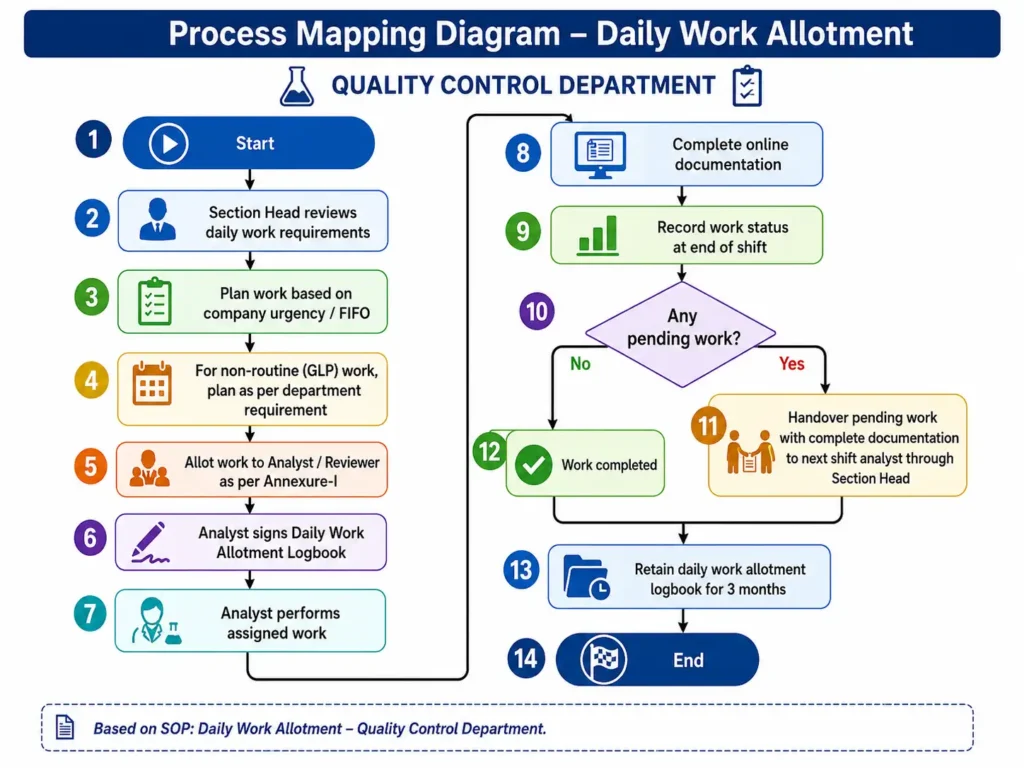
The Daily Work Allotment SOP describes the system for assigning and monitoring daily activities in the Quality Control Department. Its purpose is to ensure that work is properly planned, distributed, documented, and completed in an organized manner. The Section Head assigns work to Analysts or Reviewers every day according to company urgency or the FIFO (First In, First Out) principle. For non-routine activities, work is allotted according to departmental requirements.
During work allocation, the analyst signs the Daily Work Allotment Logbook and performs the assigned activity with proper online documentation. At the end of the shift, the current work status is recorded. Any pending work is handed over to the analyst of the next shift through the Section Head along with complete documentation. Daily work allotment records are retained for three months. Annexure-I provides the format for recording the employee name, assigned work, analyst signature, status, and verification.
1. Flow Diagram:
The Work Allotment Flow Diagram shows the step-by-step process used for assigning and completing daily work in the Quality Control Department. The process starts when the Section Head reviews daily work requirements and plans activities according to company priority or FIFO (First In, First Out). Non-routine work is planned according to departmental requirements.