






Brief Description
The SOP for Certificate of Analysis (COA) describes the standardized procedure for preparing and issuing Certificates of Analysis for finished products, raw materials, and packing materials. Its objective is to ensure that analytical results, product/material details, specifications, observations, release information, and approval status are documented in a consistent and controlled format. The SOP assigns responsibility to QC Chemists for execution and to the Lab QA Manager/Manager QC for effective implementation. The COA is structured into defined sections containing company and material/product information, batch and analytical reference numbers, manufacturing and expiry dates, sampling details, specifications, pharmacopoeial and additional tests, results, remarks, and authorized signatures. Only one original COA is generated, with photocopies used for further requirements. The SOP also defines training, document distribution, abbreviations, revision history, and separate annexure formats for finished products, raw materials, and packing materials.
Skip to PDF content1. Flow Diagram:
The flow diagram explains the step-by-step process for preparing and issuing a Certificate of Analysis (COA) for finished products, raw materials, and packing materials. The process begins with receiving the COA requirement and collecting the necessary analytical and batch information. Depending on the material type, the relevant COA format is selected and details such as product or material name, A.R. number, batch number, manufacturing and expiry dates, sampling details, specifications, test results, and observations are entered.
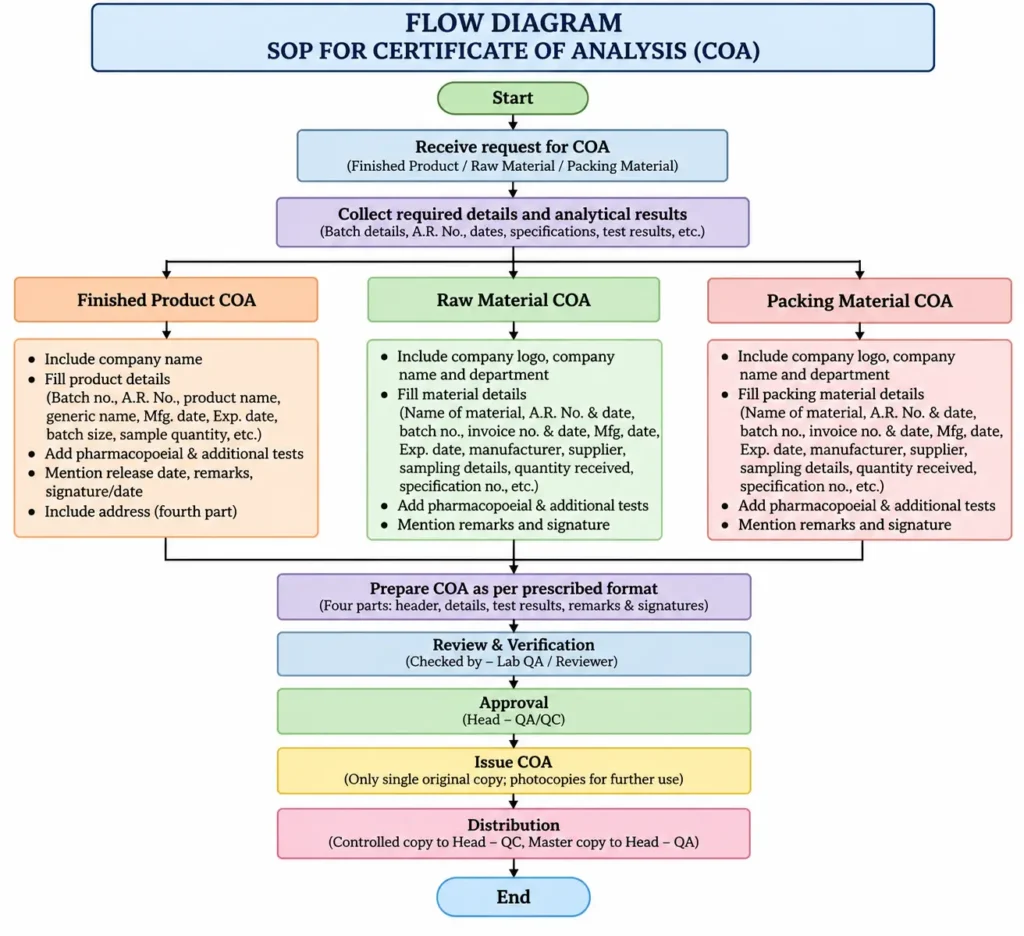
The completed COA is then reviewed and verified by the designated QC/Lab QA personnel and approved by the Head QA/QC. The SOP specifies that only one original COA is generated, while photocopies may be used for further requirements.Finally, controlled copies are distributed to Quality Control and the master copy is retained by Quality Assurance, ensuring proper documentation and traceability.
2. Brainstorming for SOP Failure:
The brainstorming diagram identifies possible reasons for failure of the SOP for Certificate of Analysis (COA) using flower-shaped sticky notes. The SOP requires QC personnel to prepare COAs for finished products, raw materials, and packing materials with correct product or material details, analytical reference numbers, batch information, specifications, test results, remarks, and authorized signatures.The flower petals group potential failure causes into major areas such as People, Method, Material, Machine/System, Measurement, Environment, Management, and Documentation. Examples include inadequate training, unclear procedures, incorrect batch or A.R. numbers, missing test results, outdated specifications, transcription mistakes, system or printer failure, missing signatures, delayed approval, and improper document distribution.
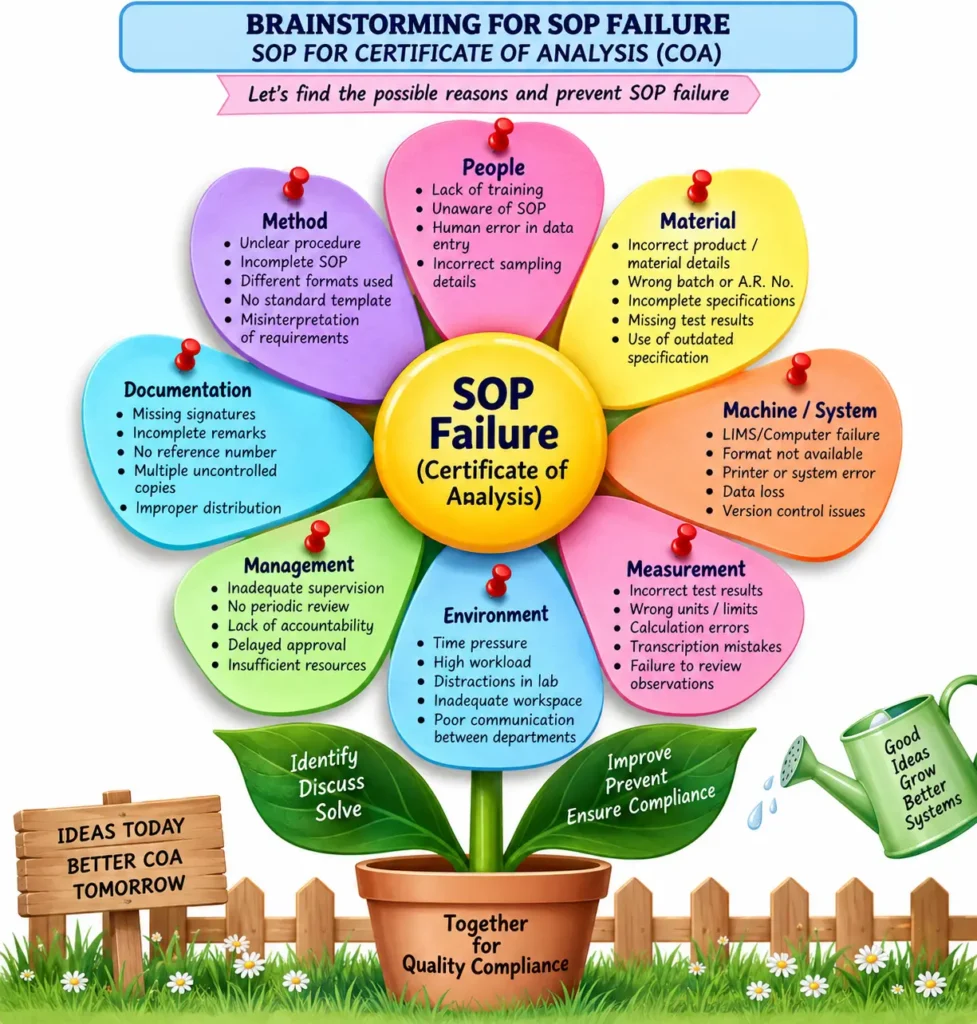
This brainstorming approach helps the quality team systematically identify weaknesses that may lead to incorrect or incomplete COAs. Discussing these causes supports better root-cause identification, corrective actions, prevention of repeat errors, and improved compliance with the approved SOP.
3. 5-Why Analysis for SOP Failure:
The 5-Why Analysis diagram explains the possible root cause of failure in the SOP for Certificate of Analysis (COA). The problem begins when a COA is prepared with incorrect or incomplete entries. Further questioning identifies missing or wrongly entered product/material details, batch information, analytical results, or specifications. The next “Why” highlights failure to properly follow the approved COA format and required checking steps. The analysis then points toward inadequate personnel training, insufficient review, and weak supervision, followed by poor periodic monitoring and document-control practices.
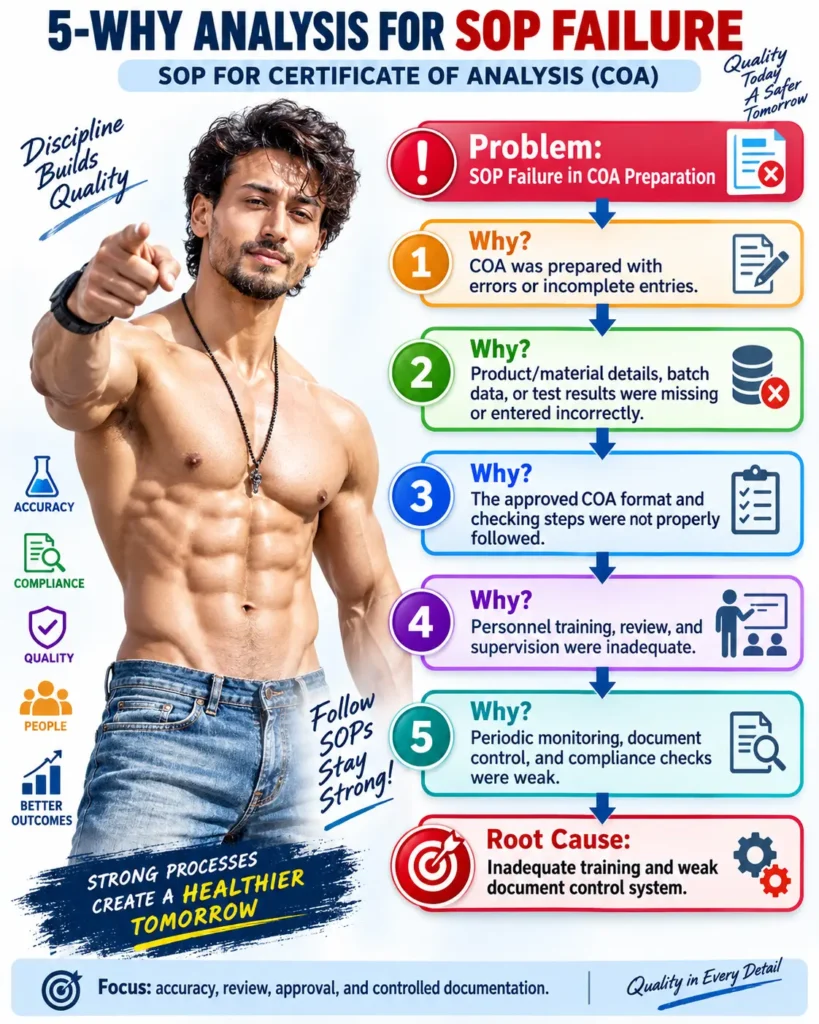
The SOP requires QC personnel to correctly execute the COA preparation process and Lab QA/Manager QC to ensure effective implementation. It also requires complete test information, remarks, signatures, and appropriate review/approval.The analysis concludes that the main root cause is inadequate training combined with a weak document-control and compliance-monitoring system.
4. Fishbone Diagram for SOP Failure:
The Fishbone Diagram presents possible root causes that may lead to failure of the SOP for Certificate of Analysis (COA). The SOP covers preparation of COAs for finished products, raw materials, and packing materials, with responsibilities assigned to QC and Lab QA personnel.
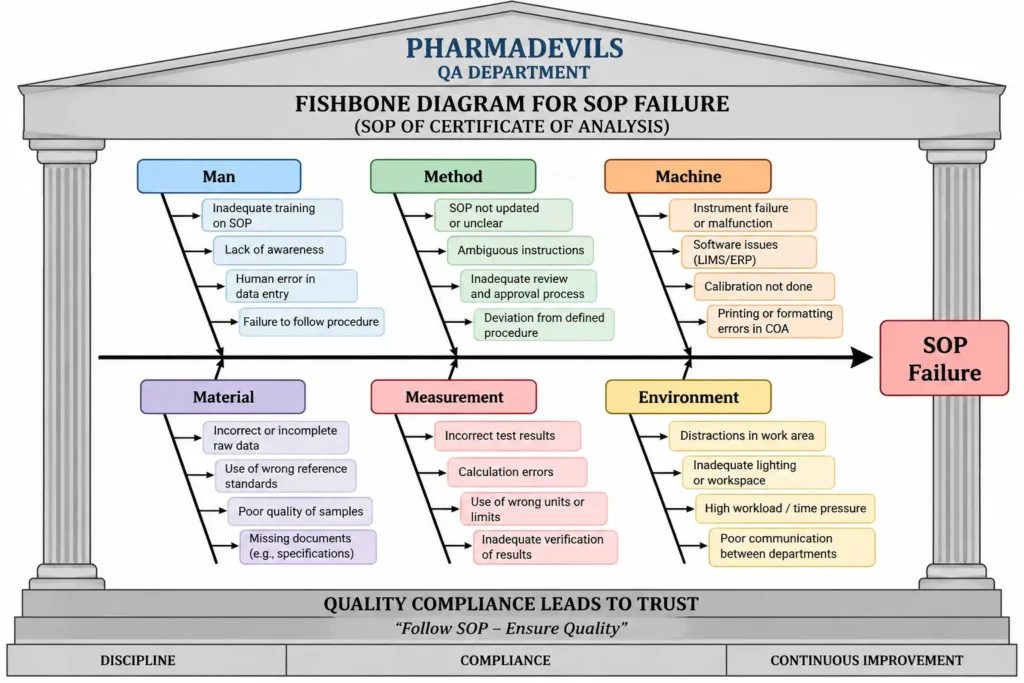
The temple-style diagram groups potential causes into six major categories: Man, Method, Machine, Material, Measurement, and Environment. Human-related causes include inadequate training, lack of awareness, data-entry mistakes, and failure to follow procedures. Method-related causes include unclear instructions, outdated procedures, and inadequate review or approval. Equipment or software problems may affect COA preparation, while incorrect raw data, specifications, test results, calculations, or limits can create documentation errors. Environmental factors such as workload, distractions, poor communication, and unsuitable workspace conditions may further increase the risk of SOP failure.The diagram emphasizes that discipline, compliance, proper verification, and continuous improvement are essential for reliable COA preparation and quality assurance.
5. Fault Tree Analysis for SOP Failure:
The Fault Tree Analysis (FTA) poster shows the possible causes that can lead to failure of the SOP for Certificate of Analysis (COA). The top event is “SOP Failure,” meaning the COA may be prepared inaccurately, incompletely, or without following the approved procedure.
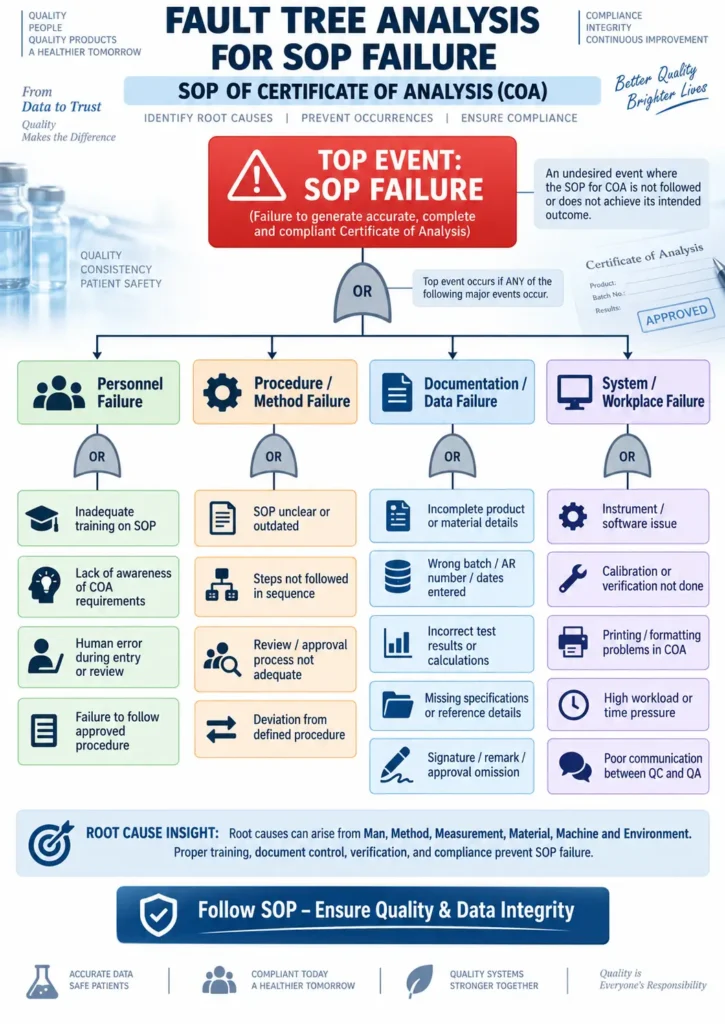
The analysis groups the causes into four major branches: Personnel Failure, Procedure/Method Failure, Documentation/Data Failure, and System/Workplace Failure. Personnel-related causes include inadequate training, lack of awareness, human error, and failure to follow the approved SOP. Method failures may result from unclear or outdated instructions, incorrect sequence of steps, inadequate review, or deviation from the defined procedure. Documentation failures include incomplete material or product details, incorrect batch or A.R. information, wrong test results, missing specifications, and absent signatures or remarks. The SOP itself requires defined COA information, testing details, remarks, and authorization signatures. The poster emphasizes training, verification, document control, communication, and compliance to prevent SOP failure and ensure reliable COA preparation.
Questions & Answers – SOP of Certificate of Analysis
Q1. What is the objective of this SOP?
Answer: The objective is to lay down a procedure for preparation of the Certificate of Analysis (COA).
Q2. What is the scope of this SOP?
Answer: The SOP is applicable to finished product, raw material, and packing material.
Q3. Who is responsible for execution of the SOP?
Answer: The Chemist QC is responsible for execution of the SOP.
Q4. Who is responsible for effective implementation of the SOP?
Answer: The Lab QA Manager/Manager Q.C. is responsible for effective implementation.
Q5. How many parts does a Certificate of Analysis contain?
Answer: The COA contains four parts.
Q6. What information is entered in the finished-product COA?
Answer: Information includes product name, A.R. No., batch number, release date, manufacturing date, expiry date, manufacturer, manufacturing licence number, marketed by, reference number/date, sampled by, sampled quantity, specification number, and batch size.
Q7. What information is entered in the raw-material and packing-material COA?
Answer: It includes material name, A.R. No. and date, batch number, invoice details, manufacturing and expiry dates, manufacturer, supplier, sampling details, quantity received, sampled quantity, reference details, and specification number.
Q8. What does the third part of the COA contain?
Answer: It contains pharmacopoeial tests and additional tests for the applicable material or product.
Q9. What does the fourth part of the COA contain?
Answer: It contains the remark and signatures for preparation, checking, and approval.
Q10. How many original copies of a COA are generated?
Answer: Only one original copy of the COA is generated. Further copies are made by photocopying.
Q11. Who provides training for this SOP?
Answer: The trainer is the Manager – Quality Control.
Q12. Who are the trainees for this SOP?
Answer: The trainees are Quality Control personnel.
Q13. What is the training duration?
Answer: The training period is half an hour.
Q14. Who keeps the controlled copy and master copy of the SOP?
Answer: The controlled copy is with the Head of Department – Quality Control, while the master copy is with the Head of Department – Quality Assurance.
Q15. What does COA stand for?
Answer: COA stands for Certificate of Analysis.
Q16. What does A.R. No. stand for?
Answer: A.R. No. stands for Analytical Reference Number.
Q17. What are RM and PM?
Answer: RM means Raw Material and PM means Packing Material.
Q18. What should be verified before approving a COA?
Answer: Product or material details, test results, limits, remarks, and required signatures should be complete as specified in the COA format before approval.