







Brief Description
The Stability Studies of Drugs SOP describes the documentation and monitoring system used to evaluate the quality of pharmaceutical products during storage under defined temperature and relative humidity conditions. The SOP contains stability test report formats for liquid and tablet products, covering parameters such as description, pH or average weight, disintegration, hardness, dissolution, related substances, assay, viscosity, and microbiological examination, as applicable.It also provides formats for tracking stability schedules, due dates, completed testing dates, stability summaries, sample labels, sample storage locations, pull-out records, and additional sample withdrawal approvals. Defined storage conditions include 25±2°C/60±5% RH, 30±2°C/75±5% RH, and 40±2°C/75±5% RH. The stability protocol covers product and batch details, packaging, storage conditions, study design, testing intervals, specifications, OOS, deviations, change control, equipment malfunction, commitments, and conclusions. Overall, the SOP ensures systematic documentation, traceability, and assessment of product stability throughout the assigned study period.
Skip to PDF content1. Flow Diagram:
The Flow Diagram for Stability Studies of Drugs presents the stability-study process in a simple window-style format. The process begins with preparation and approval of the stability protocol, including product, batch, packaging, storage condition, study design, testing schedule, specifications, and responsibilities.
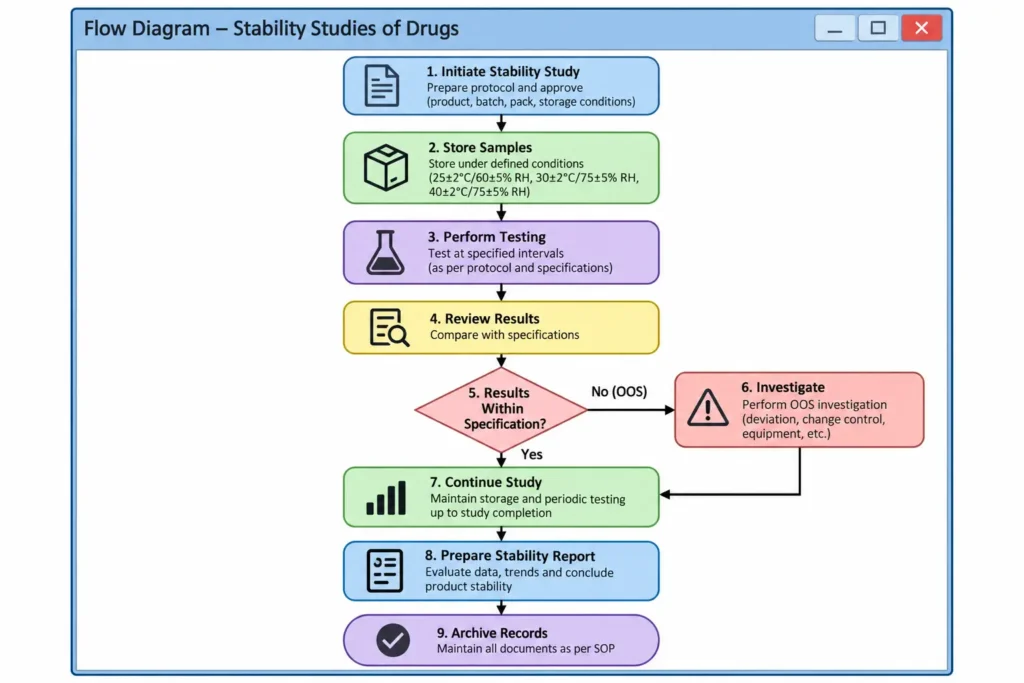
Stability samples are then stored under defined conditions such as 25±2°C/60±5% RH, 30±2°C/75±5% RH, and 40±2°C/75±5% RH. Samples are withdrawn at scheduled intervals and tested according to approved specifications. Results are reviewed to determine whether the product remains within specification. If an OOS, deviation, change control, or equipment/storage malfunction occurs, appropriate investigation and documentation are initiated.The study continues through the defined stability period, after which the data are summarized, reviewed, concluded, and maintained as controlled stability records.
2. Brainstorming for SOP Failure:
The Brainstorming Diagram for SOP Failure – Stability Studies of Drugs presents possible reasons why the stability-study procedure may not be followed effectively. The window-style sticky-note layout highlights potential failures such as inadequate personnel training, unclear SOP instructions, incorrect sample selection or labeling, delays in placing samples in stability chambers, incorrect testing intervals, use of unsuitable equipment, data-entry errors, and failure to follow approved specifications.
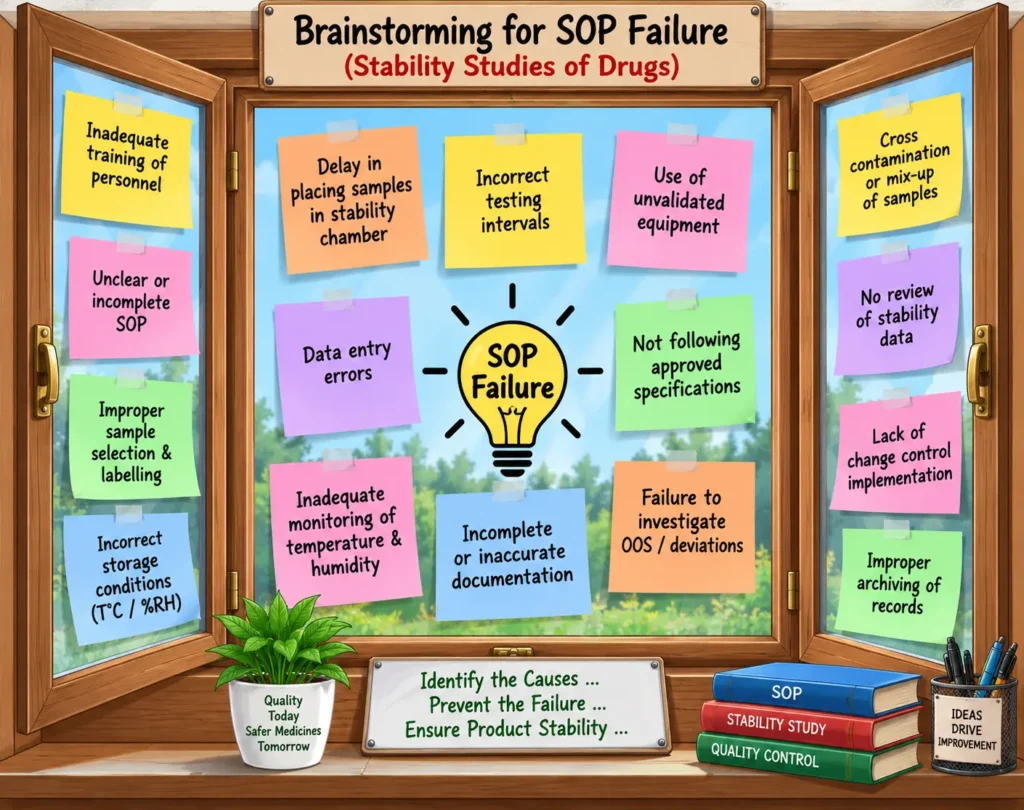
The diagram also emphasizes risks related to improper storage conditions, inadequate monitoring of temperature and humidity, incomplete documentation, sample mix-ups, insufficient review of stability data, weak change-control implementation, improper record archiving, and failure to investigate OOS results or deviations. These areas directly relate to the SOP requirements for controlled storage conditions, scheduled testing, OOS/deviation handling, change control, equipment malfunction, and stability reporting.Overall, the brainstorming exercise helps the QA/QC team identify potential weaknesses, determine root causes, and plan corrective and preventive actions to maintain reliable stability-study execution.
3. 5-Why Analysis for SOP Failure:
The 5-Why Analysis diagram is used to identify the root cause of failure in the Stability Studies of Drugs SOP. The analysis begins with the main problem: stability activities may be delayed or missed when samples are not pulled, tested, or documented at the required time points. The SOP specifically requires defined stability storage conditions, study intervals, testing schedules, and control of deviations or equipment malfunctions.
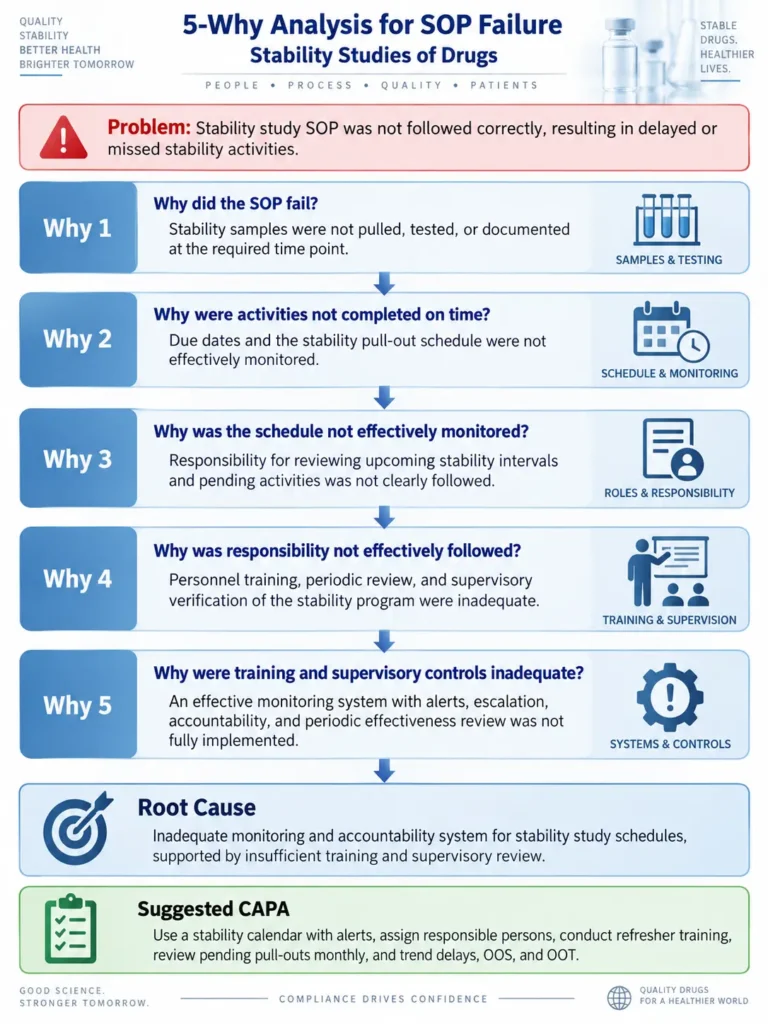
The analysis then explores why due dates were not effectively monitored, why responsibilities were not clearly followed, and why training and supervisory controls were insufficient. The final root cause is identified as an inadequate monitoring and accountability system for stability schedules, supported by insufficient training and periodic review. Corrective actions include using a stability calendar with alerts, assigning responsible personnel, conducting refresher training, reviewing pending pull-outs monthly, and trending delays, OOS, and OOT cases. The SOP also includes monthly stability KPIs to support such monitoring.
4. Fishbone Diagram for SOP Failure:
The Fishbone Diagram presents a structured root-cause analysis for failure of the Stability Studies of Drugs SOP using attractive sticky notes. It groups possible causes under Man, Method, Machine/Equipment, Material, Measurement, Environment, and Management. Key issues include inadequate SOP training, lack of awareness of stability time points, unclear procedures, missed deviation handling, stability chamber malfunction, calibration delays, improper sample labeling, incomplete records, temperature or humidity fluctuations, weak supervision, and unclear responsibilities.
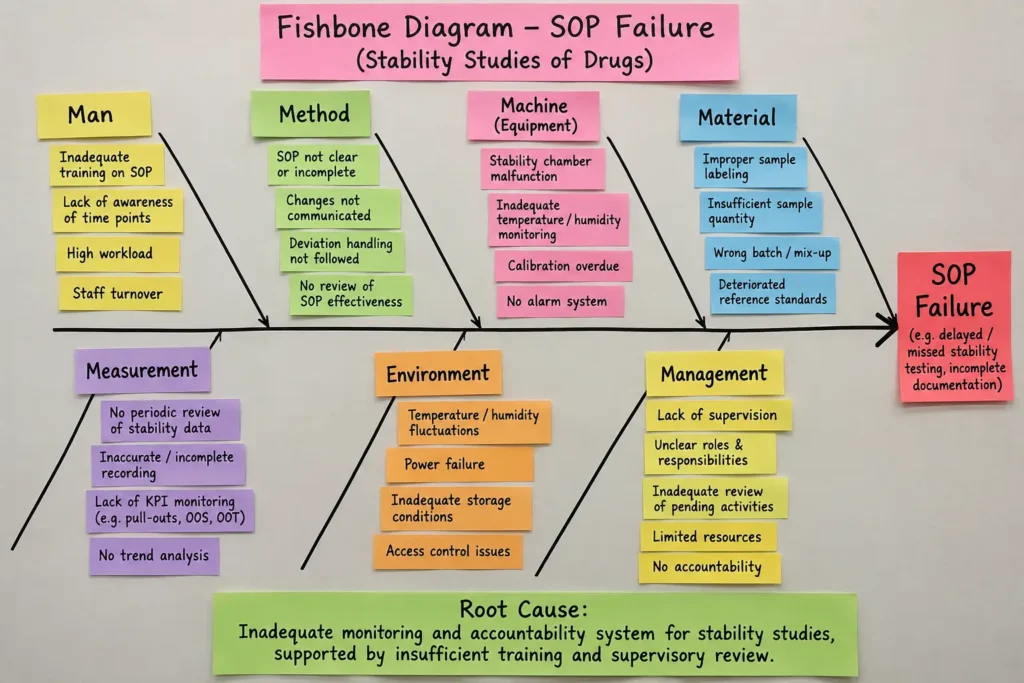
These causes can lead to delayed or missed stability sample pull-outs, testing, and documentation. The SOP requires defined storage conditions, study time points, testing schedules, deviation handling, and equipment/storage malfunction controls. It also provides a pull-out log for recording scheduled dates and deviations from the pull-out window.The diagram ultimately highlights inadequate monitoring, accountability, training, and supervisory review as major contributors to SOP failure.
5. Fault Tree Analysis for SOP Failure:
The Fault Tree Analysis (FTA) diagram systematically identifies the possible causes that may lead to failure of the Stability Studies of Drugs SOP. The top event is SOP Failure, which may occur due to the procedure not being followed, stability activities not being performed on time, or incomplete/incorrect documentation.
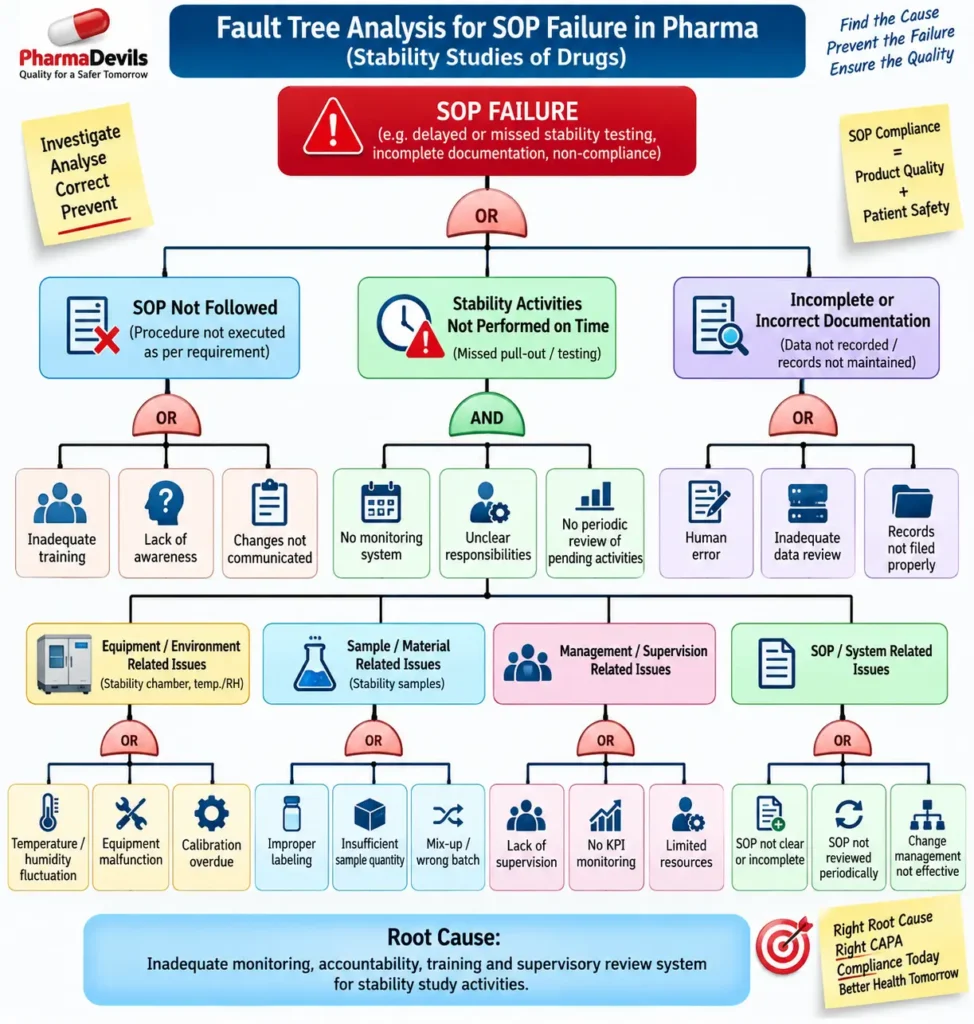
The analysis further divides these failures into contributing causes such as inadequate training, lack of awareness, poor monitoring of stability schedules, unclear responsibilities, human error, insufficient review, equipment malfunction, calibration delays, improper sample labeling, inadequate sample quantity, weak supervision, ineffective KPI monitoring, and deficiencies in SOP or change-management controls. The SOP itself requires defined stability study time points, testing schedules, handling of deviations, OOS, change control, and equipment or storage malfunction.The FTA ultimately highlights inadequate monitoring, accountability, training, and supervisory review as major root causes requiring effective CAPA.
Questions & Answers – SOP for Stability Studies of Drugs
Q1. What is the purpose of a stability study?
Answer: The SOP is designed to control the storage, scheduled testing, documentation, and evaluation of drug-product stability samples under defined conditions and time points.
Q2. What information should be included in a stability protocol?
Answer: The protocol should include purpose, scope, responsibilities, product and batch details, packaging details, storage conditions, study design, testing schedule, specifications, OOS, deviations, change control, equipment/storage malfunction, commitment, conclusion, attachments, and abbreviations.
Q3. What stability storage conditions are listed in the SOP?
Answer: The SOP lists 25±2°C/60±5% RH, 30±2°C/75±5% RH, and 40±2°C/75±5% RH for stability samples.
Q4. How are stability sample pull-outs controlled?
Answer: A Stability Samples Pull-Out Log records the product, batch number, storage condition, equipment number, sample location, pack interval, scheduled pull-out date, quantity withdrawn, AR number, person performing the activity, and any deviation from the pull-out window.
Q5. How is the location of stability samples documented?
Answer: A Sample Location Chart records storage condition, equipment number, tray number, product name, batch number, and the signatures and dates of the persons preparing and checking the record.
Q6. Is approval required for withdrawal of additional stability samples?
Answer: Yes. The SOP provides an approval form containing the department, product, batch number, stability condition, quantity to be withdrawn, reason, and signatures of the requester, reviewer, and approver.
Q7. What information is recorded in the Stability Sample Intimation Form?
Answer: It includes product name, pharmacopoeial grade, batch number, marketing status, manufacturing and expiry dates, unit name, active-material manufacturer, formulation or pack changes, reason for stability study, packaging details, storage condition, pack size, and applicable intervals.
Q8. What test information should be defined for stability samples?
Answer: The form requires specification number, test parameters, tests applicable at individual time points, initial analysis report status, sample quantity per interval, total sample quantity, extra OOS/OOT samples, and intervals for microbiological and viscosity testing.
Q9. What monthly KPIs are monitored under this SOP?
Answer: KPIs include stability batches incubated within or beyond 30 calendar days, monthly pull-outs, stability reports released within 30 days, and the number and closure status of valid OOS and OOT cases.
Q10. What should be investigated if a stability SOP activity fails?
Answer: The stability protocol specifically provides for review of OOS, deviations, change control, and equipment or storage malfunction as part of the stability-study system.
Q11. Why is a stability summary sheet important?
Answer: It provides a consolidated record of product and batch information, stability condition, due dates, test results, description, average weight, disintegration, assay, date of analysis, analyst signature, remarks, conclusion, checking, and approval.
Q12. What is the main quality objective of following the stability SOP correctly?
Answer: Correct execution helps ensure that stability samples are stored, withdrawn, tested, reviewed, and documented according to the approved study plan and scheduled intervals.