







Brief Description
A Computer Validation Plan explains how a computerized system will be checked and documented before it is used for regulated activities. Its main purpose is to provide documented evidence that the system performs its intended functions accurately and reliably.
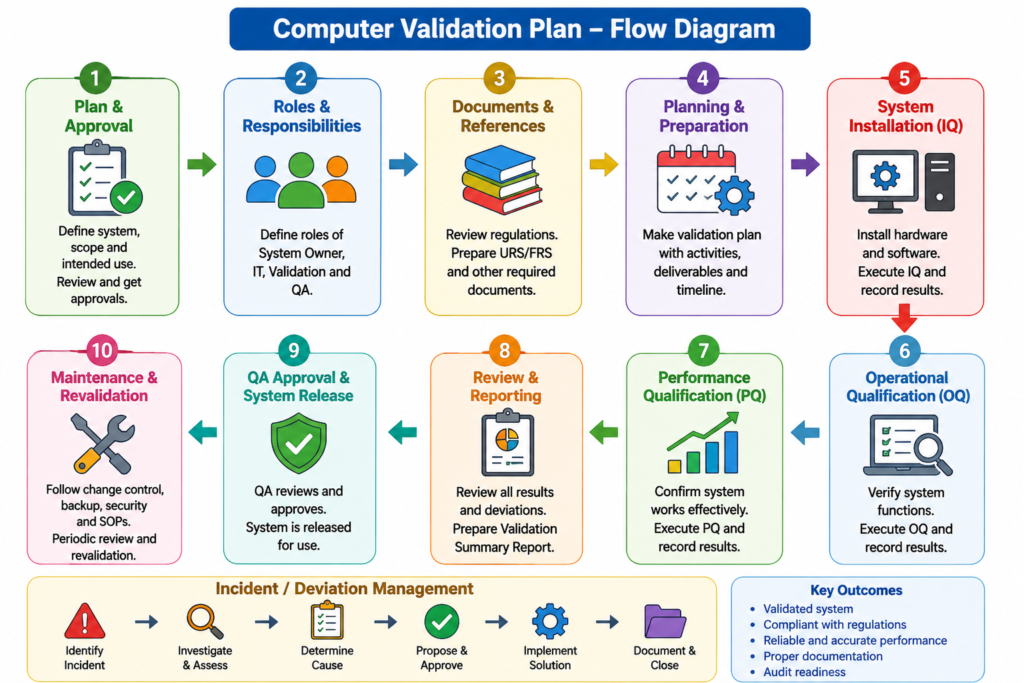
The plan defines the responsibilities of the System Owner/User, Computer Validation team, Information Technology, and Quality Assurance. It also describes important validation activities such as preparation of URS/FRS, supplier evaluation, IQ, OQ, PQ, risk analysis, test cases, SOP review, and the Validation Summary Report.
All protocols should be approved before execution, and test results should be properly recorded and reviewed. Any incident or deviation found during validation must be identified, investigated, resolved, and documented.
After successful completion, the system can be approved for regulated use and all validation documents are stored securely for future reference.
Impact Assessment
Implementation of the Computer Validation Plan will have a positive impact on the control and reliability of computerized systems used for regulated activities. The plan clearly defines the responsibilities of the System Owner, Computer Validation team, IT, and Quality Assurance, helping each department understand its role.
It ensures that important validation documents such as URS/FRS, IQ, OQ, PQ, SOP checklist, risk analysis, test cases, and Validation Summary Report are properly prepared, reviewed, approved, and executed. Any incident or deviation found during validation must be identified, investigated, documented, and resolved before final approval.
This approach improves documentation, traceability, system performance, and regulatory compliance. It also reduces the risk of system errors and helps ensure that the computerized system performs accurately and reliably. After successful completion, the system can be approved for use and all records can be safely archived for future reference.
Questions & Answers
Q1. What is the purpose of a Computer Validation Plan?
Answer: It describes the activities and documents required to validate a computerized system and provides evidence that the system performs accurately and reliably.
Q2. What is Computer Validation?
Answer: Computer Validation is documented evidence that a computerized system performs its intended functions accurately, reliably, and consistently in its operating environment.
Q3. Who is responsible for defining the intended use of the system?
Answer: The System Owner/User helps define the intended use of the system for URS/FRS and also assists in OQ/PQ testing.
Q4. What is the responsibility of the Computer Validation Department?
Answer: It prepares the validation plan and related documents such as URS/FRS, IQ, OQ/PQ, SOP Checklist, and Validation Summary.
Q5. What is the role of Quality Assurance in computer validation?
Answer: QA ensures that SOPs are followed, regulatory requirements are met, and final validation documents are properly controlled and stored.
Q6. What is checked during Installation Qualification (IQ)?
Answer: IQ verifies that the required hardware and software are correctly installed and configured according to approved specifications.
Q7. What is included in OQ/PQ testing?
Answer: OQ/PQ includes risk analysis, traceability, test cases, testing steps, expected results, acceptance criteria, and incident handling.
Q8. What should happen before PQ starts if OQ and PQ are separate?
Answer: The OQ Protocol must be completed, reviewed, and approved before PQ execution starts.
Q9. What is included in the Validation Summary Report?
Answer: It includes completed validation activities, approval dates, test results, incidents, their resolutions, and the final validation status.
Q10. What should be done when an incident occurs during validation?
Answer: The incident must be identified, investigated, documented, and resolved according to the defined incident management process.