







1. Introduction – Transfer of Finished Goods to Finished Goods Store:
The “Transfer of Finished Goods to Finished Goods Store” Standard Operating Procedure (SOP) is established to define a systematic and controlled process for transferring completely packed pharmaceutical products from the production/packing area to the Finished Goods Store or warehouse. The SOP ensures that the quantity of finished goods is accurately verified, documented, and transferred without mix-up, damage, loss, or discrepancy. According to the procedure, the packed quantity is checked and a Finished Goods Transfer/Delivery Note is prepared. Finished goods are arranged properly on pallets, with the overprinted side of the boxes facing outward for easy identification. Loose shippers are verified for correct quantity and appropriately labeled. Before transfer, the quantity is verified by In-Process Quality Assurance (IPQA), after which the material is shifted to the Finished Goods Store. A copy of the delivery note is attached to the Batch Packing Record (BPR), and precautions are taken to prevent product damage during movement. This SOP therefore supports traceability, quantity reconciliation, proper documentation, product identification, accountability, and GMP-compliant movement of finished pharmaceutical products from production to warehouse.
Skip to PDF content2. Flow Diagram – SOP for Transfer of Finished Goods to Finished Goods Store:
The “Transfer of Finished Goods to Finished Goods Store” SOP defines the controlled procedure for moving completely packed pharmaceutical products from the production or packing area to the Finished Goods Store. The process begins with verification of the packed quantity and preparation of the delivery note. Finished goods are then arranged properly on pallets, with the overprinted side of the boxes facing outward for easy identification.
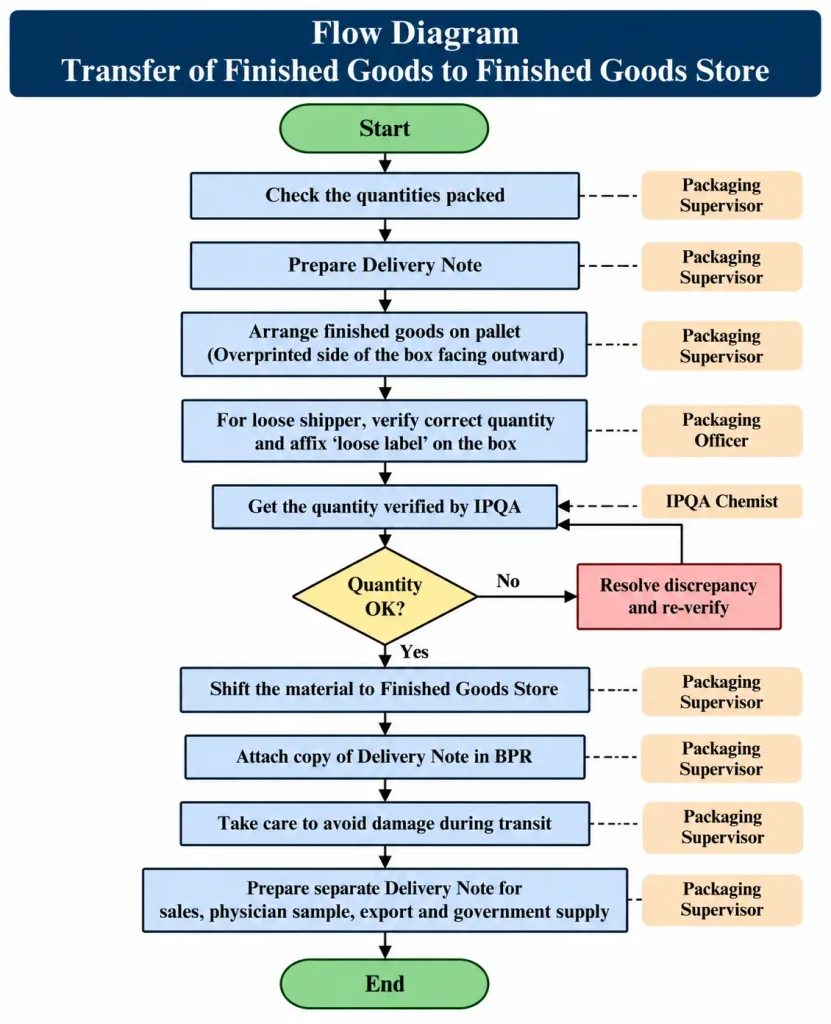
For any loose shipper, the packing officer verifies the correct quantity, records it on the label, and affixes a suitable “loose label.” The quantity is subsequently verified by the IPQA chemist, and only after approval is the material transferred to the Finished Goods Store. A copy of the delivery note is attached to the Batch Packing Record (BPR), and care is taken to prevent damage during transit. Separate delivery notes are prepared for sales, physician samples, export, and government supplies.
3. Benefits of Following SOP for Transfer of Finished Goods to Finished Goods Store:
Following the “Transfer of Finished Goods to Finished Goods Store” SOP helps ensure that packed pharmaceutical products are transferred in a controlled, documented, and traceable manner. The procedure requires verification of packed quantities, preparation of the delivery note, proper pallet arrangement, checking of loose shippers, and IPQA verification before the material is shifted to the Finished Goods Store.
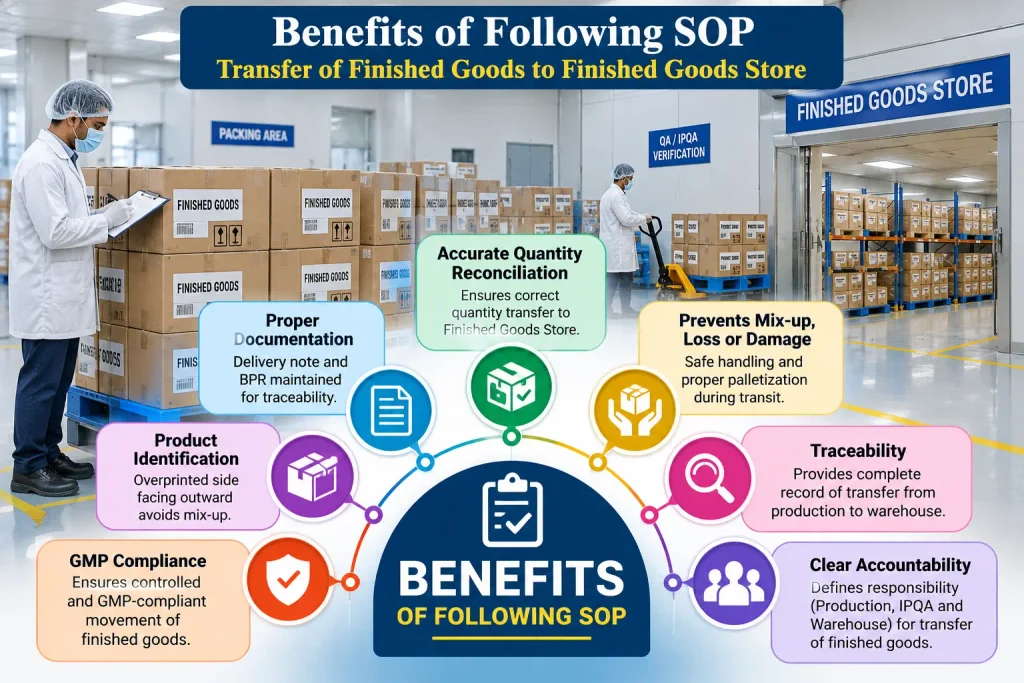
Proper implementation of this SOP supports accurate quantity reconciliation, product identification, traceability, GMP compliance, accountability, and protection of finished goods during transit. Maintaining the delivery note in the BPR provides documentary evidence of the transfer, while proper palletization and handling help reduce the possibility of mix-up or physical damage. Separate delivery notes for sales, physician samples, export, and government supply further improve identification and control of different categories of finished goods.
4. Brainstorming for SOP Failure – Transfer of Finished Goods to Finished Goods Store:
The “Transfer of Finished Goods to Finished Goods Store” SOP may fail when activities such as quantity verification, documentation, pallet arrangement, loose-shipper control, IPQA verification, and physical transfer are not performed as defined. The SOP requires checking packed quantities, preparing a delivery note, arranging finished goods properly on pallets, verifying loose shippers, obtaining IPQA verification, and attaching the delivery note to the BPR.
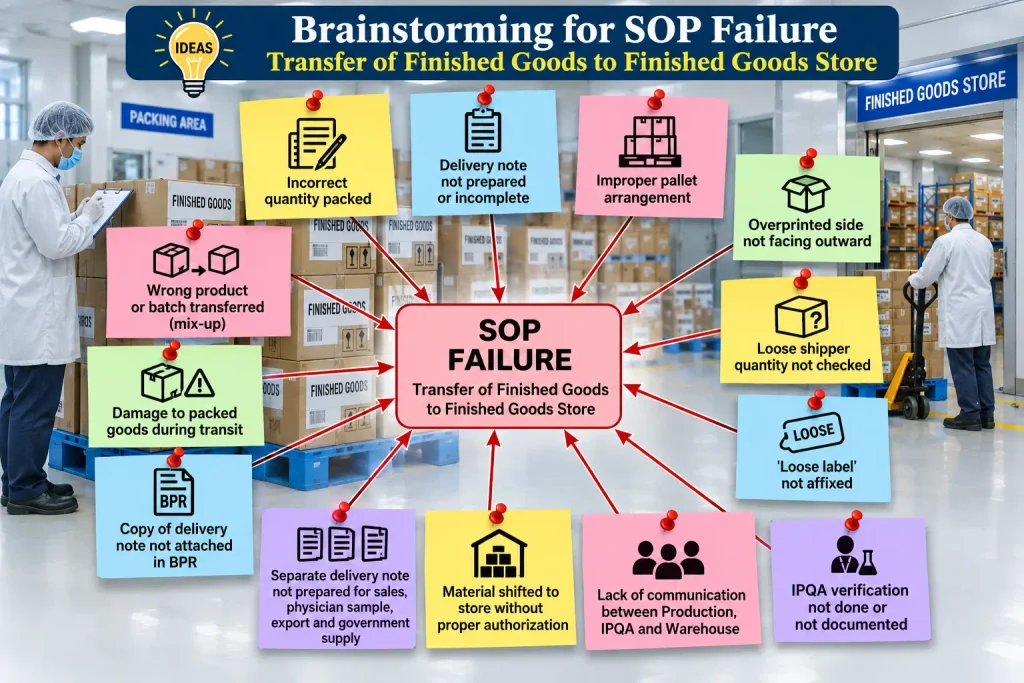
Brainstorming of potential failure causes may include incorrect quantity packed, incomplete or missing delivery notes, improper pallet arrangement, overprinted sides not facing outward, loose-shipper quantity not checked, loose labels not affixed, wrong product or batch transfer, material damage during transit, and IPQA verification not completed or documented. Failure to maintain separate delivery notes for sales, physician samples, export, and government supply may also weaken traceability and control.
5. 5-Why Analysis for SOP Failure – Transfer of Finished Goods to Finished Goods Store:
The “Transfer of Finished Goods to Finished Goods Store” SOP requires packed quantity verification, preparation of a delivery note, proper pallet arrangement, loose-shipper checking, IPQA verification, transfer to the Finished Goods Store, and retention of the delivery note in the BPR.
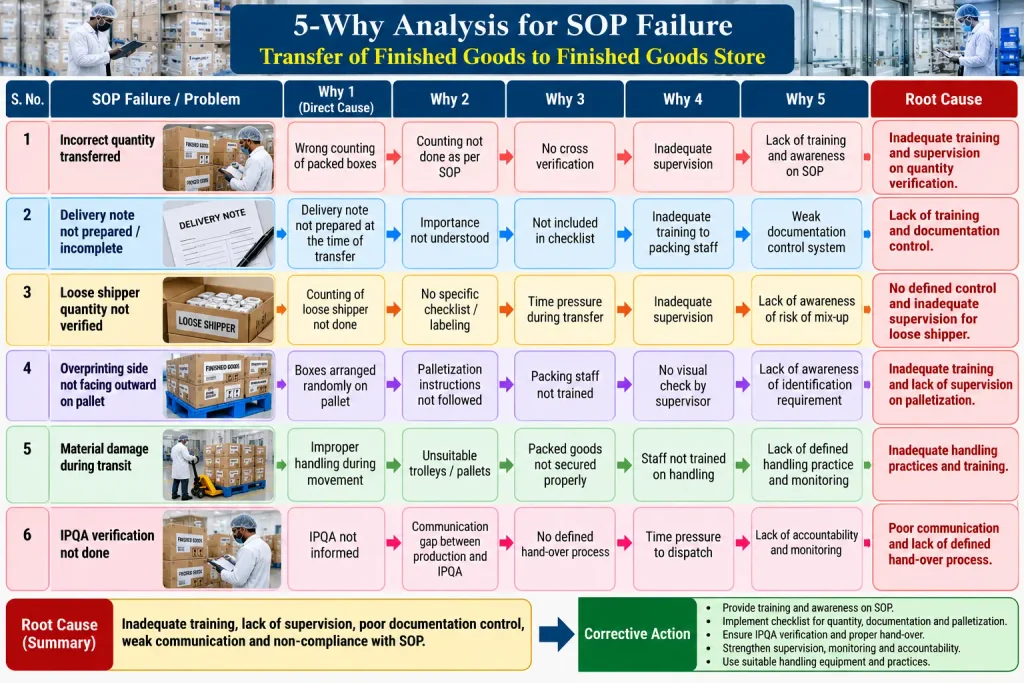
A 5-Why Analysis can be used to investigate failures in these activities by progressively identifying the underlying reasons behind each problem. For example, an incorrect quantity transfer may result from wrong counting, inadequate cross-verification, weak supervision, and insufficient SOP training. Similarly, an incomplete delivery note may arise from poor documentation practices, while failure to verify a loose shipper may be linked to inadequate controls and supervision. Improper pallet arrangement can result from lack of awareness, and material damage during transit may occur due to unsuitable handling practices. Failure of IPQA verification may also indicate weak communication or an undefined handover process.
6. Fishbone Analysis for SOP Failure – Transfer of Finished Goods to Finished Goods Store:
The “Transfer of Finished Goods to Finished Goods Store” SOP can be evaluated through a Fishbone (Ishikawa) Analysis to identify possible causes that may lead to failure during finished-goods transfer. The SOP requires verification of packed quantity, preparation of the delivery note, proper pallet arrangement, checking of loose shippers, IPQA verification, controlled transfer to the Finished Goods Store, and attachment of the delivery note in the BPR.
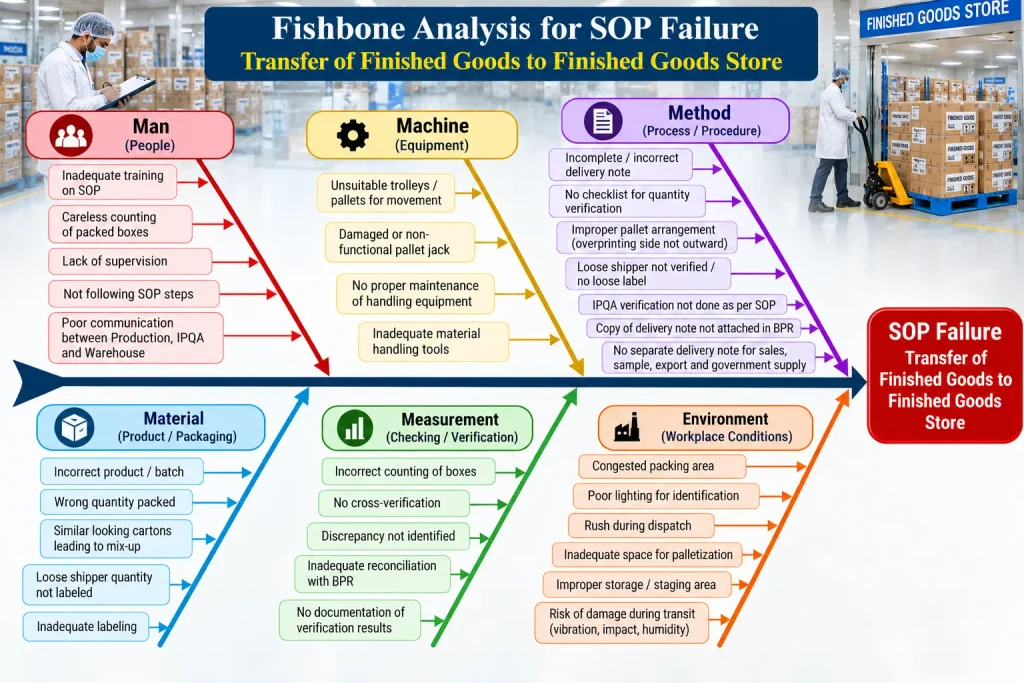
The potential causes can be grouped under Man, Machine, Method, Material, Measurement, and Environment. Man-related causes may include inadequate training, careless counting, weak supervision, and poor communication. Machine-related causes may include unsuitable trolleys or pallets and poorly maintained handling equipment. Method-related causes may involve incomplete delivery notes, improper palletization, absence of quantity-verification checks, failure to verify loose shippers, or missing IPQA approval. Material-related causes may include incorrect product or batch, wrong quantity, inadequate labeling, or similar-looking cartons. Measurement-related causes can include incorrect counting, lack of cross-verification, poor reconciliation, or undocumented verification. Environmental causes may include congestion, inadequate space, poor lighting, or rushed dispatch activities.
7. FMEA Analysis for SOP Failure – Transfer of Finished Goods to Finished Goods Store:
The “Transfer of Finished Goods to Finished Goods Store” SOP can be evaluated using Failure Mode and Effects Analysis (FMEA) to identify where the transfer process may fail and which failures require priority action. The SOP itself requires checking packed quantities, preparing the delivery note, arranging finished goods properly on pallets, verifying loose shippers, obtaining IPQA verification, transferring the material to the Finished Goods Store, and attaching the delivery note to the BPR.
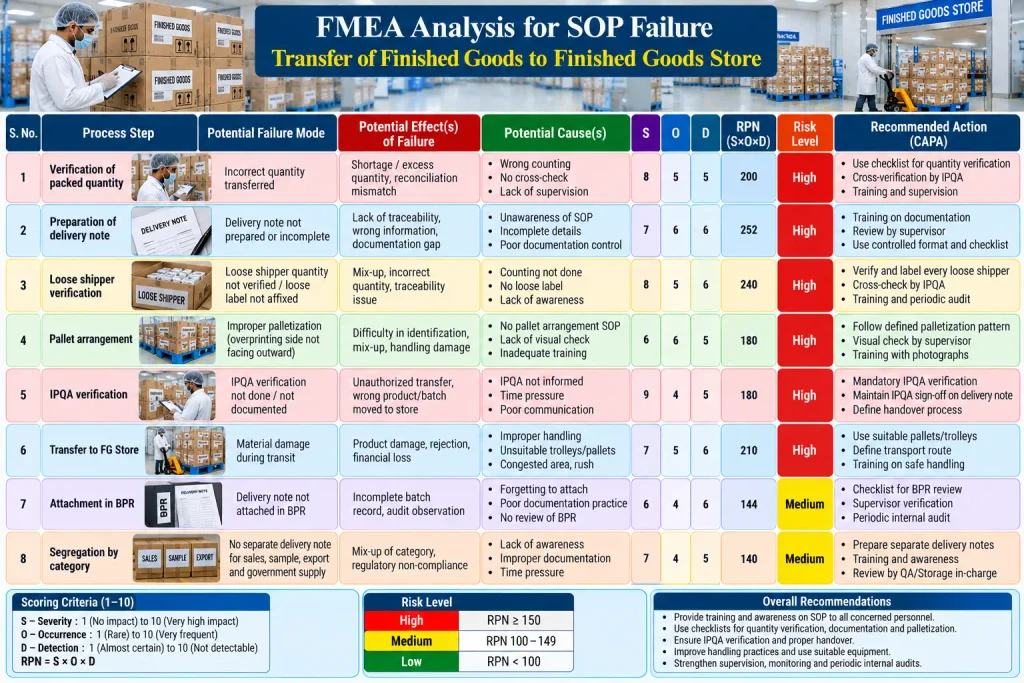
Potential failure modes include incorrect quantity transfer, incomplete delivery documentation, unverified loose shippers, improper pallet arrangement, missing IPQA verification, damage during transit, failure to attach the delivery note in the BPR, and incorrect segregation of different supply categories. These failures may result in quantity mismatch, loss of traceability, mix-up, product damage, unauthorized transfer, incomplete batch documentation, or GMP non-compliance. In the FMEA approach, each failure mode is assessed using Severity (S), Occurrence (O), and Detection (D), and the Risk Priority Number (RPN = S × O × D) is calculated to determine the level of risk. Higher-risk failures should receive priority CAPA such as improved training, quantity-verification checklists, mandatory IPQA sign-off, stronger documentation control, proper palletization, suitable handling equipment, and enhanced supervision.
8. Heat Map Analysis for SOP Failure -Transfer of Finished Goods to Finished Goods Store:
The “Transfer of Finished Goods to Finished Goods Store” SOP can be assessed through a Risk Heat Map to visually prioritize potential failures according to their Severity (S) and Occurrence (O). The SOP requires checking packed quantities, preparing the delivery note, arranging finished goods properly on pallets, verifying loose shippers, obtaining IPQA verification, shifting the material to the Finished Goods Store, attaching the delivery note in the BPR, and preparing separate delivery notes for different supply categories.
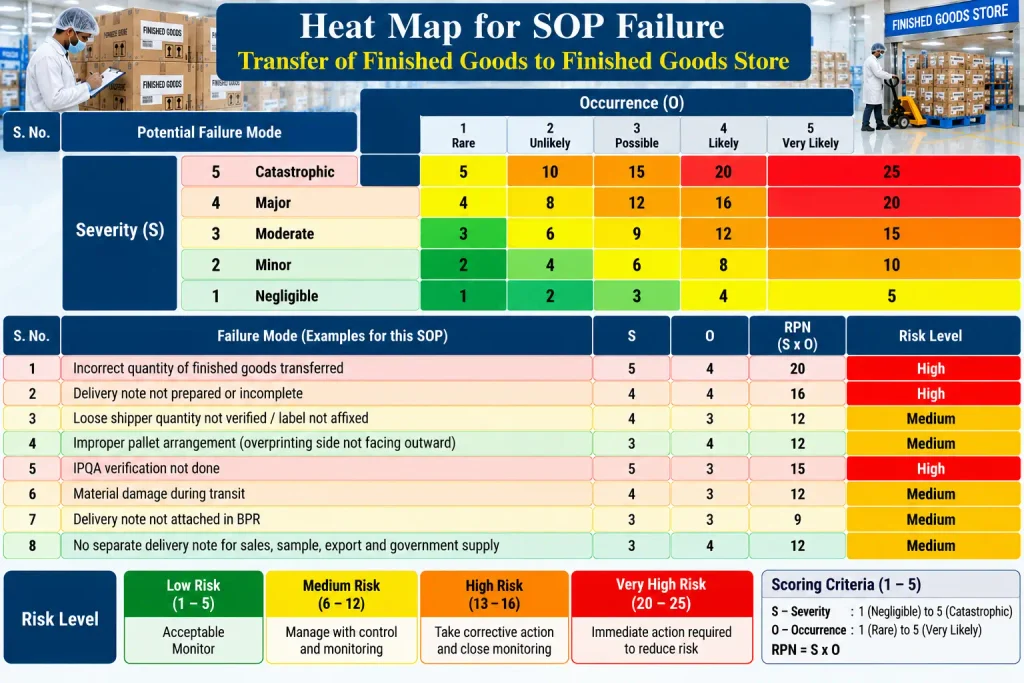
In the heat map, failures such as incorrect quantity transfer, incomplete delivery note, missed IPQA verification, improper pallet arrangement, unverified loose shippers, transit damage, missing BPR attachment, and improper segregation of sales, physician sample, export, and government supply are assigned risk scores based on severity and likelihood of occurrence. Higher-risk failures appear in the orange or red zones, while lower-risk issues fall into green or yellow zones.
Question & Answer – Transfer of Finished Goods to Finished Goods Store:
Q1. What is the objective of this SOP?
Answer: The objective is to define the procedure for transferring finished goods from the production or packing area to the Finished Goods Store.
Q2. Who is responsible for transferring finished goods?
Answer: The Packaging Supervisor is responsible for transfer, while the QA/IPQA Officer confirms the quantity being transferred to the warehouse.
Q3. What should be checked before transfer of finished goods?
Answer: The packed quantity should be checked before preparing the delivery note.
Q4. How should finished goods be arranged on pallets?
Answer: Finished goods should be arranged so that the overprinted side of the box faces outward.
Q5. How should the number of boxes be distributed on pallets?
Answer: All pallets should contain an equal number of boxes, while the last pallet may contain the remaining quantity.
Q6. What should be done in case of a loose shipper?
Answer: The Packing Officer should verify the correct quantity, mention the quantity on the label, and affix a “loose label” on the box.
Q7. Who verifies the quantity before material is shifted to the Finished Goods Store?
Answer: The quantity is verified by the In-Process Quality Assurance (IPQA) Chemist before approval for transfer.
Q8. Can finished goods be shifted before IPQA approval?
Answer: No. According to the SOP, finished goods are shifted to the Finished Goods Store only after IPQA verification and approval.
Q9. Where should the copy of the Delivery Note be maintained?
Answer: A copy of the Delivery Note should be attached to the Batch Packing Record (BPR).
Q10. What precaution should be taken during transportation of finished goods?
Answer: Care should be taken to avoid any damage to packed goods during transit to the Finished Goods Store.
Q11. Are separate Delivery Notes required for different types of supply?
Answer: Yes. Separate Delivery Notes should be prepared for sales, physician samples, export, and government supply.
Q12. What information is included in the Finished Goods Transfer Note?
Answer: The format includes details such as product name, product code, batch number, batch size, manufacturing date, expiry date, packing details, quantity transferred, full-box details, loose-box details, and QC release stamp.
Q13. Who signs or acknowledges the Finished Goods Transfer Note?
Answer: The format provides sections for the Production Supervisor, QA Chemist, and Warehouse Supervisor.
Q14. Why is quantity verification important before finished-goods transfer?
Answer: Quantity verification helps ensure that the quantity physically transferred agrees with the documented packed quantity and reduces the risk of discrepancy during warehouse receipt.
Q15. What is the main purpose of following this SOP?
Answer: The SOP ensures that finished goods are transferred in a controlled, documented, traceable, and damage-free manner from Production to the Finished Goods Store.