






1. Brief Description:
The User Requirement Specification (URS) for the Purified Water Generation System defines the functional, operational, GMP, safety, and documentation requirements for a pharmaceutical purified-water system intended for Production and QC use. The system is designed to produce purified water using RO technology, with soft water as the feed and purified water as the required output. The proposed treatment sequence includes MGF → Softener → Ultrafiltration → RO → EDI → UV, supported by chemical dosing and process controls such as a UV lamp and conductivity meter. The system is expected to operate for 24 hours, use CIP for cleaning, and employ hot water for sanitization. The URS also specifies connection to a purified-water storage tank, HMI interface, SS 316L mirror-polished contact parts with TIG orbital joints, proper earthing, and documentation including DQ, operating manual, IQ/OQ, drawings, and certificates.
Skip to PDF content1. Flow Diagram:
The flow diagram provides a structured overview of the User Requirement Specification (URS) for the Purified Water Generation System, beginning with identification of Production and QC requirements and definition of the system purpose—to generate purified water using RO-based technology. Soft water is considered the system input, which passes through the treatment sequence MGF → Softener → Ultrafiltration → RO → EDI → UV to produce purified water for equipment washing and manufacturing activities. The system is intended for 24-hour operation, with pumping, CIP cleaning, hot-water sanitization, UV treatment, and conductivity monitoring forming key operational requirements.
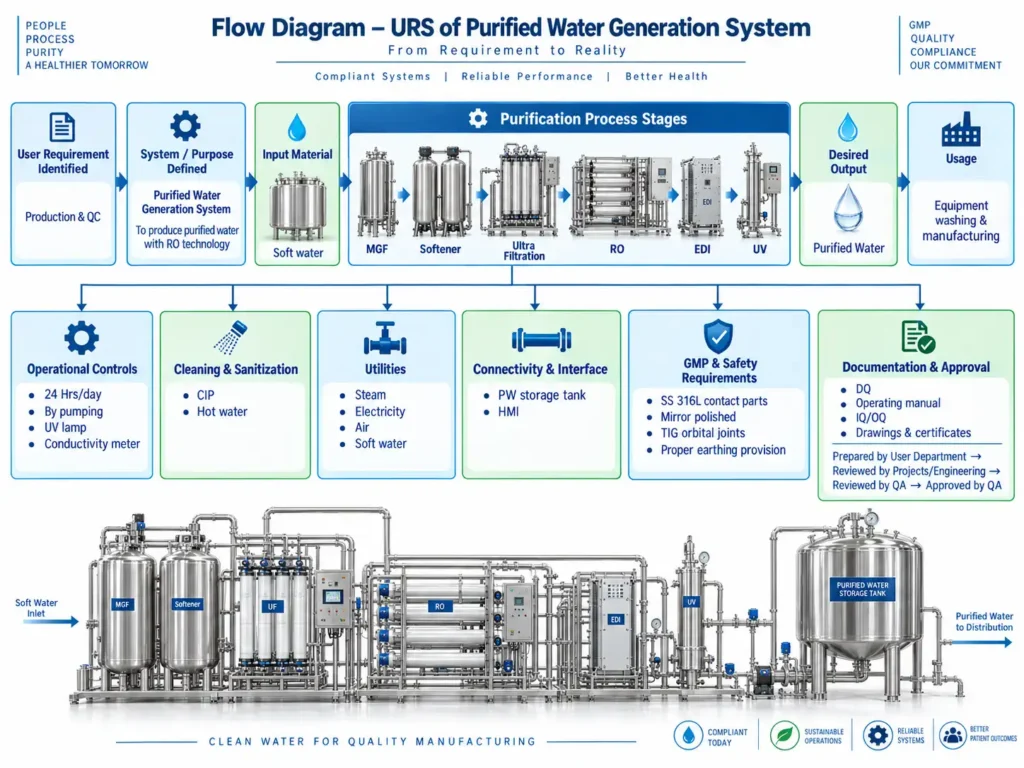
The diagram also integrates supporting requirements including utilities, connection with the purified-water storage tank, HMI interface, GMP-compliant SS 316L contact parts, proper earthing, and qualification/documentation requirements such as DQ, IQ/OQ, operating manuals, drawings, and certificates.
2. Brainstorming:
The brainstorming exercise identifies the potential reasons for failure to prepare the User Requirement Specification (URS) for the Purified Water Generation System. The diagram considers possible gaps such as unclear user requirements, weak cross-functional coordination, absence of engineering inputs, incomplete process-flow details, undefined utility requirements, and uncompiled GMP requirements. Other contributing factors highlighted include missing documentation templates, unclear roles and responsibilities, lack of timeline and ownership, non-availability of vendor or technical data, delayed review and approval, training or awareness gaps, missing room-layout annexures, and resource/workload constraints.
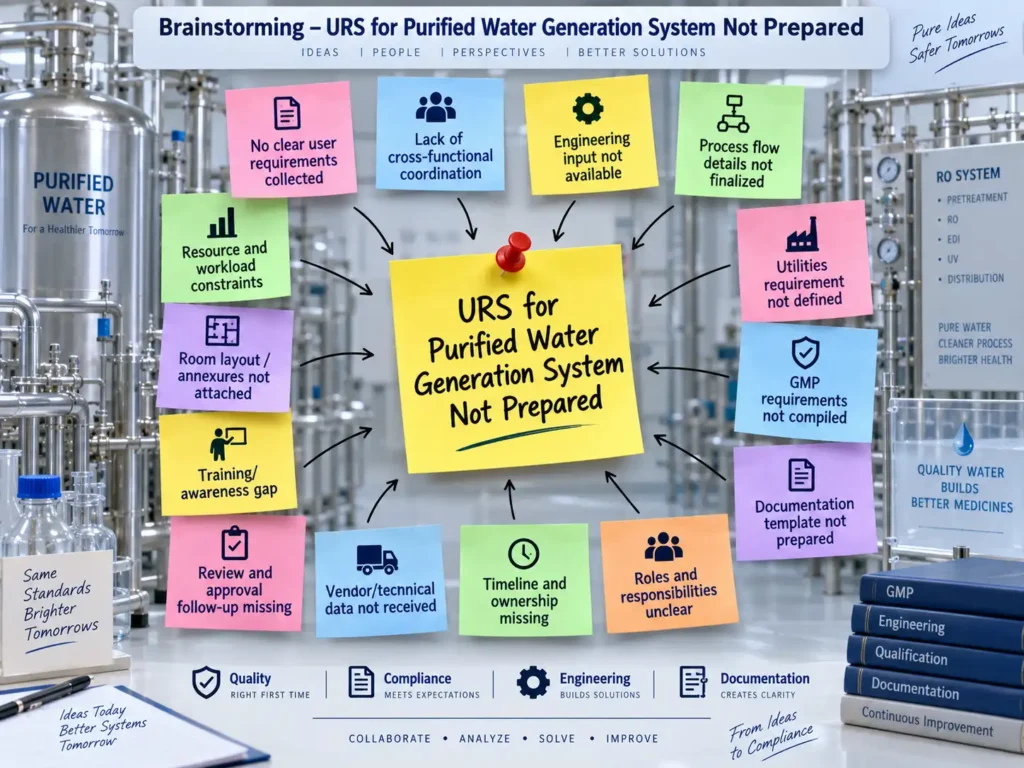
These brainstorming points should be treated as possible causes requiring verification, not confirmed root causes. The exercise helps Production, Engineering, QA, QC, and project teams systematically identify information gaps and responsibilities so that a complete, technically sound, GMP-compliant URS can be prepared, reviewed, approved, and subsequently used as the basis for design and qualification of the purified-water system.
3. 5 Why Analysis:
The 5 Why Analysis is used to systematically identify the underlying causes for the URS of the Purified Water Generation System not being prepared/performed. The analysis begins with the immediate issue that user requirements and process details were not compiled. It then traces contributing factors such as delayed inputs from Production, Engineering, QA, QC, and Utilities; unclear roles, ownership, and timelines; and non-availability of required technical documents, vendor information, utility details, and annexures. The final level of analysis indicates that the main underlying cause is the absence of structured cross-functional planning, defined responsibility, review mechanisms, training, and management follow-up for URS preparation.
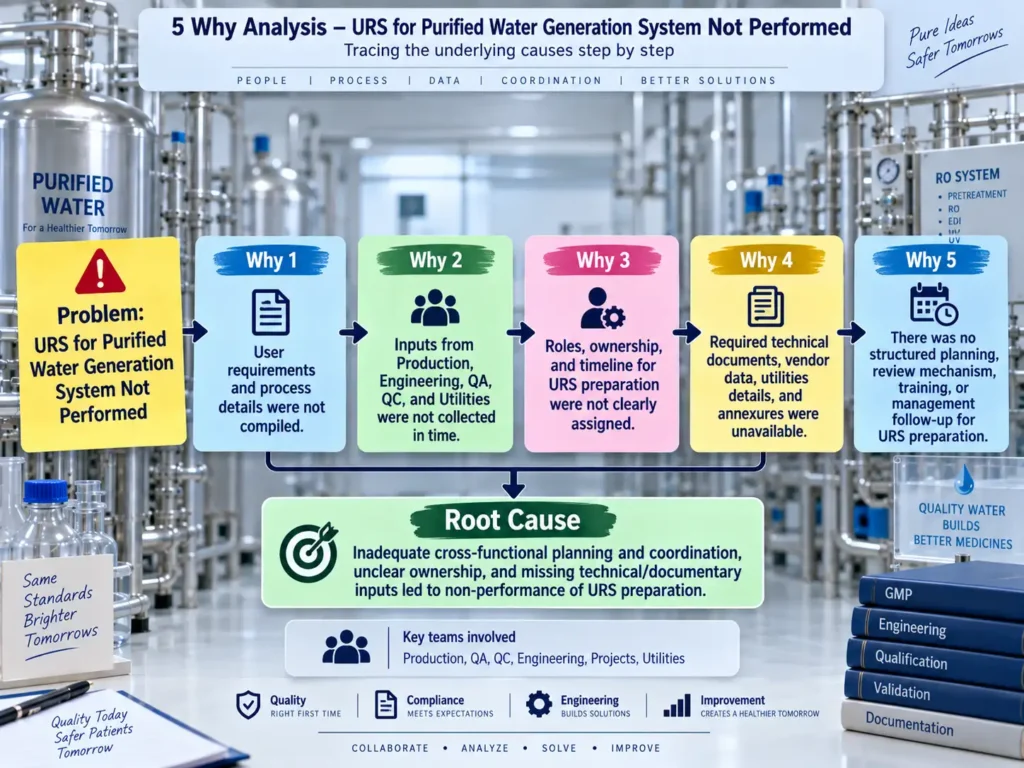
The exercise helps identify not only the visible failure but also the organizational and documentation gaps behind it, enabling appropriate corrective actions such as assigning ownership, establishing timelines, collecting technical inputs, and implementing a formal review and approval process.
4. Circular Heat Map Analysis:
The Circular Heat Map Analysis visually evaluates the relative significance of potential factors contributing to the URS for the Purified Water Generation System not being performed. The central problem is surrounded by identified causes and categorized according to their estimated risk or influence using a heat scale: Critical (Red), High (Orange), Medium (Yellow), and Moderate (Green). Critical and high-risk areas include unclear user requirements, inadequate cross-functional coordination, unavailable engineering inputs, unclear roles and responsibilities, incomplete process information, undefined utilities, and missing vendor/technical data. Medium-risk factors include GMP compilation, documentation preparation, review follow-up, and training gaps, while missing annexures and resource constraints are comparatively lower-risk contributors.
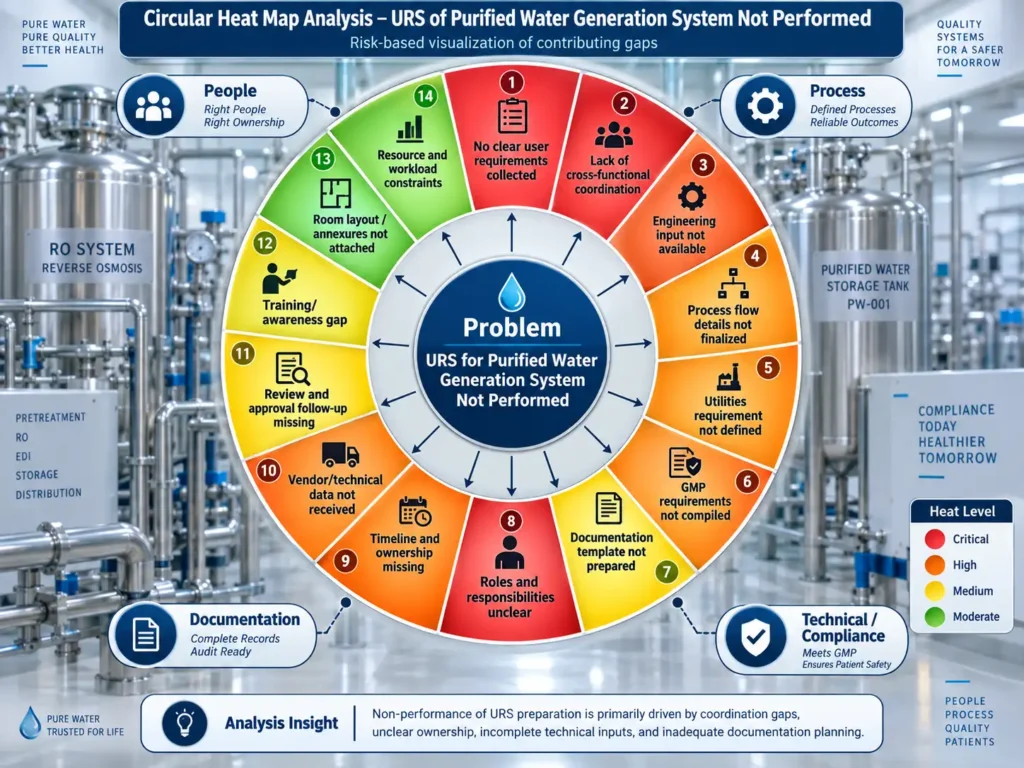
The heat map helps prioritize investigation and corrective actions by directing management attention toward the most influential people, process, technical, and documentation gaps. The assigned heat levels are a risk-screening assessment and should be confirmed through documented investigation and cross-functional review.
Questions & Answers:
- What is the purpose of the Purified Water Generation System?
The purpose is to produce Purified Water using RO technology. - Which functional areas are covered by this URS?
The URS is applicable to Production and QC. - How many Purified Water Generation Systems are required?
One system is specified. - What is the feed material to the system?
The input material is soft water. - What is the desired output of the system?
The desired output is Purified Water (PW). - Where will the generated purified water be used?
It is intended for equipment washing and manufacturing. - What are the main filtration/treatment stages?
The specified stages are MGF → Softener → Ultra Filtration → RO → EDI → UV. - What chemical dosing is mentioned in the URS?
The URS lists NaOCl, NaOH, Sodium Hexametaphosphate, and Sodium Metabisulphite dosing. - What is the expected operating duration of the system?
The system is expected to operate for 24 hours per day. - What cleaning method is specified?
The preferred cleaning method is CIP (Clean-In-Place). - What sanitization method is recommended?
Hot water is specified for cleaning/sanitization. - Which utilities are required for the system?
Required utilities are steam, electricity, air, and soft water. - What process controls are specified?
The URS specifies a UV lamp and conductivity meter as process-control requirements. - What equipment is connected to the purified-water generation system?
The system is connected to a Purified Water Storage Tank. - What operator/system interface is specified?
The specified interface is HMI. - What material requirement is specified for product-contact parts?
Contact parts shall be SS 316L with mirror polishing, and all joints shall be TIG orbital. - What safety requirement is mentioned?
The URS requires proper earthing provision. - Which qualification and technical documents are required?
Required documents include DQ, operating manual, IQ/OQ, drawings, and certificates. - What environmental condition is specified for the working area?
The working-area environmental requirement is stated as ambient. - Who prepares, reviews, and approves the URS?
It is prepared by the User Department, reviewed by Projects/Engineering and Quality Assurance, and approved by Quality Assurance.
Reference Guidelines:
- WHO Technical Report Series No. 1033, Annex 3 – Good Manufacturing Practices: Water for Pharmaceutical Use (2021)
This is one of the most directly applicable references for design, production, storage, distribution, monitoring, sanitization, and qualification of pharmaceutical water systems.
WHO TRS 1033 Annex 3 - USP General Chapter <1231> – Water for Pharmaceutical Purposes
Provides guidance on pharmaceutical-water production, system design, operation, monitoring, sampling, microbial control, and maintenance.
USP <1231> Water for Pharmaceutical Purposes - USP <643> – Total Organic Carbon
Applicable for monitoring organic contamination and performance of pharmaceutical-water purification and distribution systems.
USP <643> Total Organic Carbon - USP <645> – Water Conductivity
Applicable for establishing and verifying the ionic purity of Purified Water through conductivity testing.
USP <645> Water Conductivity - EU GMP – Annex 15: Qualification and Validation
Applicable to the lifecycle qualification of the water system, including URS, DQ, IQ, OQ, PQ, change control, and requalification principles.
EU GMP Volume 4 / Annex 15 - FDA – Guide to Inspections of High Purity Water Systems
Useful for system design, sanitization, microbial control, validation, sampling points, distribution loops, and inspection expectations. FDA notes that this is reference material for investigators and is not legally binding guidance.
FDA High Purity Water Systems Guide - Revised Schedule M, Drugs Rules, 1945 – India, G.S.R. 922(E), 28 December 2023
Applicable to GMP, pharmaceutical quality systems, premises, plant, equipment, qualification, documentation, utilities, and risk-based controls for Indian pharmaceutical manufacturers.
CDSCO Revised Schedule M
For the reference section of this URS, the strongest core set would be: WHO TRS 1033 Annex 3, USP <1231>, USP <643>, USP <645>, EU GMP Annex 15, and Revised Schedule M.