






Brief Description
The List of Placebo is a QA-controlled format used to maintain systematic records of placebo preparations used for pharmaceutical testing activities. The document records key information including the product for which the placebo is prepared, component excluded, applicable test, batch number, preparation date, and validity period.This format helps ensure that each placebo is clearly identified, traceable, and used only within its defined validity period. Recording the excluded component is particularly important because it clarifies the intended composition and purpose of the placebo during analytical or quality-related testing. The form also provides spaces for Prepared By, Checked By, dates, and final approval, supporting proper review and accountability within the QA system. Overall, the document provides a standardized and controlled method for maintaining placebo-related records and supporting accurate documentation and traceability.
Skip to PDF content1. Flow Diagram:
The PharmaDevils Devils Army Training Flow Diagram illustrates a systematic approach for planning, conducting, evaluating, and documenting employee training in a pharmaceutical environment. The process begins with identifying the training need based on job responsibilities, competency gaps, new procedures, or regulatory requirements. A suitable training plan is then prepared, followed by development or updating of training materials such as SOPs, presentations, and work instructions.
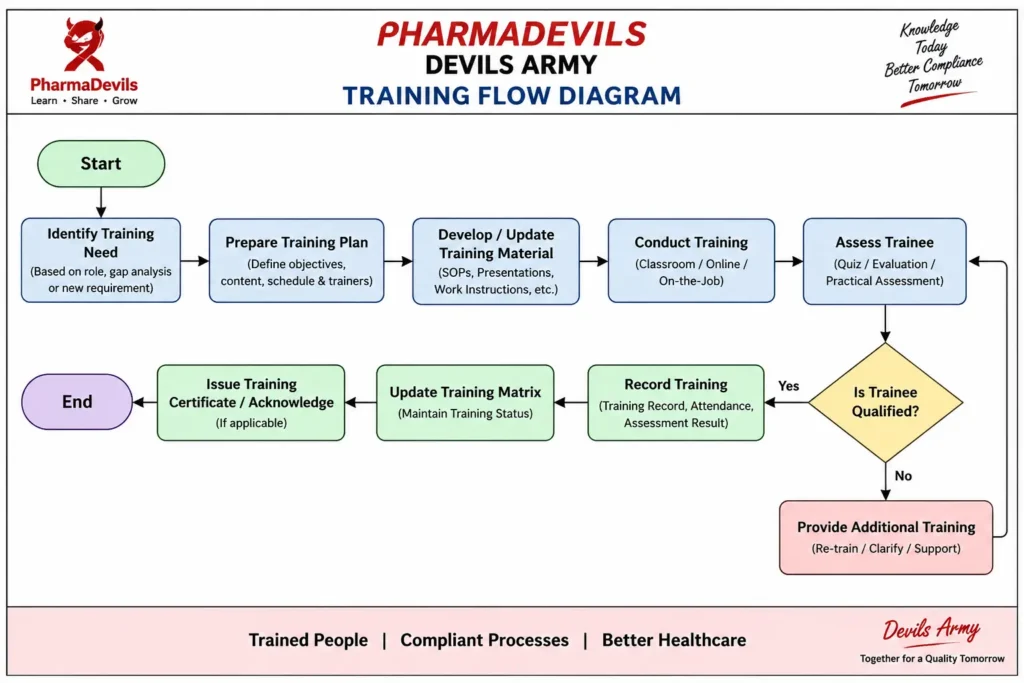
Training is conducted through classroom sessions, online learning, or on-the-job methods. After completion, trainees are assessed through quizzes, evaluations, or practical demonstrations. A qualification decision is then made. Qualified trainees proceed to training documentation, training-matrix updating, and issuance of acknowledgement or certification where applicable. Unqualified trainees receive additional training and are reassessed until competency is demonstrated.The flow emphasizes continuous learning, documented competency, GMP compliance, and effective workforce development.
2. Brainstorming for SOP Failure:
The brainstorming exercise identifies possible reasons why the SOP for Usage and Upkeep of Placebo may not be followed correctly in the Quality Control Department. Key discussion areas include improper requisition of placebo from Production, incorrect labeling, unsuitable storage conditions, use of expired placebo, inadequate segregation of routine and stock quantities, and poor documentation. The SOP requires appropriate containers, defined storage conditions, validity control, and proper identification of placebo stocks.
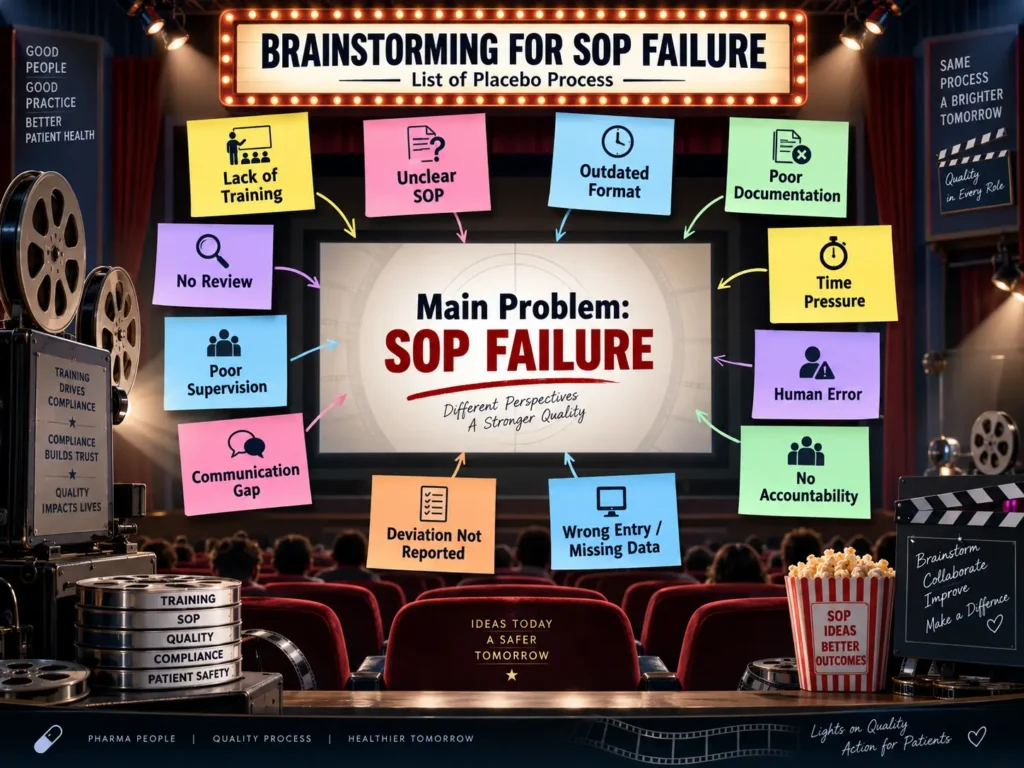
Other potential causes include use of unclean accessories, returning unused liquid placebo to the original container, contamination during handling, failure to investigate abnormal chromatographic peaks, and failure to obtain new placebo after formulation changes. Training gaps and inadequate awareness among QC personnel may further contribute to non-compliance. Brainstorming helps identify these human, procedural, material, storage, communication, and documentation-related factors so that suitable corrective and preventive actions can be developed.
3. 5-Why Analysis for SOP Failure:
The 5 Why Analysis for SOP Failure identifies the underlying reasons why an SOP may not be followed effectively. The analysis begins with the main problem: the SOP was not followed. The first cause identified is that the employee was not sufficiently aware of the SOP requirements. Further analysis shows that the training provided was not fully effective, which may result in poor understanding or improper execution of the procedure.
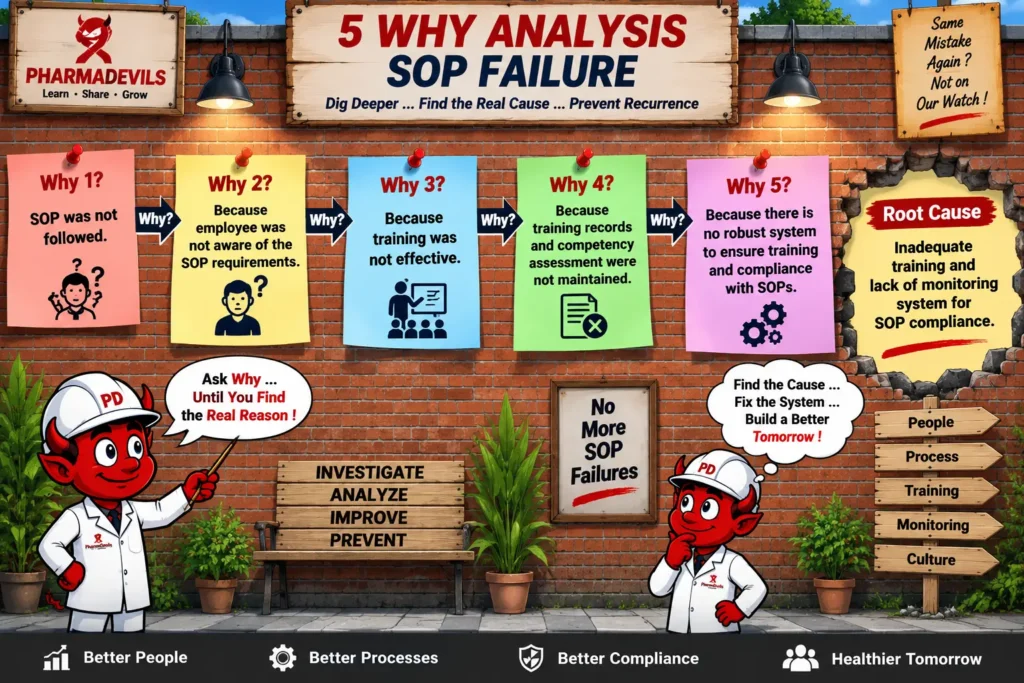
The next level highlights weaknesses in training records and competency assessment, indicating that employee capability may not have been adequately verified or documented. The final “Why” points to the absence of a strong system for ensuring continuous training, supervision, and SOP compliance.The analysis concludes that the major root cause is inadequate training combined with weak monitoring of SOP compliance. Corrective actions should therefore focus on effective training, competency verification, proper documentation, routine supervision, and periodic compliance monitoring.
4. Fishbone Analysis for SOP Failure:
The tree-themed Fishbone Analysis shows the possible root causes for failure to follow the SOP for Usage and Upkeep of Placebo. The causes are grouped under Manpower, Method, Material, Machine/Equipment, Environment, Measurement, Management, and Documentation. Major issues include inadequate training, incomplete requisition, incorrect labeling, contaminated or expired placebo, improper containers, unclean accessories, unsuitable storage conditions, weak monitoring, poor communication between QC and Production, and incomplete records.
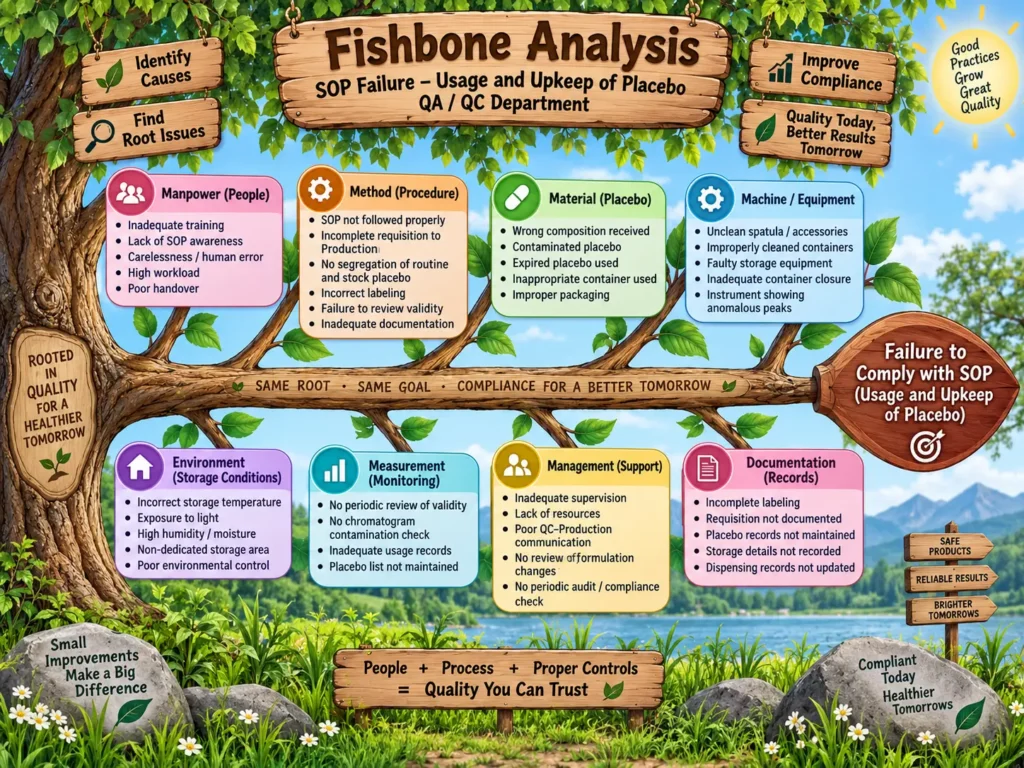
The SOP requires proper preparation requests, segregation of routine and stock placebo, suitable storage and labeling, validity control, clean handling accessories, contamination checks, and maintenance of placebo records.The diagram helps visually connect these contributing factors to the main problem, supporting effective root-cause identification, CAPA, improved compliance, reliable analytical results, and consistent quality practices.
5. Fault Tree Analysis for SOP Failure:
The Fault Tree Analysis identifies the major causes that can lead to failure in following the SOP for Usage and Upkeep of Placebo. The top event is “SOP Not Followed,” which is linked to key failure areas such as incorrect preparation or receipt, improper storage, incorrect handling and usage, inadequate documentation, expired or contaminated placebo, lack of training, formulation-change communication failure, and improper disposal.
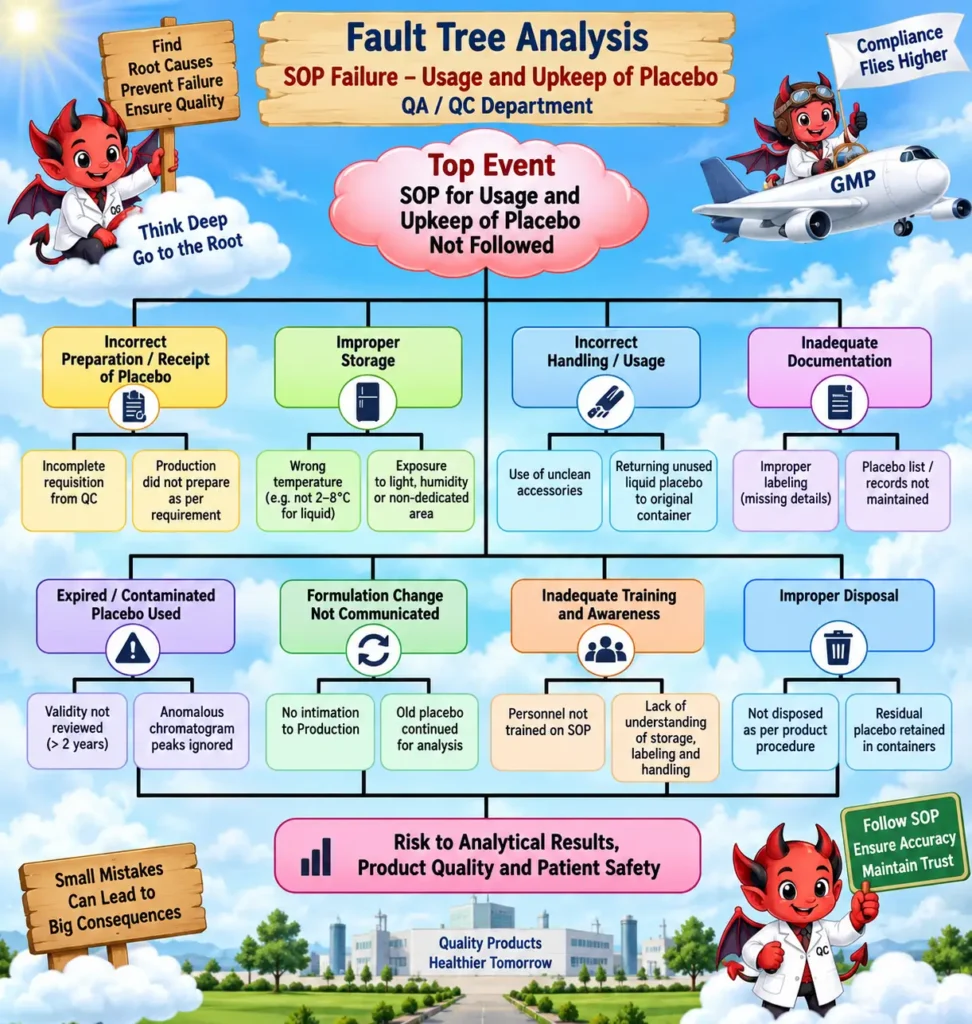
The SOP requires QC to raise a placebo request to Production, maintain appropriate labeling and storage, use clean accessories, prevent contamination, review abnormal chromatographic observations, obtain fresh placebo when formulation changes, and dispose of placebo according to the respective product procedure.The sky-themed fault tree visually shows how individual basic failures can combine into broader compliance problems, potentially affecting analytical reliability, traceability, and overall quality-system performance.
Questions & Answers – SOP for Usage and Upkeep of Placebo
- Q: What is the objective of this SOP?
A: To describe the procedure for proper usage and upkeep of placebo used for analysis in the Quality Control Department. - Q: What is a placebo?
A: A placebo is a mixture of formulation ingredients without the component under determination. - Q: Who raises the request for preparation of placebo?
A: The Quality Control Department sends the requisition to the Production Department. - Q: When may placebo be required?
A: For new products, product transfer, routine analysis, and stability analysis. - Q: What should be done after receipt of placebo?
A: The quantity should be divided into two parts: one for routine use and the other as stock. - Q: How should solid placebo be stored?
A: In a double polythene bag placed inside a stainless steel or HDPE container. Light-sensitive placebo should additionally be protected with an outer black polythene bag. - Q: How should liquid or semisolid placebo be stored?
A: In a clean and dry glass or HDPE bottle. Photosensitive placebo should be kept in an amber-colored bottle. - Q: What information should appear on the placebo label?
A: Product name, batch number, date of preparation, valid-up-to date, and storage condition. - Q: At what temperature should liquid placebo be stored?
A: At 2–8°C. - Q: What is the usual validity of placebo?
A: Two years from the date of preparation, or less depending on the characteristics of the formulation. - Q: What is the validity of dispensed liquid placebo?
A: Three months from the date of dispensing. - Q: What accessories should be used for withdrawing placebo?
A: Clean and dry accessories should be used. For solid or semisolid placebo, a clean spatula should be used. - Q: Can unused liquid placebo be returned to the original container?
A: No. The remaining quantity should not be transferred back to the original container because this may cause contamination. - Q: What should be done if anomalous peaks are observed in the placebo chromatogram?
A: Prepare a fresh placebo solution and check for contamination. If the problem persists, dispense a new quantity from the bulk container. If contamination still exists, Production should be informed to prepare fresh placebo. - Q: What should be done when the formulation changes?
A: Production should be informed, and a new placebo should be procured for analysis of the changed formulation. - Q: How should expired or unwanted placebo be disposed of?
A: It should be disposed of according to the disposal procedure of the respective product. - Q: Who is responsible for training on this SOP?
A: Head-QC/QA is the trainer, and Quality Control personnel are the trainees. - Q: What is the specified training duration?
A: One hour. - Q: Which annexure is used for requesting placebo for analytical purposes?
A: Annexure I. - Q: Which annexure contains the list of placebo?
A: Annexure III.