






Brief Description
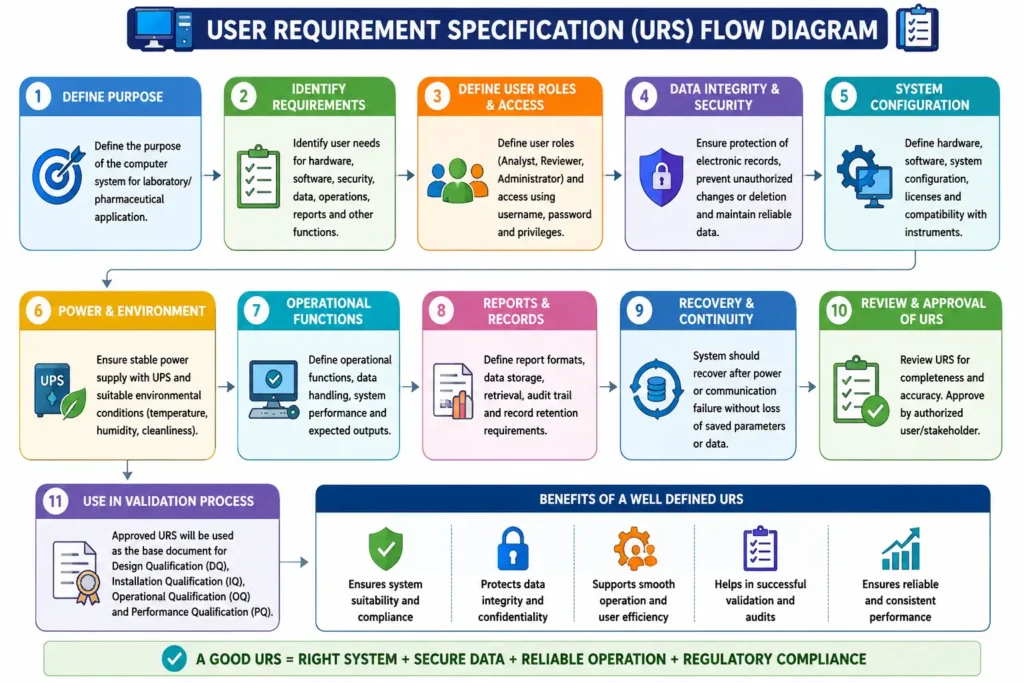
This User Requirement Specification for Computer System (URS) is prepared for a computer system used with laboratory or pharmaceutical application software. It explains what the user expects from the computer system before installation, qualification, and routine use. The document covers hardware, software, system configuration, security, user access, data handling, power supply, environmental conditions, operational functions, and report requirements. It also defines user roles such as Analyst, Reviewer, and Administrator, with access controlled through usernames, passwords, and assigned privileges. The system should protect electronic records, prevent unauthorized changes or deletion, and maintain reliable data. It should also support recovery after power or communication failure without affecting saved parameters. Hardware and software licenses, operating conditions, UPS, and compatibility with instruments are also considered. Overall, the URS helps ensure that the computer system is suitable, secure, reliable, and capable of meeting the required operational and regulatory needs during its intended use within the pharmaceutical site operations.
Impact Assessment
Implementation of this User Requirement Specification (URS) will have a positive impact on the computer system used in laboratory and pharmaceutical activities. It will ensure that all important user needs are clearly defined before purchasing, installing, and validating the system. The URS will help select suitable hardware and software that are compatible with laboratory instruments and required operations. Defined user roles and password controls will reduce the risk of unauthorized access. Proper data security, audit trail, backup, and recovery requirements will help protect electronic records from loss or unwanted changes. UPS and environmental requirements will support continuous and stable system operation. Clear reporting and record retention requirements will improve traceability and review of data. The approved URS will also support qualification and validation activities such as DQ, IQ, OQ, and PQ. Overall, it will improve data integrity, regulatory compliance, system reliability, user control, and smooth routine operations.
Questions & Answers
1. What is a User Requirement Specification (URS)?
A URS is a document that describes what the user expects from a computer system.
2. Why is a URS prepared?
It is prepared to clearly define system requirements before installation, qualification, validation, and routine use.
3. What requirements are covered in the URS?
It covers hardware, software, security, data handling, reports, power supply, environmental conditions, and system functions.
4. Who are the main users of the computer system?
The main users may include Analyst, Reviewer, and Administrator.
5. How is user access controlled?
Access is controlled through individual usernames, passwords, and assigned user privileges.
6. Why is data security important?
Data security prevents unauthorized access, changes, deletion, or loss of electronic records.
7. What is the role of the Administrator?
The Administrator manages users, system settings, access rights, and other authorized system functions.
8. Why is a UPS required?
A UPS provides backup power and helps protect the computer system during power failure.
9. What should happen after a power or communication failure?
The system should recover safely without losing saved data or important parameters.
10. Why is hardware and software compatibility important?
It ensures that the computer system works properly with connected laboratory or pharmaceutical instruments.
11. What are the reporting requirements in a URS?
The URS should define required reports, data storage, retrieval, audit trails, and record retention.
12. How does the URS support data integrity?
It defines controls for secure access, reliable records, audit trails, backup, and prevention of unauthorized changes.
13. Who should review and approve the URS?
The URS should be reviewed and approved by authorized users and relevant departments.
14. How is the URS used during validation?
It acts as a base document for DQ, IQ, OQ, PQ, and computer system validation activities.
15. What is the main benefit of a well-defined URS?
It helps ensure that the computer system is secure, reliable, suitable for its intended use, and compliant with regulatory requirements.