






Brief Description
This SOP describes the procedure for validation of an autoclave used in the Microbiology Department to demonstrate that the equipment consistently achieves the required sterilization conditions. The validation includes Operational Qualification (OQ) and Performance Qualification (PQ), with verification of the autoclave temperature display, pressure gauge, and calibration status before execution. The procedure requires calibration of data-logger thermocouples and execution of heat distribution and heat penetration studies using multiple temperature probes. Temperature, pressure, holding time, and probe lag time are recorded and assessed against specified acceptance criteria. Validation covers empty, minimum, fixed, and maximum load patterns. Biological indicator studies using Bacillus stearothermophilus strips and microbial growth testing are performed to verify sterilization effectiveness. The SOP specifies that autoclave validation is performed at a 12-month frequency.
Skip to PDF content1. Flow Diagram:
The flow diagram for Validation of Autoclave presents the sequence of activities required to confirm that the autoclave performs effectively and consistently for sterilization. It begins with preparation, including review of the operating procedure, verification of calibration certificates, and confirmation that the temperature display and pressure gauge are within limits. It then proceeds to calibration of thermocouples, followed by heat distribution and heat penetration studies using multiple probes to monitor temperature, pressure, holding time, and lag time.
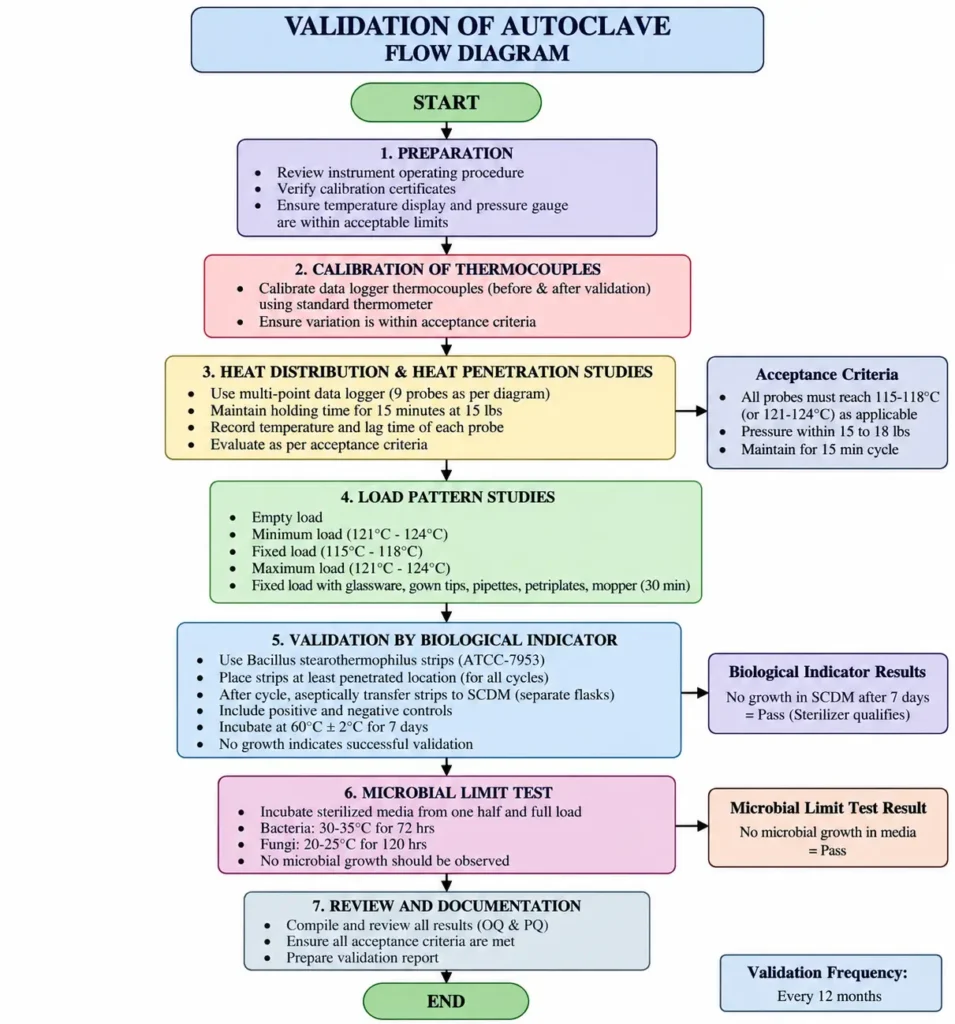
The diagram further includes load pattern studies under empty, minimum, fixed, and maximum load conditions, followed by biological indicator validation using Bacillus stearothermophilus strips and microbial limit testing to verify sterilization efficiency. Finally, all observations are reviewed, documented, and compared with acceptance criteria before concluding validation. The SOP specifies that this validation is to be performed once every 12 months.
2. Brainstorming for SOP Failure:
The brainstorming diagram identifies potential causes of SOP failure in a pharmaceutical injection manufacturing area, particularly under worst-case conditions. The central issue, “SOP Failure in Injection Area,” is surrounded by major contributing factors such as inadequate training, procedure not followed, poor supervision, documentation gaps, line-clearance lapse, improper gowning, unclean surfaces, equipment not sanitized, environmental-control failure, pressure differential issues, material mix-up risk, missed visual inspection, deviation not reported, aseptic-behavior lapse, and workload or human error.
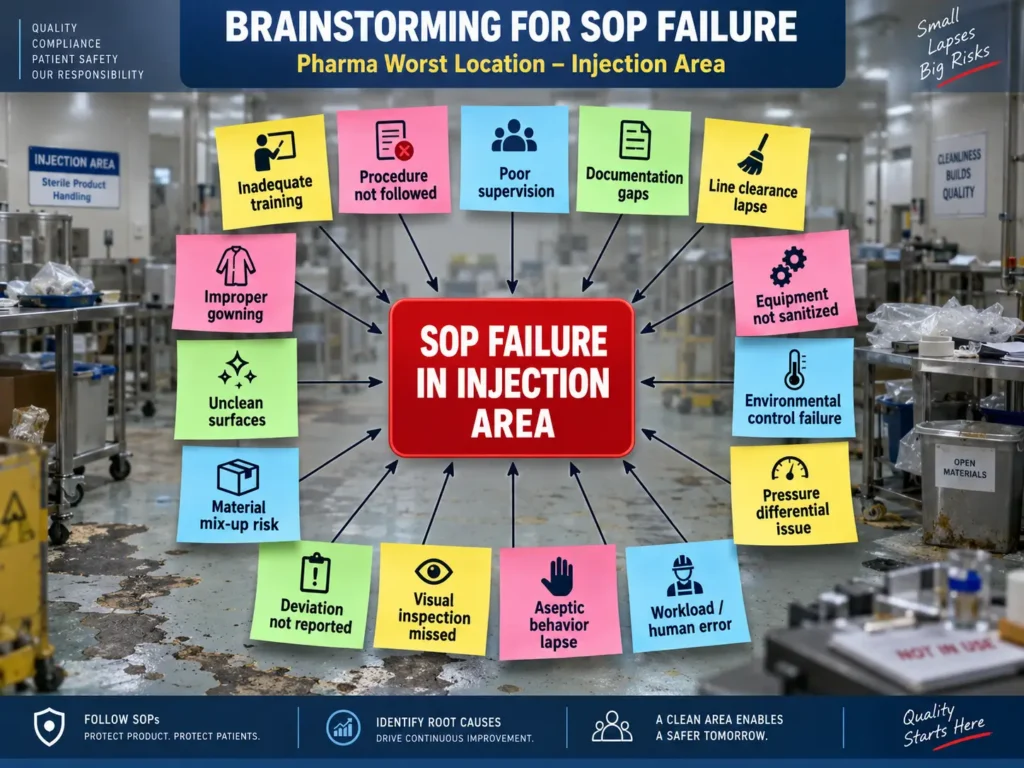
The diagram supports a structured investigation by highlighting risks related to personnel, procedures, equipment, environment, materials, and documentation. It can be used during deviation investigation, root-cause analysis, CAPA development, and GMP review to identify weaknesses that may compromise aseptic operations, product quality, sterility assurance, and patient safety.
3. 5-Why Analysis for SOP Failure:
The 5-Why analysis diagram illustrates a structured investigation of SOP failure in a pharmaceutical vial manufacturing section. It begins with the immediate issue that the approved procedure was not followed during vial line operation. The analysis then traces the problem through successive causes: inadequate operator understanding of the SOP, insufficient training and periodic retraining, weak supervision and compliance verification, and finally inadequate quality oversight and management review.
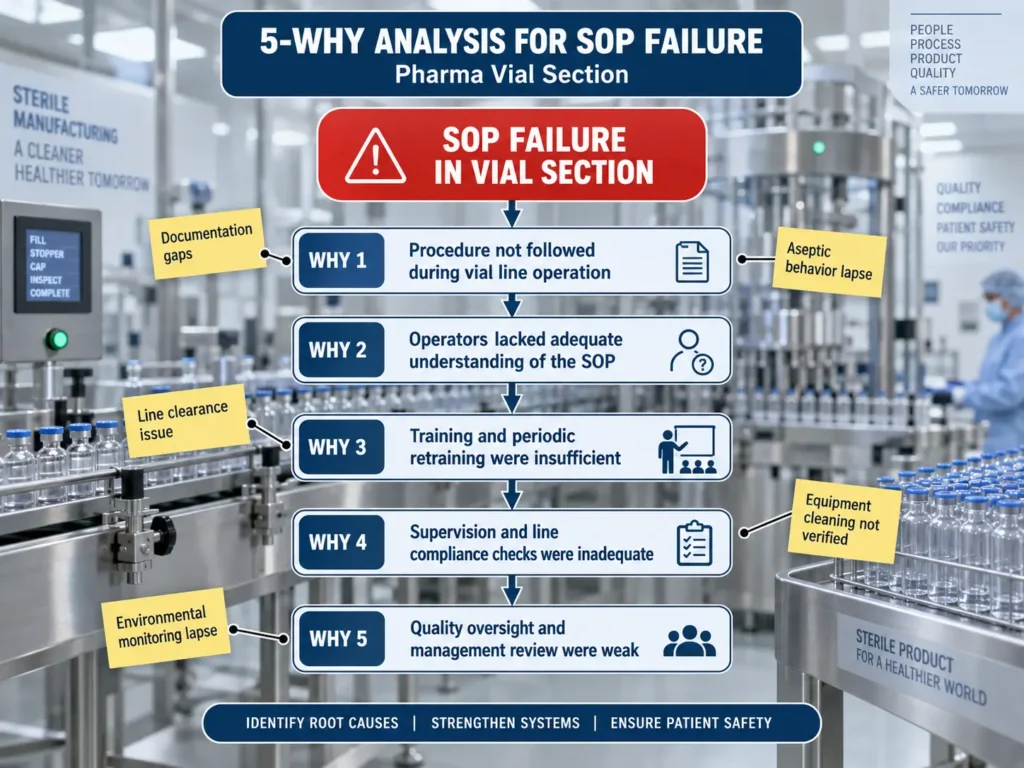
The diagram also highlights associated risk factors such as documentation gaps, aseptic behavior lapses, line-clearance issues, inadequate verification of equipment cleaning, and environmental-monitoring lapses. By progressively questioning why the failure occurred, the analysis helps distinguish symptoms from underlying systemic causes. The identified root causes can be used to establish appropriate CAPA, strengthen training and supervision, improve documentation and aseptic controls, and enhance overall GMP compliance and patient safety in the vial manufacturing area.
4. Fishbone Analysis for SOP Failure:
The Fishbone Analysis diagram provides a structured method for identifying the potential causes of SOP failure in a pharmaceutical manufacturing area. The causes are grouped under the main categories of Man, Machine, Method, Material, Mother Nature (Environment), and Measurement.
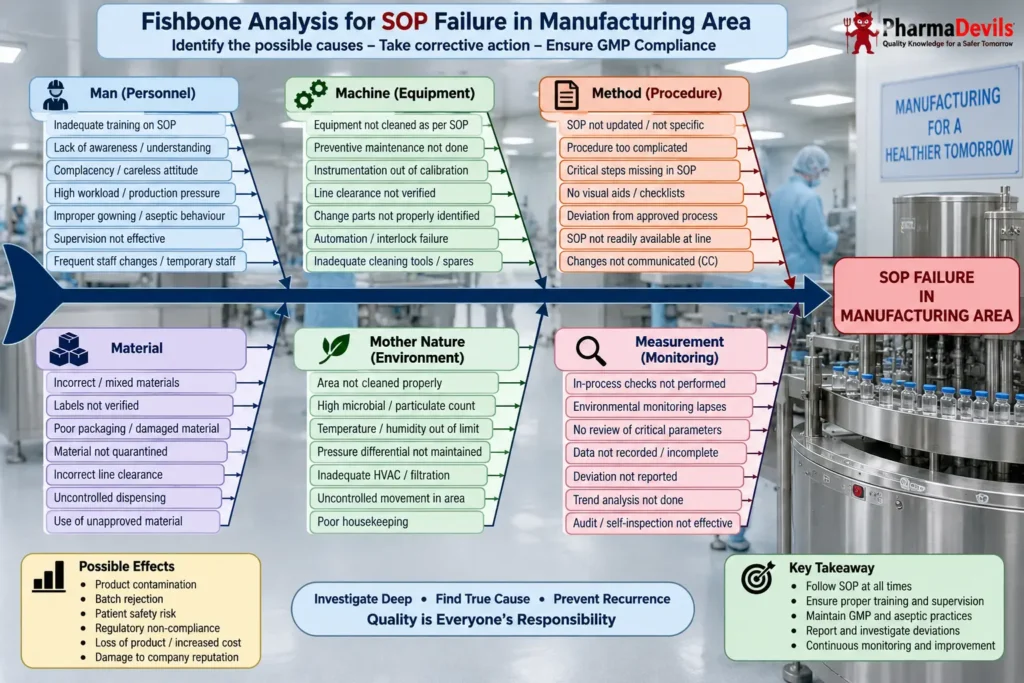
Personnel-related causes include inadequate training, poor understanding, high workload, improper gowning, and ineffective supervision. Equipment-related causes cover improper cleaning, overdue maintenance, calibration issues, and line-clearance failures. Method causes include outdated or unclear SOPs, missing critical steps, unavailable procedures, and poor communication of changes. Material factors include mix-ups, incorrect labeling, damaged materials, and use of unapproved materials. Environmental factors include poor housekeeping, high microbial or particulate load, pressure differential issues, and inadequate HVAC control. Measurement-related causes include missed in-process checks, incomplete records, environmental-monitoring gaps, and unreported deviations. The diagram supports root-cause investigation, CAPA development, GMP compliance, and prevention of recurrence.
5. Fault Tree Analysis for SOP Failure:
The Fault Tree Analysis (FTA) diagram evaluates the potential causes that can lead to SOP failure in a pharmaceutical manufacturing environment. The top event is defined as failure to follow an approved procedure or deviation from the SOP. The analysis then breaks this event into major contributing categories, including people, equipment, process/method, material, environment, management/supervision, and monitoring/records.
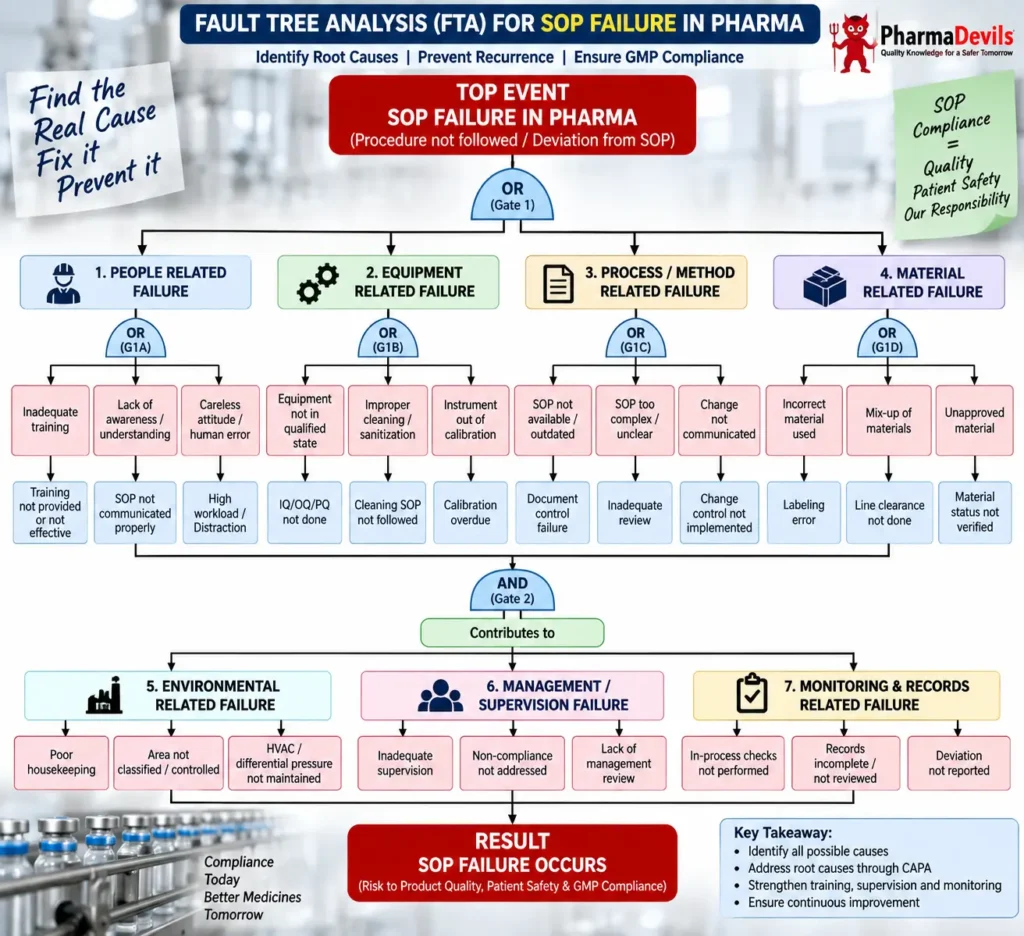
Typical causes include inadequate training, poor SOP understanding, human error, equipment qualification or calibration gaps, improper cleaning, outdated or unclear procedures, material mix-ups, weak line clearance, poor housekeeping, pressure differential failures, insufficient supervision, incomplete records, missed in-process checks, and unreported deviations. By using OR and AND logic gates, the diagram shows how individual or combined failures can result in SOP non-compliance. It supports systematic root-cause identification, CAPA planning, stronger training, improved supervision, better monitoring, and prevention of recurrence, thereby protecting product quality, patient safety, and GMP compliance.
Questions & Answers – Validation of Autoclave
Q1. What is the objective of the SOP for Validation of Autoclave?
Answer: The objective is to lay down the procedure for validation of the autoclave.
Q2. Where is this SOP applicable?
Answer: It is applicable to autoclave validation in the Microbiology Department.-
Q3. Who is responsible for execution of the SOP?
Answer: The Microbiologist is responsible for execution of the SOP.
Q4. Who is responsible for effective implementation of the SOP?
Answer: Head QA/QC is responsible for effective implementation.
Q5. What are the main qualification stages mentioned for autoclave validation?
Answer: The SOP classifies autoclave validation into Operational Qualification (OQ) and Performance Qualification (PQ).
Q6. What should be verified before starting validation?
Answer: The autoclave temperature display, compound pressure gauge, operating procedure, and relevant calibration certificates should be verified.
Q7. Why are thermocouples calibrated before and after validation?
Answer: To verify that the thermocouples of the data logger provide acceptable temperature readings compared with a standard thermometer.
Q8. How are heat distribution and heat penetration studies performed?
Answer: A multi-point data logger is used, with probes positioned as specified. Temperature and lag time are recorded while maintaining the required holding time and pressure.
Q9. What temperature and pressure acceptance criteria are specified?
Answer: The SOP specifies probe temperatures of 115–118°C or 121–124°C, as applicable, with pressure between 15 and 18 lbs for a 15-minute cycle.
Q10. What load patterns are considered during autoclave validation?
Answer: The SOP includes empty load, minimum load, fixed load, and maximum load studies.
Q11. Which biological indicator is specified for autoclave validation?
Answer: The SOP specifies Bacillus stearothermophilus strips, ATCC-7953.
Q12. Where should biological indicator strips be placed?
Answer: They should be placed at the location where heat penetration is lowest.
Q13. What is the acceptance criterion for the biological indicator study?
Answer: After incubation, no visible growth should be observed in the test strip medium; this indicates that the moist heat sterilizer qualifies the validation test.
Q14. What are the incubation conditions for the microbial limit test?
Answer: Bacteria are incubated at 30–35°C for 72 hours, and fungi at 20–25°C for 120 hours.
Q15. What is the acceptance criterion for the microbial limit test?
Answer: No microbial growth should be observed in the media.
Q16. What is the frequency of autoclave validation as per the SOP?
Answer: Autoclave validation is performed every 12 months.
Q17. Who provides training under this SOP?
Answer: Head QA/QC acts as the trainer, and the Microbiologist is the trainee.
Q18. Which annexures are included in the SOP?
Answer: Annexure-I covers display temperature, and Annexure-II covers the load pattern.
Reference Guidelines:
- EU GMP, Volume 4, Annex 1 – Manufacture of Sterile Medicinal Products: includes requirements for sterilization processes, validation, load patterns, physical measurements, biological indicators, and routine control of sterile manufacturing. (Public Health)
EU GMP Annex 1 – Official European Commission PDF - WHO Technical Report Series No. 1044, Annex 2 – WHO GMP for Sterile Pharmaceutical Products: provides GMP expectations for sterile manufacturing and sterilization processes. (World Health Organization)
WHO TRS 1044 Annex 2 - PIC/S GMP Guide PE 009, Annex 1 – Manufacture of Sterile Medicinal Products: internationally recognized guidance covering sterile processing and validated sterilization systems. (PIC/S)
PIC/S GMP Annex 1 - USP General Chapter <1229> – Sterilization of Compendial Articles and USP <1229.1> – Steam Sterilization by Direct Contact: address principles of sterilization and validation of steam sterilization processes. (USP)
- USP <1229.2> – Moist Heat Sterilization of Aqueous Liquids: particularly relevant when autoclaves are used for culture media, aqueous preparations, or liquid loads. (USP)
- USP <1211> – Sterility Assurance: provides the overall principles of sterility assurance and the use of process controls to establish confidence in sterile processing. (USP)
- ISO 17665:2024 – Sterilization of Health Care Products—Moist Heat: specifies requirements for development, validation, and routine control of moist-heat sterilization processes. Note that its formal scope is primarily medical devices, so it is best used as a supporting technical reference for pharmaceutical autoclave validation. (ISO)
ISO 17665:2024 official page