







1. Introduction – Visual Inspection of Tablets, Oral Liquids, Capsules & Ointment:
The Visual Inspection of Tablets, Oral Liquids, Capsules & Ointment SOP establishes a standardized procedure for visually examining pharmaceutical products before final packing to identify and segregate products having visible defects. The procedure applies to tablets, oral liquids, capsules, and ointments and is intended to ensure that only products meeting the required visual quality standards proceed for packaging. For tablets, visual inspection includes checking for defects such as capping, black spots, chipping, picking, sticking, mottling, broken tablets, foreign or For oral liquids, inspection includes clarity, foreign particles, sealing defects, fill-volume variation, cap defects, and glass or fibre contamination, with inspection performed against black and white backgrounds. Capsules are examined for appearance, pinholes, colour variation, dents, sealing, and proper locking, while ointments are checked for defects such as folding, creeping, embossing, and dirtiness. Defective products are handed over to the Production Chemist for assessment of wastage.
Skip to PDF content2. Flow Diagram – Visual Inspection of Tablets, Oral Liquids, Capsules & Ointment:
The Visual Inspection of Tablets, Oral Liquids, Capsules & Ointment SOP describes the systematic inspection of pharmaceutical products before final packing to identify visible defects and prevent nonconforming units from progressing further. The procedure covers tablets, oral liquids, capsules, and ointments and defines the specific visual defects to be checked for each dosage form. Tablets are examined for capping, spots, chipping, sticking, mottling, broken units, colour variation, and surface defects.
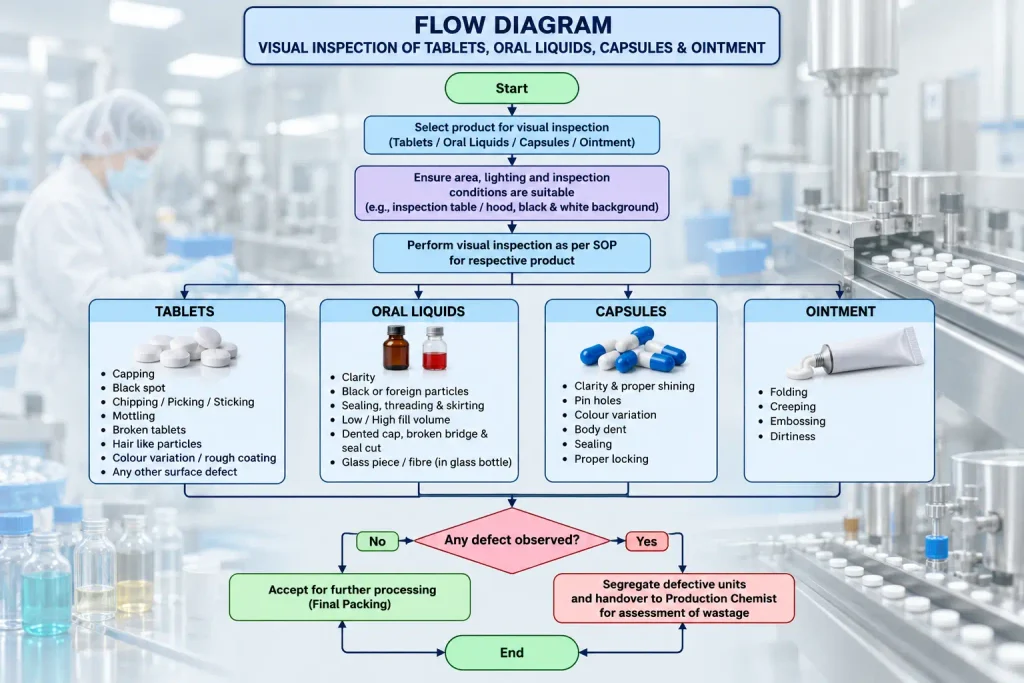
Oral liquids are checked for clarity, foreign particles, sealing condition, fill volume, and container defects. Capsules are inspected for pinholes, colour variation, dents, sealing, and proper locking, while ointments are checked for folding, creeping, embossing, and dirtiness. Defective units are segregated and handed over to the Production Chemist for assessment of wastage.
3. Benefits of Following SOP – Visual Inspection of Tablets, Oral Liquids, Capsules & Ointment:
The Visual Inspection of Tablets, Oral Liquids, Capsules &B Ointment SOP provides a controlled and standardized approach for detecting visible defects in pharmaceutical products before final packing. It ensures that tablets, oral liquids, capsules, and ointments are systematically inspected according to defined visual quality parameters so that defective or unacceptable units can be identified and segregated.
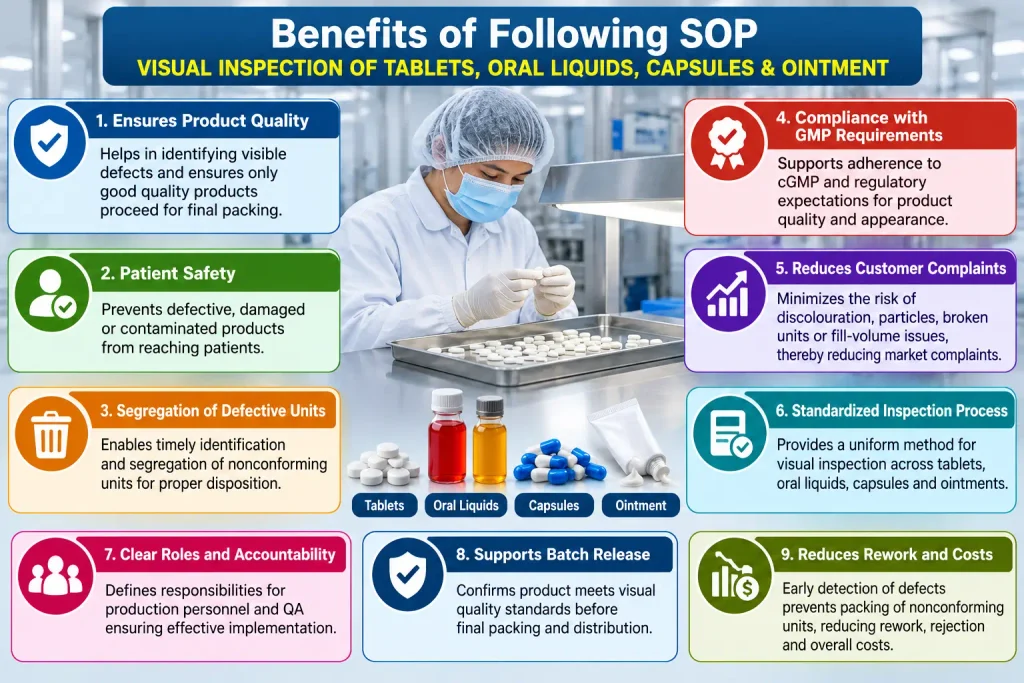
Following this SOP helps maintain consistent product appearance, product quality, patient safety, and effective defect control. Tablets are checked for defects such as capping, spots, chipping, sticking, mottling, breakage, and colour variation, while oral liquids are examined for clarity, foreign particles, sealing, fill-volume variation, and container-related defects. Capsules are inspected for pinholes, colour variation, dents, sealing, and proper locking, whereas ointments are checked for folding, creeping, embossing, and dirtiness. Any defective units identified during inspection are handed over to the Production Chemist for assessment of wastage.
4. Brainstorming for SOP Failure – Visual Inspection of Tablets, Oral Liquids, Capsules & Ointment:
The Visual Inspection of Tablets, Oral Liquids, Capsules & Ointment SOP requires systematic checking of each dosage form for defined visible defects before final packing. The brainstorming analysis identifies potential reasons why this inspection process may fail or may not be performed effectively. These can include inadequate operator training, poor vision or inspector fatigue, unsuitable lighting, absence of the required black-and-white inspection background for oral liquids, failure to use gloves, insufficient inspection time, weak understanding of defect categories, poor segregation of rejected units, inadequate supervision, high workload, and incomplete documentation.
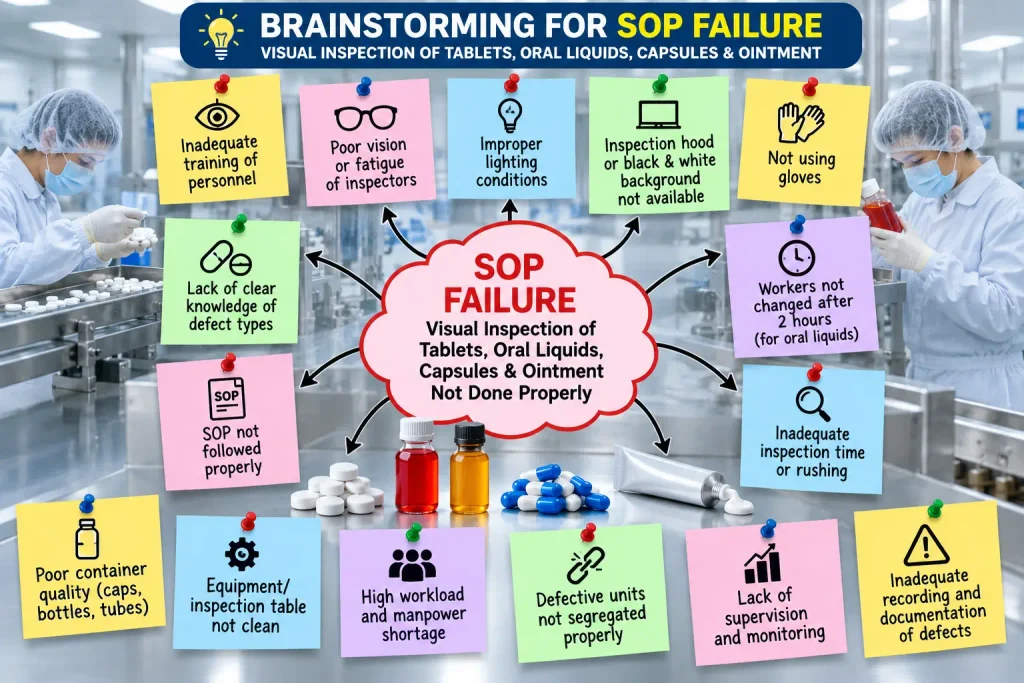
The SOP specifically requires visual defect checks for tablets, oral liquids, capsules, and ointments, with defective units handed over to the Production Chemist for wastage assessment.Brainstorming helps the production and quality teams identify possible manpower, method, equipment, environment, material, and documentation-related causes so that suitable corrective and preventive actions can be developed to strengthen visual inspection effectiveness.
5. 5-Why Analysis for SOP Failure – Visual Inspection of Tablets, Oral Liquids, Capsules & Ointment:
The 5-Why Analysis for SOP Failure – Visual Inspection of Tablets, Oral Liquids, Capsules & Ointment is used to systematically identify the underlying reason why the visual inspection process may not be performed effectively. The analysis begins with the problem that product defects are not detected during inspection and then progressively evaluates why inspectors may fail to identify them.
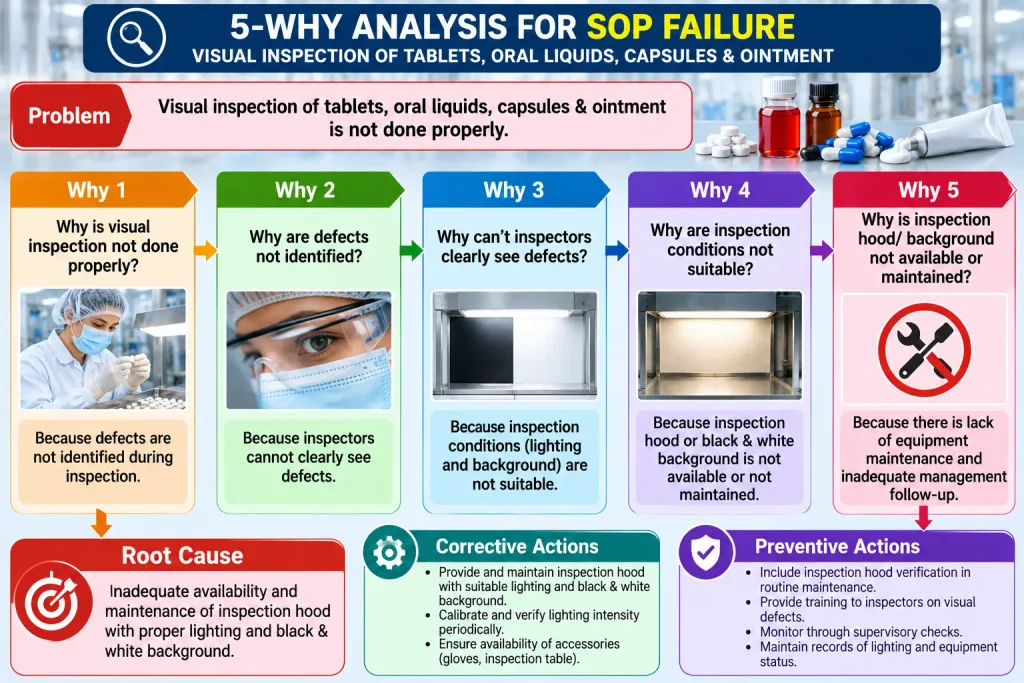
Possible contributing factors include inadequate visibility of defects, unsuitable lighting conditions, lack of a proper inspection hood, and absence or poor maintenance of the required black-and-white background. The SOP specifically states that oral liquids should be visually inspected under an inspection hood against black and white backgrounds, while tablets, capsules, and ointments are also required to be checked for defined visual defects before final packing. The 5-Why approach helps trace the immediate failure to a root cause, enabling appropriate corrective and preventive actions such as improving inspection conditions, maintaining inspection equipment, strengthening operator training, enhancing supervision, and ensuring consistent documentation.
6. Fishbone Analysis for SOP Failure – Visual Inspection of Tablets, Oral Liquids, Capsules & Ointment:
The Fishbone Analysis for SOP Failure – Visual Inspection of Tablets, Oral Liquids, Capsules & Ointment is used to identify and organize the possible causes responsible for ineffective or improper visual inspection. The potential causes can be grouped under major categories such as Man, Machine/Equipment, Method, Material, Environment, and Measurement.
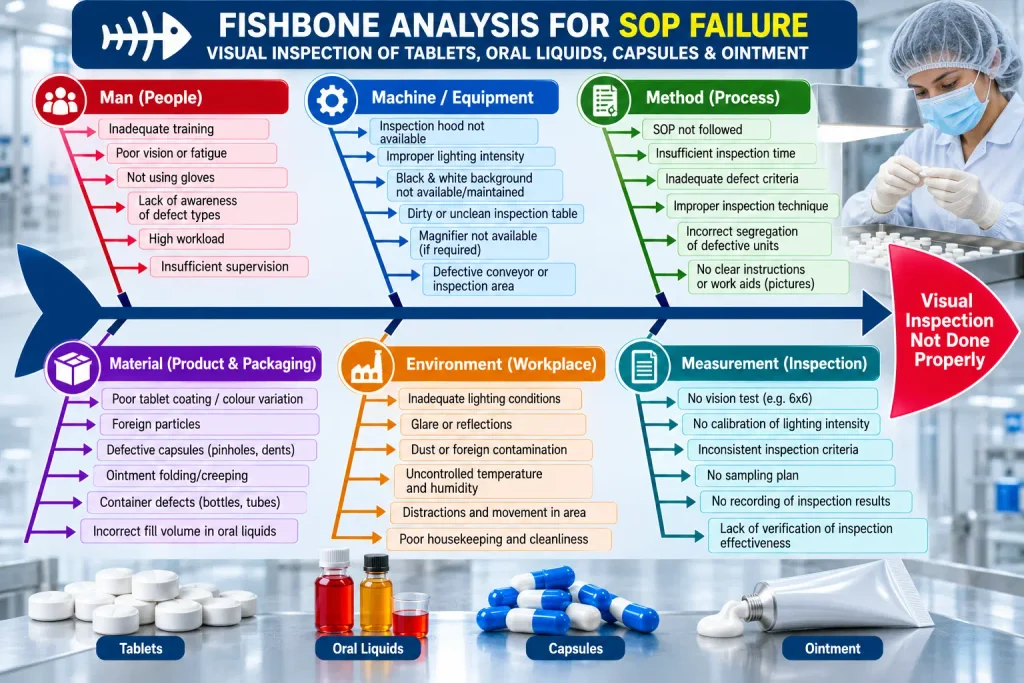
People-related causes may include inadequate training, poor vision, fatigue, lack of awareness, and insufficient supervision. Equipment-related causes can include unsuitable lighting, unavailable inspection hood, or improper black-and-white background. Method-related causes may involve failure to follow the SOP, insufficient inspection time, poor segregation practices, or unclear instructions. Material-related causes include coating defects, foreign particles, defective capsules, incorrect fill volume, and container defects. Environmental and measurement factors may include glare, poor housekeeping, inadequate lighting verification, inconsistent inspection criteria, and incomplete recording of inspection results.The SOP requires defined visual checks for tablets, oral liquids, capsules, and ointments before final packing and specifies segregation and assessment of defective units.
7. FMEA Analysis for SOP Failure – Visual Inspection of Tablets, Oral Liquids, Capsules & Ointment:
The FMEA Analysis for SOP Failure – Visual Inspection of Tablets, Oral Liquids, Capsules & Ointment is used to evaluate potential failure modes associated with improper visual inspection and to prioritize risks based on Severity (S), Occurrence (O), Detection (D), and Risk Priority Number (RPN). The analysis considers failures such as missed tablet defects, undetected particulate matter or fill-volume issues in oral liquids, defective capsules, ointment defects, non-use of proper inspection equipment, incorrect segregation of rejected units, incomplete documentation, and inadequate inspector competency.
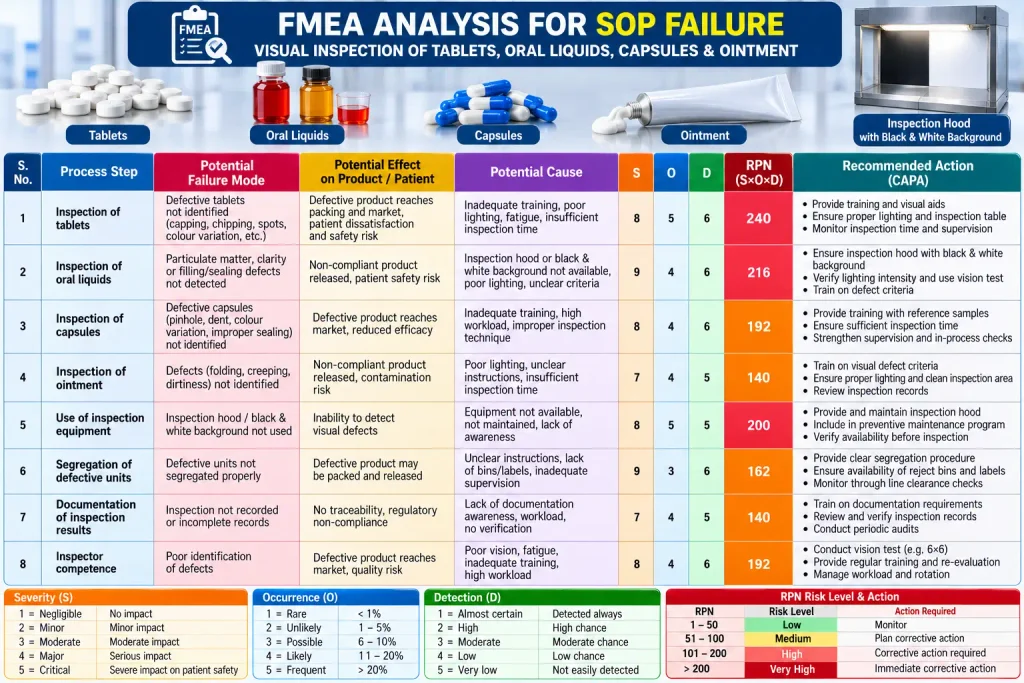
The SOP requires specific visual checks for tablets, oral liquids, capsules, and ointments before final packing, and defective units are to be handed over to the Production Chemist for wastage assessment. FMEA helps identify high-risk failure points requiring priority action. Recommended controls may include operator training, proper lighting, maintenance of inspection facilities, clear defect criteria, effective segregation, review of inspection records, and periodic verification of inspector performance. This risk-based approach strengthens SOP compliance and improves the effectiveness and consistency of visual inspection.
8. Heat Map Analysis for SOP Failure – Visual Inspection of Tablets, Oral Liquids, Capsules & Ointment:
The Heat Map Analysis for SOP Failure – Visual Inspection of Tablets, Oral Liquids, Capsules & Ointment provides a visual method for prioritizing risks associated with failures in the visual inspection process. Potential failure modes are evaluated using Severity, Occurrence, Detection, and Risk Priority Number (RPN) so that higher-risk issues can be identified and addressed first.
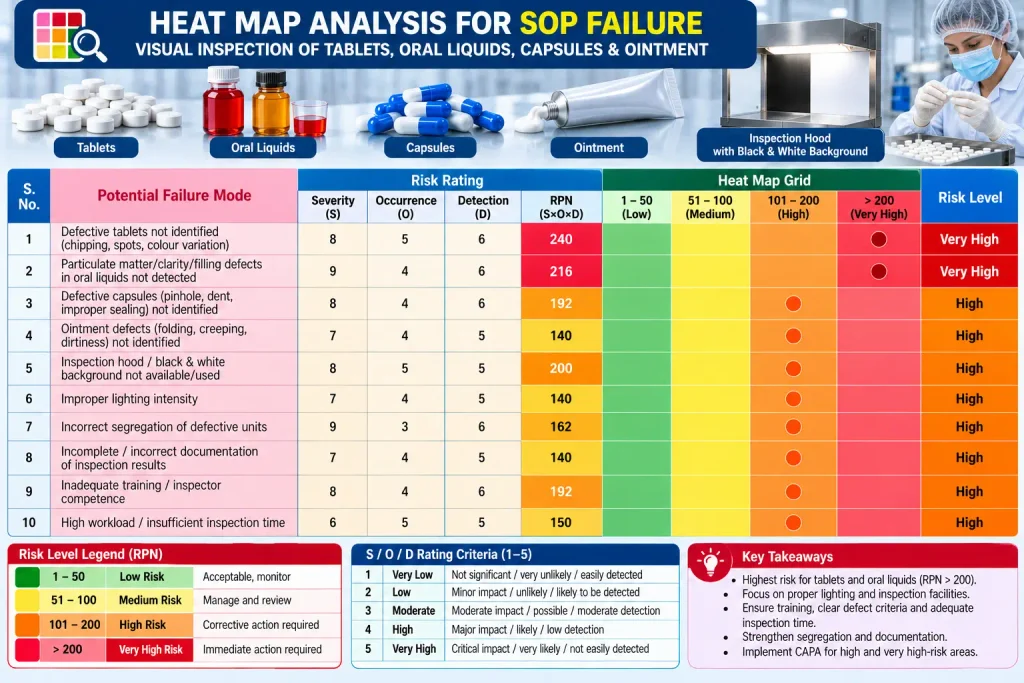
The analysis may include risks such as failure to detect tablet defects, particulate matter or fill-volume problems in oral liquids, defective capsules, ointment defects, improper lighting, absence of the required inspection hood or black-and-white background, inadequate inspector training, incorrect segregation, and incomplete documentation. The SOP specifically requires defined visual checks for tablets and oral liquids, including inspection of oral liquids under an inspection hood against black and white backgrounds. It also defines visual inspection requirements for capsules and ointments and requires defective units to be handed over to the Production Chemist for wastage assessment. a heat map helps distinguish low, medium, high, and very high risks, enabling timely CAPA, improved inspection controls, better training, strengthened supervision, and more effective prevention of defective products progressing to final packing.
9. CAPA for SOP Failure – Visual Inspection of Tablets, Oral Liquids, Capsules & Ointment:
The CAPA for SOP Failure – Visual Inspection of Tablets, Oral Liquids, Capsules & Ointment is intended to correct deficiencies in the visual inspection process and prevent their recurrence. Corrective actions may include re-inspection of affected batches, segregation of defective units, retraining of inspectors, restoration of proper inspection conditions, verification of lighting, and completion of missing inspection records. Preventive actions should focus on strengthening routine controls through periodic training, use of defined defect criteria and reference samples, proper maintenance of inspection hoods and black-and-white backgrounds, adequate supervision, documented lighting verification, proper rejection and segregation practices, and periodic review of inspection records.
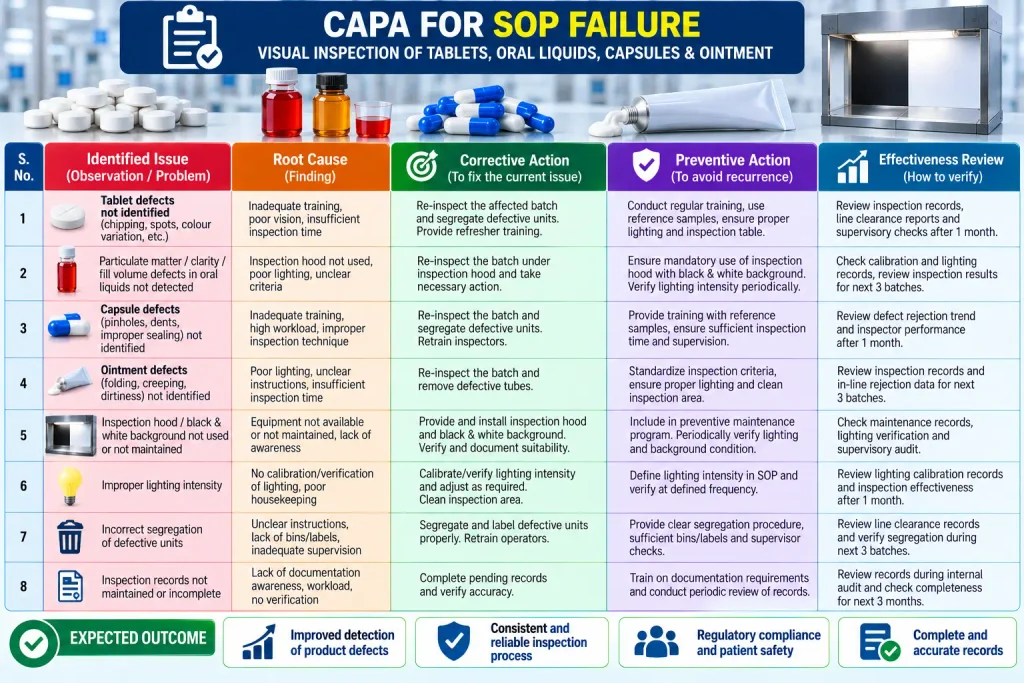
The SOP requires tablets, oral liquids, capsules, and ointments to be visually inspected for defined defects before final packing, with defective units handed over to the Production Chemist for assessment. CAPA effectiveness can be verified through review of subsequent batches, defect-rejection trends, inspection records, supervisory checks, maintenance records, and periodic internal audits, ensuring that the visual inspection process remains consistent, effective, and properly documented.
Questions & Answers: Visual Inspection of Tablets, Oral Liquids, Capsules & Ointment:
- What is the objective of this SOP?
The objective is to describe the procedure for visual inspection of tablets, oral liquids, capsules, and ointments. - What is the scope of this SOP?
The SOP covers visual inspection of tablets, oral liquids, capsules, and ointments. - Who is responsible for execution of this SOP?
Officer/Chemist–Production and the concerned Production person are responsible for execution. - Who is responsible for effective implementation of this SOP?
AGM–Production and Head–QA/QC are responsible for effective implementation. - When are tablets visually inspected?
Tablets are visually inspected for defects before final packing into blisters or strips. - What defects are checked in tablets?
Tablets are checked for capping, black or other spots, chipping, picking, sticking, mottling, broken tablets, hair-like particles, colour variation, rough coating, uncovered sides, improper hardness, rough surface, and other defects. - What precaution is required while checking tablets?
Gloves should always be used during tablet inspection. - What is done with defective tablets?
Defective tablets are handed over to the Production Chemist for assessment of the percentage of wastage.