







Brief Description
The SOP for Analysis of Raw Material defines the systematic procedure for receiving, sampling, testing, documentation, approval, rejection, and control of raw materials handled by the Quality Control Department. Its objective is to ensure that every raw material is properly identified and evaluated before being released for use in manufacturing. The procedure requires QC personnel to verify receiving-report details such as material name, pharmacopoeial status, batch number, quantity, supplier, manufacturer, receipt details, and QC number. The consignment is inspected for identity, container condition, and correct labeling before sampling according to an approved sampling plan. Samples are analyzed using approved procedures, with test observations, calculations, standards used, and results properly documented. QC reviews the analytical report against the applicable master specifications and determines whether the material should be released or rejected. Appropriate status labels are prepared and affixed to containers, while records are maintained in the raw-material register. The SOP also describes handling and evaluation of samples received from new suppliers.
Skip to PDF content1. Flow Diagram:
The flow diagram illustrates the complete Quality Control workflow for analysis of raw materials, beginning with receipt of the material intimation and verification of the receiving report. QC personnel confirm key details such as material name, pharmacopoeial status, batch number, quantity, supplier, manufacturer, and receipt information, followed by entry in the raw material register and physical inspection of the consignment.
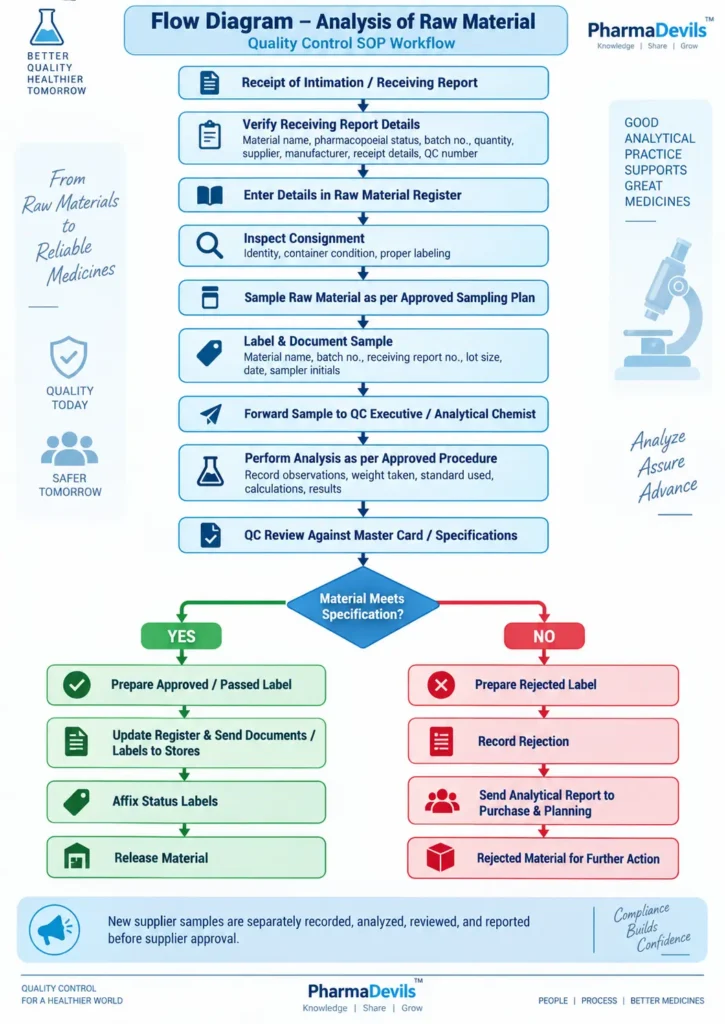
The material is then sampled according to the approved sampling plan, properly labeled, documented, and forwarded to the Analytical Chemist for testing. Analysis is performed using the approved procedure, and all observations, calculations, standards used, and results are recorded.After QC review against the applicable master specifications, compliant material is approved, labeled, documented, and released to Stores, while non-compliant material is rejected, documented, and reported to Purchase and Planning for further action. The SOP also covers evaluation of samples received from new suppliers.
2. Brainstorming for SOP Failure:
The SOP Failure Brainstorming Diagram for Analysis of Raw Material presents possible causes of procedural non-compliance in a simple and visually engaging manner. The LED-tree and sticky-note concept groups potential failures into key areas such as receiving report verification, sampling, inspection, documentation, laboratory analysis, review and approval, labeling and release, new supplier evaluation, and sample storage/retention.
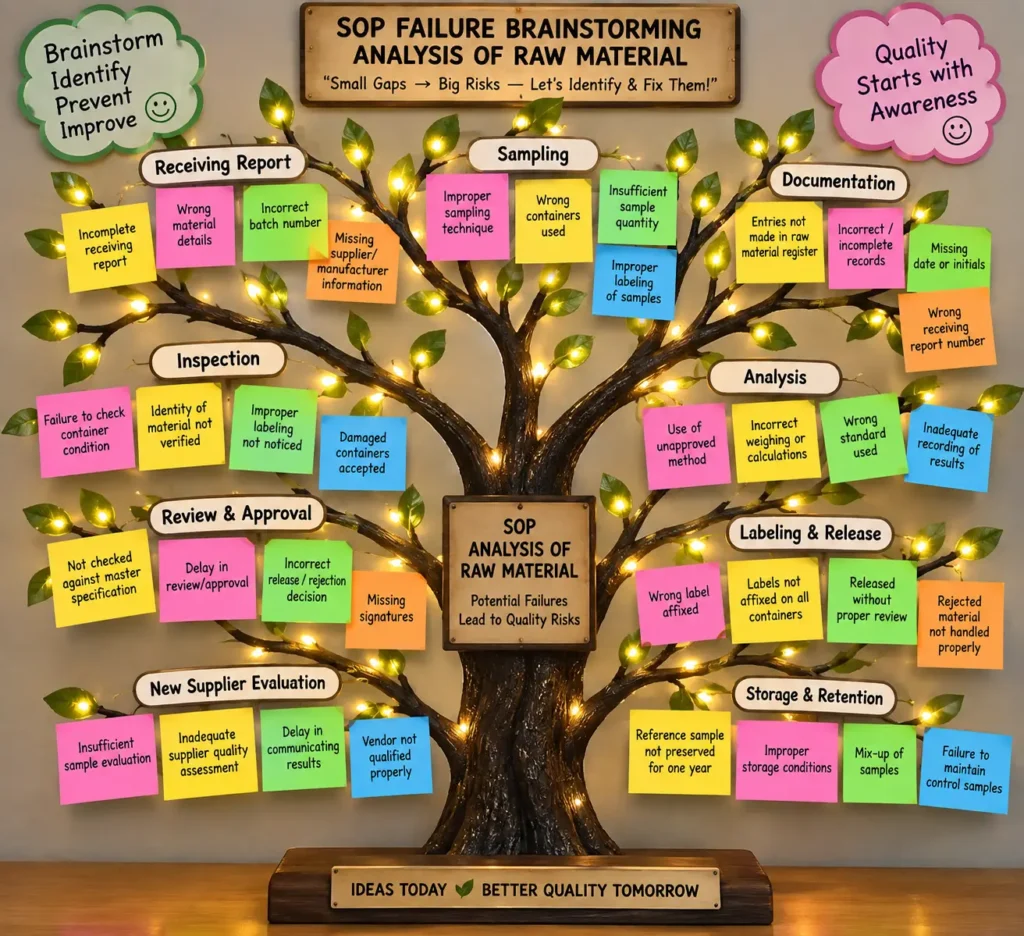
The diagram highlights issues including incomplete receiving information, incorrect batch details, improper sampling techniques, inadequate sample labeling, damaged containers, missing records, incorrect calculations, use of wrong standards, delayed review, improper release or rejection decisions, and inadequate supplier assessment. By displaying these risks as individual brainstorming points, QC personnel can easily discuss potential weaknesses and identify probable root causes. This visual tool supports GMP training, risk assessment, deviation investigation, CAPA development, and continuous improvement, helping strengthen the overall raw-material analysis process.
3. 5-Why Analysis for SOP Failure:
The 5-Why Analysis diagram illustrates a systematic root-cause investigation for a failure in following the Raw Material Analysis SOP. The SOP requires QC personnel to verify the completeness of the receiving report, inspect and sample the material, forward the sample for analysis, document analytical results, and subsequently release or reject the material based on specifications.
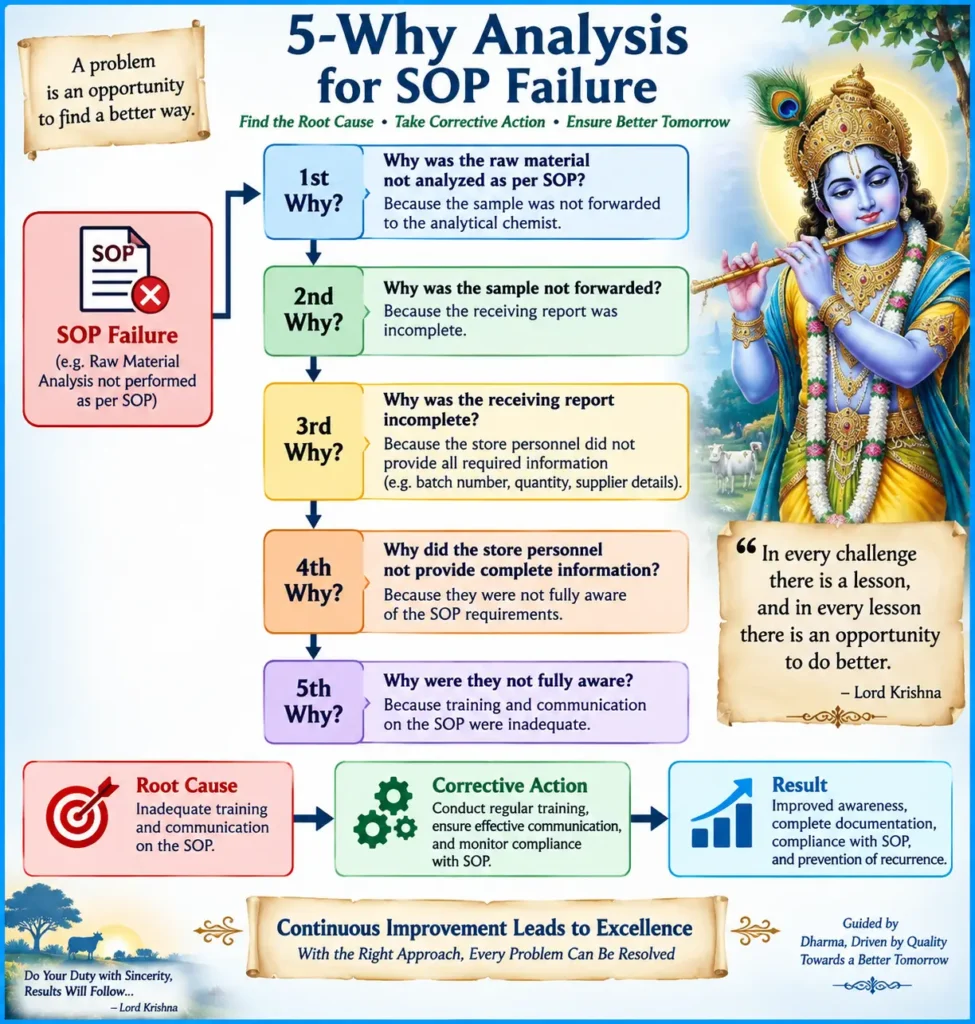
The diagram progressively asks “Why?” five times—from the immediate failure, such as raw material analysis not being performed correctly, through incomplete documentation and lack of awareness, to the underlying root cause of inadequate SOP training and communication. Corrective actions emphasize retraining concerned personnel, strengthening communication, verifying understanding, and monitoring SOP compliance. The Lord Krishna theme adds a motivational message of duty, discipline, learning, and continuous improvement, reinforcing the importance of performing assigned GMP activities correctly and consistently.
4. Fishbone Analysis for SOP Failure:
The Fishbone Analysis for SOP Failure systematically identifies potential causes that may lead to non-compliance with the Raw Material Analysis SOP. The diagram applies the 6M approach—Man, Method, Material, Machine, Measurement, and Environment—to organize possible contributing factors such as inadequate training, lack of awareness, unclear procedures, incomplete receiving reports, incorrect sample details, unavailable equipment, missing records, poor communication, interruptions, and time pressure.
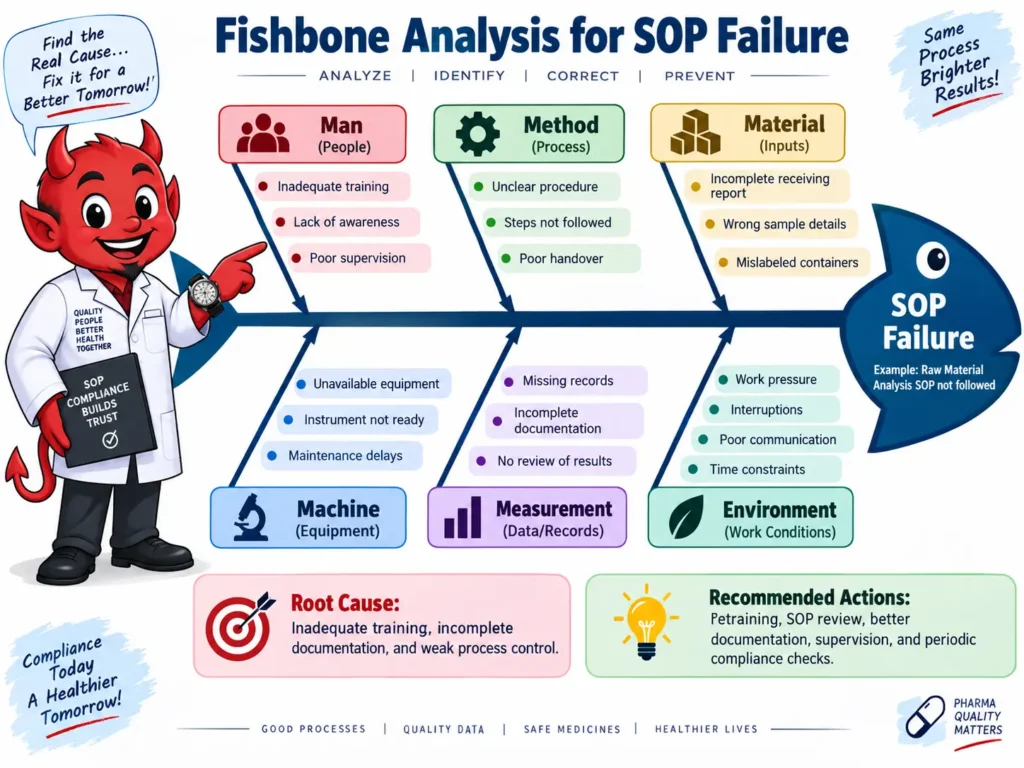
This analysis is aligned with the SOP requirement that QC personnel verify receiving-report completeness, inspect and sample raw materials correctly, and maintain required material information before analysis. The SOP also requires proper sample forwarding, analytical testing, documentation, review, and final release or rejection.The Devil character wearing a watch emphasizes timely SOP compliance, while the diagram supports identification of root causes and development of corrective actions such as retraining, improved documentation, supervision, and periodic compliance monitoring.
5. Fault Tree Analysis for SOP Failure:
The Fault Tree Analysis (FTA) for SOP Failure presents a structured method to identify the possible causes that can lead to failure of the Raw Material Analysis SOP. The top event, “SOP Failure,” is divided into major contributing branches such as SOP not followed, incomplete or incorrect input for analysis, and analysis not performed correctly.
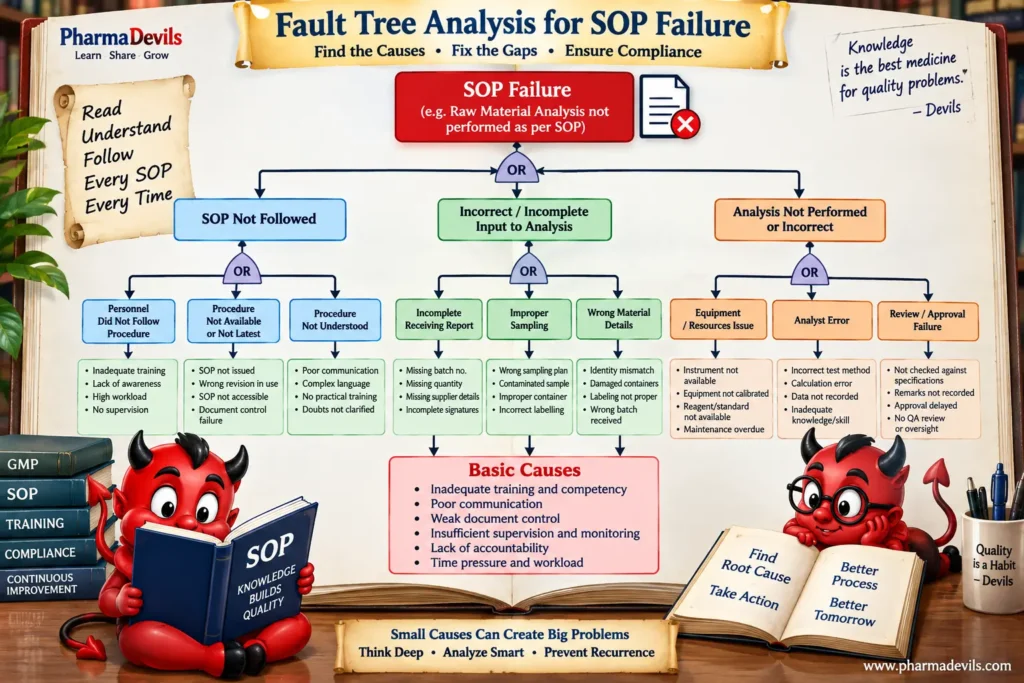
The diagram further traces these failures to basic causes including inadequate training, poor communication, incomplete receiving reports, improper sampling, incorrect material details, equipment or reagent issues, analyst errors, weak documentation, and inadequate review or approval. These causes are relevant to the SOP because QC personnel are required to verify receiving information, inspect and sample materials correctly, and maintain proper records before analysis. The SOP also requires analytical testing, documentation of results, review against specifications, and final release or rejection of the material.The Devils reading books concept emphasizes that SOP knowledge, training, understanding, and disciplined execution are essential for preventing recurrence and maintaining GMP compliance.
Questions & Answers – SOP for Analysis of Raw Material
- What is the objective of this SOP?
The objective is to define the procedure for analysis of raw material. - Who is responsible for implementation of this SOP?
The responsibility is assigned to the QC Chemist, Assistant Manager-QC, and Head-QA/QC. - What should QC personnel verify before sampling raw material?
QC personnel should ensure that the receiving report is complete and contains required information such as material name, pharmacopoeial status, batch number, quantity, supplier, manufacturer, date of receipt, challan details, purchase order details, and QC number. - What details are entered in the raw material register?
The register includes material name and batch number, supplier/manufacturer, quantity received, number of units, date of receipt, date of sampling, and receiving report number. - What is checked during physical inspection of the consignment?
QC checks the identity of the material, condition of containers, and proper labeling. - How should raw materials be sampled?
Raw materials should be sampled according to the approved sampling plan applicable to the material type. - How are active-material samples stored after sampling?
They are sampled into clean and dry glass bottles with pilfer-proof caps or self-sealing poly bags and properly labeled. - Who performs the actual analysis of the raw material?
The Analytical Chemist analyzes the material as per the approved procedure. - What analytical details must be recorded?
Details such as weight taken, working standard used, calculations, findings, initials, and date of analysis are recorded. - Who reviews the analytical report before release or rejection?
The Quality Control Executive checks the receiving report against the master card and decides whether the material complies with specifications. - What happens when raw material complies with specifications?
Appropriate approved/passed labels are prepared, records are updated, and labels are forwarded to stores for affixing on containers. - What happens when raw material is rejected?
Duplicate analytical reports containing receiving report number, quantity, supplier details, and analytical findings are forwarded to the Purchase and Planning Departments for further action. - How are samples from new suppliers evaluated?
The Purchase Department provides samples, QC records the required details, and the Analytical Chemist analyzes them according to the approved procedure. - What happens after a new supplier sample is approved?
The manufacturer’s premises are inspected by the Assistant Quality Control Manager and Purchase Manager. - What training is specified in the SOP?
The trainer is the Assistant Manager–Quality Control, trainees are QC personnel, and the training period is one day. - Why is SOP compliance important during raw-material analysis?
Following the SOP helps ensure correct sampling, analysis, documentation, review, and disposition of raw materials, reducing the risk of errors and inappropriate material release. This is an inference from the documented workflow and responsibilities in the SOP.
Reference Guidelines:
- EU GMP – EudraLex Volume 4, Part I, Chapter 6: Quality Control
Covers sampling, specifications, testing, documentation, and QC release activities. (Public Health)
EU GMP Volume 4 - EU GMP – Annex 8: Sampling of Starting and Packaging Materials
Specifically addresses representative sampling of starting/raw materials and packaging materials. (Public Health) - US FDA – 21 CFR 211.84: Testing and Approval or Rejection of Components, Drug Product Containers and Closures
Requires components to be appropriately sampled, tested or examined, and released before use; identity testing is also specifically addressed. (U.S. Food and Drug Administration)
FDA CGMP – Components and Containers - US FDA – 21 CFR 211.80 and 211.160
Relevant for component control, written specifications, laboratory controls, sampling plans, testing, and approval/rejection procedures. (U.S. Food and Drug Administration) - WHO TRS 1052, Annex 4 – Good Practices for Pharmaceutical Quality Control Laboratories, 2024
Provides detailed requirements for pharmaceutical QC laboratories performing sampling, testing, documentation, equipment control, and reporting. (World Health Organization)
WHO QC Laboratory Guideline - WHO TRS 929, Annex 4 – Guidelines for Sampling of Pharmaceutical Products and Related Materials
Useful specifically for establishing scientifically justified sampling procedures and representative sampling of pharmaceutical materials. (WHO Extranet) - WHO GMP Compendium, Volume 2 – Good Manufacturing Practices and Inspection, 10th Edition, 2024
Provides broader GMP expectations covering materials management, QC, documentation, personnel, equipment, and quality systems. (World Health Organization)