







Brief Description
The SOP for Analyst Validation describes the systematic procedure for training, qualifying, certifying, and re-qualifying Quality Control analysts to ensure they are competent to independently perform chemical, instrumental, and microbiological testing. The procedure begins with employee induction, general/interdepartmental SOP training, safety and Good Documentation Practices, followed by supervised working under a qualified analyst. Before qualification, analysts receive practical training in basic laboratory activities such as weighing verification, pipetting, and pH meter calibration. Qualification is performed using coded samples of known analytical value, with the new analyst carrying out testing in triplicate and results being evaluated against predefined acceptance criteria.The SOP also defines handling of qualification failures, certification, periodic re-qualification, and maintenance of an analytical-technique competency list. Re-qualification is required after two years, after prolonged absence from analytical work, or whenever considered necessary.
Skip to PDF content1. Flow Diagram:
The Analyst Validation Process Flow Diagram presents the complete sequence for qualifying a newly joined QC analyst before independent analytical work. The process starts with employee induction, followed by general/interdepartmental SOP training, QC laboratory orientation, safety training, Good Documentation Practices, and supervised working under a qualified analyst for five days.
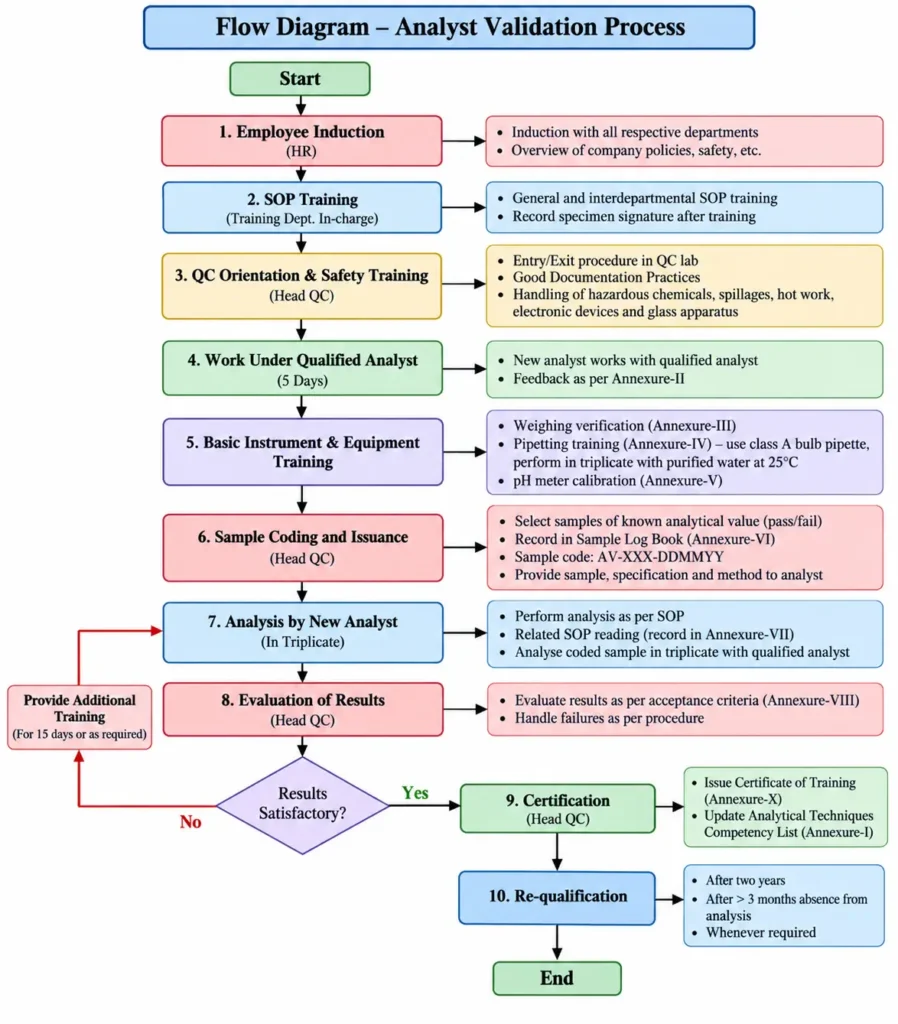
The analyst then receives practical training in weighing verification, pipetting, and pH meter calibration before entering the formal qualification stage. The Head QC selects and codes a sample of known analytical value, after which the analyst performs the test in triplicate and the results are evaluated against predefined acceptance criteria. If results are satisfactory, the analyst is certified and added to the competency list. If unsuccessful, additional training and requalification are required. Periodic requalification is also performed after two years, prolonged inactivity, or whenever necessary.
2. Brainstorming for SOP Failure:
The Brainstorming Diagram for Analyst Validation SOP Failure highlights the major causes that may lead to improper implementation of analyst qualification activities, particularly in an injection manufacturing environment. The diagram groups potential failures into training, personnel, procedure, equipment/method, documentation, and management/system-related issues. Key concerns include incomplete induction and SOP training, inadequate supervision by qualified analysts, uncontrolled sample coding, failure to perform analysis in triplicate, missed weighing/pipetting/pH training, incomplete annexures, and delayed requalification. These are important because the SOP specifically requires supervised working, practical laboratory training, coded sample handling, defined acceptance criteria, and documented qualification before analysts work independently.
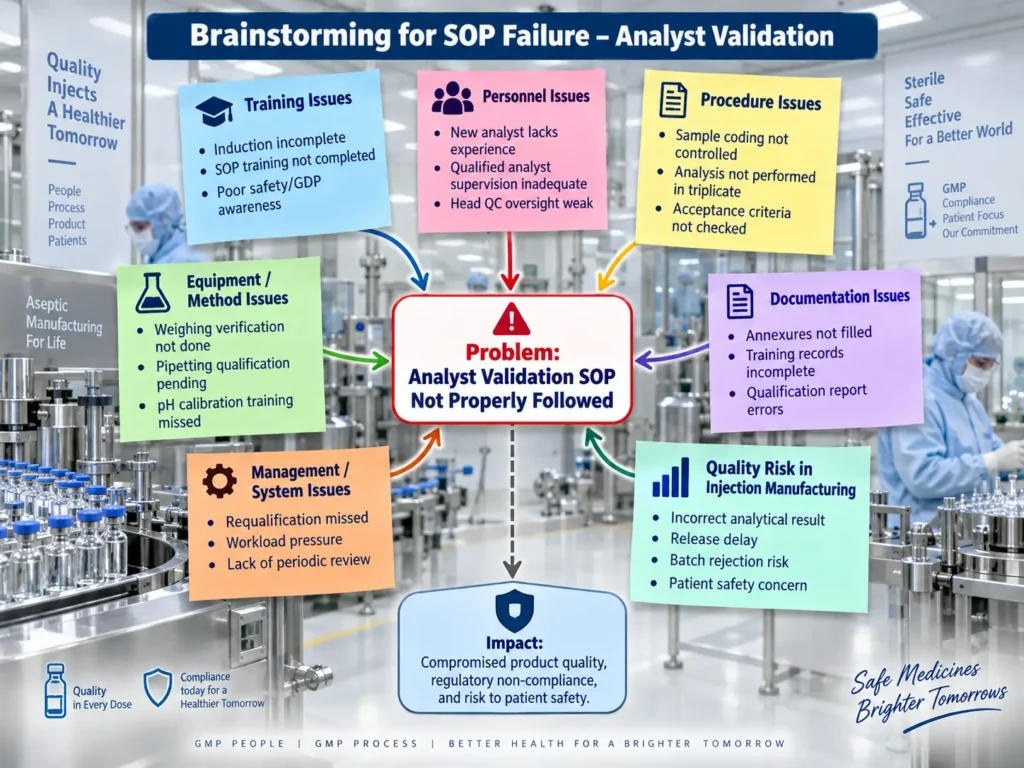
Failure to control these activities may increase the risk of incorrect analytical results, delayed batch release, regulatory non-compliance, batch rejection, and potential patient-safety impact in sterile/injection manufacturing.
3. 5-Why Analysis for SOP Failure:
The 5-Why Analysis for Analyst Validation SOP Failure evaluates the progressive causes behind an analyst being permitted to perform analytical work before completing the required qualification and certification process. The analysis begins with the immediate failure—an analyst starting work without full qualification—and traces it through incomplete training and equipment-specific practical verification, inadequate supervision and scheduling, weak follow-up of qualification records, and insufficient periodic quality-system monitoring.
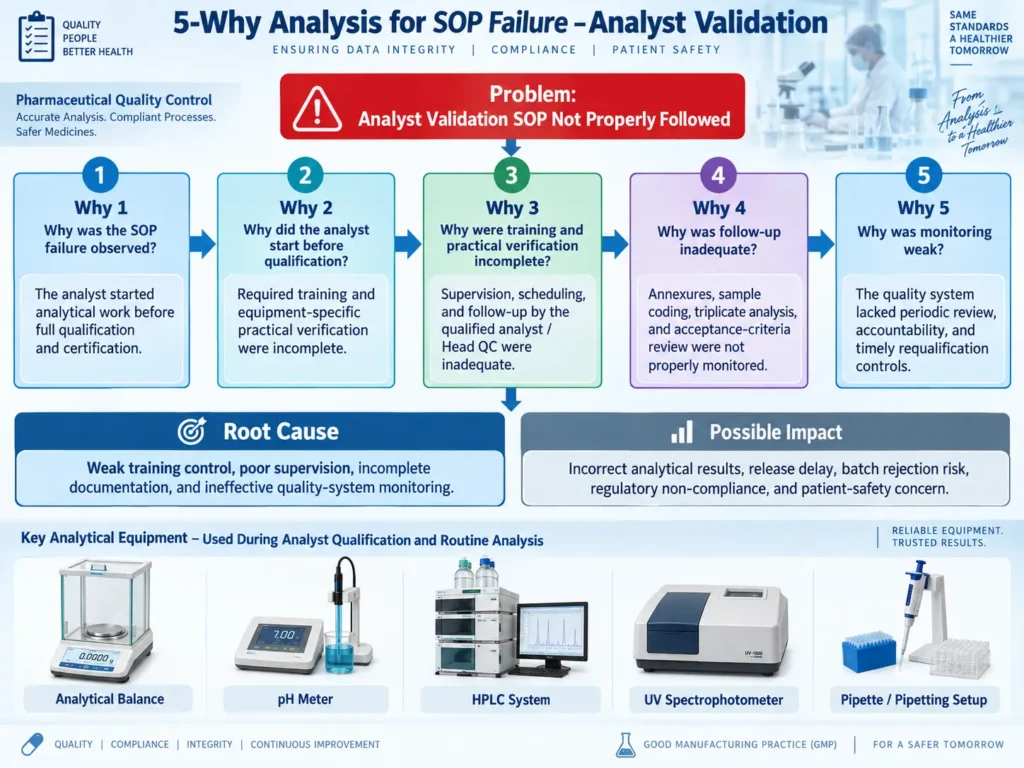
The SOP requires supervised working under a qualified analyst, practical training in weighing, pipetting and pH calibration, coded-sample analysis in triplicate, evaluation against defined acceptance criteria, and formal certification before independent work. The diagram also highlights five key QC tools—analytical balance, pH meter, HPLC system, UV spectrophotometer, and pipetting setup—to emphasize the importance of equipment competency. The identified root cause is a combination of weak training control, inadequate supervision, incomplete documentation, and ineffective monitoring, which may lead to unreliable analytical results, delayed release decisions, regulatory non-compliance, and increased quality risk.
4. Fishbone Analysis for SOP Failure:
The Fishbone Analysis for Analyst Validation SOP Failure identifies the main contributing causes that may result in the analyst qualification procedure not being properly followed, with the scenario presented against a liquid manufacturing environment. The causes are grouped under six major categories: Personnel, Training, Method/Procedure, Equipment/Instrument, Documentation, and Management/System.
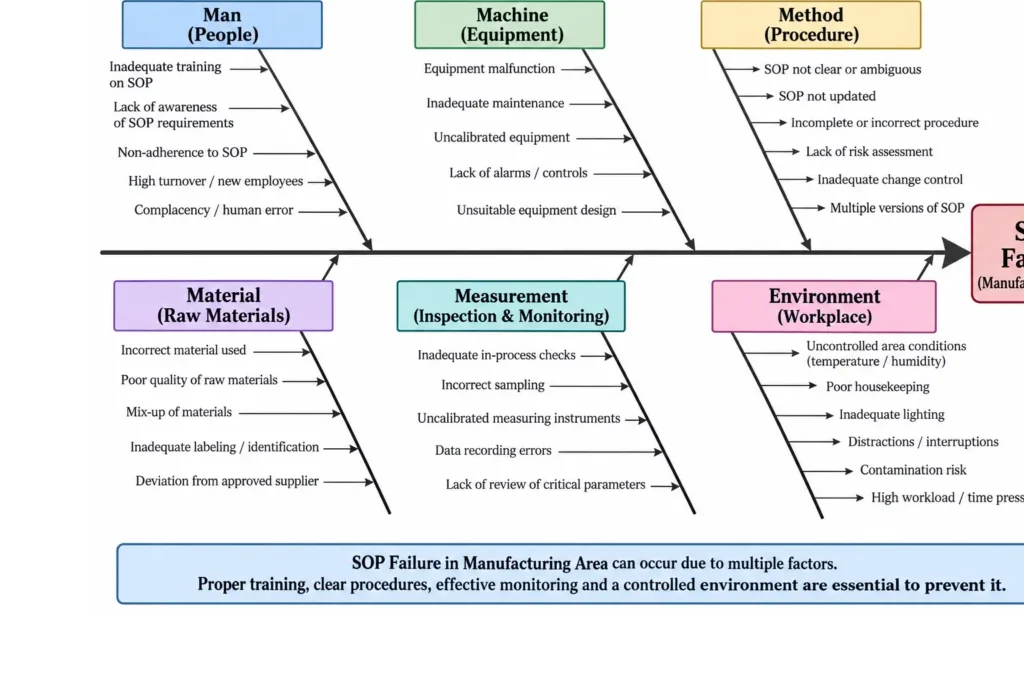
Potential causes include inadequate supervision of newly joined analysts, incomplete induction and SOP/GDP/safety training, improper sample coding, failure to perform analysis in triplicate, missed weighing or pipetting verification, inadequate pH meter training, incomplete annexures, qualification-report errors, delayed requalification, and insufficient periodic monitoring. These factors directly relate to the SOP requirements for supervised analyst training, practical instrument competency, coded sample analysis, result evaluation, certification, and requalification.Such failures may contribute to incorrect analytical results, delayed batch release, regulatory non-compliance, product-quality risk, and potential patient-safety concerns in liquid pharmaceutical manufacturing.
5. Fault Tree Analysis for SOP Failure:
The Fault Tree Analysis (FTA) for Analyst Validation SOP Failure systematically traces how failure to implement the analyst validation procedure can arise within a pharmaceutical manufacturing environment. The top event is defined as “SOP for Analyst Validation Not Implemented.” The diagram then divides the failure into three major pathways: the analyst working independently before qualification, qualification being performed inadequately or invalidly, and required requalification not being completed.
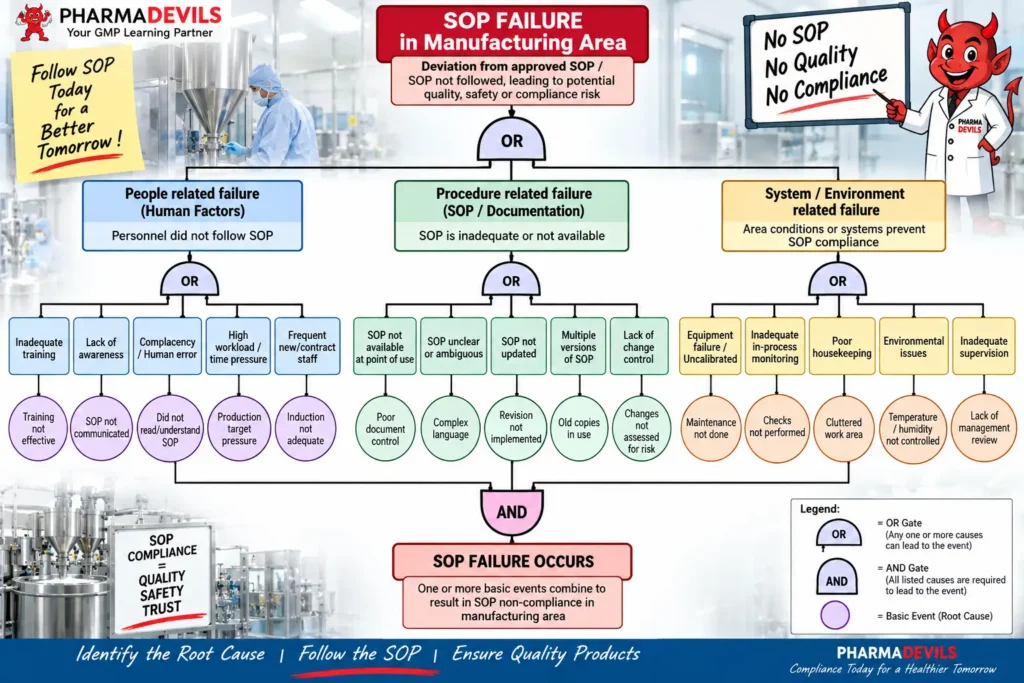
The analysis further identifies contributing causes such as incomplete induction and SOP training, missing practical instrument training, inadequate supervision by a qualified analyst, incorrect sample coding, failure to perform analysis in triplicate, improper result evaluation, incomplete qualification documentation, and missed periodic requalification. These causes reflect the SOP requirements for supervised training, instrument competency, coded-sample analysis, acceptance-criteria evaluation, certification, and requalification. The FTA concludes that weak training control, inadequate supervision, poor documentation, and ineffective monitoring are key root causes that may lead to unreliable analytical results, delayed batch release, regulatory non-compliance, product-quality risk, and potential patient-safety impact.
Questions & Answers – Analyst Validation
Q1. What is the objective of the Analyst Validation SOP?
Answer: To provide documented evidence and experimental data demonstrating that an analyst has adequate knowledge and competency to perform chemical and instrumental analysis.
Q2. Who is responsible for execution and implementation of the SOP?
Answer: Executive-QC is responsible for execution, while the QC Manager and Head QA/QC are responsible for effective implementation.
Q3. What training is required before a new analyst starts laboratory activities?
Answer: The analyst should complete induction, general/interdepartmental SOP training, laboratory entry/exit procedures, GDP, chemical safety, spill handling, hot-work precautions, and safe use of laboratory equipment.
Q4. What is the minimum acceptable training-feedback score?
Answer: The analyst should obtain not less than 75% marks; otherwise, retraining is required.
Q5. Why can failure to follow an SOP occur during manufacturing or analytical activities?
Answer: Typical causes include inadequate training, poor understanding of the SOP, unclear responsibilities, failure to use approved procedures, inadequate supervision, equipment/calibration problems, weak documentation control, or ineffective monitoring.
Q6. What should be done if an analyst fails the qualification acceptance criteria?
Answer: The analyst should be retrained/re-evaluated. After two consecutive failures, the analyst is considered non-qualified and should work under a qualified analyst for 15 days before requalification.
Q7. Can a repeatedly failing analyst perform critical analysis independently?
Answer: No. If the analyst fails qualification more than three consecutive times, the SOP states that the person should not be permitted to perform critical analysis.
Q8. What important items are checked during analyst qualification?
Answer: Checks include adherence to the SOP and analytical method, correct reagents, calibrated instruments, software use, chromatographic/integration techniques, GLP practices, correct dilution, calculations, reporting, and Good Documentation Practices.
Q9. When is analyst requalification required?
Answer: Requalification is performed after two years, when an analyst has not been involved in analysis for more than three months, or whenever otherwise required.
Q10. What is the final conclusion of analyst qualification?
Answer: Based on the evaluated results, the analyst is formally concluded as qualified or not qualified to carry out the specified analysis independently.
Q11. How can SOP failure be prevented in a manufacturing area?
Answer: Prevention should focus on effective training, use of current approved SOPs, clear responsibilities, calibrated and maintained equipment, proper documentation, in-process monitoring, controlled environmental conditions, supervision, and timely CAPA.
Q12. Why is investigation of an SOP failure important?
Answer: Investigation helps identify the true root cause, assess potential product-quality and compliance impact, establish corrective and preventive actions, and prevent recurrence.
Reference Guidelines:
- US FDA – 21 CFR §211.25, Personnel Qualifications: Requires personnel involved in drug manufacturing, processing, packing, or holding to have appropriate education, training, and experience, with continuing CGMP training. (eCFR)
21 CFR 211.25 – Personnel Qualifications - EU GMP – EudraLex Volume 4, Part I, Chapter 2: Personnel: Covers personnel qualifications, responsibilities, GMP training, hygiene, and management responsibilities. (Public Health)
EU GMP Volume 4 - EU GMP – Chapter 4: Documentation: Relevant to SOP preparation, approval, revision, document control, availability of current procedures, and recording of activities. The current EudraLex Volume 4 identifies Chapter 4 as the GMP chapter governing documentation. (Public Health)
- PIC/S GMP Guide PE 009-17, Part I: Particularly Chapter 1 – Pharmaceutical Quality System, Chapter 2 – Personnel, Chapter 4 – Documentation, and Chapter 5 – Production for SOP compliance and investigation of procedural failures. (PIC/S)
PIC/S Publications and PE 009-17 - ICH Q10 – Pharmaceutical Quality System: Supports defined responsibilities, adequate resources and training, management oversight, CAPA, change management, and continual improvement. (ICH Database)
ICH Q10 Pharmaceutical Quality System - WHO GMP – Main Principles / GMP Compendium: WHO GMP emphasizes trained personnel, suitable premises/equipment, clearly defined and documented processes, and consistent adherence to approved procedures. (World Health Organization)
WHO GMP Guidance