





Brief Description
The SOP “Training of Trainee Analyst” establishes a documented system for training analysts working in the Quality Control Department. Its objective is to ensure that trainee analysts receive structured theoretical and practical training before independently performing routine laboratory testing. The Executive-QC is responsible for execution, while Manager-QC and Head-QC/QA ensure effective implementation.Training covers the Chemical/Instrument Section, including sampling, weight variation, disintegration, friability, moisture determination, titrations, purified water testing, UV assay, Karl Fischer analysis, dissolution, finished-product testing, packing-material analysis, documentation, Drug Laws, GMP and GLP.For the Microbiology Section, training includes purified water testing, media preparation, sterilization, culture maintenance, growth-promotion testing, operation of laboratory instruments and environmental monitoring. After completing training, the analyst is evaluated; personnel scoring more than 75% are considered successful and permitted to perform routine sample analysis, while those scoring below 75% require retraining.The SOP also includes an annual QC SOP training schedule (Annexure-I) covering January through December.
Skip to PDF content1. Flow Diagram:
The flow diagram illustrates the structured process for training and qualification of a trainee analyst in the Quality Control Department. The process begins with induction of the new trainee analyst, followed by general training. After induction, training is provided according to the assigned area, covering either the Chemical/Instrument Section or the Microbiology Section.
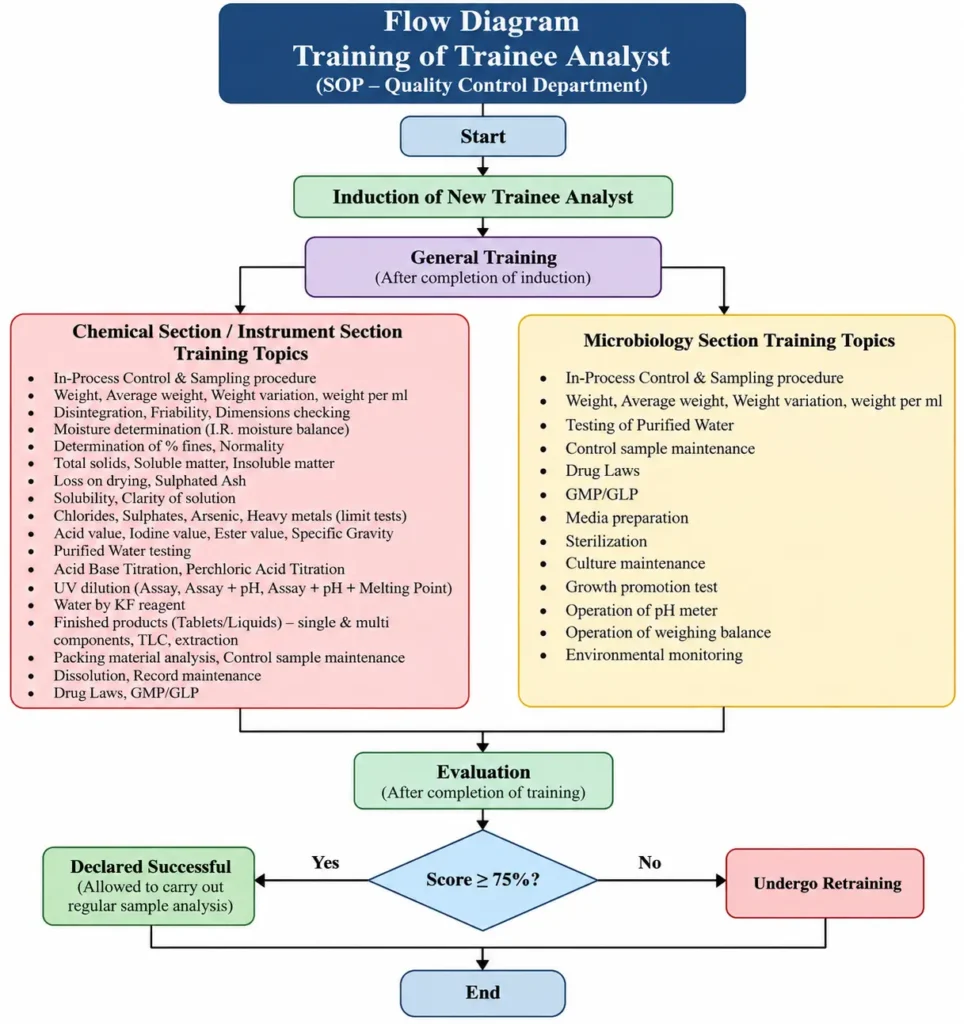
Chemical and instrument training includes sampling, physical testing, titrations, purified water testing, UV analysis, Karl Fischer testing, finished-product analysis, dissolution, packing-material analysis, documentation, Drug Laws and GMP/GLP. Microbiology training includes purified water testing, media preparation, sterilization, culture maintenance, growth-promotion testing, pH meter and weighing-balance operation, and environmental monitoring.After completion of training, the trainee undergoes an evaluation. A score above 75% qualifies the analyst to perform routine sample analysis independently, while a score below 75% requires retraining before reassessment.
2. Brainstorming for SOP Failure:
The brainstorming diagram identifies possible causes that may lead to failure in implementing the SOP for Training of Trainee Analyst. The SOP requires structured induction, section-specific training and evaluation before an analyst is permitted to perform routine sample analysis.
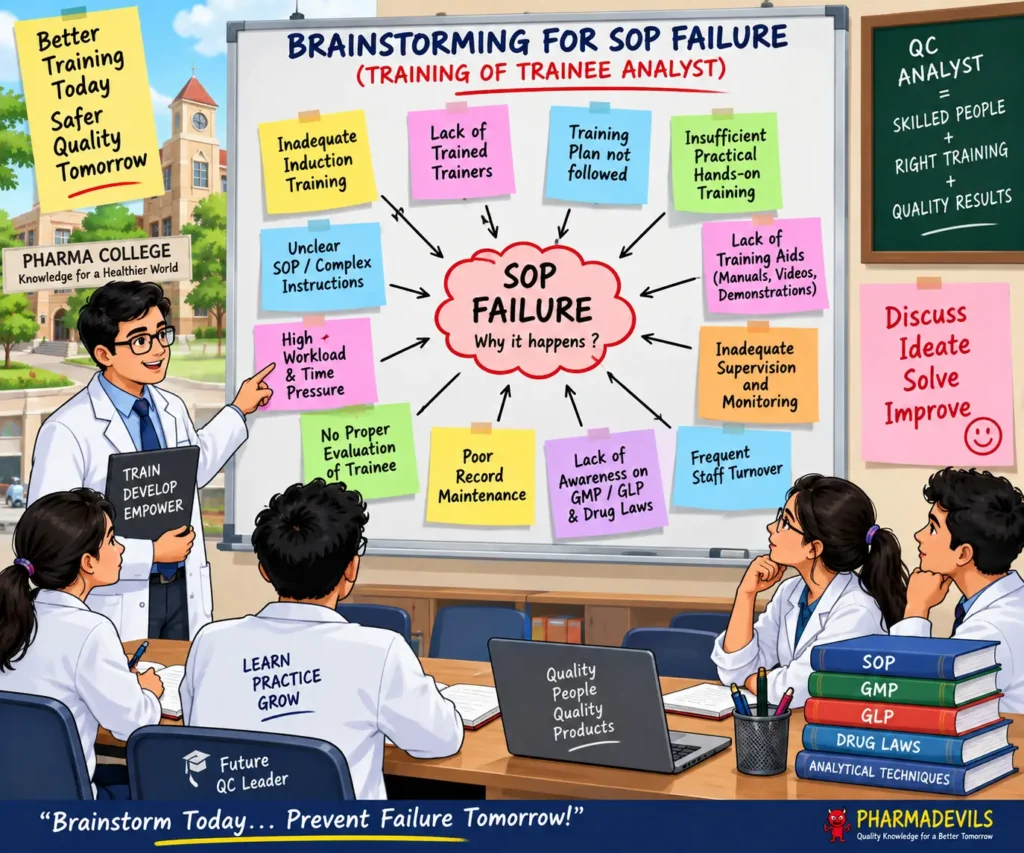
The sticky-note brainstorming highlights potential failure factors such as inadequate induction training, lack of competent trainers, training plans not being followed, insufficient practical hands-on training, unclear SOP instructions, inadequate supervision, poor training-record maintenance, weak GMP/GLP awareness, lack of proper trainee evaluation, high workload and frequent staff turnover. These are brainstorming hypotheses for investigation rather than causes specifically stated in the SOP.The college-classroom presentation emphasizes collaborative discussion and root-cause identification so that suitable corrective and preventive actions (CAPA) can be developed to strengthen analyst competency, documentation and consistent SOP compliance.
3. 5-Why Analysis for SOP Failure:
The 5-Why diagram presents a structured root-cause investigation for failure to follow the Training of Trainee Analyst SOP. It traces the issue from training not being conducted as planned, to lack of qualified trainers, absence of defined trainer assignment and planning, unclear responsibilities, and inadequate monitoring and supervision.
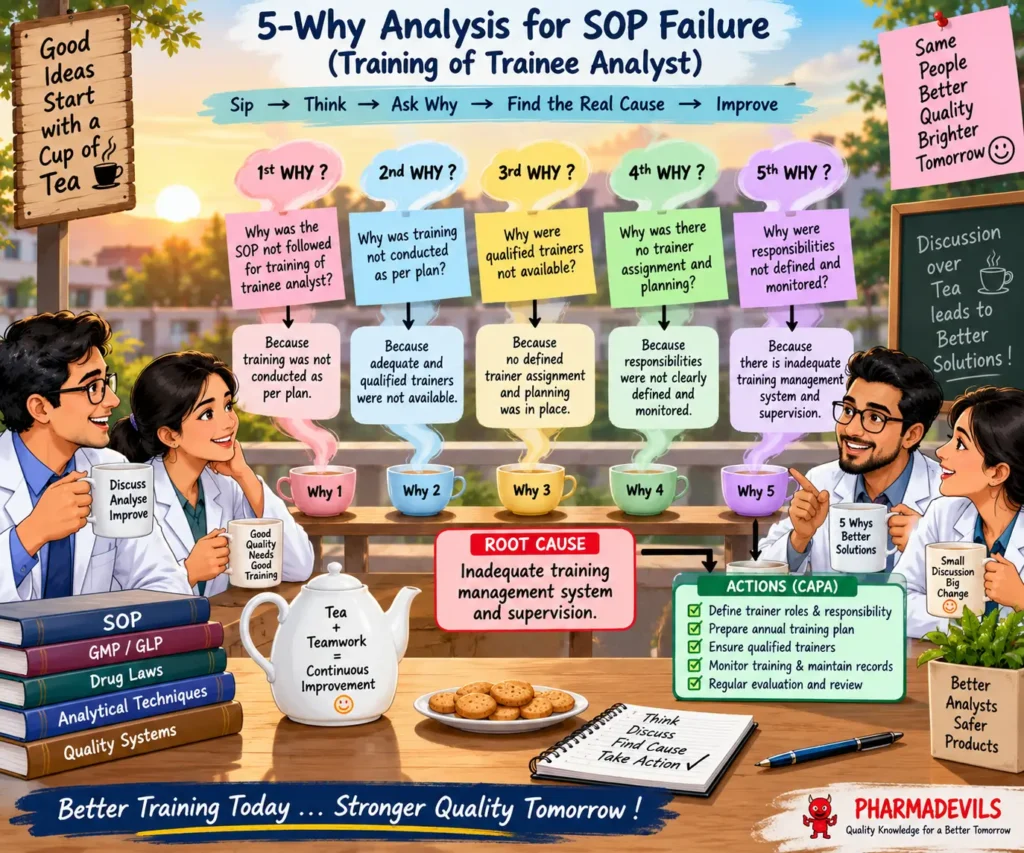
The analysis identifies the root cause as an inadequate training management system and supervision. Recommended CAPA includes defining trainer roles and responsibilities, preparing an annual training plan, ensuring availability of qualified trainers, monitoring training completion and records, and conducting regular evaluation and review. These controls support the SOP requirement that trainees complete structured training and evaluation before being allowed to perform routine sample analysis.
4. Fishbone Analysis for SOP Failure:
The Fishbone Analysis diagram identifies potential causes for failure in implementing the Training of Trainee Analyst SOP by grouping them under major categories such as Man, Machine, Method, Material, Environment, Money, Measurement, and Management. The analysis highlights issues such as untrained or inexperienced trainers, lack of hands-on training facilities, unclear or incomplete SOP instructions, inadequate training materials, poor training environment, insufficient budget, weak evaluation practices, and inadequate management monitoring.
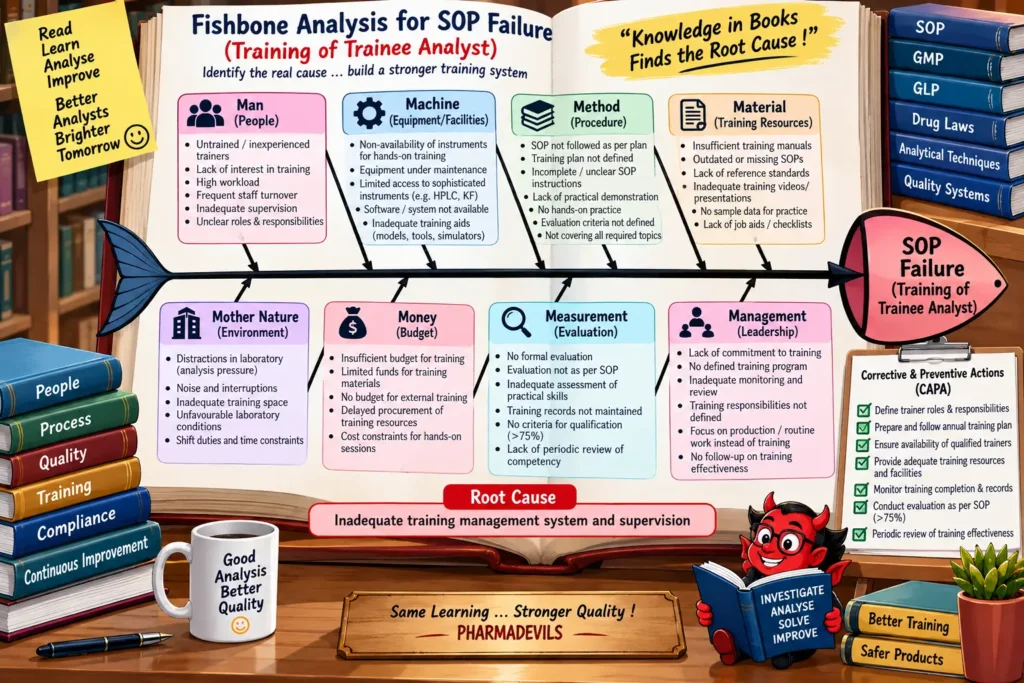
The diagram indicates the likely root cause as inadequate training management system and supervision. Recommended CAPA includes defining trainer responsibilities, following an annual training plan, ensuring qualified trainers and suitable training resources, maintaining training records, conducting evaluation as required by the SOP, and periodically reviewing training effectiveness. The source SOP itself requires structured training and evaluation before the analyst is permitted to perform routine sample analysis.
5. Fault Tree Analysis for SOP Failure:
The bottle-themed Fault Tree Analysis illustrates the possible causes of failure in implementing the Training of Trainee Analyst SOP. The top event, “SOP Failure,” is divided into major contributing areas such as People, Process, Documentation, and Resources, with sub-causes including lack of qualified trainers, poor trainee assignment, ineffective training plans, unclear SOP instructions, inadequate evaluation, incomplete records, limited training aids, and unsuitable training environment.
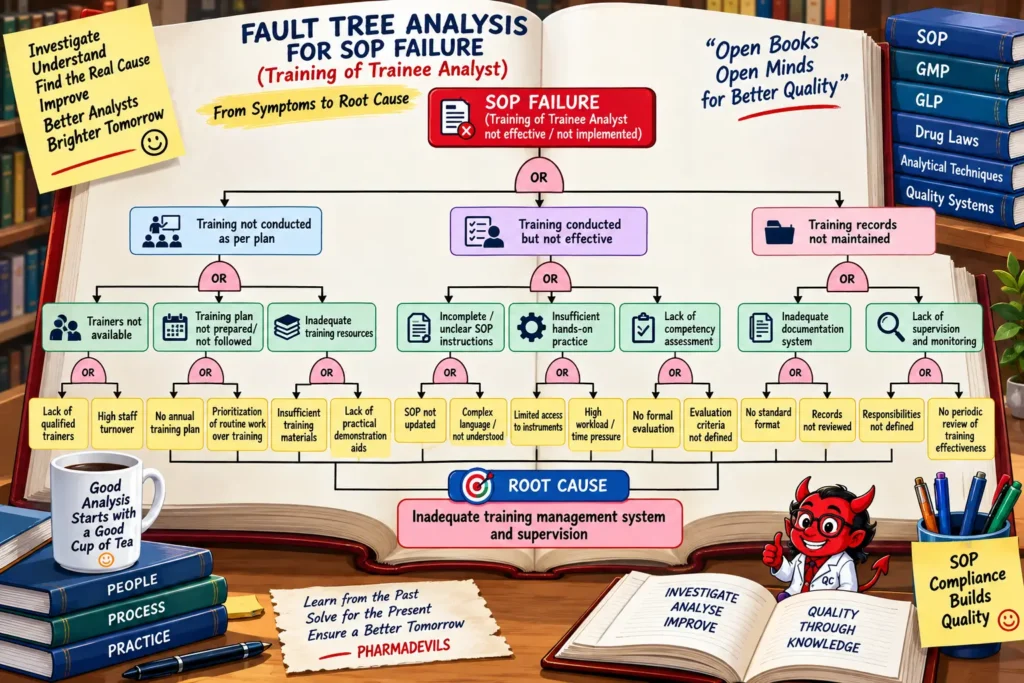
The analysis leads to the probable root cause of inadequate training management and supervision. Recommended CAPA includes defining trainer responsibilities, preparing and following an annual training plan, ensuring availability of competent trainers and training resources, maintaining complete training records, and periodically reviewing training effectiveness. The SOP requires formal evaluation after training, with personnel scoring above 75% permitted to conduct routine sample analysis and those scoring below 75% requiring retraining.
Questions & Answers – Training of Trainee Analyst
Q1. What is the objective of the SOP for Training of Trainee Analyst?
Answer: To lay down a written procedure for training of analysts working in the Quality Control Department.
Q2. Who is responsible for execution of this SOP?
Answer: Executive-QC is responsible for execution of the SOP.
Q3. Who is responsible for effective implementation of the SOP?
Answer: Manager-QC and Head-QC/QA are responsible for effective implementation.
Q4. When is general training provided to the trainee analyst?
Answer: General training is conducted after completion of induction.
Q5. What types of training are included in the Chemical/Instrument Section?
Answer: Training includes sampling, weight variation, disintegration, friability, moisture determination, normality, loss on drying, limit tests, titrations, purified water testing, UV assay, Karl Fischer analysis, finished-product testing, dissolution, packing-material analysis, record maintenance, Drug Laws and GMP/GLP.
Q6. What microbiology topics are covered during trainee analyst training?
Answer: Training includes purified water testing, media preparation, sterilization, culture maintenance, growth-promotion testing, operation of pH meter and weighing balance, and environmental monitoring.
Q7. When is the trainee analyst evaluated?
Answer: Evaluation is carried out after completion of training.
Q8. What score is required for successful completion of training?
Answer: A trainee scoring more than 75% is declared successful.
Q9. What happens after successful evaluation?
Answer: The successful trainee is allowed to carry out regular sample analysis.
Q10. What happens if the trainee scores less than 75%?
Answer: The trainee must undergo retraining.
Q11. What is the frequency of training?
Answer: Training is conducted as and when required.
Q12. How are experienced personnel trained?
Answer: Experienced personnel undergo “read and understood” training of Quality Control SOPs according to their job responsibilities and sign the training document after reading and understanding it.
Q13. What enclosure is provided with this SOP?
Answer: Annexure-I provides the Schedule for SOP Training in Quality Control Department.
Q14. Who holds the controlled and master copies of the SOP?
Answer: The controlled copy is held by the Head of Department–Quality Control, while the master copy is held by the Head of Department–Quality Assurance.
Reference Guidelines:
- Revised Schedule M, Drugs Rules, 1945 – India: Requires appropriately qualified personnel, defined responsibilities, regular GMP training by qualified persons and maintenance of training records. (CDSCO)
CDSCO Revised Schedule M - WHO TRS 1052, Annex 4 – Good Practices for Pharmaceutical Quality Control Laboratories: Provides specific guidance on laboratory personnel competence, training, supervision and documentation for pharmaceutical QC laboratories. (World Health Organization)
WHO Good Practices for Pharmaceutical Quality Control Laboratories - PIC/S GMP Guide PE 009-17, Part I – Chapter 2: Personnel: Requires adequate qualified personnel and appropriate initial and continuing training relevant to assigned duties and GMP responsibilities. (PIC/S)
PIC/S Publications – GMP Guide PE 009-17 - EU GMP, EudraLex Volume 4 – Chapter 2: Personnel: Covers qualification, responsibilities, initial training, continuing training and assessment of personnel working in GMP activities, including QC personnel. (Public Health)
EU EudraLex Volume 4 GMP Guidelines - US FDA – 21 CFR 211.25, Personnel Qualifications: Requires personnel engaged in manufacture, processing, packing, holding or laboratory activities to have appropriate education, training and experience and to receive continuing cGMP training