







1. Brief Description:
The SOP for Analytical Method Validation defines a systematic procedure for demonstrating that an analytical method is suitable, reliable, and capable of producing accurate results for its intended use. In the referenced document, the method is validated for determination of trace Glimepiride residues in swab samples by HPLC as part of cleaning validation. The procedure covers objective, scope, responsibilities, chromatographic conditions, preparation of mobile phase and standards, sample analysis, calculations, and documentation requirements. Qualified instruments and equipment are used, with QC responsible for protocol development, execution, and data compilation, while QA provides approval. Validation includes system suitability, specificity, precision, accuracy, linearity and range, along with determination of LOD and LOQ. Defined acceptance criteria are applied to confirm method performance. Successful validation provides documented evidence that the analytical method is appropriate for routine cleaning-validation testing and reliable trace-level residue determination.
Skip to PDF content2. Flow Diagram:
The flow diagram presents the step-by-step process for Analytical Method Validation in a clear and systematic manner. The process begins by defining the objective and scope of validation, followed by formation of the validation team involving Quality Control and Quality Assurance. Qualified and calibrated instruments, suitable materials, standards, reagents, and chromatographic conditions are then ensured before validation activities are started.
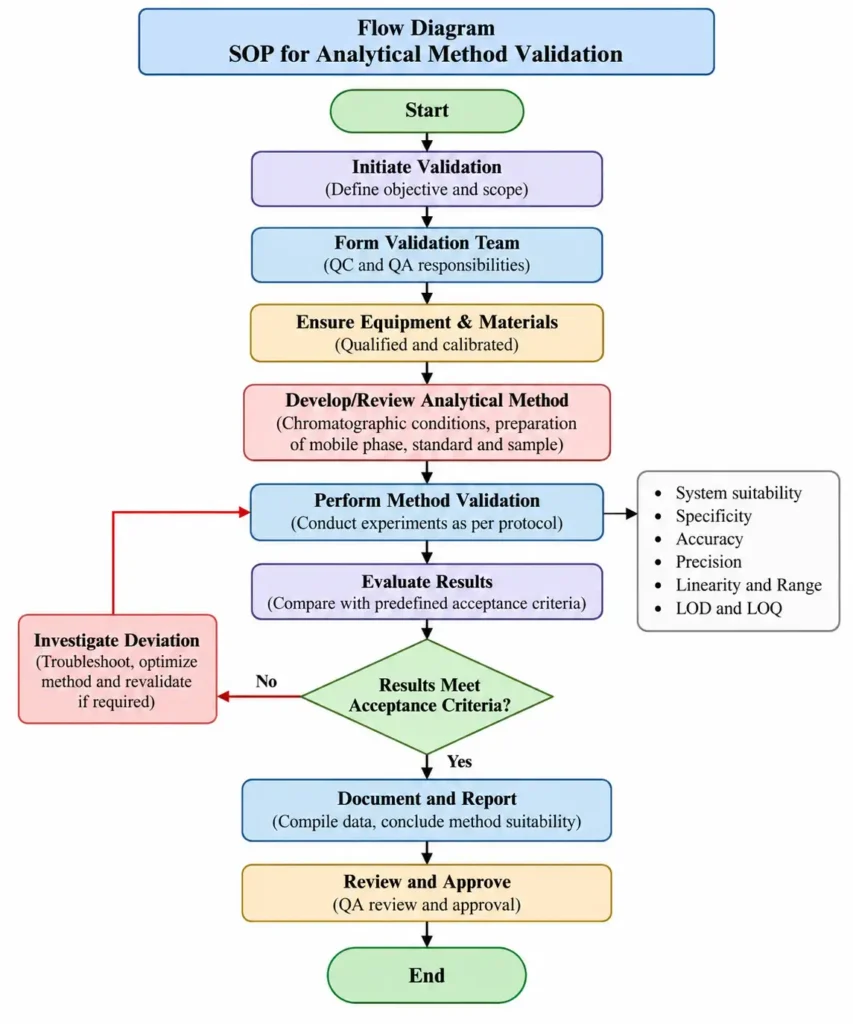
The analytical method is evaluated through important validation parameters such as system suitability, specificity, accuracy, precision, linearity and range, LOD, and LOQ. Experimental results are compared against predefined acceptance criteria. When results do not comply, the deviation is investigated, the method is reviewed or optimized, and validation testing is repeated as required. When all acceptance criteria are successfully met, the results are compiled and documented in the validation report. Finally, the validation data are reviewed and approved by Quality Assurance, confirming that the method is suitable for its intended analytical purpose.
3. Brainstorming:
Brainstorming for SOP of Analytical Method Validation (AMV) Failure is used to identify all possible causes that may lead to unsuccessful method validation. The central issue is AMV failure, and potential causes are collected from different areas such as method development, instrument condition, sample preparation, system suitability, mobile phase preparation, standard preparation, analyst performance, training, documentation, and predefined acceptance criteria.
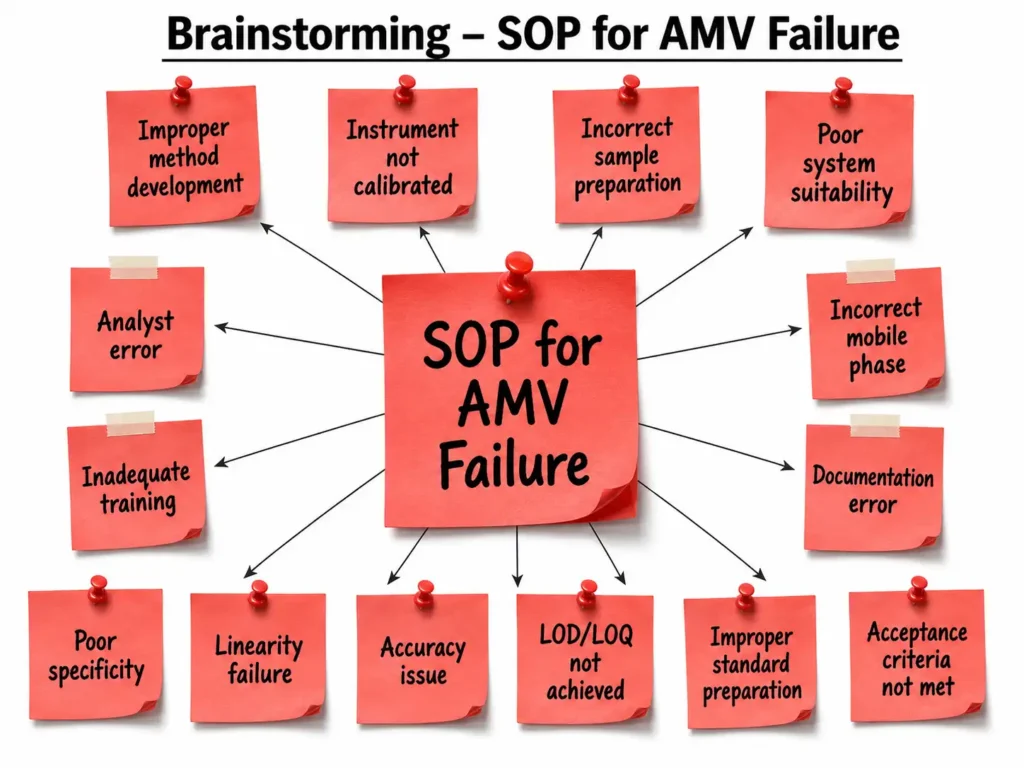
The brainstorming also considers failures related to important validation parameters such as specificity, accuracy, linearity, LOD, and LOQ. Each possible cause is written separately on sticky notes so that the investigation team can review and discuss them clearly. This approach encourages participation from QC, QA, and other concerned personnel and helps prevent important causes from being overlooked. After listing the potential causes, the team can evaluate them using supporting data and further root-cause tools. Brainstorming therefore provides a simple and effective starting point for investigating AMV failure and deciding appropriate corrective and preventive actions.
4. 5 Why Analysis – SOP for AMV Failure:
The 5 Why Analysis is a simple root-cause analysis tool used to identify the underlying reason for failure of an Analytical Method Validation (AMV) SOP. The analysis begins with the main problem, such as AMV results not meeting predefined acceptance criteria. The first “Why” identifies inconsistent validation results. The next “Why” examines possible errors in sample, standard, or mobile-phase preparation. Further questioning checks whether the analytical procedure was followed correctly and whether analyst handling contributed to the failure.
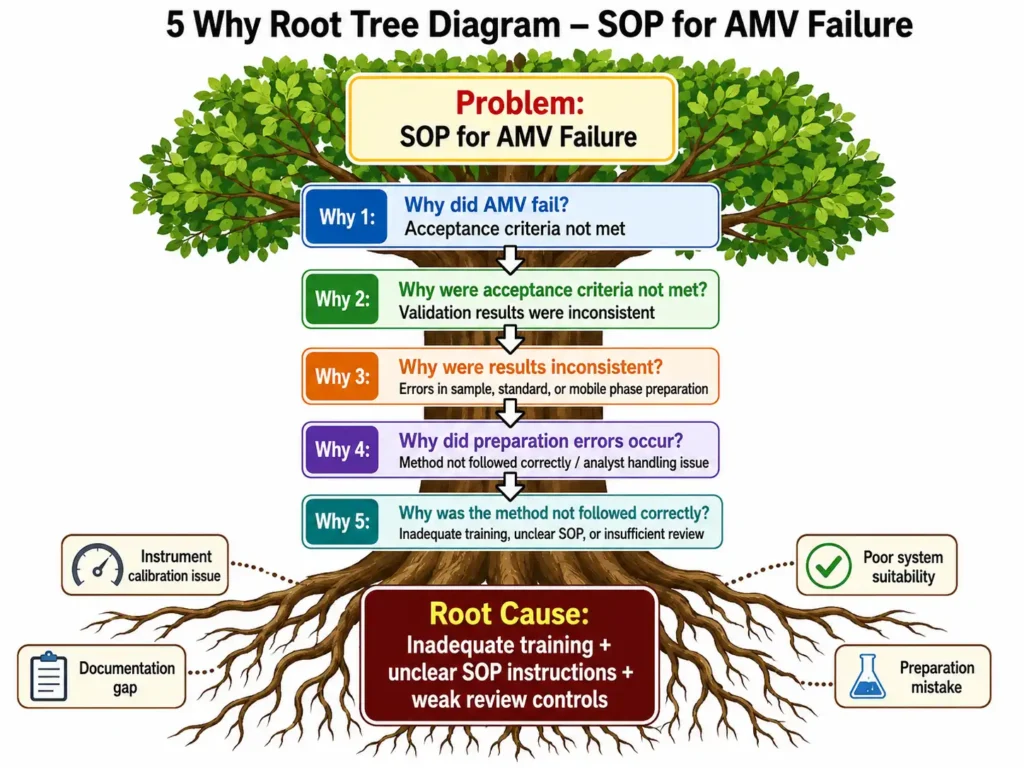
The final “Why” may reveal deeper system-related causes such as inadequate training, unclear SOP instructions, insufficient review, poor documentation control, or weak supervision. Instrument calibration issues, poor system suitability, and preparation mistakes may also contribute. By repeatedly asking “Why,” the investigation moves beyond the immediate error and identifies the true root cause. Appropriate CAPA can then be implemented to improve training, SOP clarity, review controls, and overall reliability of analytical method validation.
Before & After CAPA FMEA
The Before & After CAPA FMEA is used to demonstrate how identified risks associated with SOP failure in Analytical Method Validation (AMV) are reduced after implementation of corrective and preventive actions. In the Before CAPA stage, potential failure modes such as incorrect standard preparation, mobile phase preparation error, unsuitable instruments, improper sample preparation, calculation mistakes, incomplete documentation, inadequate analyst training, and unclear SOP instructions are evaluated using Severity (S), Occurrence (O), and Detection (D) scores. These scores are used to calculate the Risk Priority Number (RPN) and determine the initial risk level.
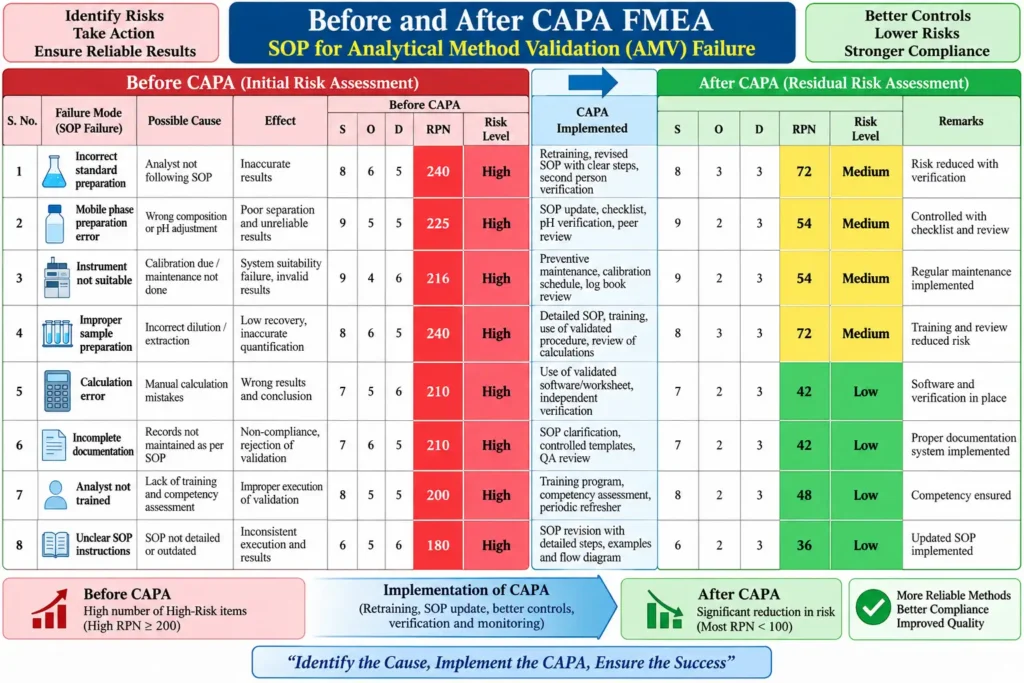
After appropriate CAPA is implemented—such as retraining, SOP revision, calibration control, independent verification, improved documentation, and competency assessment—the risks are reassessed. The After CAPA evaluation generally shows reduced occurrence and improved detection, resulting in lower RPN values. This comparison provides clear evidence that CAPA actions have effectively reduced risk and strengthened the reliability, compliance, and control of the AMV process.
Questions & Answers:
Q1. What is the purpose of Analytical Method Validation?
Answer: The purpose is to provide documented evidence that the analytical method is suitable for determining trace amounts of API in samples and produces reliable results for its intended use. In this protocol, Glimepiride residues in swab samples are determined by HPLC.
Q2. What is the scope of the AMV protocol?
Answer: The scope is to evaluate the acceptability of the analytical method for determination of trace API content in swab samples by HPLC, including procedure, documentation, acceptance criteria, and evaluation of results.
Q3. Which departments are involved in AMV?
Answer: Quality Control is responsible for protocol development, execution, and compilation of data, while Quality Assurance is responsible for protocol approval.
Q4. Which major validation parameters are evaluated?
Answer: The protocol evaluates system suitability, specificity, system precision, precision, linearity and range, and accuracy. It also includes determination of LOD and LOQ.
Q5. What is system suitability?
Answer: System suitability verifies that the chromatographic system is adequate and capable of performing the intended analysis before sample testing.
Q6. What is specificity in analytical method validation?
Answer: Specificity demonstrates that the analytical method can identify the analyte without interference from other components present in the sample matrix.
Q7. How is specificity checked in this protocol?
Answer: Specificity is evaluated by injecting blank, placebo preparation containing the swab stick, and standard preparation into the HPLC and checking for interference at the retention time of Glimepiride.
Q8. What is accuracy?
Answer: Accuracy represents the closeness of the test result obtained by an analytical procedure to the true value. The protocol evaluates accuracy through recovery studies.
Q9. At which levels is recovery studied?
Answer: Recovery is evaluated at 50%, 100%, and 150% levels, using stainless-steel surfaces for swab recovery assessment.
Q10. What is linearity?
Answer: Linearity demonstrates that analytical test results are directly proportional to the concentration of the analyte within the specified range.
Q11. What linearity levels are used in the protocol?
Answer: The protocol uses 25%, 50%, 75%, 100%, and 125% concentration levels for evaluation of linearity.
Q12. What is the acceptance criterion for the correlation coefficient?
Answer: The correlation coefficient should be not less than 0.99. The recorded value in the protocol is 0.9998.
Q13. What is LOD?
Answer: Limit of Detection (LOD) is the lowest amount of analyte in a sample that can be detected under the stated experimental conditions, but not necessarily quantified.
Q14. What is LOQ?
Answer: Limit of Quantification (LOQ) is the lowest amount of analyte that can be quantified with acceptable precision under the specified analytical conditions.
Q15. Why are qualified instruments required during AMV?
Answer: Qualified and validated instruments help ensure that analytical results are reliable and that equipment performance does not adversely affect validation results. The protocol specifically requires instruments and equipment to be qualified and validated.
Q16. Which major instruments are listed in the protocol?
Answer: The equipment list includes HPLC, analytical balances, and a pH meter.
Q17. What happens if validation results fail to meet acceptance criteria?
Answer: The failure should be investigated to identify causes such as method execution errors, sample or standard preparation errors, instrument problems, or procedural deficiencies. Appropriate corrective actions should then be implemented before reassessment.
Q18. What is the final outcome of successful AMV?
Answer: Successful AMV demonstrates that the analytical method has met the specified validation requirements and is suitable for its intended cleaning-validation application.