







1. Brief Description:
This Standard Operating Procedure (SOP) describes the systematic approach for validating analytical methods used for pharmaceutical drug products, including pharmacopoeial and in-house methods. Its purpose is to define the validation characteristics, testing process, and applicable acceptance criteria to ensure that analytical methods are reliable, accurate, precise, and suitable for their intended use. The SOP covers important validation parameters such as specificity, solution stability, filter compatibility, filter saturation, linearity and range, precision, accuracy, robustness, and system suitability. It also addresses analytical method validation for assay/preservative testing, related substances, and dissolution testing. Responsibilities are assigned to Quality Control analysts, Head QC or designee, Corporate Quality Assurance, and the QA Head for performing, reviewing, approving, and implementing validation activities. Proper method validation provides documented evidence that analytical procedures consistently generate dependable results for routine quality-control testing and pharmaceutical product evaluation.
Skip to PDF content2. Flow Diagram:
The flow diagram presents the step-by-step process for Analytical Method Validation in a simple and systematic manner. It begins with defining the objective and intended use of the analytical method, whether pharmacopoeial or in-house. The next step is validation planning, where suitable parameters and predefined acceptance criteria are selected. The SOP identifies parameters such as specificity, solution stability, filter compatibility, filter saturation, linearity and range, precision, accuracy, robustness, and system suitability.
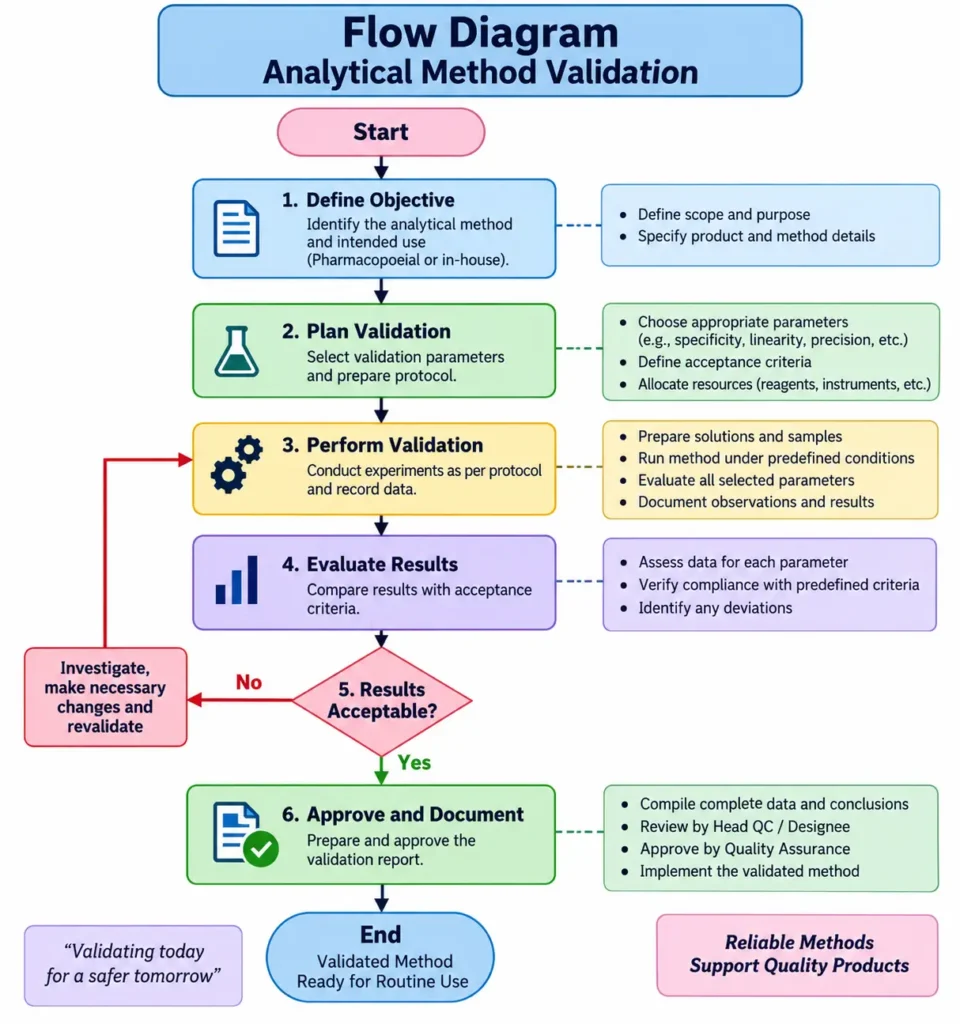
Validation experiments are then performed according to the approved procedure, and all observations and results are documented. The generated data are evaluated against the established acceptance criteria. If results are unacceptable, the cause is investigated, necessary changes are made, and validation is repeated. When all requirements are successfully met, the validation data are reviewed, documented, and approved. The validated analytical method is then considered suitable for routine quality-control testing and reliable product evaluation.
3. Brainstorming:
The brainstorming diagram identifies the possible causes that may lead to failure of the Analytical Method Validation SOP. It brings together different potential issues such as inadequate training, unclear SOP instructions, insufficient resources, poor understanding of the analytical method, incorrect selection of validation parameters, instrument or software changes, documentation errors, inadequate review, and failure to follow the approved procedure. It also considers workload pressure, environmental conditions, weak communication between QA, QC and R&D, improper investigation of deviations, lack of system-suitability checks, and failure to periodically review or update the SOP.
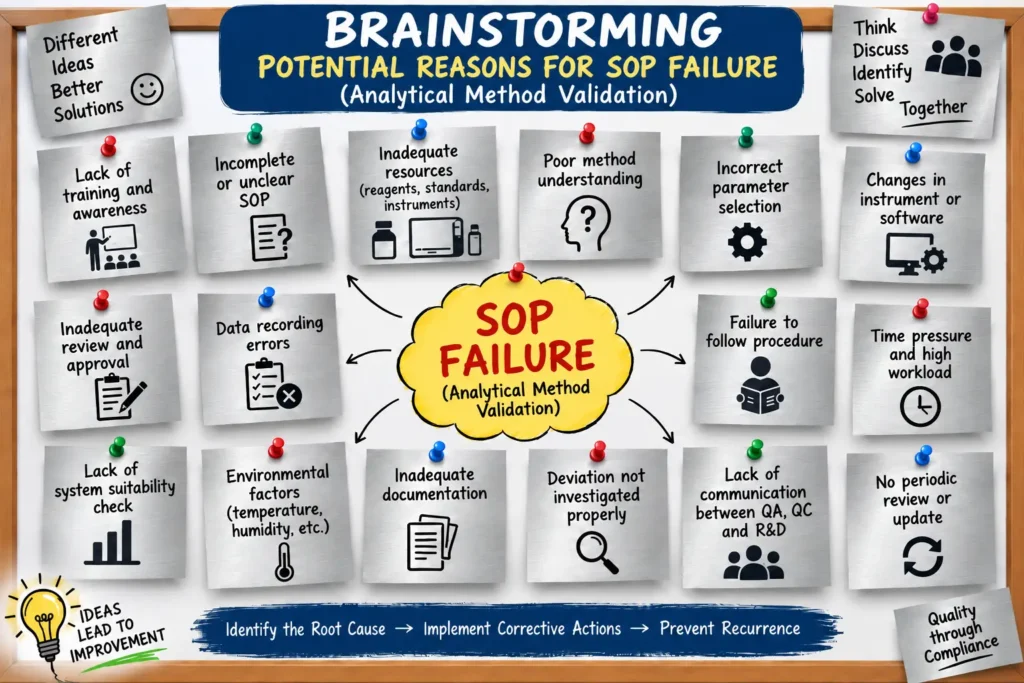
Using brainstorming helps the investigation team collect ideas from different functions and view the failure from multiple angles. These causes can then be evaluated to identify the most probable root cause. Based on the findings, suitable corrective and preventive actions can be implemented to improve compliance, strengthen analytical method validation, and reduce the chance of recurrence.
4. 5 Why Analysis:
The 5 Why Analysis is used to identify the root cause of failure in the Analytical Method Validation SOP by repeatedly asking “Why?” for each problem. The analysis begins with unacceptable analytical method validation results. The next why identifies poor precision and linearity in the validation data. Further investigation shows that important method parameters, such as wavelength, mobile phase, or analytical range, were not properly optimized.
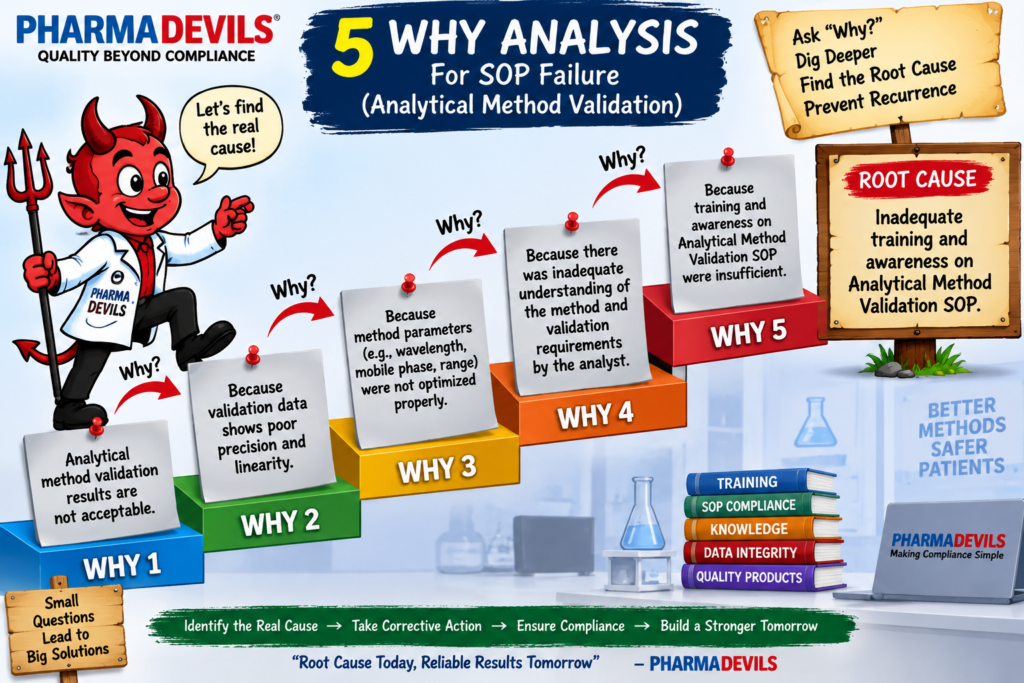
The analysis then goes deeper and identifies inadequate understanding of the analytical method and validation requirements by the analyst. The final why points to insufficient training and awareness regarding the Analytical Method Validation SOP as the primary root cause. This structured approach helps move beyond the immediate problem and identify the underlying reason for failure. Once the root cause is identified, appropriate corrective and preventive actions, such as improved training, better supervision, and stronger SOP compliance, can be implemented to prevent recurrence and improve analytical reliability.
5. Heat Map (FMEA):
The Heat Map (FMEA) provides a simple visual method for assessing and prioritizing risks associated with failure of the Analytical Method Validation SOP. It evaluates each potential failure based on two factors: Likelihood (Probability) and Severity (Impact). The combination of these values generates a risk score, which is displayed using different colors. Green represents very low risk, yellow indicates low risk, orange shows medium risk, and red identifies high risk requiring immediate attention.
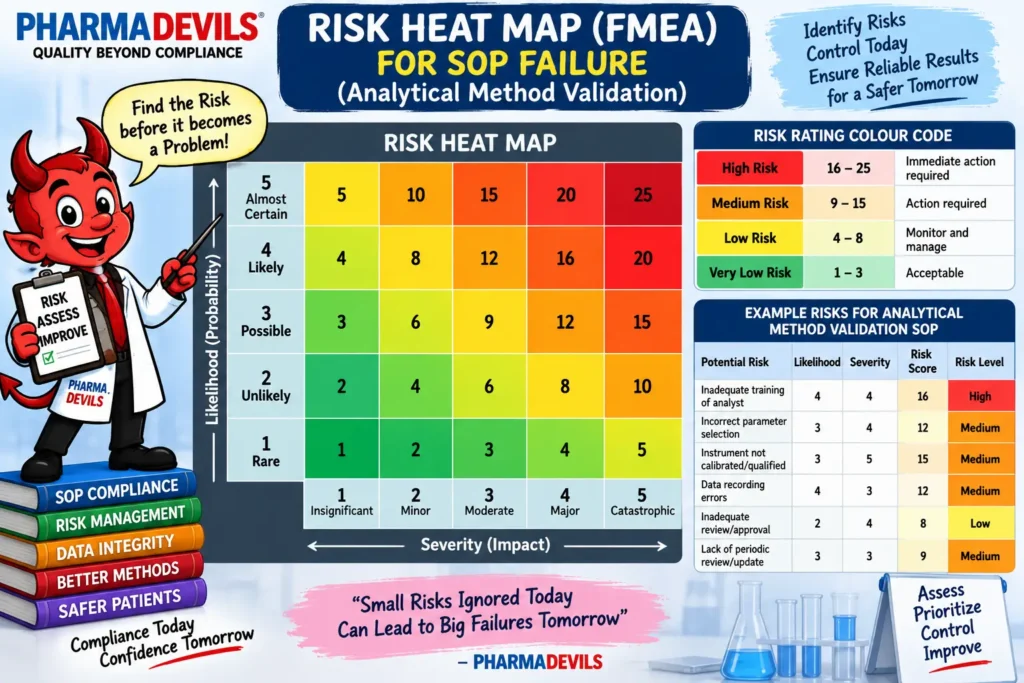
Typical risks shown in the heat map include inadequate analyst training, incorrect parameter selection, use of unqualified or uncalibrated instruments, data recording errors, inadequate review and approval, and lack of periodic SOP updates. The heat map helps QA and QC teams quickly identify which failures require priority action. Based on the risk level, suitable controls, corrective actions, training, monitoring, and preventive measures can be implemented to reduce recurrence and improve compliance.
Questions & Answers
Q1. What is the purpose of the Analytical Method Validation SOP?
Answer: The purpose is to define the characteristics that should be considered while validating analytical methods used for pharmaceutical drug products, including pharmacopoeial and in-house methods.
Q2. Which departments are mainly involved in analytical method validation?
Answer: Quality Control performs and records the validation, while Head QC or a designee reviews and approves the analytical method validation report. Quality Assurance ensures implementation of the procedure.
Q3. Which parameters are considered for validation of an in-house assay or preservative method?
Answer: Parameters include specificity, solution stability, filter compatibility, filter saturation, linearity and range, precision, accuracy, robustness, and system suitability.
Q4. What is specificity in analytical method validation?
Answer: Specificity is the ability of an analytical method to measure the analyte clearly in the presence of other components that may be present in the sample.
Q5. What is the acceptance criterion for assay linearity?
Answer: For assay validation, the SOP specifies a correlation coefficient of not less than 0.999.
Q6. How is system precision evaluated?
Answer: The standard solution is prepared according to the analytical method and injected six times. The relative standard deviation of the responses is calculated.
Q7. What is the acceptance criterion for assay repeatability?
Answer: The relative standard deviation of assay results obtained from six sample preparations should not be more than 2.0%.
Q8. What is intermediate precision?
Answer: Intermediate precision evaluates variation within the laboratory by performing analysis under changed conditions such as a different analyst, different equipment, and a different day.
Q9. What is the acceptance criterion for assay accuracy or recovery?
Answer: Individual recoveries should be within 97.0%–103.0%, while the mean recovery should be within 98.0%–102.0%.
Q10. What is robustness in analytical method validation?
Answer: Robustness demonstrates whether the analytical method remains reliable when small deliberate changes are made to parameters such as buffer pH, mobile-phase pH or composition, and column temperature.
Q11. What are LOD and LOQ?
Answer: LOD is the lowest amount of analyte that can be detected, while LOQ is the lowest amount that can be quantitatively determined with suitable precision and accuracy.
Q12. What signal-to-noise ratios are specified for LOD and LOQ?
Answer: The SOP specifies a signal-to-noise ratio of approximately 3:1 for LOD and 10:1 for LOQ.
Q13. Why is filter compatibility checked?
Answer: Filter compatibility is checked to confirm that filtration does not significantly affect the analytical result compared with an unfiltered/centrifuged sample solution.
Q14. Why is system suitability performed?
Answer: System suitability is performed before validation parameters to confirm that the analytical system meets the requirements specified in the methodology.
Q15. What is the main benefit of analytical method validation?
Answer: Analytical method validation provides documented evidence that a method is suitable for its intended purpose and can generate reliable results for routine pharmaceutical quality-control testing.