




Brief Description
The SOP for Approval and Rejection of Drug Products defines the procedure for evaluating finished pharmaceutical products and deciding whether a batch should be released or rejected. After completion of packing, the Packing Department raises a finished-product analysis request to IPQA. IPQA verifies the packed quantity and quality, collects representative random samples as per the applicable sampling procedure, and forwards the samples with the finished-product requisition slip to Quality Control. QC performs the required testing and issues the Certificate of Analysis (COA). Products complying with approved specifications are released for marketing after QC approval. If a product fails to comply with specifications, confirmatory testing is performed using multiple analysts and fresh reagents/reference substances. Depending on repeat-test results, the batch may be released, reprocessed, or rejected for destruction. The SOP also specifies responsibilities for QC and QA/QC personnel, training requirements, document distribution, abbreviations, and revision-history controls.
Skip to PDF content1. Flow Diagram:
The flow diagram illustrates the complete process for approval and rejection of finished drug products. The process begins after completion of packing, when the Packing Department raises a finished-product analysis request to IPQA. IPQA verifies the packed quantity and quality, collects a random sample as per the applicable SOP, and forwards the sample with the finished-product requisition slip to Quality Control. QC performs the required analysis, issues the COA, and IPQA attaches the COA and terminal inspection report to the BPR.
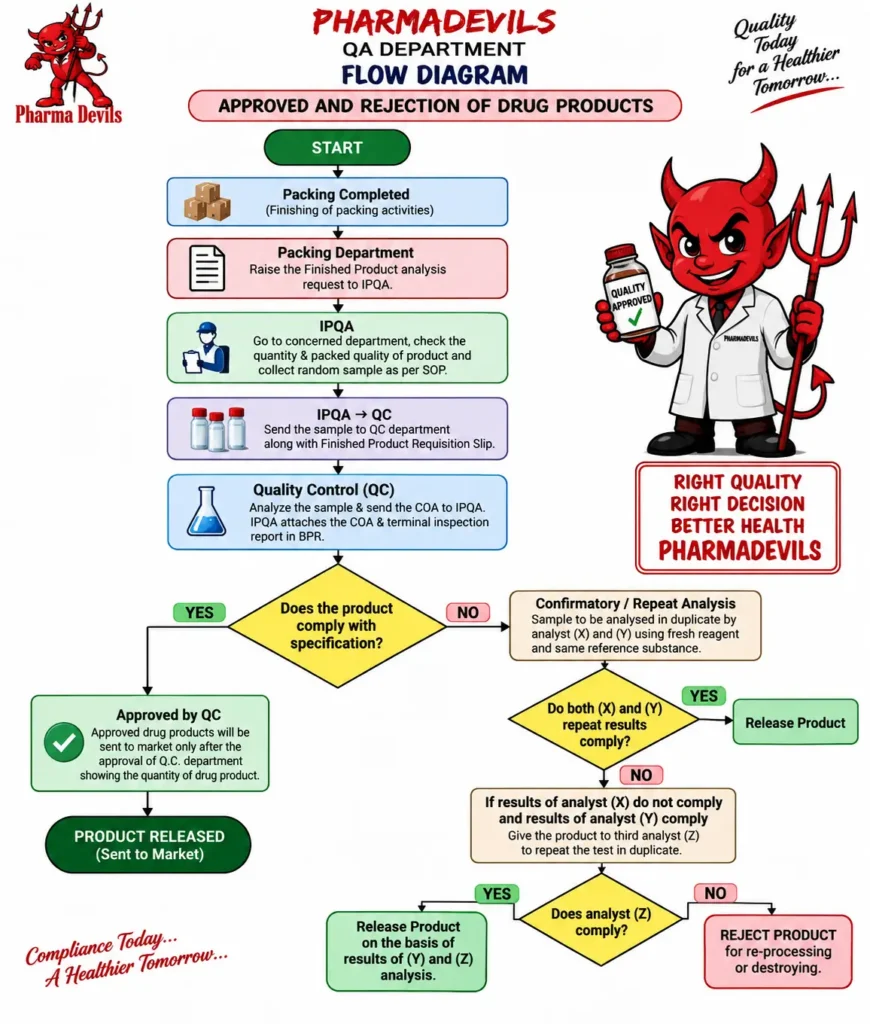
If the product complies with specifications, it is approved by QC and released to the market. If it does not comply, confirmatory testing is performed by analysts X and Y in duplicate. Where required, analyst Z performs further duplicate testing. Based on the confirmed results, the batch may be released, reprocessed, or rejected for destruction.
2. Brainstorming for SOP Failure:
The brainstorming diagram presents potential causes that may lead to failure in following the SOP for Approval and Rejection of Drug Products. Using a mango-tree and sticky-note concept, the diagram visually organizes possible issues such as inadequate personnel training, poor understanding of the SOP, unclear responsibilities between QC, IPQA and Packing, improper sampling, incomplete documentation, time pressure, inadequate result review, equipment calibration problems, incorrect sample handling, weak supervision, and failure to perform repeat analysis correctly.
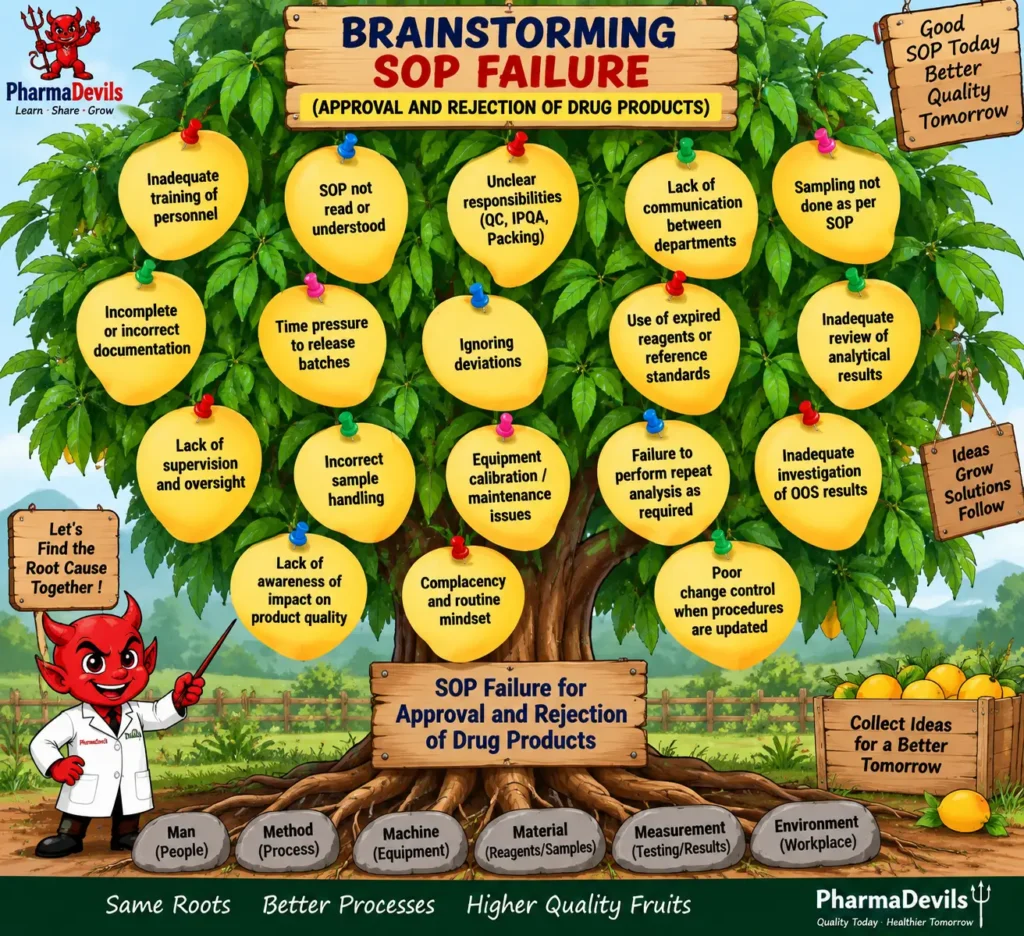
The causes are broadly grouped around Man, Method, Machine, Material, Measurement, and Environment, helping the investigation team consider different sources of failure systematically. The mango-tree concept represents root causes growing into visible operational problems, while the PharmaDevils character promotes collaborative problem-solving. This brainstorming diagram is an investigation aid; these listed failure causes are not stated as actual failures in the SOP and should be verified with records and evidence before assigning root cause.
3. 5-Why Analysis for SOP Failure:
The 5-Why Analysis for SOP Failure in Approval and Rejection of Drug Products is designed to identify the underlying reasons behind failure to follow the approved procedure. The analysis begins with the problem of a drug-product batch failing to meet specifications and progressively examines possible causes such as out-of-specification analytical results, non-representative sampling, sample-handling or analytical errors, inadequate SOP compliance, and insufficient personnel understanding.
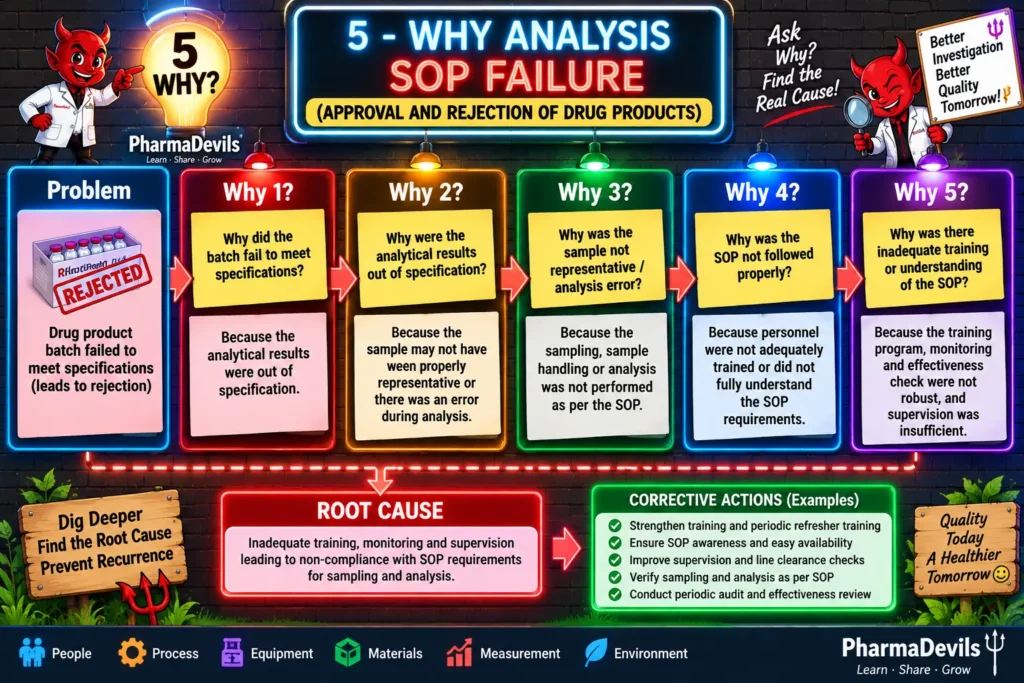
The final potential root cause identified in the diagram is inadequate training, monitoring, supervision, and effectiveness verification, which may result in non-compliance with sampling and analytical requirements. The LED-style visual layout clearly connects each “Why” through a logical sequence, making the investigation easy to understand.Suggested corrective actions include refresher training, improved SOP accessibility, stronger supervision, verification of sampling and analysis practices, periodic audits, and effectiveness checks. The diagram should be treated as an investigation example, and the actual root cause must be confirmed through documented evidence.
3. Fishbone Analysis for SOP Failure:
The Fishbone Analysis for SOP Failure in Approval and Rejection of Drug Products is used to systematically identify possible causes that may lead to failure in following the approved procedure. The diagram groups potential causes under major categories such as Man (People), Method (Process), Machine (Equipment), Material (Reagents/Samples), Measurement (Testing/Results), Environment (Workplace), and Management (System).
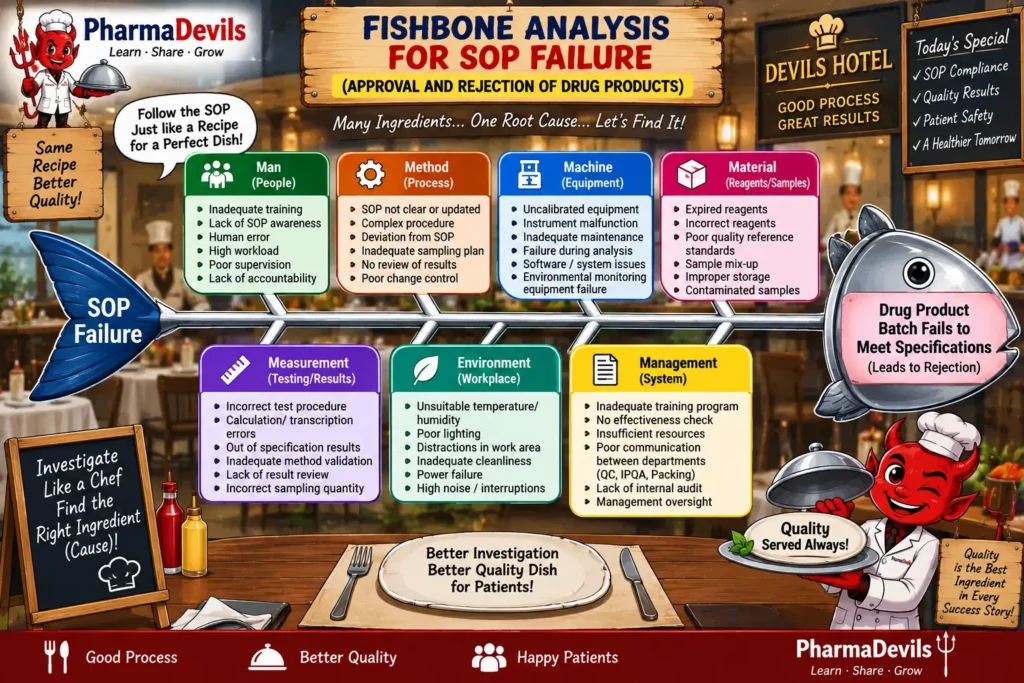
Possible contributors include inadequate training, poor SOP awareness, human error, unclear procedures, improper sampling, equipment malfunction, expired reagents, sample mix-up, analytical errors, unsuitable environmental conditions, weak communication, and insufficient supervision. These factors may ultimately contribute to incorrect evaluation of a drug-product batch or failure to meet specifications.The hotel-themed fishbone design makes root-cause investigation easy to understand by comparing SOP compliance with following the correct recipe. The diagram is an investigation aid; the actual root cause should be confirmed through documented evidence, records, interviews, and data review.
5. Fault Tree Analysis for SOP Failure:
The Fault Tree Analysis (FTA) for SOP Failure in Approval and Rejection of Drug Products visually identifies possible pathways that can contribute to failure of the approved procedure. The top event is SOP Failure, which is broken down into major contributing branches such as inadequate personnel competence, improper SOP implementation, analytical or sampling failure, and insufficient oversight and management.
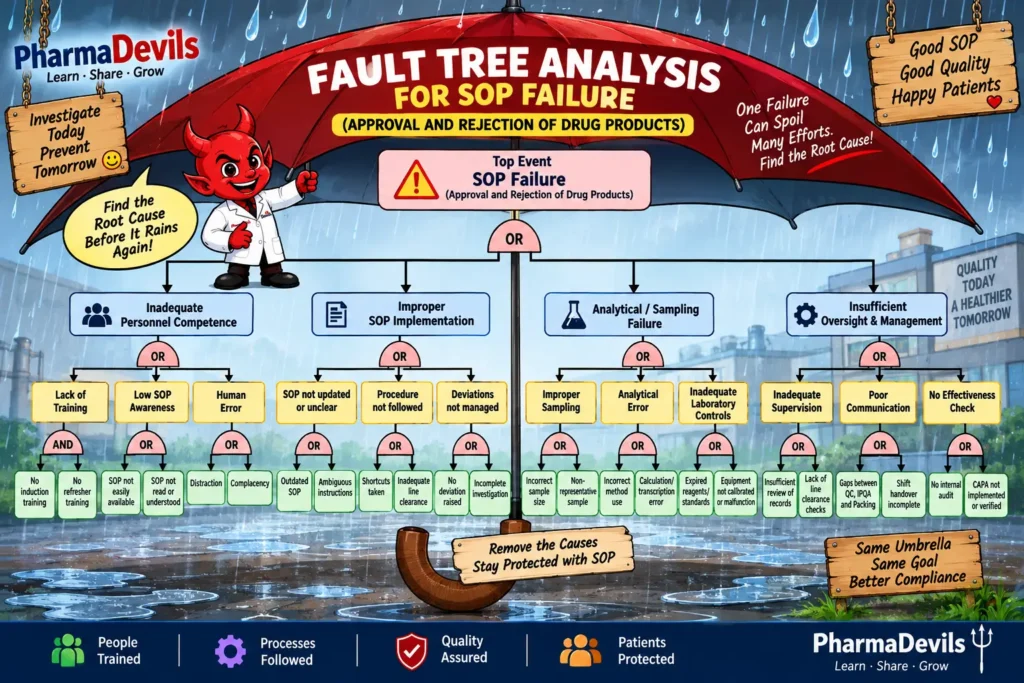
Each branch is further divided into possible causes including lack of training, poor SOP awareness, human error, unclear or outdated procedures, unmanaged deviations, incorrect sampling, analytical errors, expired reagents, uncalibrated equipment, weak supervision, poor communication, and ineffective CAPA or effectiveness checks.The umbrella-themed design represents the SOP as a protective system that prevents quality failures when all controls are functioning effectively. The diagram helps investigation teams trace potential causes logically from the top event down to basic contributing factors. These causes are illustrative and should be confirmed through records, interviews, investigation data, and documented evidence before assigning the final root cause.
Questions & Answers – Approval and Rejection of Drug Products
Q1. What is the objective of this SOP?
Answer: To lay down a procedure for the approval and rejection of drug products.
Q2. What is the scope of this SOP?
Answer: The SOP is applicable to the approval and rejection of drug products.
Q3. Who is responsible for implementation of this SOP?
Answer: Executive QC, Manager-QC, and Head-QA/QC are responsible.
Q4. When is the finished-product analysis request raised?
Answer: The Packing Department raises the request to IPQA after packing is completed.
Q5. What does IPQA check before sampling?
Answer: IPQA checks the quantity and packed quality of the product and collects a random sample as per the SOP.
Q6. What documents accompany the sample to QC?
Answer: The sample is sent to QC along with the finished-product requisition slip.
Q7. What does QC do after receiving the sample?
Answer: QC analyzes the sample and sends the Certificate of Analysis (COA) to IPQA.
Q8. Which documents are attached in the BPR by IPQA?
Answer: The COA and terminal inspection report are attached in the BPR.
Q9. When can an approved drug product be sent to the market?
Answer: It can be sent to the market only after approval by the QC department.
Q10. What happens if a drug product does not comply with specifications?
Answer: After confirmation by analysis, the product is rejected according to the procedure defined in the SOP.
Q11. How is repeat analysis initially performed?
Answer: The sample is analyzed in duplicate by analysts X and Y using fresh reagent and the same reference substance.
Q12. What happens if repeat results from both analysts X and Y comply?
Answer: The product is released.
Q13. What happens if analyst X does not comply but analyst Y complies?
Answer: The product sample is given to a third analyst, Z, for duplicate repeat testing.
Q14. What happens if analyst Z complies?
Answer: The product may be released on the basis of the results of analysts Y and Z.
Q15. What happens if analyst Z does not comply?
Answer: The product is rejected for reprocessing or destruction.
Q16. Who provides training for this SOP?
Answer: The Assistant Manager – Quality Control is the trainer, and Quality Control personnel are the trainees.
Q17. What is the training period?
Answer: The training period specified in the SOP is one day.
Q18. What do QC and IPQA stand for?
Answer: QC means Quality Control, and IPQA means In-process Quality Assurance.
Reference Guidelines:
- Revised Schedule M, Drugs Rules, 1945 – India, G.S.R. 922(E), 28 December 2023. This is the primary Indian GMP reference for Pharmaceutical Quality System, Quality Control, authorized-person responsibilities, finished-product assessment and batch release. CDSCO lists the final revised Schedule M notification officially. (CDSCO) CDSCO – Revised Schedule M / Gazette Notifications
- US FDA – 21 CFR 211.165, Testing and Release for Distribution. Requires appropriate laboratory determination that every batch conforms to final specifications before release; written sampling/testing plans must be followed, and products failing specifications must be rejected. (Legal Information Institute) 21 CFR 211.165 – Testing and Release
- US FDA – 21 CFR 211.192, Production Record Review. Requires Quality Control Unit review of production and control records before batch release and thorough investigation of unexplained discrepancies or specification failures. (Legal Information Institute) 21 CFR 211.192 – Production Record Review
- US FDA Guidance – Investigating Out-of-Specification (OOS) Test Results for Pharmaceutical Production, Revision 1, May 2022. Provides the regulatory approach for laboratory investigation, full-scale OOS investigation, retesting, resampling and evaluation of results. FDA states that an OOS result requires a scientifically sound, documented investigation. (U.S. Food and Drug Administration) FDA OOS Guidance – May 2022
- EU GMP – EudraLex Volume 4, Part I, Chapter 6: Quality Control. Covers sampling, testing, specifications, documentation, OOS/OOT investigation and Quality Control requirements. Annex 16 specifically addresses certification by a Qualified Person and batch release. (Public Health) European Commission – EudraLex Volume 4 GMP
- PIC/S GMP Guide PE 009 – Part I, Chapters 4 and 6. Chapter 4 requires written release and rejection procedures, while Chapter 6 addresses QC documentation, testing and investigation of OOS/OOT results. (PIC/S) PIC/S GMP Guide Part I
- WHO GMP – Good Manufacturing Practices for Pharmaceutical Products and WHO Good Practices for Pharmaceutical Quality Control Laboratories, TRS 1052 Annex 4 (2024). These provide international principles for manufacturing, QC testing, documentation and laboratory quality systems. (World Health Organization) WHO GMP Guidelines