




1. Brief Description:
The SOP for Handling & Decontamination of In-Process Rejection describes the controlled procedure for managing rejected units generated during routine production. It covers rejection at filling and sealing, visual inspection, labeling, and packing stages. Containers rejected for low fill volume, emptiness, neck cuts, missing droppers, or leakage are collected in designated “Rejected Containers” bins, counted, and recorded in the BMR and logbook. Empty vials and ampoules are segregated and sent to the scrap yard. During visual inspection, rejection counts are verified in the presence of Production and IPQA personnel. At labeling and packing, rejections are classified as recoverable or non-recoverable. Recoverable units may undergo controlled de-labeling, re-labeling, and 100% visual inspection. Sharp tools, IPA, and organic solvents are prohibited during de-labeling. All rejection quantities are documented in Annexure-I with Production and QA verification, ensuring proper traceability and disposition throughout the process.
Skip to PDF content2. Flow Diagram:
The flow diagram explains the complete procedure for Handling & Decontamination of In-Process Rejection during pharmaceutical production. The process starts when an in-process rejection is identified and then separates the handling route according to the stage where the rejection occurs: Filling/Sealing, Visual Inspection, or Labeling/Packing.
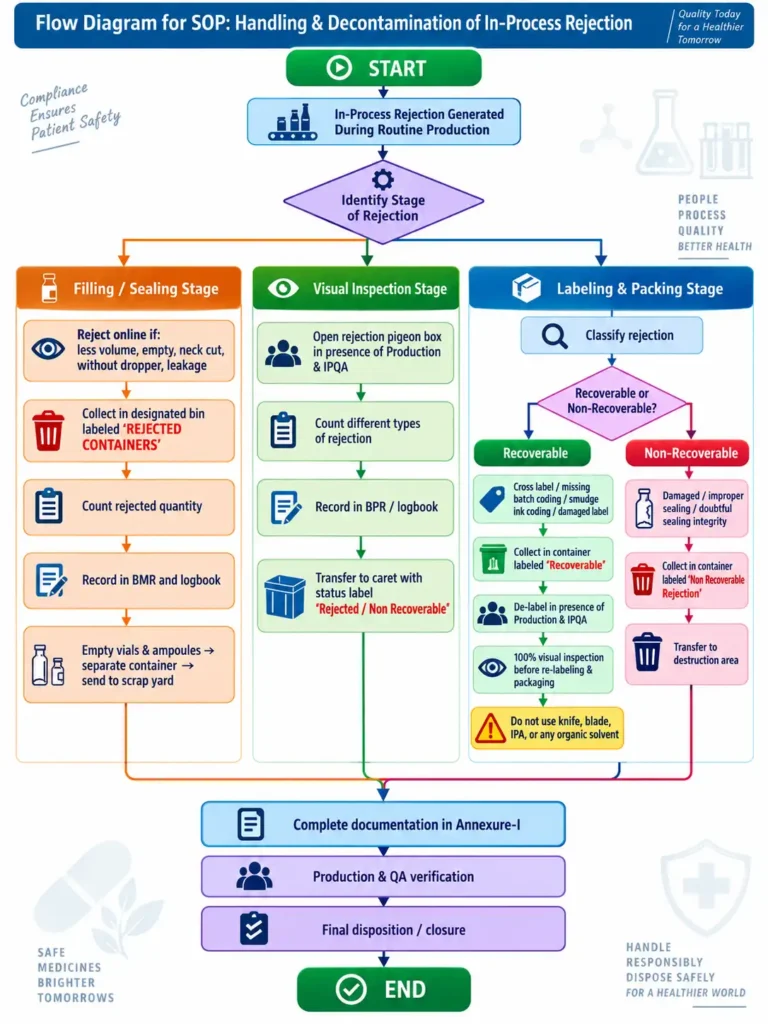
At the filling and sealing stage, rejected containers are segregated, counted, recorded, and appropriately disposed of. During visual inspection, rejection types are counted in the presence of Production and IPQA personnel and documented in the BPR and logbook. At the labeling and packing stage, rejection is classified as recoverable or non-recoverable. Recoverable units undergo controlled de-labeling, re-labeling, and 100% visual inspection, while non-recoverable units are transferred for destruction. Finally, rejection details are documented in Annexure-I, verified by Production and QA, and closed through proper disposition.
3. Brainstorming:
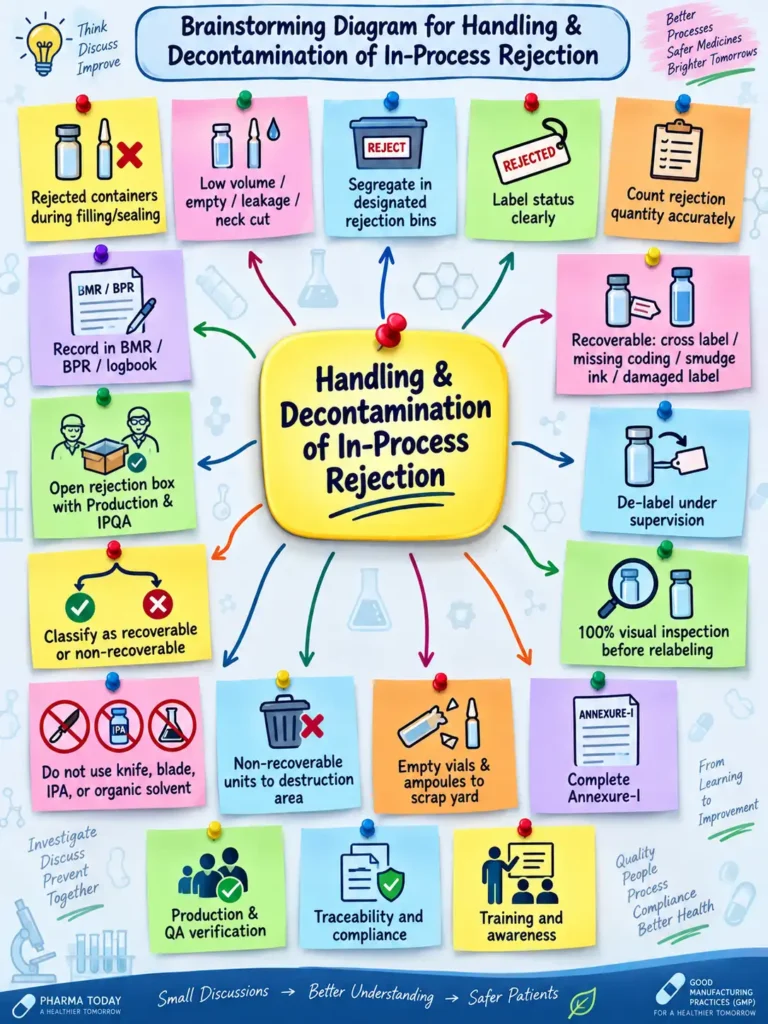
The brainstorming diagram highlights the key points that should be considered for effective Handling & Decontamination of In-Process Rejection. It focuses on identifying rejected containers generated during filling, sealing, visual inspection, labeling, and packing activities. Important discussion points include proper segregation of rejected units, clear status labeling, accurate counting, and recording of rejection quantities in the BMR, BPR, or logbook. The diagram also emphasizes classification of rejections as recoverable or non-recoverable. Recoverable units may require controlled de-labeling and 100% visual inspection before re-labeling, while non-recoverable units are transferred to the destruction area. It also highlights safe handling practices, such as avoiding knives, blades, IPA, or organic solvents during de-labeling. Empty vials and ampoules are segregated for scrap disposal. Documentation, Production and QA verification, traceability, compliance, and personnel awareness are central elements for preventing errors and ensuring controlled rejection management.
4. 5 Why Analysis:
The 5 Why Analysis for Handling & Decontamination of In-Process Rejection is used to identify the underlying reasons for rejection occurring during pharmaceutical production. The analysis begins with the problem of an in-process rejection and progressively examines why the product failed to meet acceptance criteria, why the process deviation occurred, why it was not detected earlier, and why monitoring or procedural compliance was inadequate.
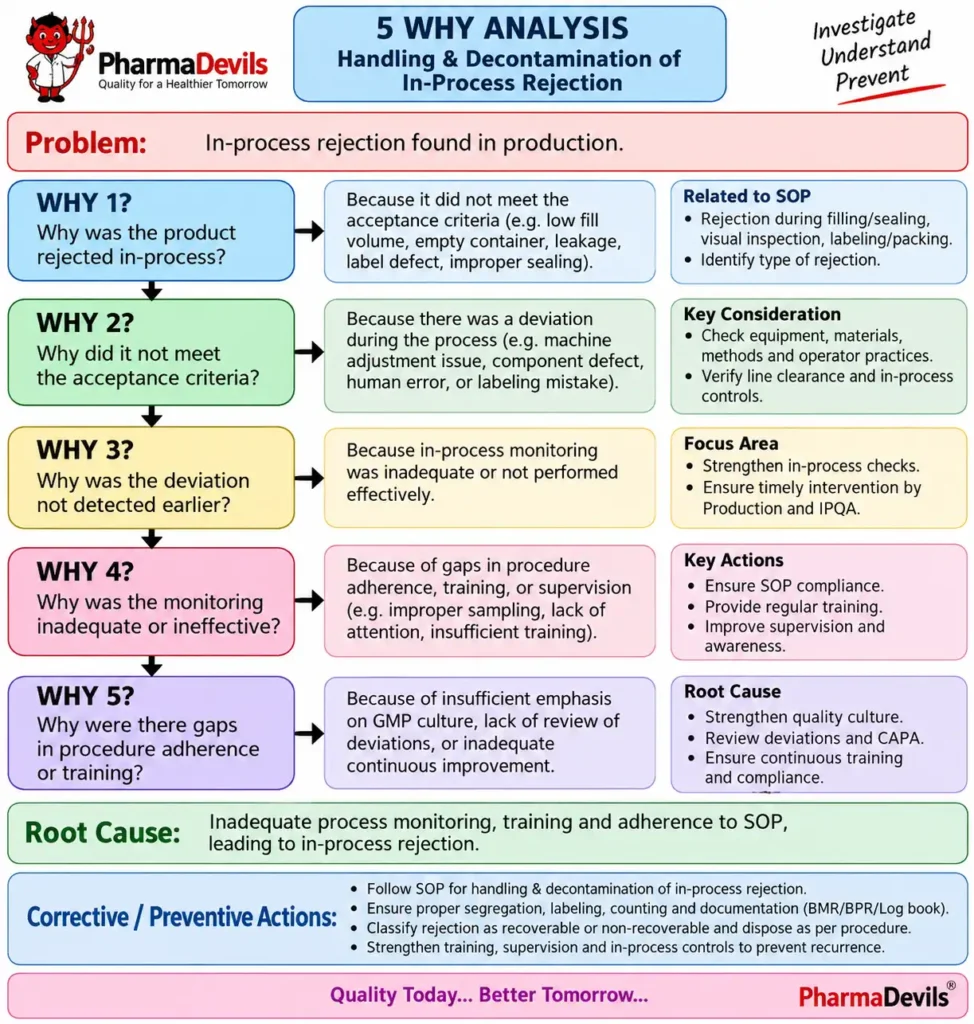
The diagram highlights possible contributing factors such as machine adjustment issues, component defects, labeling mistakes, human error, inadequate in-process monitoring, insufficient training, and weak supervision. It ultimately identifies the root cause as inadequate process monitoring, insufficient training, and poor adherence to the SOP. The analysis also emphasizes corrective and preventive actions, including proper segregation and labeling of rejected materials, complete documentation in BMR/BPR/logbooks, classification of recoverable and non-recoverable rejection, stronger Production and IPQA oversight, regular training, and improved GMP compliance to prevent recurrence.
5. Heat Map (FMEA):
The Heat Map for Handling & Decontamination of In-Process Rejection visually identifies and prioritizes the major risks associated with improper rejection handling in pharmaceutical production. It evaluates potential failure areas such as incorrect segregation of rejected units, incomplete documentation, wrong classification of recoverable and non-recoverable rejection, inadequate decontamination, improper disposal, insufficient training, equipment-related issues, weak in-process monitoring, and non-compliance with the SOP.
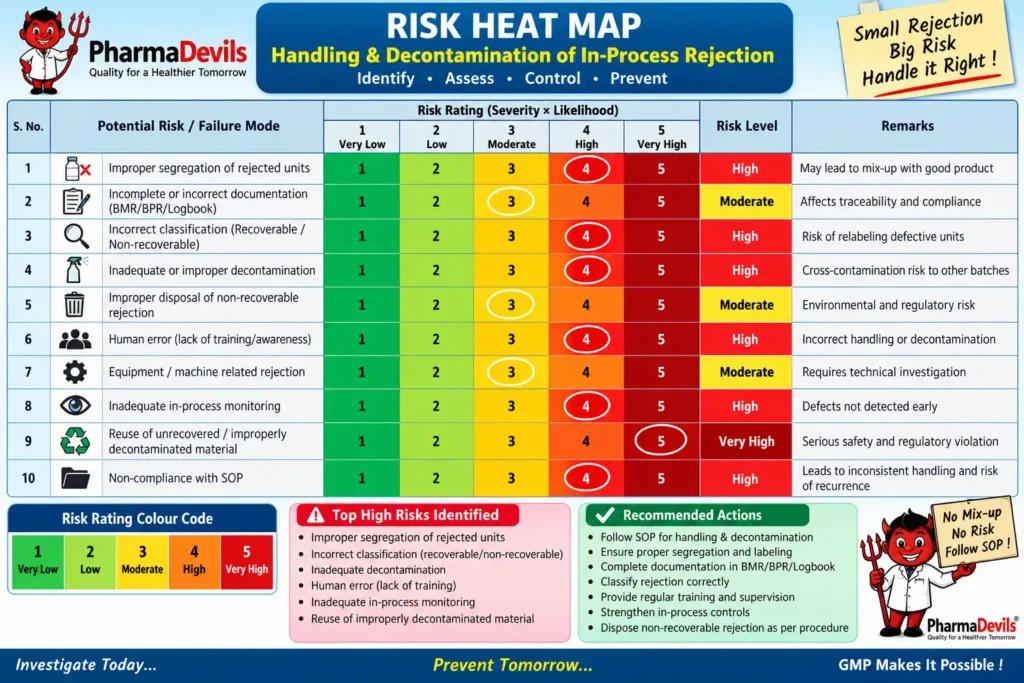
The heat map uses a color-coded risk scale from Very Low to Very High, making critical risks easy to recognize. High-risk areas require immediate attention because they may lead to mix-ups, loss of traceability, cross-contamination, incorrect reuse of rejected material, or regulatory non-compliance. The diagram also emphasizes preventive actions such as proper segregation and labeling, complete BMR/BPR/logbook documentation, correct rejection classification, adequate supervision, regular personnel training, strengthened in-process controls, and safe disposal of non-recoverable rejected material.
Questions & Answers
- Q: What is the objective of this SOP?
A: To establish a procedure for handling and decontamination of in-process rejection generated during routine production. - Q: Who is responsible for carrying out this SOP?
A: Officer/Executive – Production is responsible for implementation of the procedure. - Q: Who is accountable for this SOP?
A: The Head of Production is accountable. - Q: What types of containers may be rejected during filling and sealing?
A: Containers may be rejected for low volume, empty condition, neck cut, missing dropper, or leakage. - Q: How should rejected containers be collected?
A: They should be collected in a designated bin in the respective area and labeled “REJECTED CONTAINERS.” - Q: Where should the rejection quantity be recorded?
A: The rejected quantity should be counted and recorded in the BMR and logbook as per Annexure-I. - Q: How are empty vials and ampoules handled?
A: Empty vials and ampoules are collected separately in a container labeled “Empty Vials & Ampoules” and sent to the scrap yard. - Q: Who should be present when the visual-inspection rejection box is opened?
A: Production and IPQA personnel should be present. - Q: What happens to rejected units after visual inspection?
A: The rejection types are counted, recorded in the respective BPR and logbook, and transferred to a container with status labeling as “Rejected / Non Recoverable.” - Q: What are the two types of rejection during labeling and packing?
A: They are classified as Recoverable Rejection and Non-Recoverable Rejection. - Q: What is considered a non-recoverable rejection?
A: A labeled container with damage, improper sealing, or doubt regarding sealing integrity is considered non-recoverable. - Q: Where are non-recoverable rejected units sent?
A: They are transferred to the destruction area for disposition. - Q: What defects are considered recoverable rejection?
A: Cross labels, missing batch coding, smudged ink coding, or damaged labels may be treated as recoverable rejection. - Q: What is required after de-labeling recoverable units?
A: All de-labeled containers must undergo 100% visual inspection before re-labeling and packaging. - Q: Can a knife or blade be used for de-labeling vials or ampoules?
A: No. Sharp-edged utensils such as knives or blades must not be used during de-labeling. - Q: Can IPA or other organic solvents be used to remove labels or gum?
A: No. The SOP specifically states that IPA or any other organic solvent should not be used for de-labeling. - Q: How should labels or gum traces be removed?
A: The label should be peeled off and remaining traces should be removed by wet mopping with a clean cloth. - Q: What precaution should be taken during de-labeling?
A: Vials and ampoules should not be scratched during the de-labeling activity. - Q: What is Annexure-I used for?
A: Annexure-I is used for documenting product details, batch number, rejection quantities from filling/sealing, visual inspection, and labeling/packing, along with total rejection and Production/QA verification. - Q: Which departments receive controlled copies of this SOP?
A: Controlled copies are distributed to Production and Quality Assurance, while the master copy is retained by Quality Assurance.