





Brief Description
The SOP for Behavior in the Quality Control Department establishes the expected conduct, discipline, safety practices, and Good Laboratory Practices (GLP) for all personnel working in QC. Its purpose is to ensure that laboratory activities are performed in a clean, safe, controlled, and compliant manner. QC chemists are responsible for following the procedure, while senior QC personnel are responsible for its review and effective implementation. The SOP requires personnel to maintain workplace cleanliness, wear appropriate clothing, follow departmental instructions, specifications, SOPs, Methods of Analysis (MOA), and MSDS requirements when handling hazardous chemicals. It also emphasizes real-time documentation, verification of reagent/chemical expiry and instrument calibration status before analysis, proper storage of reagents, segregation of used glassware, careful handling of sensitive instruments, and protection of analytical records from damage or spillage. Training is provided to all QC chemists to ensure consistent implementation of these laboratory behavior requirements.
Skip to PDF content1. Flow Diagram:
The flow diagram illustrates the systematic behavioral and operational requirements that personnel must follow while working in the Quality Control Department. It begins with maintaining a clean and organized workplace and ensuring appropriate clothing and safety practices. Personnel are required to follow departmental instructions, applicable SOPs, Methods of Analysis (MOA), specifications, and MSDS requirements during laboratory activities.
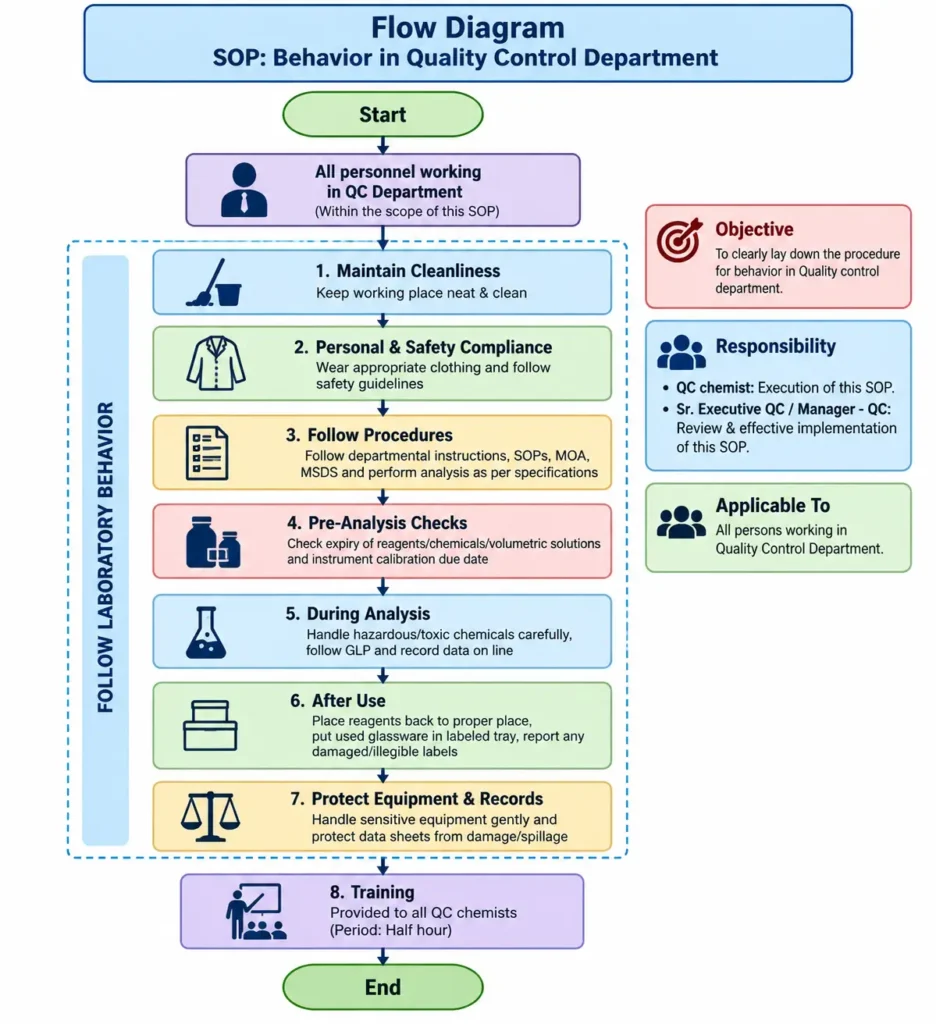
Before starting analysis, the analyst verifies the expiry status of volumetric solutions, reagents, and chemicals, along with the calibration due date of instruments. During testing, hazardous and toxic chemicals are handled carefully, GLP requirements are followed, and analytical records are completed online. After use, reagents are returned to their designated locations, used glassware is placed in the appropriate washing tray, damaged labels are reported, and sensitive equipment and data sheets are protected from damage or spillage.The process concludes with training of QC chemists to ensure consistent implementation of the SOP.
2. Brainstorming for SOP Failure:
The brainstorming diagram identifies potential causes that may lead to SOP failure or non-compliance in a pharmaceutical manufacturing area. The causes are grouped into six major categories: Man, Machine, Method, Material, Environment, and Management. Typical contributors include inadequate training, unclear or outdated SOPs, equipment qualification or maintenance gaps, material mix-ups, poor housekeeping, environmental control issues, insufficient supervision, ineffective CAPA, and weak compliance monitoring.
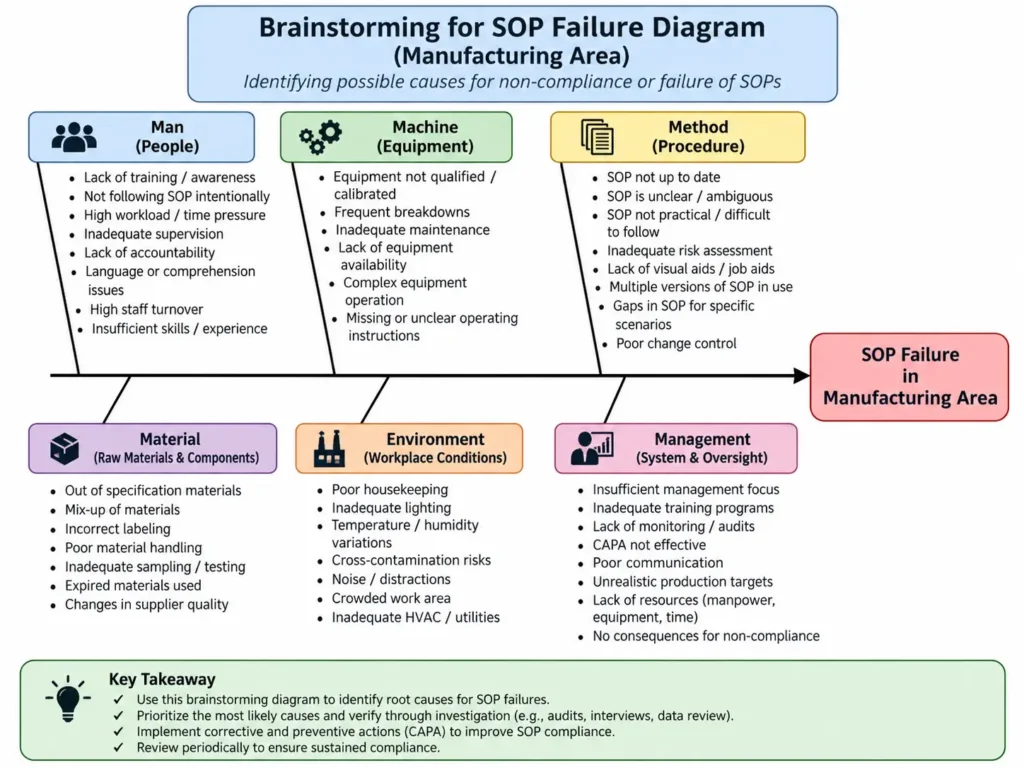
The purpose of the brainstorming exercise is to capture all plausible causes before conducting detailed root-cause analysis. The supporting SOP emphasizes disciplined practices such as maintaining a clean workplace, following approved SOPs and methods, observing safety/MSDS requirements, completing records contemporaneously, and checking reagent expiry and equipment calibration status.This analysis can support investigation, risk assessment, CAPA development, and prevention of repeated SOP failures.
3. 5-Why Analysis for SOP Failure:
The 5-Why Analysis systematically investigates the underlying reasons for SOP failure or non-compliance in a manufacturing area. The analysis begins with the problem that personnel did not follow the approved SOP and progressively identifies contributing factors such as inadequate understanding of SOP requirements, insufficient training and communication, ineffective refresher training, lack of verification of employee understanding, and weak management monitoring.
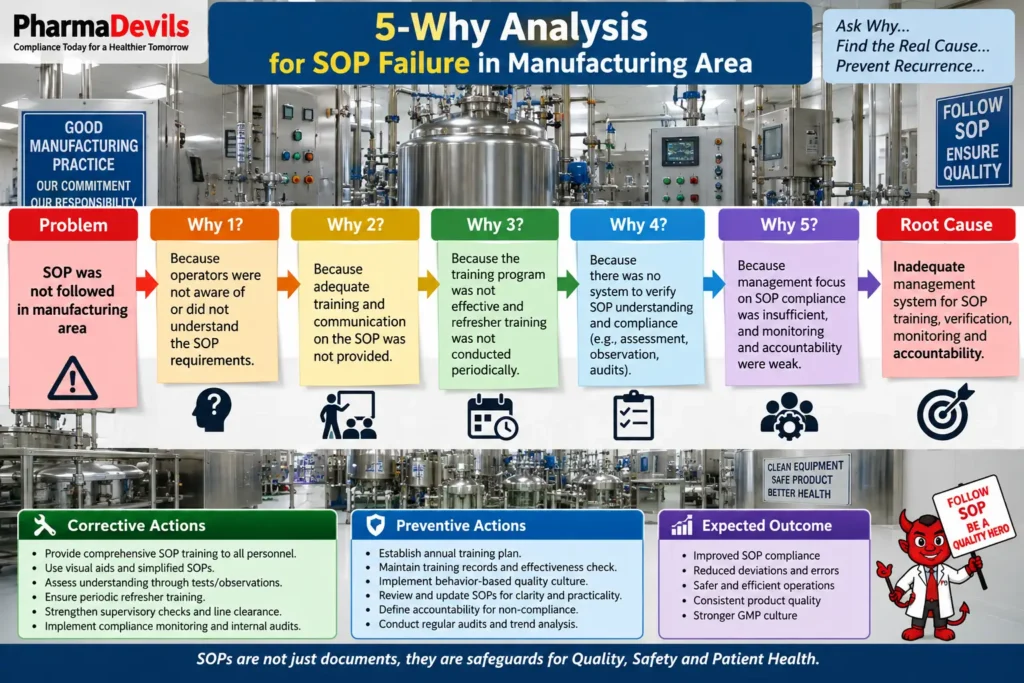
The analysis ultimately identifies the likely root cause as an inadequate SOP compliance management system, particularly in relation to training, effectiveness checks, supervision, monitoring, and accountability. The source SOP emphasizes following approved procedures, maintaining good workplace practices, observing safety requirements, completing records properly, and checking relevant materials and equipment before use. This 5-Why approach helps establish appropriate CAPA, including retraining, competency assessment, stronger supervision, periodic compliance audits, and routine SOP effectiveness review to prevent recurrence.
4. Fishbone Analysis for SOP Failure:
The Fishbone Analysis diagram is used to identify and organize the possible causes of SOP failure in a pharmaceutical manufacturing area. Potential causes are grouped under six major categories: Man, Machine, Method, Material, Environment, and Management. Typical issues include inadequate training, poor SOP awareness, equipment breakdown or overdue calibration, unclear or outdated procedures, material mix-ups, poor housekeeping, inadequate environmental controls, weak supervision, ineffective CAPA, and insufficient compliance monitoring.
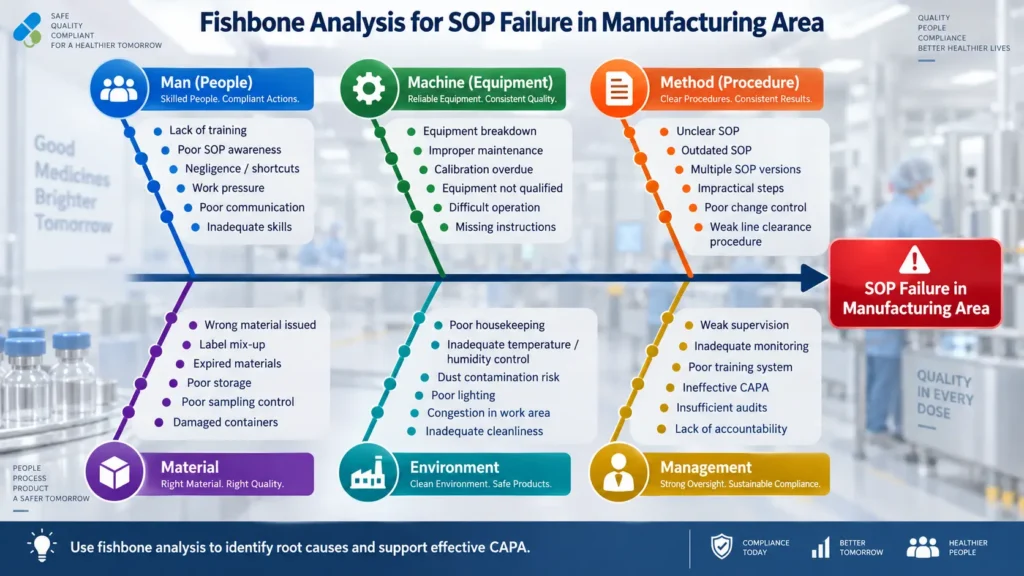
The source SOP emphasizes key compliance behaviors such as maintaining a clean workplace, following approved SOPs and methods, observing safety requirements, completing records properly, and checking reagent expiry and instrument calibration status before work begins. This analysis helps investigation teams systematically identify probable root causes, prioritize high-risk factors, and develop appropriate corrective and preventive actions (CAPA) to prevent recurrence and strengthen GMP compliance.
5. Fault Tree Analysis for SOP Failure:
The Fault Tree Analysis diagram systematically evaluates the possible causes leading to SOP failure in a pharmaceutical manufacturing area. The top event, “SOP Failure in Manufacturing Area,” is divided through logical OR gates into four major failure groups: People, Process/Method, Equipment, and Materials/Environment.
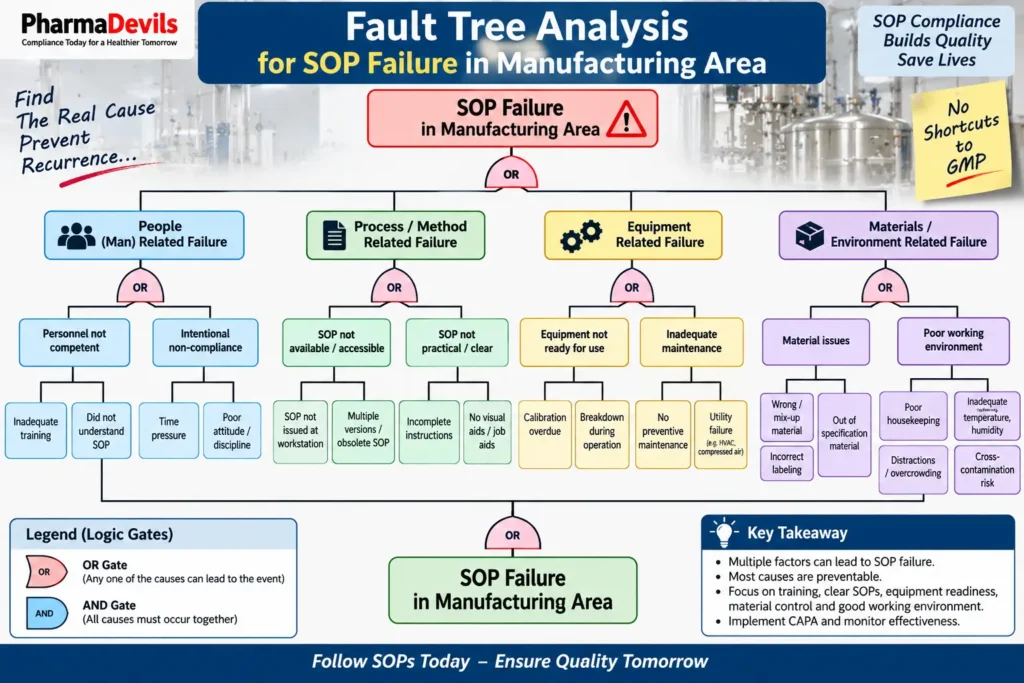
Possible contributing causes include inadequate training, poor understanding of SOP requirements, intentional non-compliance, time pressure, unavailable or obsolete SOPs, unclear instructions, overdue calibration, equipment breakdown, inadequate preventive maintenance, material mix-ups, incorrect labeling, poor housekeeping, temperature/humidity variation, and cross-contamination risk. The attached SOP emphasizes workplace cleanliness, adherence to approved procedures and methods, safety requirements, proper documentation, and verification of reagent expiry and instrument calibration before analysis. The Fault Tree helps investigators trace failures to their basic causes and supports targeted CAPA, risk reduction, and improved GMP compliance.
Questions & Answers – Behavior in Quality Control Department
Q1. What is the objective of this SOP?
Answer: To clearly lay down the procedure for behavior in the Quality Control Department.
Q2. To whom is this SOP applicable?
Answer: It is applicable to all persons working in the Quality Control Department.
Q3. Who is responsible for execution of this SOP?
Answer: The QC chemist is responsible for execution of the SOP.
Q4. Who is responsible for review and effective implementation of the SOP?
Answer: Sr. Executive Q.C. / Manager-Q.C. are responsible for review and effective implementation.
Q5. What should be maintained at the QC workplace?
Answer: The workplace should be kept neat and clean.
Q6. What clothing should QC personnel wear?
Answer: Appropriate clothing should be worn as per the applicable SOP.
Q7. How should hazardous chemicals be handled?
Answer: Safety guidelines provided on the manufacturer’s container label and the applicable MSDS/SOP should be followed. Hazardous and toxic chemicals should be handled carefully in the presence of the In-charge.
Q8. According to what documents should analysis be performed?
Answer: Analysis should be carried out as per the respective specification, SOP and MOA.
Q9. What documentation practice should be followed during analysis?
Answer: GLP should be followed and all related records should be filled online while performing the analysis in the respective annexures/records.
Q10. What should be checked before starting an analysis?
Answer: The expiry of volumetric solutions, chemicals and reagents, along with the instrument calibration due date, should be checked.
Q11. What should be done with reagents and chemical bottles after use?
Answer: They should always be returned to their proper designated place.
Q12. How should used glassware be handled?
Answer: Used glassware should not be kept on the working platform; it should be placed in the tray labeled “glassware for washing.”
Q13. What should be done if a reagent or chemical bottle label is damaged or illegible?
Answer: The In-charge should be informed and the damaged or illegible label should be replaced.
Q14. How should sensitive equipment such as an analytical balance be handled?
Answer: Sensitive equipment should always be handled gently.
Q15. How should data sheets be protected during use?
Answer: Care should be taken to protect data sheets from damage or spillage while they are being used for reporting.
Q16. Who provides training for this SOP and who are the trainees?
Answer: The trainer is the Assistant Quality Control Manager, and the trainees are all QC chemists. The specified training period is half an hour.
Q17. What abbreviations are defined in the SOP?
Answer: SOP – Standard Operating Procedure; MSDS – Material Safety Data Sheet; QC – Quality Control; GLP – Good Laboratory Practice; MOA – Method of Analysis.
Reference Guidelines:
- WHO Technical Report Series No. 957, Annex 1 – WHO Good Practices for Pharmaceutical Quality Control Laboratories. This is highly relevant to QC personnel, documentation, reagents, equipment calibration/qualification, analytical work, records, and laboratory safety. (World Health Organization)
WHO TRS 957, Annex 1 - Revised Schedule M of the Drugs Rules, 1945 – Good Manufacturing Practices, Government of India. Applicable to pharmaceutical quality systems, personnel, documentation, hygiene, equipment, QC operations, calibration, and SOP compliance. CDSCO lists the revised Schedule M notification as G.S.R. 922(E), dated 28 December 2023. (CDSCO)
CDSCO Gazette Notifications – Schedule M - EU GMP – EudraLex Volume 4, Part I, Chapter 6: Quality Control. Covers QC organization, laboratory documentation, testing, reagents, records, specifications, and responsibilities. (Public Health)
EU GMP Volume 4 - PIC/S GMP Guide PE 009-17, Part I – Chapter 6: Quality Control. Relevant to laboratory controls, testing records, approved methods, reagents, equipment usage, and QC documentation. (PIC/S)
PIC/S Publications – GMP Guide PE 009-17