







Brief Description
This SOP explains the correct method for making entries in the Equipment/Instrument Usage Record in the Quality Control Department. Its main purpose is to ensure that every use of QC equipment is properly recorded and can be easily traced. The SOP applies to all equipment and instruments used in the QC department. QC Chemists and Executives are responsible for following the procedure, while the Lab-QA Manager, QC Manager, and Head-QA/QC are responsible for its effective implementation. For each equipment use, personnel should record the date, product name, batch number, operation start and completion time, and signatures of the person performing and checking the activity. Time should be entered using the 24-hour clock format. Maintenance activities must also be recorded with start time, completion time, and reason for maintenance. The SOP also includes training requirements and an Equipment/Instrument Usage Log format for proper documentation and traceability.
Skip to PDF content1. Flow Diagram:
The flow diagram describes the step-by-step process for making entries in the Equipment/Instrument Usage Record in the Quality Control Department. The process begins when an equipment or instrument is used for QC activity. The user opens the equipment usage log and records the date, product name, batch number, operation start time, and completion time. The time is entered using the 24-hour clock format.
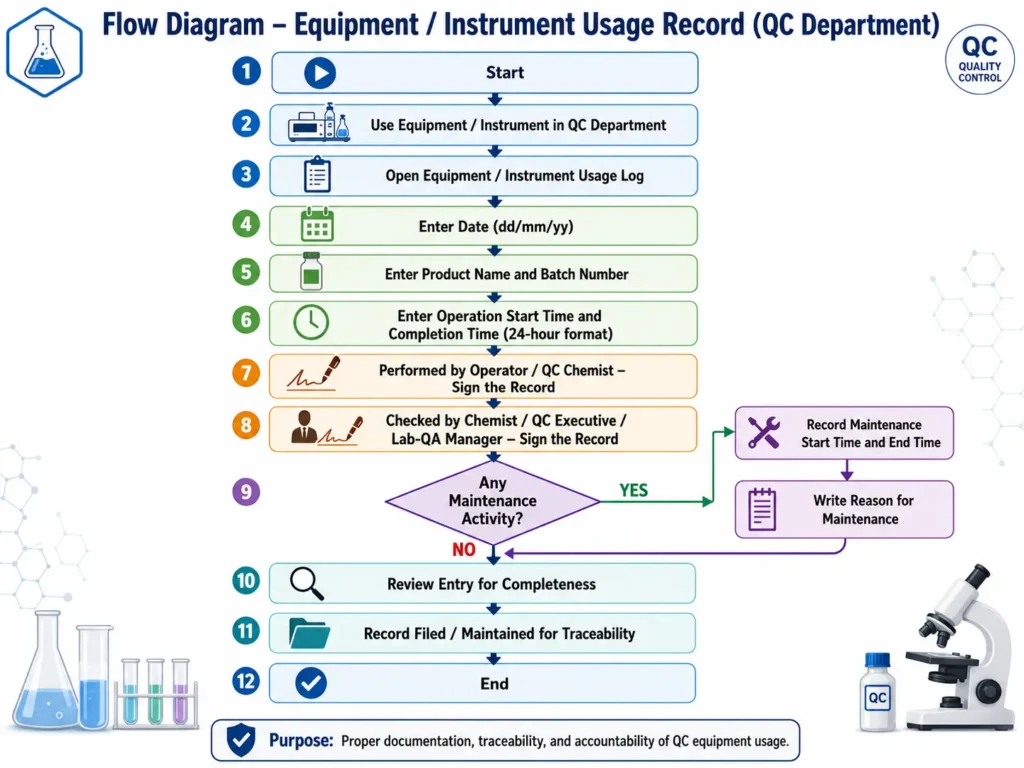
After completing the activity, the person performing the operation signs the record, followed by checking and signing by the responsible Chemist, QC Executive, or Lab-QA Manager. If any maintenance activity is performed, the maintenance start time, completion time, and reason are also documented. Finally, the completed record is reviewed and maintained to ensure proper documentation, traceability, accountability, and reliable history of equipment usage in the QC department.
2. Brainstorming for SOP Failure:
Brainstorming is used to identify possible reasons why the Equipment/Instrument Usage Record SOP may not be followed correctly in the Quality Control Department. The SOP requires recording details such as date, product name, batch number, operation start and completion time, and signatures of the person performing and checking the activity. It also requires proper documentation of maintenance time and the reason for maintenance.
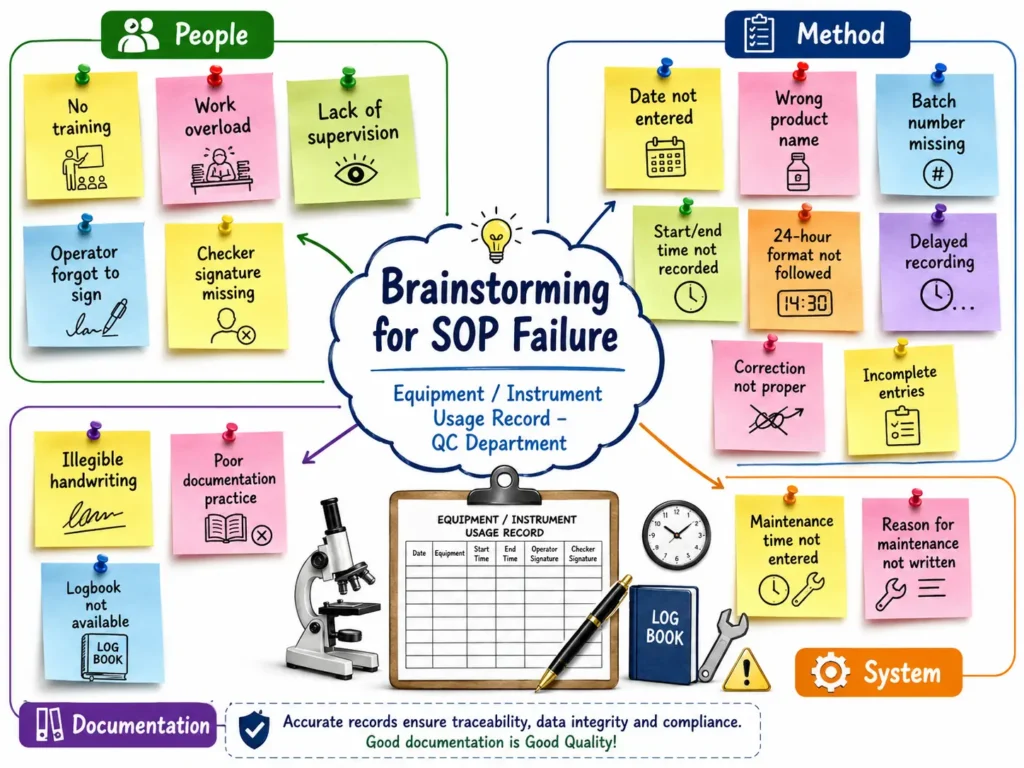
During brainstorming, possible failure causes can be grouped under People, Method, Documentation, and System. Examples include lack of training, work overload, missing signatures, incorrect date or batch number, delayed recording, incomplete entries, poor handwriting, unavailable logbooks, improper corrections, and missing maintenance details. These ideas help the investigation team identify likely causes, select areas for detailed root-cause analysis, and develop suitable corrective and preventive actions to improve documentation, traceability, data integrity, and GMP compliance.
3. 5-Why Analysis for SOP Failure:
The 5-Why Analysis is a simple root cause investigation tool used to understand why the SOP for Equipment/Instrument Usage Record may fail in the Quality Control Department. The SOP requires recording the date, product name, batch number, operation start and completion time, along with signatures of the person performing and checking the activity.
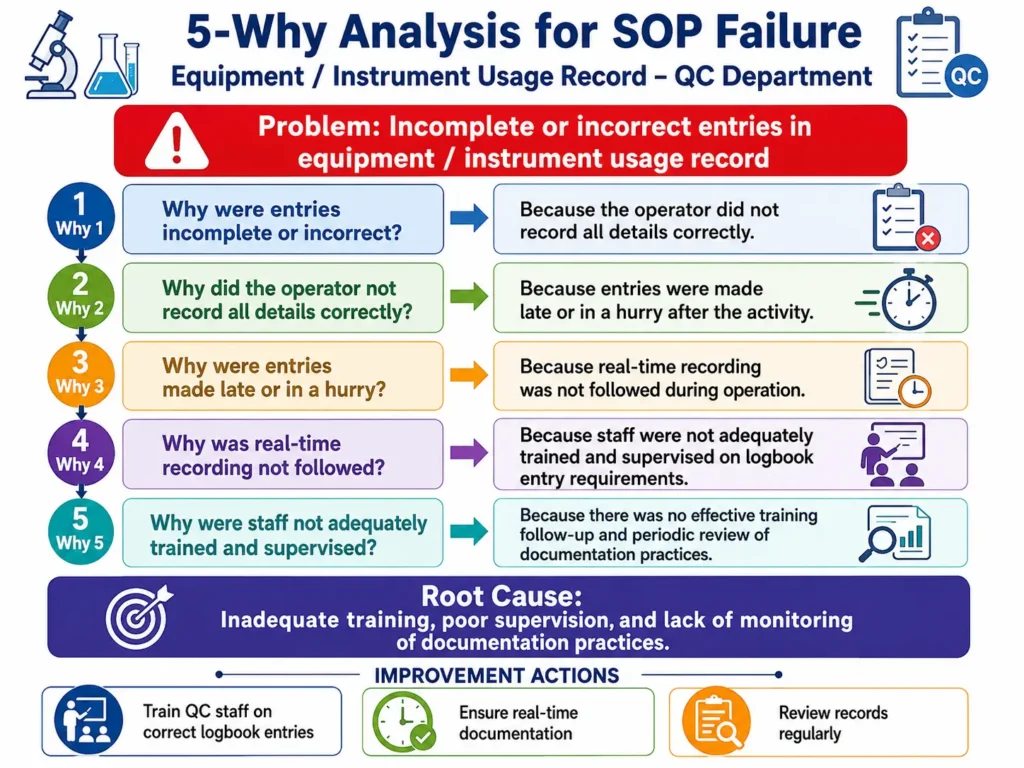
In the illustrated analysis, the failure starts with incomplete or incorrect entries. Repeatedly asking “Why?” may reveal that entries were made late, real-time recording was not followed, supervision was weak, or personnel were not adequately trained. The SOP itself specifies training for Quality Control personnel. The 5-Why approach helps move from the visible problem to a likely underlying cause. Based on the investigation outcome, actions such as refresher training, better supervision, timely documentation, and regular review of usage records can be implemented to reduce recurrence and improve traceability.
4. Fishbone Analysis for SOP Failure:
The Fishbone Analysis, also known as the Ishikawa or Cause-and-Effect Diagram, is used to identify possible causes of failure in the Equipment/Instrument Usage Record SOP in the Quality Control Department. The main problem considered is incomplete or incorrect entries in the usage record. Possible causes are grouped into major categories such as People, Method, Machine/Instrument, Material/Record, Environment, and Management/System.
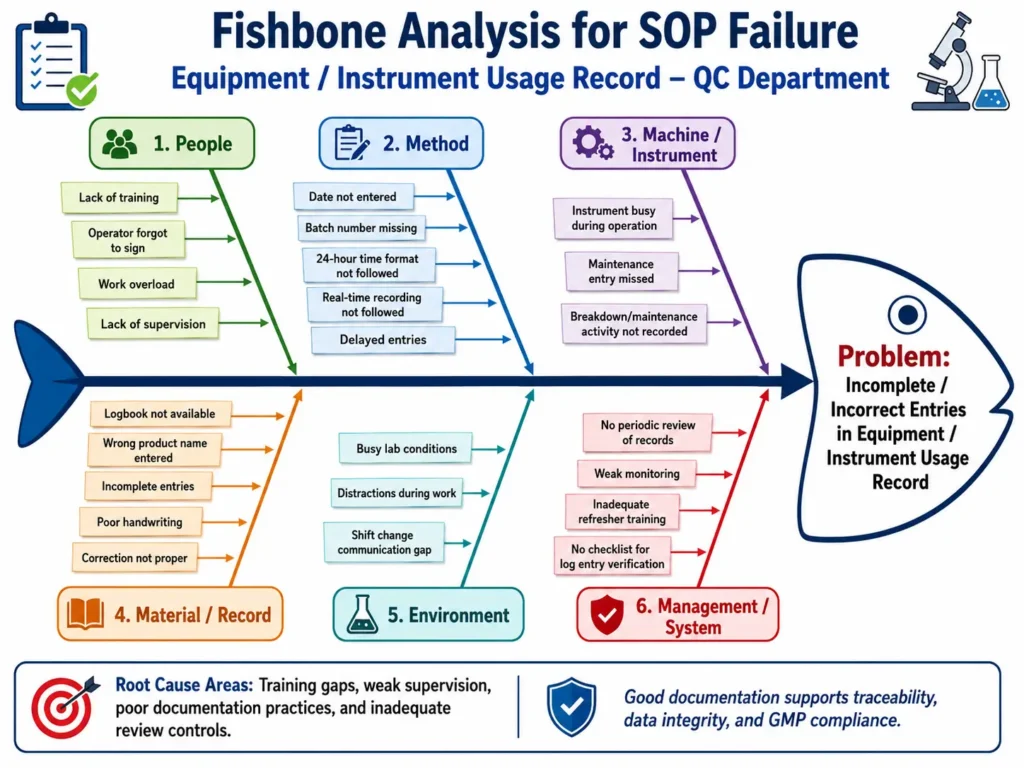
Common causes may include lack of training, missed signatures, work overload, incorrect or delayed entries, failure to use the 24-hour time format, unavailable logbooks, poor handwriting, missed maintenance records, distractions, weak supervision, and lack of periodic review. The SOP requires accurate recording of date, product name, batch number, operation times, signatures, and maintenance details. Fishbone analysis helps the investigation team organize these potential causes and identify the most likely root causes for suitable corrective and preventive actions.
5. Fault Tree Analysis (FTA) for SOP Failure:
Fault Tree Analysis (FTA) is a systematic tool used to identify the possible causes that can lead to failure of the Equipment/Instrument Usage Record SOP in the Quality Control Department. The main problem, or top event, is incomplete, incorrect, or missing entries in the equipment usage record. The SOP requires proper recording of the date, product name, batch number, operation start and completion time, and signatures of the person performing and checking the activity.
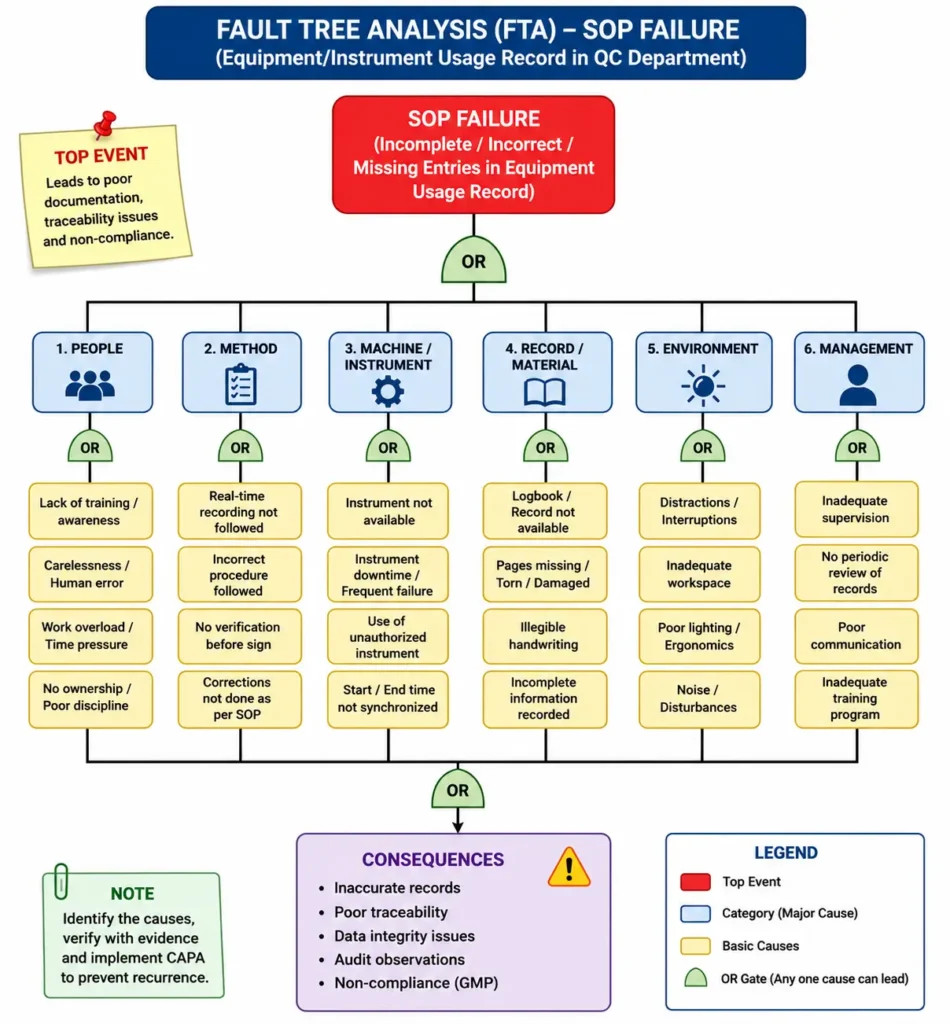
In the FTA, possible causes can be arranged under areas such as People, Method, Machine/Instrument, Record/Material, Environment, and Management. Maintenance activities must also include the start time, completion time, and reason for maintenance. FTA helps the investigation team understand how different failures may combine or individually lead to SOP failure, supporting root-cause identification and suitable CAPA.
Questions & Answers:
- What is the purpose of this SOP?
The purpose of this SOP is to describe the correct method for making entries in the Equipment/Instrument Usage Record in the Quality Control Department. - Where is this SOP applicable?
This SOP is applicable to equipment and instruments used in the Quality Control Department. - Who is responsible for following this SOP?
QC Chemists and QC Executives are responsible for executing this SOP. - Is an equipment usage record required for all QC equipment?
Yes, an equipment usage record should be maintained for all equipment used in the QC Department. - Which basic details should be entered in the usage log?
The log should include the date, product name, batch number, operation start time, and completion time. - Which time format should be used in the usage record?
Time should be entered in the 24-hour clock format, for example, 2 PM should be written as 14:00 hrs. - Who should sign after completing the operation?
The person who performs the operation should sign in the respective column of the usage record. - Who should check the equipment usage entry?
The Chemist, QC Executive, or Lab-QA Manager who checks the activity should sign the respective column. - What information should be recorded during maintenance?
The maintenance start time, completion time, and reason for maintenance should be recorded in the respective columns. - Who provides training for this SOP?
The Lab-QA Manager is the trainer, and Quality Control personnel are the trainees. - What is the reference for this SOP?
The SOP refers to GMP requirements. - What is the enclosure provided with this SOP?
Annexure-I contains the Equipment/Instrument Usage Log.