






Brief Description
This SOP describes the procedure for monitoring, drying, replacing, and reusing self-indicating silica gel used in desiccators, weighing balances, potentiometric titrators, and Karl Fischer titrators within the Quality Control Department. The silica gel is visually checked daily for its original blue colour. If decolourisation occurs, indicating moisture absorption, the silica gel is removed and dried in a 500 mL beaker at 100°C in an oven until the original blue colour reappears. After drying, it is cooled to room temperature in a desiccator. Silica gel that regains its original colour may be reused; if the colour is not restored, it must be discarded and replaced with fresh silica gel. The QC Chemist is responsible for execution, while the Sr. Executive/Manager-QC is responsible for review and effective implementation. Training is provided to QC chemists by the Quality Control Manager.
Skip to PDF content1. Flow Diagram:
The flow diagram illustrates the step-by-step procedure for changing and regenerating silica gel used in desiccators and weighing balances in the Quality Control Department. The process begins with a daily visual inspection of the self-indicating silica gel to verify whether its original blue colour has changed. If no colour change is observed, the silica gel remains in use and routine daily monitoring continues.
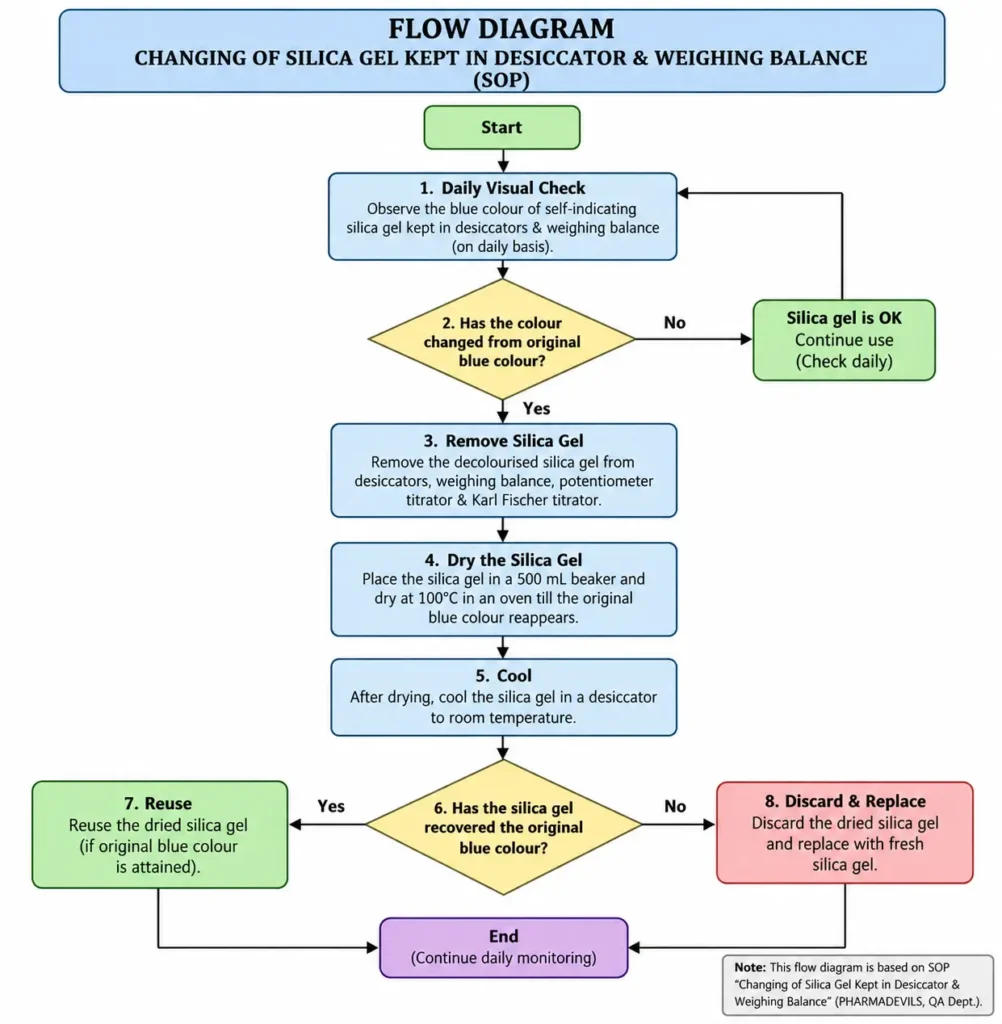
When decolourisation occurs, the silica gel is removed from the desiccator, weighing balance, potentiometer titrator, or Karl Fischer titrator. It is then placed in a 500 mL beaker and dried at 100°C in an oven until the original blue colour reappears. After drying, it is cooled to room temperature in a desiccator. If the original blue colour is restored, the silica gel is reused. If the colour is not recovered, it is discarded and replaced with fresh silica gel, followed by continued routine monitoring.
2. Brief Description:
The SOP Failure Brainstorming Diagram provides a structured approach to identify potential reasons for failure to follow or effectively implement Standard Operating Procedures within a pharmaceutical manufacturing area. The diagram places “SOP Failure in MFG Area” at the center and evaluates contributing factors through major categories such as Man, Machine, Material, Method, Environment, Measurement, Management, and Other Factors. Typical causes include inadequate training, lack of SOP awareness, human error, unclear or outdated procedures, equipment qualification or maintenance deficiencies, material mix-ups, poor housekeeping, environmental control issues, inadequate in-process monitoring, weak supervision, insufficient resources, production pressure, and communication gaps between shifts.
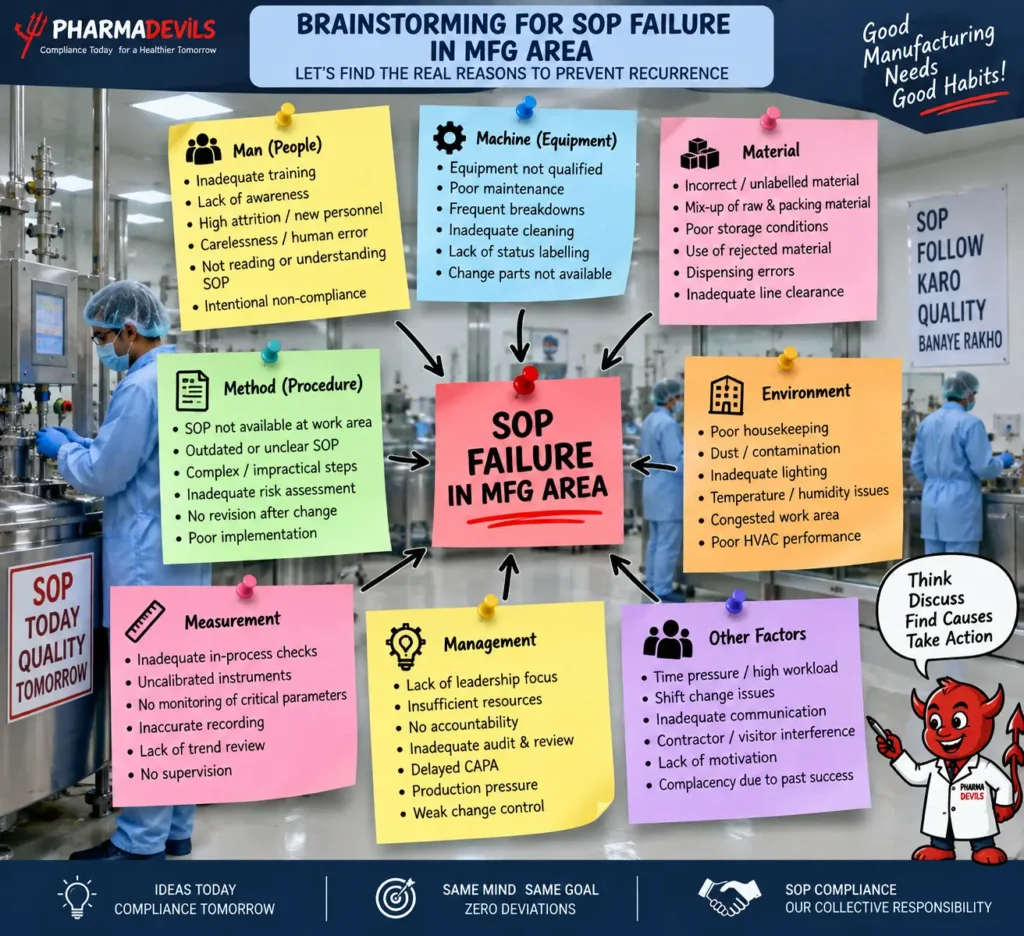
The brainstorming approach helps a cross-functional team systematically identify possible causes before performing detailed root-cause analysis. It supports investigation, risk assessment, CAPA development, training improvement, stronger supervision, and prevention of recurrence, thereby promoting GMP compliance, product quality, process consistency, and patient safety.
3. 5-Why Analysis for SOP Failure:
The 5-Why Analysis Diagram evaluates the underlying reasons for an SOP not being followed in the manufacturing area. The analysis starts with the observed problem and progressively asks “Why?” to move from the immediate cause toward the systemic root cause.
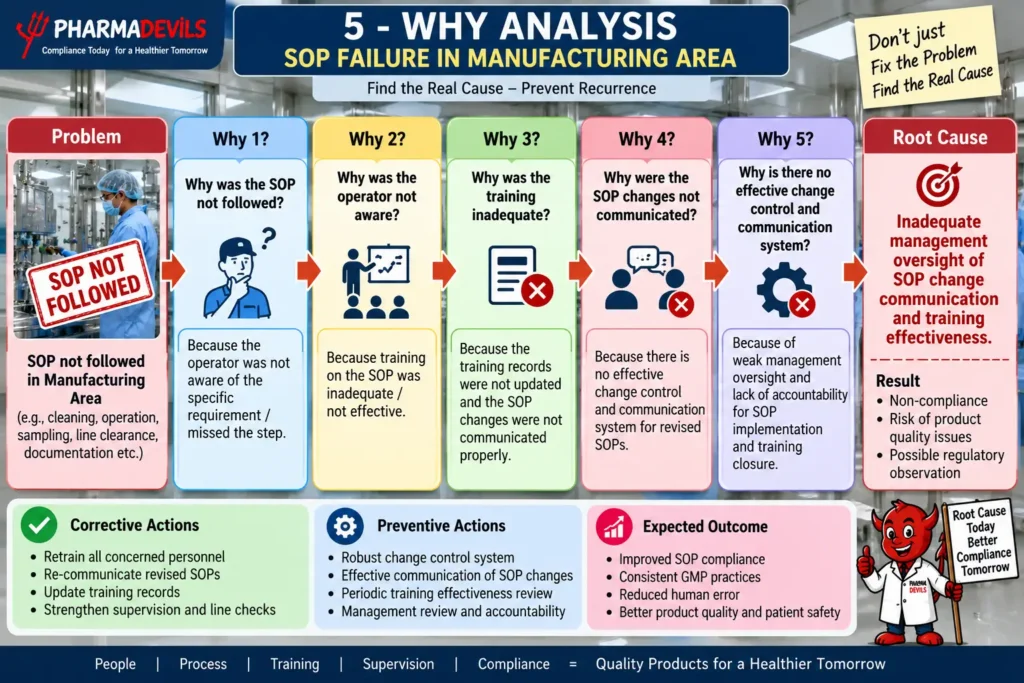
The first level identifies that the operator was not aware of a specific SOP requirement or missed a required step. Further analysis indicates that the operator’s training was inadequate or ineffective, while training records and revised SOP information were not properly updated or communicated. The next level highlights weaknesses in the change-control and communication system for revised SOPs. The final root cause identified in the diagram is inadequate management oversight of SOP change communication and training effectiveness. The diagram also recommends corrective and preventive actions such as retraining concerned personnel, re-communicating revised SOPs, updating training records, strengthening supervision, improving change control, and periodically reviewing training effectiveness to improve SOP compliance and prevent recurrence.
4. Fishbone Analysis for SOP Failure:
The Fishbone (Ishikawa) Analysis Diagram identifies and organizes the possible causes of SOP failure in the pharmaceutical manufacturing area. The analysis groups potential contributing factors under six major categories: Man, Machine, Material, Method, Environment, and Measurement.
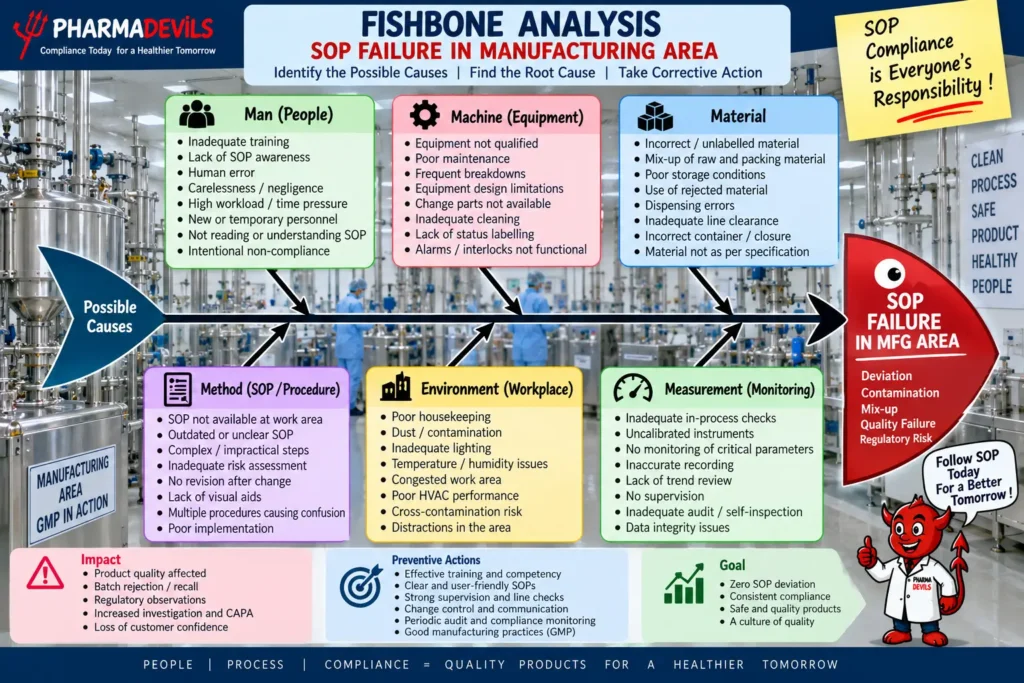
People-related causes may include inadequate training, poor SOP awareness, human error, excessive workload, or intentional non-compliance. Equipment factors include inadequate qualification, poor maintenance, malfunctioning alarms or interlocks, and improper cleaning. Material-related causes include mix-ups, incorrect labeling, improper storage, and dispensing errors. Method-related issues may involve unclear, outdated, complex, or unavailable SOPs. Environmental factors include poor housekeeping, inadequate HVAC performance, contamination risk, lighting, and temperature or humidity problems. Measurement factors include inadequate in-process checks, uncalibrated instruments, weak monitoring, and inaccurate recording. The diagram supports root-cause investigation, CAPA development, improved training, stronger supervision, and prevention of recurring SOP deviations, thereby supporting GMP compliance and consistent product quality.
5. Fault Tree Analysis for SOP Failure:
The Fault Tree Analysis (FTA) Diagram systematically evaluates the possible causes that can lead to SOP failure in the pharmaceutical manufacturing area. The top event is defined as an SOP not being followed or a deviation occurring during manufacturing activities. The analysis then breaks this event into major contributing branches such as Human Factors, Equipment Factors, Material Factors, and Process/System Factors.
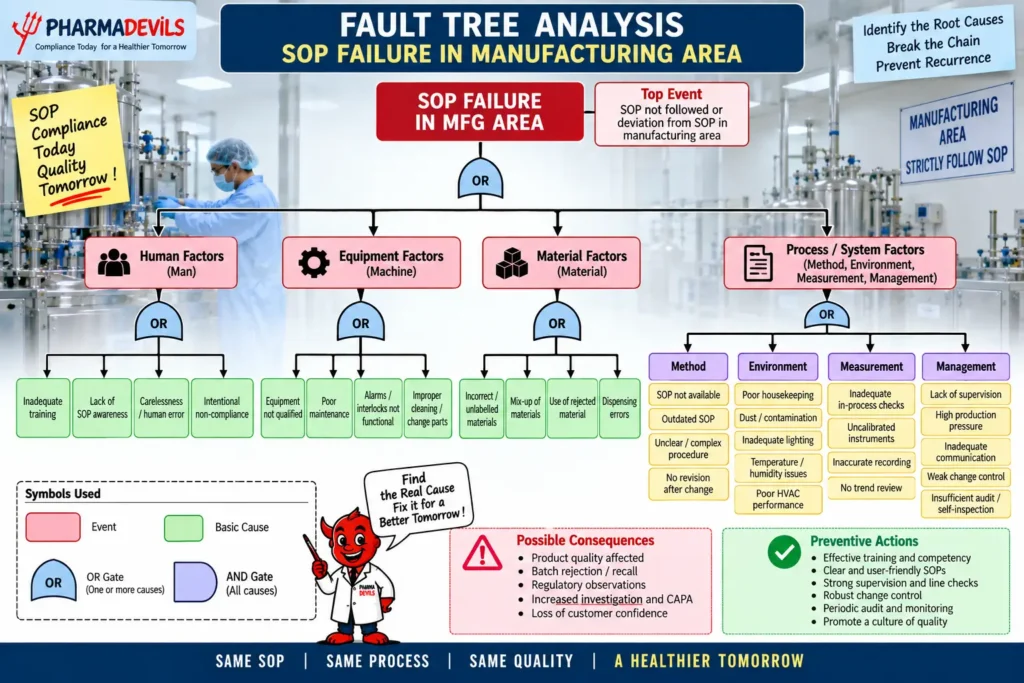
Human-related causes may include inadequate training, lack of SOP awareness, human error, and intentional non-compliance. Equipment-related causes include poor maintenance, inadequate qualification, malfunctioning alarms or interlocks, and improper cleaning. Material-related causes include mix-ups, incorrect labeling, rejected material use, and dispensing errors. Process and system causes may involve outdated or unclear SOPs, poor housekeeping, inadequate monitoring, weak supervision, ineffective communication, and deficient change control. FTA helps identify how individual failures or combinations of failures can result in SOP non-compliance, supporting root-cause investigation, CAPA, stronger controls, improved training, and prevention of recurrence.
Questions & Answers – SOP Failure in Manufacturing Area
- What is meant by SOP failure in a manufacturing area?
SOP failure means an approved procedure was not followed correctly, completely, or consistently during a manufacturing activity. - What was the immediate cause identified in the 5-Why analysis?
The operator was not aware of a specific SOP requirement or missed a required step. - Why was the operator not fully aware of the SOP requirement?
Because training on the SOP was inadequate or ineffective. - Why was the SOP training considered inadequate?
Training records were not properly updated and changes made to the SOP were not effectively communicated. - Why were revised SOP requirements not communicated properly?
The change-control and communication system for revised SOPs was ineffective. - What root cause was identified through the 5-Why analysis?
Inadequate management oversight of SOP-change communication, implementation, and training effectiveness. - What risks can arise from SOP failure?
It can lead to GMP non-compliance, deviations, product-quality problems, documentation errors, and possible regulatory observations. - What corrective actions should be taken after an SOP failure?
Retrain concerned personnel, communicate the revised SOP, update training records, and strengthen supervision and line checks. - What preventive actions can reduce recurrence?
Strengthen change control, improve communication of SOP revisions, periodically evaluate training effectiveness, and establish management accountability. - Why is training effectiveness important?
Training attendance alone does not confirm understanding. Effectiveness checks verify that personnel can correctly perform the required SOP steps. - How can management improve SOP compliance?
By ensuring adequate resources, timely training, effective communication, routine shop-floor supervision, periodic audits, and prompt CAPA implementation. - What should happen when an SOP is revised?
The revision should be controlled through change control, communicated to affected personnel, followed by documented training before implementation. - How can SOP compliance be monitored in the manufacturing area?
Through routine line supervision, self-inspection, internal audits, training-effectiveness assessments, deviation trending, and periodic SOP compliance checks. - What is the objective of performing a 5-Why analysis for an SOP failure?
The objective is to move beyond the immediate error and identify the underlying systemic cause so recurrence can be prevented. - What is the expected outcome after effective CAPA implementation?
Improved SOP compliance, reduced human errors and deviations, consistent GMP practices, and better assurance of product quality and patient safety.
Reference Guidelines:
- Revised Schedule M, Drugs Rules, 1945 – India, notified through G.S.R. 922(E), dated 28 December 2023. This is the principal Indian GMP reference for pharmaceutical quality systems, documentation, personnel, premises, equipment, and quality control. (CDSCO)
CDSCO Gazette Notifications – Schedule M - WHO TRS 1052, Annex 4 – Good Practices for Pharmaceutical Quality Control Laboratories (2024). This is particularly relevant because the SOP applies to QC laboratory equipment and desiccators. (World Health Organization)
WHO Good Practices for Pharmaceutical Quality Control Laboratories - WHO GMP for Pharmaceutical Products – Main Principles, TRS 986, Annex 2. It provides general expectations for documented procedures, trained personnel, equipment, QC, and consistent GMP operations. (World Health Organization)
- EU GMP, EudraLex Volume 4 – Chapter 4: Documentation. Relevant for preparation, approval, control, availability, revision, and implementation of SOPs and GMP records. (Public Health)
EU GMP Volume 4 - EU GMP, Chapter 2 – Personnel. Applicable to personnel responsibilities, GMP training, and ensuring that employees are competent for their assigned activities. (Public Health)
- US FDA 21 CFR 211.25 – Personnel Qualifications. Requires personnel to receive appropriate training in their assigned operations and CGMP procedures on a continuing basis. (eCFR)
21 CFR 211.25 - US FDA 21 CFR 211.160 – General Requirements for Laboratory Controls. Requires scientifically sound laboratory controls, written procedures, documentation at the time of performance, and appropriate calibration/control of laboratory equipment. (eCFR)