






1. Brief Description:
The Clean Equipment Hold Time (CEHT) Study Protocol is designed to establish how long cleaned equipment and accessories can remain in storage before use without unacceptable microbial growth. The study evaluates bioburden on equipment after Type-B cleaning over a period of seven days, including weekends or adjoining holidays. Sampling is performed using sterile swabs from difficult-to-clean and product-contact locations, with approximately 25 cm² area selected for microbial analysis. Samples are collected on Day-0, Day-1, Day-2, Day-3, Day-5 and Day-7 to observe any increase in microbial contamination during storage. The acceptance criteria require the total bacterial count to be not more than 25 CFU/swab, while yeast and mould must be absent. The study results are reviewed, deviations are investigated, and the acceptable clean equipment hold time is established through a final report.
Skip to PDF content2. Flow Diagram:
The flow diagram explains the step-by-step process for conducting a Clean Equipment Hold Time (CEHT) Study. It starts with preparation and approval of the CEHT protocol according to cGMP requirements. Relevant cleaning validation documents and SOPs are reviewed, followed by defining the study scope, responsibilities, equipment, accessories, sampling locations, and the seven-day study period.
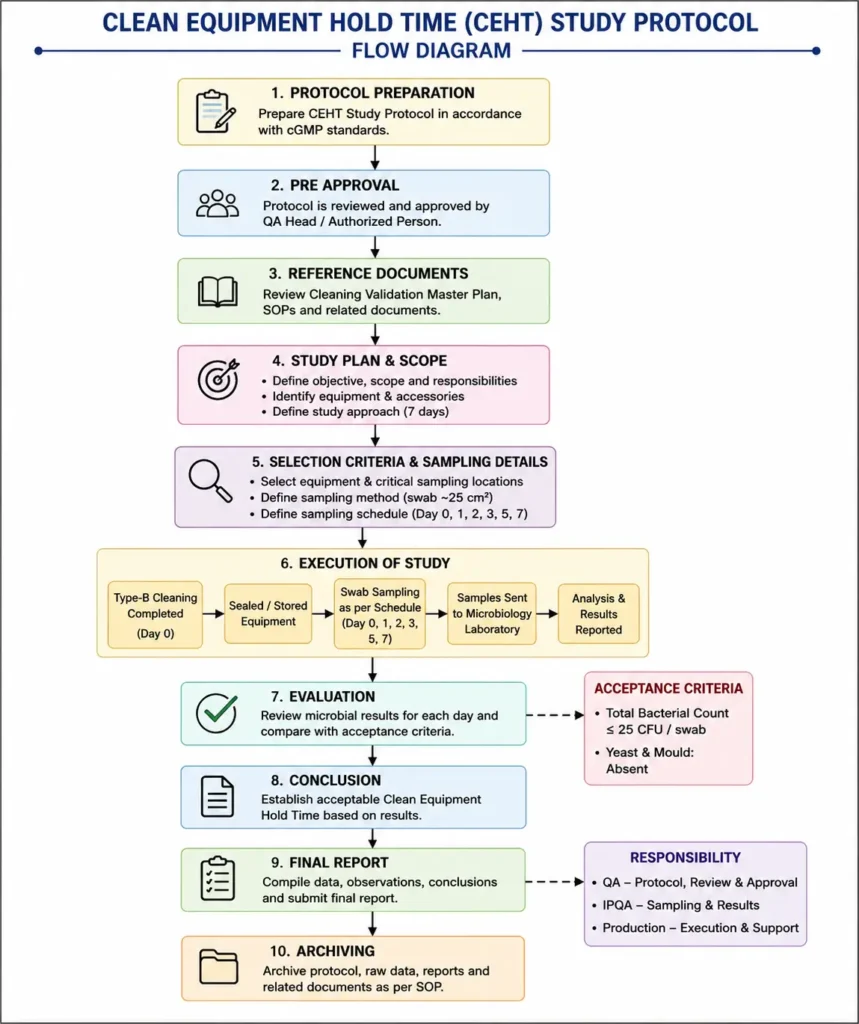
After Type-B cleaning, the cleaned equipment is stored under defined conditions. Microbiological swab samples are collected from selected locations on Day-0, Day-1, Day-2, Day-3, Day-5, and Day-7. The samples are analyzed and the results are compared with the acceptance criteria of not more than 25 CFU/swab for total bacterial count, while yeast and mould must be absent. Based on the results, the acceptable clean equipment hold time is established. Finally, observations, deviations, conclusions, and recommendations are compiled into the CEHT study report.
3. Critical Process Parameters (CPP) & Critical Quality Attributes (CQA):
The protocol does not formally label parameters as “CPP” or “CQA.” However, based on the defined CEHT study controls and acceptance requirements, the following classification can be made from the document.
| Critical Process Parameters (CPP) | Requirement / Control |
|---|---|
| Type-B Cleaning Completion | Equipment must be satisfactorily cleaned before starting the hold-time study. |
| Clean Equipment Storage Period | Study is conducted for a maximum period of 7 days. |
| Sampling Frequency | Sampling on Day-0, 1, 2, 3, 5 and 7. |
| Sampling Method | Microbiological swab sampling is used. |
| Sampling Area | Approximately 25 cm² for microbial analysis. |
| Sampling Locations | Difficult-to-clean and critical equipment locations are selected considering shape, accessibility and cleaning procedure. |
| Swab Handling / Extraction | Swab is processed using 0.9% NaCl or buffered sodium chloride peptone solution. |
| Microbial Incubation Conditions | Plates are incubated at 20–25°C for 48–72 hours, followed by 30–35°C for 24–48 hours. |
Critical Quality Attributes (CQA)
| Critical Quality Attribute | Acceptance Requirement |
|---|---|
| Total Bacterial Count | Not more than 25 CFU/swab |
| Total Fungal Count – Yeast & Mould | Must be absent |
| Microbiological Condition During Storage | Equipment must remain within microbial acceptance criteria throughout the established hold period. |
| Clean Equipment Hold Time | Acceptable hold time is established from satisfactory microbiological results. |
| Visual Cleanliness | Equipment should be satisfactorily clean before microbiological sampling. |
The key quality requirement is that microbial contamination remains controlled during the entire storage period. The protocol specifies ≤25 CFU/swab for bacterial count and absence of yeast and mould as the final acceptance criteria.
4. Impact Assessment:
The Clean Equipment Hold Time (CEHT) Study has a direct impact on product quality, equipment cleanliness, microbial control, and GMP compliance. The purpose of the study is to confirm how long cleaned equipment can remain stored after Type-B cleaning without unacceptable microbial growth. The protocol evaluates equipment over a seven-day storage period using microbiological swab sampling.
If the established hold time is not followed, microbial contamination may increase on equipment surfaces and may create a risk of contaminating the next product manufactured or packed. Sampling on Day-0, 1, 2, 3, 5, and 7 helps identify any increase in bioburden during storage. The study requires the total bacterial count to remain not more than 25 CFU/swab, while yeast and mould must be absent. Any deviation must be investigated and appropriate corrective and preventive actions taken. Changes in the cleaning procedure or equipment require revalidation of the CEHT study.
5. Questions & Answers:
1. What is the purpose of the CEHT study?
The purpose is to establish how long cleaned equipment and accessories can remain in storage without unacceptable microbial growth.
2. What does CEHT stand for?
CEHT means Clean Equipment Hold Time.
3. How long is the CEHT study conducted?
The study is conducted for a storage period of 7 days.
4. After which cleaning is the CEHT study performed?
The study is performed after Type-B cleaning of the equipment.
5. What is the main parameter checked during the CEHT study?
The main parameter is bioburden, including total bacterial count and total fungal count.
6. Which sampling method is used?
Swab sampling is used for the CEHT study.
7. What sampling area is used for microbial analysis?
Approximately 25 cm² area is swabbed for microbial analysis.
8. How are sampling locations selected?
Difficult-to-clean locations are selected based on equipment shape, cleaning procedure, accessibility, and feasibility of visual inspection.
9. On which days are samples collected?
Samples are collected on Day-0, Day-1, Day-2, Day-3, Day-5, and Day-7.
10. What is the significance of Day-0 sampling?
Day-0 sampling is performed after Type-B cleaning and provides the baseline microbiological result for the study.
11. What is the bacterial acceptance limit?
The total bacterial count must be not more than 25 CFU/swab.
12. What is the acceptance limit for yeast and mould?
Yeast and mould must be absent.
13. What should be done if a deviation occurs during the study?
The deviation must be recorded, reviewed, and handled with appropriate corrective and preventive actions.
14. When is revalidation of the CEHT study required?
Revalidation is required when there is a change in the cleaning procedure or equipment.
15. What is the final outcome of the CEHT study?
A final report is prepared summarizing the results, deviations, conclusions, and recommendations, and the acceptable clean equipment hold time is established.