






1. Brief Description:
The Dirty Equipment Hold Time (DEHT) Study Protocol is designed to establish how long equipment can remain in a dirty or partially cleaned condition before final cleaning without creating unacceptable microbial or chemical contamination risks. The study starts after completion of a defined product batch or campaign and evaluates equipment over a 7-day holding period. After Type ‘A’ cleaning, microbial swab samples are collected on Day-0, Day-1, Day-2, Day-3, Day-5 and Day-7. After Day-7 sampling, Type ‘B’ cleaning is performed, followed by microbial and chemical residue testing. Difficult-to-clean and product-contact areas are selected for swab sampling. The protocol defines responsibilities, sampling methods, acceptance criteria, deviation handling, CAPA and reporting requirements. Microbial counts must remain within specified limits, while chemical residue after Type ‘B’ cleaning should meet the predefined limit, generally NMT 10 ppm or the calculated MACO limit.
Skip to PDF content2. Flow Diagram:
The flow diagram explains the complete sequence for conducting a Dirty Equipment Hold Time (DEHT) Study. The process starts with selection of the product batch or campaign and preparation and approval of the DEHT protocol. After completion of packaging, Type ‘A’ cleaning is performed and Day-0 microbial swab sampling is taken as the baseline. The equipment is then stored under defined conditions and microbial sampling is carried out on Day-1, Day-2, Day-3, Day-5 and Day-7.
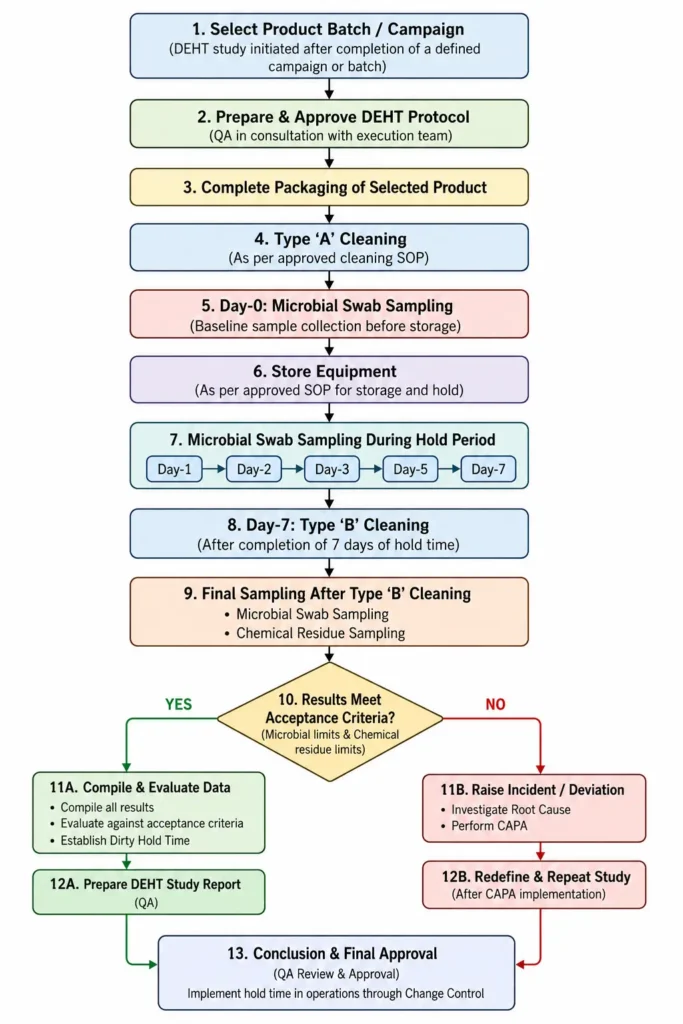
After Day-7, Type ‘B’ cleaning is performed, followed by microbial and chemical residue sampling. The results are checked against predefined acceptance criteria. If results comply, data is evaluated, the dirty hold time is established, and the DEHT report is prepared. If results fail, deviation investigation and CAPA are performed before redefining or repeating the study.
3. Critical Process Parameters & Critical Quality Attributes:
The DEHT protocol does not explicitly label items as CPPs or CQAs. However, based on the study controls, sampling requirements, analytical conditions, and acceptance criteria defined in the protocol, the following can be considered the key parameters and attributes.
| Critical Process Parameters (CPPs) | Requirement / Control |
|---|---|
| Equipment cleaning stage | Type ‘A’ cleaning before hold-time study; Type ‘B’ cleaning after Day-7 |
| Dirty equipment hold time | 7 days |
| Microbial sampling schedule | Day-0, Day-1, Day-2, Day-3, Day-5 and Day-7 |
| Sampling location | Difficult-to-clean/product-contact areas as per approved swab location sheet |
| Microbial swab area | 25 cm² (5 × 5 cm) |
| Chemical swab area | Approximately 100 cm² (10 × 10 cm) |
| Storage condition | Equipment stored as per approved storage and usage SOP |
| Microbial incubation | 20–25°C for 72 hours, followed by 30–35°C for 48 hours |
| Sampling method | Swab sampling using specified swab devices |
These controls are defined in the protocol’s sampling and execution sections.
Critical Quality Attributes (CQAs)
| Critical Quality Attribute | Acceptance Criteria |
|---|---|
| Total bacterial count, Day-0 to Day-7 | NMT 100 CFU/swab |
| Total fungal count, Day-0 to Day-7 | Absent |
| Total bacterial count after Type ‘B’ cleaning | NMT 25 CFU/swab |
| Total fungal count after Type ‘B’ cleaning | Absent |
| Chemical residue after Type ‘B’ cleaning | NMT 10 ppm or calculated MACO limit |
| Equipment cleanliness | Must meet defined microbial and chemical residue limits |
These attributes determine whether the established dirty equipment hold time is acceptable.
4. Impact Assessment:
The Dirty Equipment Hold Time (DEHT) Study is important because it confirms how long equipment can remain in a dirty condition before final cleaning without creating unacceptable microbial or chemical contamination risks. The protocol evaluates equipment for a 7-day hold period using scheduled microbial swab sampling and final chemical residue testing after Type ‘B’ cleaning. If the established hold time is followed, it helps maintain equipment cleanliness, supports effective cleaning practices, and reduces the possibility of microbial growth, product residue carryover, and cross-contamination. The study also provides documented evidence for routine manufacturing and cleaning operations. Results are compared against defined limits for bacterial count, fungal contamination, and chemical residue. If any result is outside the acceptance criteria, the deviation must be investigated and appropriate CAPA taken before the study is concluded. Overall, successful DEHT validation supports product quality, patient safety, GMP compliance, and controlled equipment storage practices.
5. Questions & Answers:
1. What is Dirty Equipment Hold Time (DEHT)?
DEHT is the maximum period for which equipment can remain in a dirty condition before final cleaning while still meeting defined microbial and chemical residue requirements.
2. What is the objective of the DEHT study?
The objective is to evaluate microbial load during the dirty equipment holding period and chemical residue after Type ‘B’ cleaning.
3. What is the duration of the DEHT study?
The study is performed for a 7-day storage period.
4. When is the DEHT study initiated?
It is initiated after completion of a defined campaign or batch of the selected product.
5. Which cleaning is performed before starting the hold-time study?
Type ‘A’ cleaning is performed as per the equipment-specific cleaning SOP.
6. Why is Day-0 sampling performed?
Day-0 microbial sampling provides the baseline result before the equipment is stored.
7. On which days is microbial sampling performed?
Sampling is performed on Day-0, Day-1, Day-2, Day-3, Day-5 and Day-7 during the study.
8. What happens after Day-7 sampling?
After Day-7 sampling, Type ‘B’ cleaning is performed, followed by microbial and chemical residue sampling.
9. Which sampling method is used for DEHT?
The protocol specifies swab sampling.
10. Which locations are selected for sampling?
Difficult-to-clean locations and approved product-contact sampling locations are selected as per the current swab location sheet.
11. What is the microbial swab sampling area?
The microbial sampling area is 25 cm² (5 cm × 5 cm).
12. What is the chemical residue swab area?
The chemical residue sampling area is approximately 100 cm² (10 cm × 10 cm).
13. What is the bacterial acceptance limit from Day-0 to Day-7?
Total bacterial count should be Not More Than 100 CFU/swab.
14. What is the fungal acceptance limit during the study?
Total fungal count, including yeast and moulds, should be absent.
15. What is the bacterial limit after Type ‘B’ cleaning?
Total bacterial count should be Not More Than 25 CFU/swab.
16. What is the chemical residue acceptance criterion?
The predefined limit is NMT 10 ppm, or a residue limit calculated through the MACO formula where applicable.
17. What should be done if results are outside the acceptance criteria?
The deviation should be documented, investigated, and appropriate Corrective and Preventive Action (CAPA) should be taken.
18. Who coordinates the DEHT study?
Quality Assurance coordinates the study, compiles data, prepares the report, ensures compliance, and reviews execution data.
19. What is the final outcome of the DEHT study?
The study establishes the acceptable dirty equipment hold time based on validation results, deviations, conclusions, and recommendations.
20. When is revalidation required?
The protocol specifies revalidation when there is a change in the acceptance criteria for microbial analysis.