






Brief Description
This SOP describes the standardized procedure for cleaning laboratory glassware used for chemical analysis in the Quality Control laboratory. Its objective is to ensure that glassware is cleaned properly before reuse, thereby reducing the risk of contamination and analytical errors. The procedure requires used glassware to be placed in the washing area, emptied, and rinsed two to three times with running tap water. Routine cleaning is performed using 1.0% Laboline solution with proper brushing, while chromic acid is specified for oily glassware. After cleaning, the glassware is thoroughly rinsed with tap water followed by purified water, then dried in an oven at 55 ± 5°C and transferred to the designated dry-glassware area.The SOP also specifies safety precautions such as wearing gloves, mask, safety goggles, and lab coat while handling acids and avoiding damaged glassware. Training is assigned to Quality Control personnel, and Annexure-I provides a record for preparation and destruction of the 1.0% v/v Loboline cleaning solution.
Skip to PDF content1. Flow Diagram:
The flow diagram presents the step-by-step cleaning process for laboratory glassware used in chemical analysis. It begins with placing used glassware in the designated washing area, discarding any remaining solution, and rinsing the glassware two or three times with running tap water. Routine cleaning is performed using 1.0% v/v Laboline solution with proper brushing, while chromic acid is used for oily glassware. After cleaning, the glassware is rinsed with purified water, dried in an oven at 55°C ± 5°C, and transferred to the designated dry-glassware area.
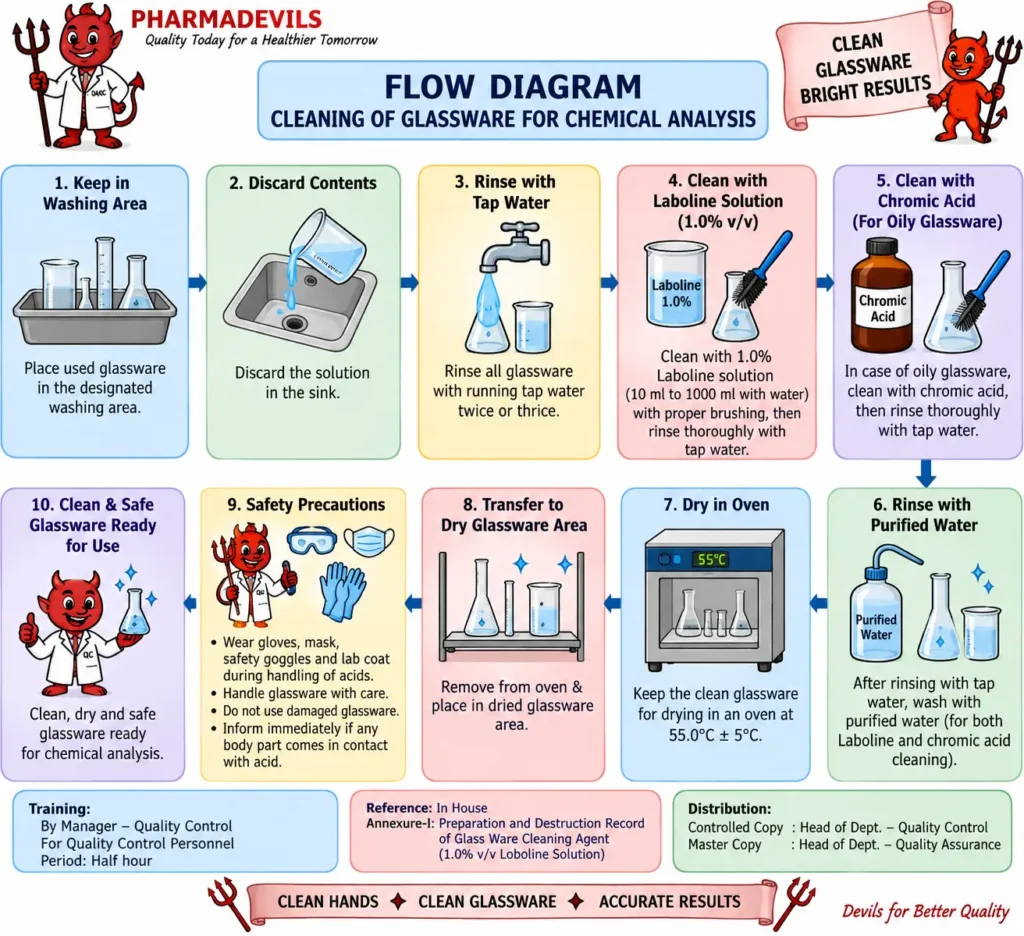
The diagram also highlights important safety precautions, including wearing gloves, mask, safety goggles, and lab coat while handling acids, careful handling of glassware, and avoiding damaged glassware.The Devils-themed visual makes the SOP easier to understand and remember during Quality Control personnel training.
2. Brainstorming for SOP Failure:
The brainstorming diagram identifies possible causes for failure of the SOP for Cleaning of Glassware for Chemical Analysis. The sticky-note format highlights issues related to people, procedure, materials, equipment, safety, documentation, and workload.
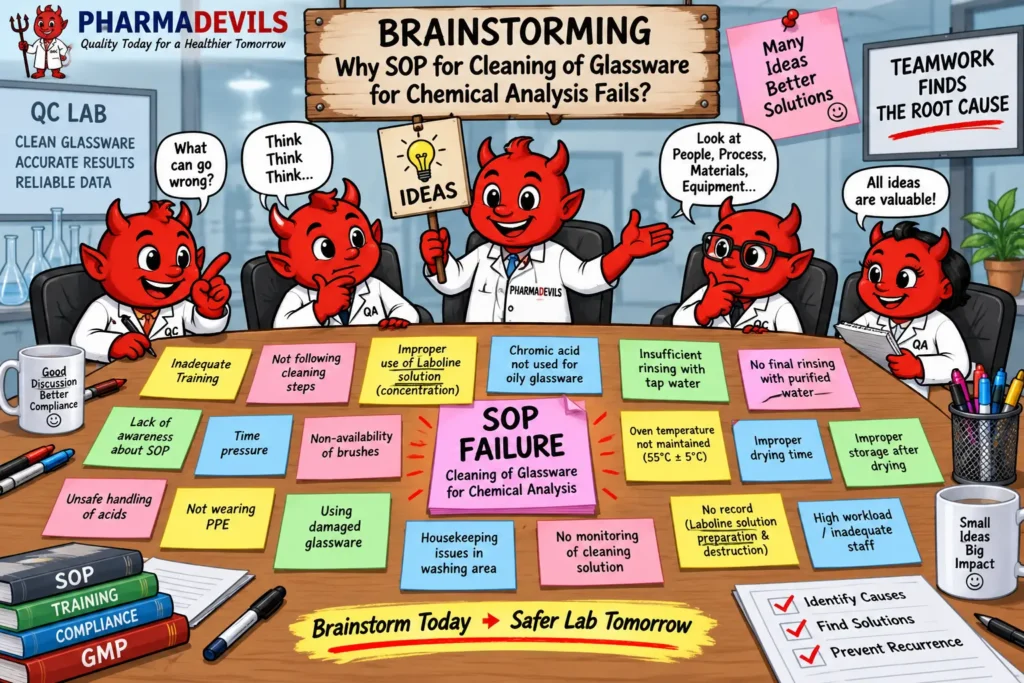
Key potential causes include inadequate training, lack of SOP awareness, failure to follow cleaning steps, incorrect preparation or use of 1.0% Laboline solution, inadequate rinsing with tap or purified water, failure to use chromic acid for oily glassware, improper oven temperature or drying time, and incorrect storage after drying. The diagram also considers unsafe acid handling, failure to wear PPE, use of damaged glassware, poor housekeeping, inadequate brushes, high workload, and missing cleaning-agent preparation/destruction records.These brainstorming points are consistent with the SOP requirements for cleaning, rinsing, drying, safety precautions, training, and documentation.The visual is useful for root-cause discussions, deviation investigations, CAPA planning, and SOP training.
3. 5-Why Analysis for SOP Failure:
The 5-Why diagram analyzes the failure of the SOP for Cleaning of Glassware for Chemical Analysis by progressively asking why the required cleaning procedure was not followed. It begins with glassware not being cleaned according to the specified procedure and traces the issue through skipped cleaning steps, inadequate awareness of SOP requirements, insufficient training, and lack of effective follow-up or monitoring.
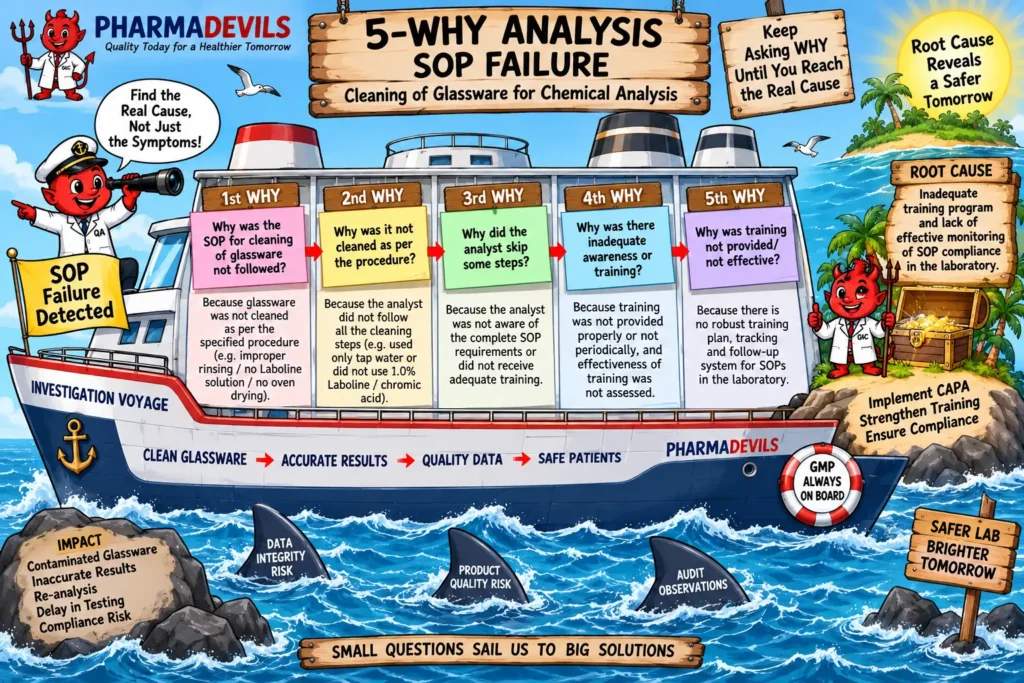
The SOP itself requires defined cleaning steps such as rinsing with tap water, cleaning with 1.0% Laboline solution, using chromic acid for oily glassware, final rinsing with purified water, and drying at 55°C ± 5°C. It also specifies training of Quality Control personnel.The diagram identifies the likely root cause as an inadequate training and SOP-compliance monitoring system. Corrective actions should therefore focus on strengthening training, verifying operator understanding, supervising compliance, and routinely checking adherence to the approved cleaning procedure.
4. Fishbone Analysis for SOP Failure:
The Fishbone Analysis diagram presents the possible causes of SOP failure during cleaning of glassware for chemical analysis using six major categories: Man, Method, Material, Machine, Measurement, and Environment.
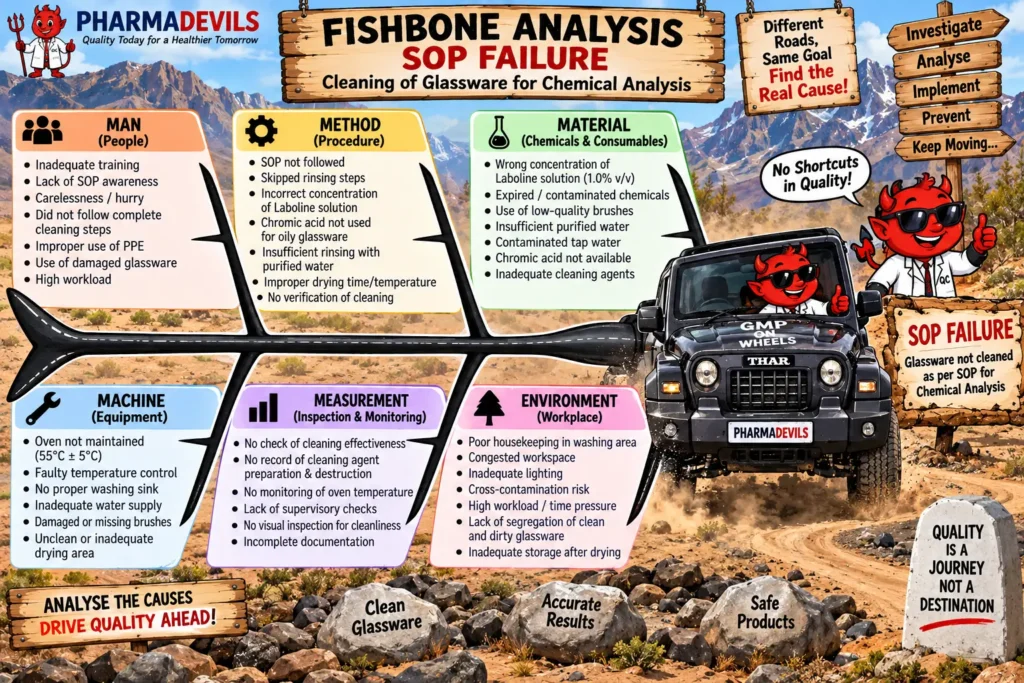
Potential causes include inadequate training, lack of SOP awareness, skipped cleaning steps, incorrect preparation or use of 1.0% Laboline solution, failure to use chromic acid for oily glassware, insufficient rinsing with purified water, improper oven drying conditions, damaged brushes, poor housekeeping, and incomplete monitoring or documentation. These causes are aligned with the SOP requirements for washing, rinsing, chemical cleaning, drying at 55°C ± 5°C, safe handling, and training of QC personnel.The Thar-themed diagram makes the investigation visually engaging while emphasizing that identifying causes systematically helps determine the root cause, implement CAPA, strengthen SOP compliance, and prevent recurrence.
5. Fault Tree Analysis for SOP Failure:
The Fault Tree Analysis diagram identifies the possible causes leading to failure of the SOP for Cleaning of Glassware for Chemical Analysis. The top event is defined as glassware not being cleaned according to the approved procedure.
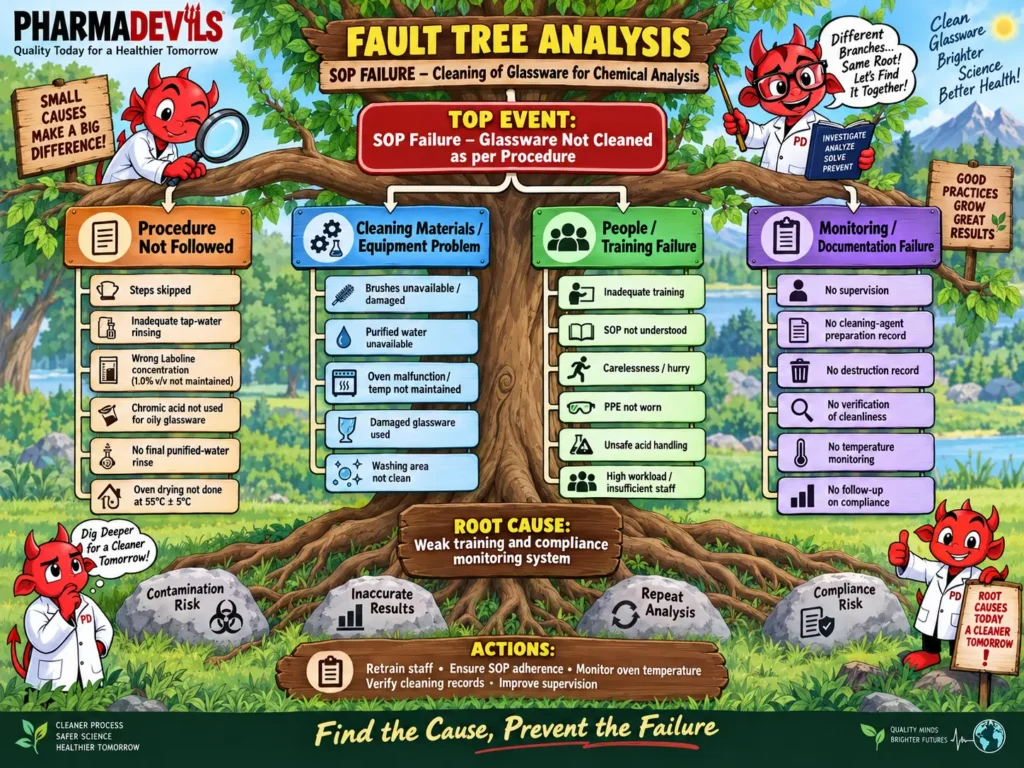
The major branches include procedure failure, cleaning material/equipment problems, people/training failure, and monitoring/documentation failure. Possible contributing causes include skipped cleaning steps, inadequate rinsing, incorrect 1.0% Laboline concentration, failure to use chromic acid for oily glassware, absence of final purified-water rinsing, improper oven drying, damaged brushes, inadequate training, poor PPE compliance, unsafe acid handling, and weak supervision or recordkeeping. These causes relate directly to the SOP requirements for cleaning, rinsing, drying, precautions, training, and documentation.The diagram highlights weak training and compliance monitoring as a likely root cause and supports CAPA actions such as retraining personnel, improving supervision, monitoring oven temperature, and verifying cleaning records.
Questions & Answers
- What is the objective of this SOP?
The objective is to lay down a procedure for cleaning glassware used for chemical analysis. - Where is this SOP applicable?
It is applicable to glassware cleaning for chemical analysis in the Quality Control laboratory. - Who is responsible for execution of the SOP?
The Lab QA Manager is responsible for execution of the SOP. - Where should used glassware be kept before washing?
It should be kept in the designated washing area. - How many times should glassware be rinsed with running tap water?
It should be rinsed twice or thrice with running tap water. - Which cleaning solution is used for routine glassware cleaning?
1.0% Laboline solution is used with proper brushing. The SOP specifies 10 mL in 1000 mL with water. - Which cleaning agent is specified for oily glassware?
Chromic acid is specified for oily glassware, followed by thorough rinsing with running tap water. - What should be done after rinsing with tap water?
The glassware should be washed with purified water after cleaning with either Laboline or chromic acid. - At what temperature is cleaned glassware dried?
Clean glassware is dried in an oven at 55°C ± 5°C. - Where is the glassware kept after drying?
It is removed from the oven and placed in the dried glassware area. - What PPE is required while handling acids?
Gloves, mask, safety goggles, and lab coat are required. - Can damaged glassware be used?
No. The SOP specifically states that damaged glassware should not be used. - What should be done if acid comes into contact with a body part?
The person should immediately inform the present chemist. - Who provides training for this SOP?
The Manager – Quality Control is the trainer, and the trainees are Quality Control personnel. - What is the training period?
The training period is half an hour. - What record is provided in Annexure-I?
Annexure-I contains the Preparation and Destruction Record of Glass Ware Cleaning Agent (1.0% v/v Loboline Solution). - What does QC stand for?
QC stands for Quality Control. - What does C.C. No. mean?
C.C. No. means Certified Copy Number.
Reference Guidelines:
The uploaded SOP itself lists its reference as “In House” rather than citing an external regulatory guideline. For strengthening the SOP, these external references are relevant:
- WHO TRS 1052, Annex 4 – Good Practices for Pharmaceutical Quality Control Laboratories (2024)
Provides current WHO expectations for pharmaceutical QC laboratories, including laboratory organization, equipment, reagents, working procedures, safety, documentation, and quality systems. (World Health Organization)
WHO TRS 1052 – Annex 4 - Revised Schedule M – Drugs Rules, 1945, G.S.R. 922(E), India
Applicable GMP framework for pharmaceutical manufacturing and Quality Control operations in India. CDSCO officially lists the revised Schedule M notification dated 28 December 2023. (CDSCO)
CDSCO Revised Schedule M Notifications - EU GMP – EudraLex Volume 4, Chapter 6: Quality Control
Covers requirements for QC laboratories, approved procedures, laboratory documentation, testing activities, reagents, equipment, and good laboratory practices within pharmaceutical GMP. (Public Health)
EU GMP EudraLex Volume 4 - 21 CFR Part 211 – Laboratory Controls, §211.160
Requires scientifically sound laboratory procedures and controls to be established, approved, followed, and documented during performance. (eCFR.io)
21 CFR 211.160 – Laboratory Controls - 21 CFR 211.67 – Equipment Cleaning and Maintenance
Requires written cleaning procedures, defined responsibilities, cleaning methods, protection of cleaned equipment, cleanliness inspection, and maintenance of records. It is useful as a general GMP reference for controlled cleaning procedures. (Legal Information Institute)
21 CFR 211.67 – Equipment Cleaning and Maintenance
Important note for this SOP: the document specifies chromic acid for oily glassware. Chromic acid involves hexavalent chromium hazards; OSHA identifies Cr(VI) compounds as carcinogenic and potentially harmful to the respiratory system, skin, and eyes. (OSHA) Therefore, its continued use should be subject to your site’s EHS risk assessment, chemical-handling controls, and approved laboratory procedure.