





1. Introduction:
The SOP for Chemical Analysis of Nitrogen describes the standardized procedure for evaluating the quality and purity of nitrogen gas used in pharmaceutical operations. Nitrogen purity is tested using gas chromatography, while carbon monoxide is measured with a specific Gastec detector tube. Oxygen content is determined using a calibrated oxygen meter. The procedure includes requirements for sample collection, chromatographic conditions, system suitability, instrument calibration, documentation, and reporting. Nitrogen must contain not less than 99.0% purity, carbon monoxide must not exceed 10 ppm, and oxygen content must not exceed 1.0%. Proper testing ensures that nitrogen gas meets established quality requirements and is suitable for its intended pharmaceutical use.
Skip to PDF content2. Flow Diagram – SOP for Chemical Analysis of Nitrogen:
The flow diagram shows the complete sequence for testing the quality and purity of nitrogen gas used in pharmaceutical operations. The procedure starts with reviewing the approved SOP and checking that all required instruments are properly calibrated. A representative nitrogen gas sample is then collected according to the defined sampling procedure. Nitrogen purity is tested using Gas Chromatography after setting the required chromatographic conditions and confirming system suitability. The purity result is recorded and must meet the acceptance criterion of not less than 99.0%. Carbon monoxide is then checked using a suitable Gastec detector tube and should not exceed 10 ppm. Oxygen content is measured using a calibrated oxygen meter and must not exceed 1.0%.
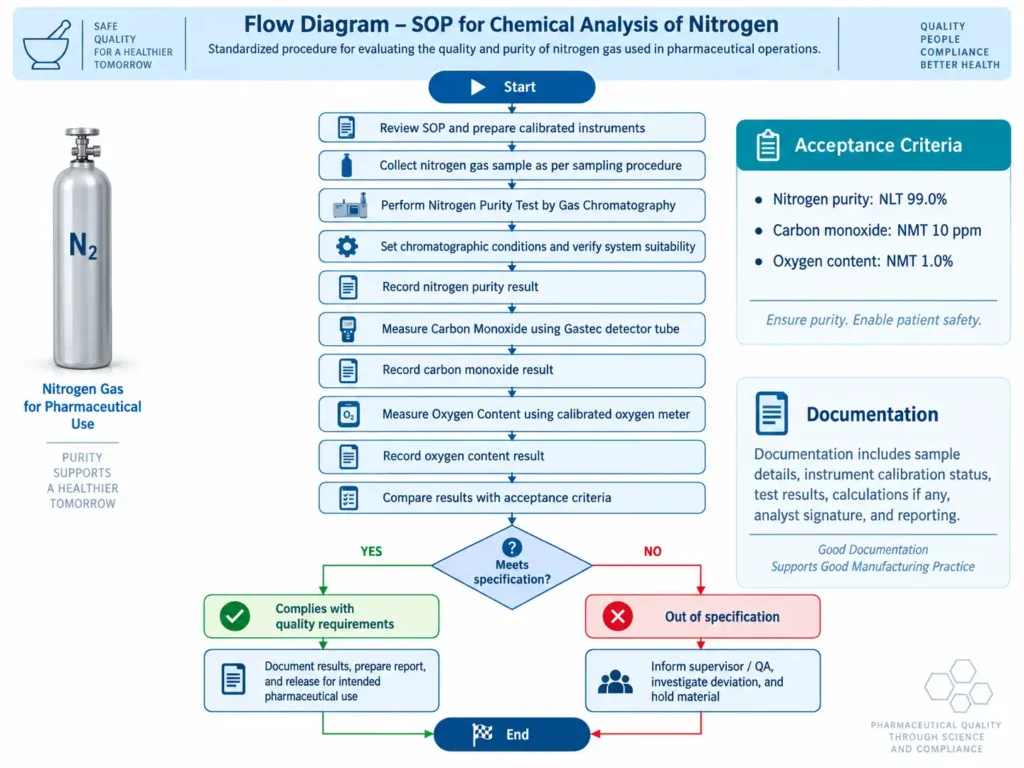
All test results are compared with the specified limits. If the nitrogen sample meets all requirements, the results are documented and reported for release. If any result is out of specification, QA or the concerned supervisor is informed and an investigation is initiated.
3. Brainstorming – SOP for Chemical Analysis of Nitrogen Not Available:
The brainstorming diagram identifies possible reasons and risks associated with the non-availability of an SOP for Chemical Analysis of Nitrogen. The main concern is that, without an approved procedure, analysts may follow different testing practices, leading to inconsistent or unreliable results. Possible causes include absence of a documented procedure, unclear nitrogen sampling steps, undefined gas chromatography conditions, unclear carbon monoxide and oxygen testing methods, insufficient analyst training, calibration-related confusion, and missing acceptance limits or reporting formats. These gaps may increase the risk of incorrect test results, delayed QA review, documentation errors, regulatory non-compliance, and impact on product release.
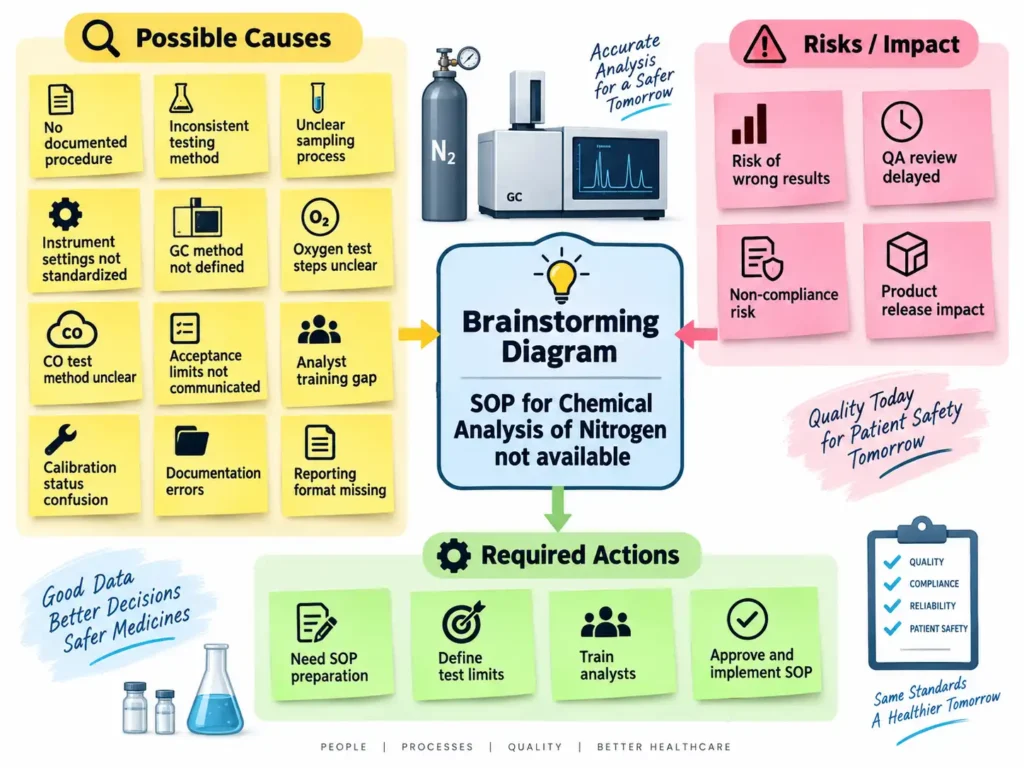
The brainstorming also highlights the required actions. These include preparing and approving the SOP, clearly defining test methods and acceptance criteria, ensuring instruments are calibrated, training analysts, and implementing proper documentation and reporting practices. These measures help establish a consistent, controlled, and compliant nitrogen testing process.
4. 5 Why Analysis – SOP for Chemical Analysis of Nitrogen Not Available:
The 5 Why analysis explains the possible root causes behind the non-availability of the SOP for Chemical Analysis of Nitrogen. The investigation starts with the basic question of why the SOP was not available. The first finding is that the SOP had not been prepared and approved. Further questioning shows that the requirement for the SOP was not identified during documentation planning. The analysis then goes deeper and identifies that nitrogen testing activities were being performed without a formal documented system. This happened because departmental responsibility and document ownership were not clearly defined. The final root cause indicates inadequate QA oversight for identifying, preparing, reviewing, approving, and controlling the required SOP.
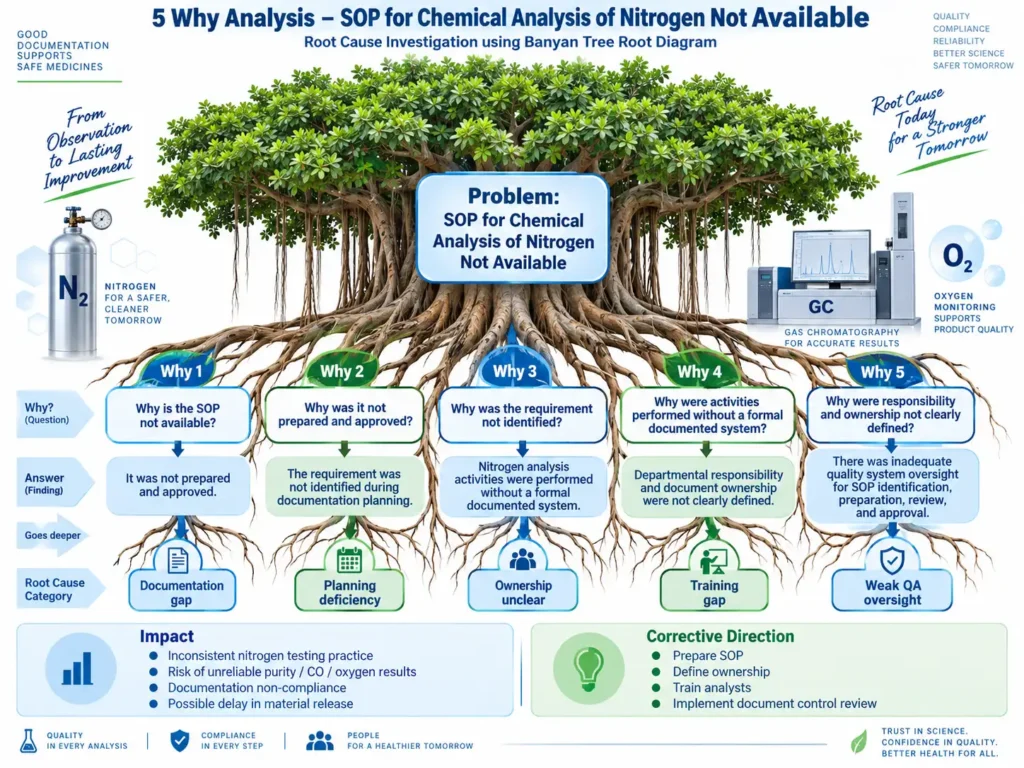
The analysis highlights key gaps such as documentation deficiency, poor planning, unclear ownership, training gaps, and weak quality-system oversight. Corrective actions should include preparing and approving the SOP, assigning clear responsibility, training analysts, and strengthening document-control and QA review processes.
5. Heat Map – SOP for Chemical Analysis of Nitrogen Not Available:
The heat map diagram shows the level of risk associated with the non-availability of an SOP for Chemical Analysis of Nitrogen. Risks are evaluated based on two factors: severity and likelihood. The color scale ranges from green for low risk, yellow for medium risk, orange for significant risk, and red for high or critical risk. Major concerns include inconsistent nitrogen purity testing, incorrect gas chromatography conditions, non-standardized carbon monoxide testing, oxygen testing errors, calibration confusion, documentation gaps, delayed QA review, and possible incorrect material release decisions. Regulatory non-compliance and wrong reporting are placed in the higher-risk zones because they can directly affect product quality and compliance.
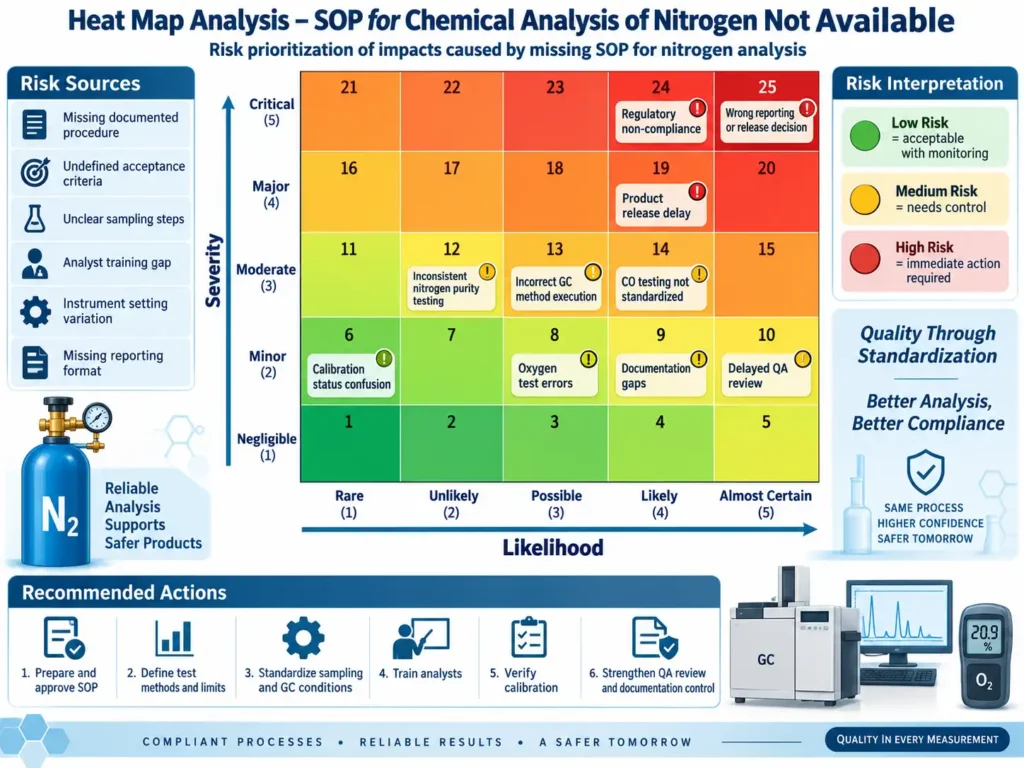
The heat map helps prioritize corrective actions. Key measures include preparing and approving the SOP, defining test methods and acceptance limits, standardizing sampling and instrument conditions, training analysts, verifying calibration status, and strengthening QA review and documentation control.
6. Fault Tree Analysis – SOP for Chemical Analysis of Nitrogen Not Available:
The Fault Tree Analysis diagram identifies the possible causes leading to the non-availability of the SOP for Chemical Analysis of Nitrogen. The top event is the missing SOP, which may occur because the SOP was not prepared, was prepared but not approved, or was approved but not properly available to users. Possible causes include failure to identify the SOP requirement during planning, lack of technical input, limited resources, pending QA review, insufficient supporting data, competing priorities, poor document control, restricted access, and inadequate communication or training.
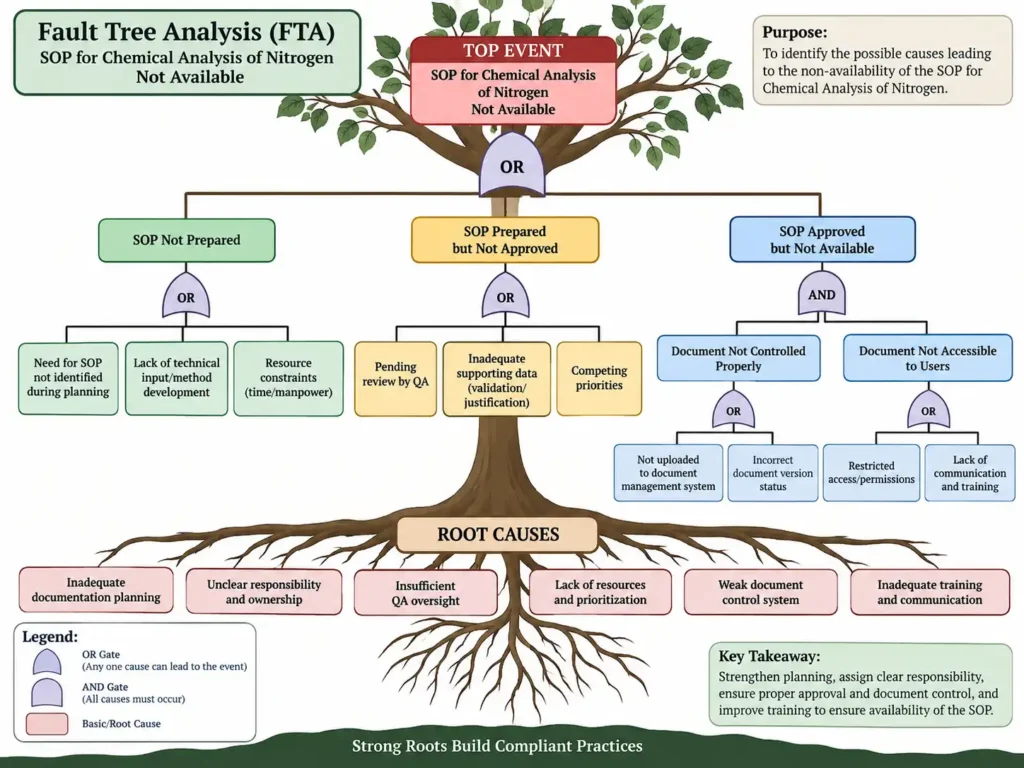
The analysis further highlights important root causes such as weak documentation planning, unclear responsibility and ownership, insufficient QA oversight, lack of resources, ineffective document control, and inadequate training. Fault Tree Analysis helps the organization understand how different failures can combine to create the main problem. It supports focused corrective actions such as defining ownership, improving QA review, strengthening document control, providing training, and ensuring timely SOP preparation and approval.
7. Pareto Chart – SOP for Chemical Analysis of Nitrogen Not Available:
The Pareto chart identifies and prioritizes the major causes responsible for the non-availability of the SOP for Chemical Analysis of Nitrogen. The causes are arranged from the highest to the lowest contribution so that the most important problems can be addressed first. The analysis indicates that documentation planning gaps, unclear ownership and responsibility, weak QA follow-up, and competing priorities are the major contributors. Together, these factors account for approximately 80% of the overall problem. Other contributing causes include inadequate analyst training, poor document control or accessibility, and insufficient technical input.
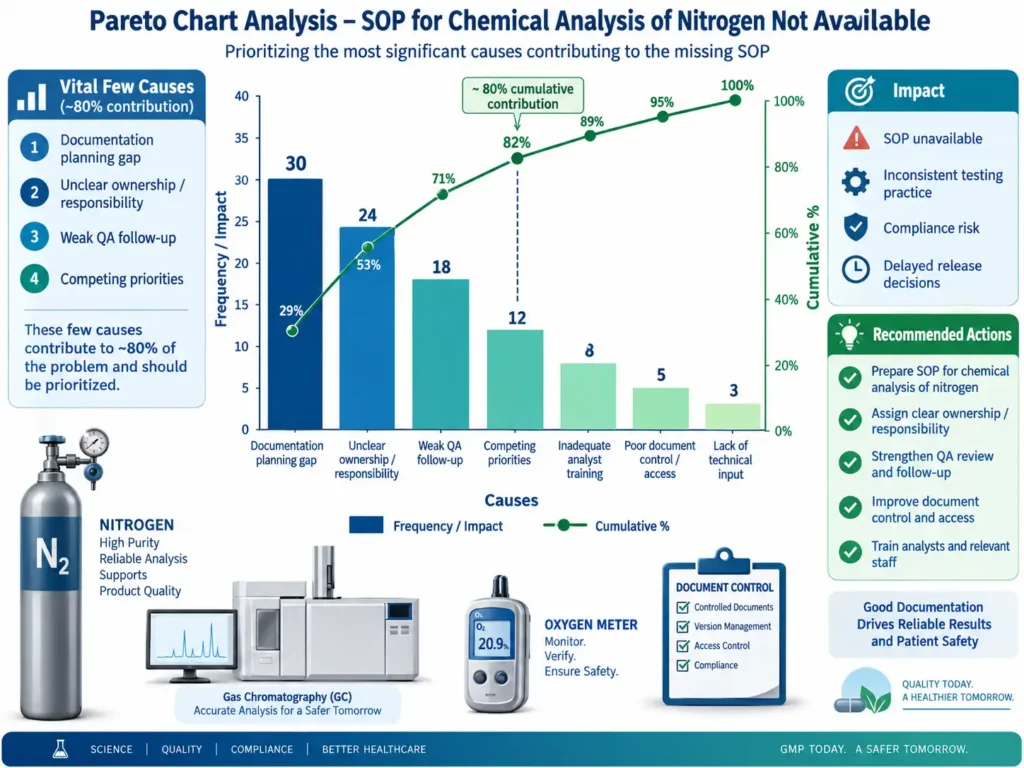
The Pareto analysis helps management focus resources on the “vital few” causes rather than trying to address every issue at the same time. Priority actions should include preparing and approving the SOP, assigning clear ownership, strengthening QA review, improving document control, providing appropriate analyst training, and ensuring that technical requirements for nitrogen testing are properly defined and documented.
8. Corrective Action and Preventive Action – SOP for Chemical Analysis of Nitrogen Not Available
Corrective Actions
| S. No. | Corrective Action | Responsibility | Target |
|---|---|---|---|
| 1 | Initiate a deviation or quality event for non-availability of the SOP. | QC / QA | Immediate |
| 2 | Prepare the SOP for Chemical Analysis of Nitrogen covering sampling, nitrogen purity, carbon monoxide, oxygen testing, calculations, documentation, and reporting. | QC | Immediate |
| 3 | Define approved acceptance criteria for nitrogen purity, carbon monoxide, and oxygen content as per applicable specification. | QC / QA | Before approval |
| 4 | Review and approve the SOP through the established document-control system. | QC / QA | Before implementation |
| 5 | Verify calibration and qualification status of Gas Chromatograph, oxygen meter, and other required testing devices. | QC / Engineering | Before testing |
| 6 | Review previously generated nitrogen test results performed without an approved SOP and assess their impact on material/product quality. | QC / QA | During investigation |
| 7 | Train all concerned QC analysts and relevant personnel on the approved SOP. | QC / QA / Training | Before implementation |
| 8 | Make the current approved SOP readily available at the point of use. | QA / Document Control | After approval |
| 9 | Document completion of all corrective actions in the deviation/CAPA record. | QA | On completion |
Preventive Actions
| S. No. | Preventive Action | Responsibility |
|---|---|---|
| 1 | Establish a master list of all required QC analytical SOPs and periodically verify their availability. | QA / QC |
| 2 | Introduce periodic SOP gap assessment to identify missing, obsolete, or incomplete procedures. | QA |
| 3 | Assign clear ownership for preparation, review, approval, revision, and periodic review of analytical SOPs. | QA / QC |
| 4 | Include new analytical methods and utility testing requirements in the document-planning process before routine testing starts. | QC / QA |
| 5 | Implement an electronic or controlled document-tracking system for SOP status and review dates. | QA |
| 6 | Conduct periodic training and effectiveness checks for analysts involved in nitrogen testing. | QC / Training |
| 7 | Perform routine internal audits to confirm that testing is performed only against approved and current procedures. | QA |
| 8 | Establish escalation timelines for overdue SOP preparation, review, or approval. | QA Management |
| 9 | Periodically verify availability of calibrated instruments, approved methods, specifications, and reporting formats. | QC |
| 10 | Review CAPA effectiveness after implementation to ensure recurrence has been prevented. | QA |
CAPA Effectiveness Check
Effectiveness may be verified after an appropriate monitoring period by confirming that the approved SOP is available, trained analysts are following it, instruments are calibrated, test records are complete, results meet established specifications, and no recurrence of missing or uncontrolled nitrogen-testing procedures is observed.
9. Questions & Answers – SOP for Chemical Analysis of Nitrogen:
Q1. What is the purpose of the SOP for Chemical Analysis of Nitrogen?
Answer: The purpose is to provide a standardized procedure for testing the quality and purity of nitrogen gas used in pharmaceutical operations.
Q2. Why is nitrogen gas tested before pharmaceutical use?
Answer: Nitrogen is tested to confirm that it meets approved quality specifications and does not contain unacceptable levels of impurities.
Q3. How is nitrogen purity tested?
Answer: Nitrogen purity is tested using a validated or approved Gas Chromatography method.
Q4. What is the acceptance criterion for nitrogen purity in this SOP?
Answer: Nitrogen purity should be not less than 99.0%, as defined in the applicable specification.
Q5. How is carbon monoxide tested in nitrogen?
Answer: Carbon monoxide is measured using a suitable and specified Gastec detector tube or another approved method.
Q6. What is the carbon monoxide limit?
Answer: Carbon monoxide should be not more than 10 ppm, as per the applicable specification.
Q7. How is oxygen content determined?
Answer: Oxygen content is determined using a properly calibrated oxygen meter or an approved analytical method.
Q8. What is the oxygen acceptance limit?
Answer: Oxygen content should be not more than 1.0%, according to the defined specification.
Q9. Why is system suitability important in Gas Chromatography?
Answer: System suitability confirms that the chromatographic system is performing properly before sample results are accepted.
Q10. Why must the GC and oxygen meter be calibrated?
Answer: Calibration helps ensure that instruments provide accurate, reliable, and traceable analytical results.
Q11. Why is a documented sampling procedure required?
Answer: Proper sampling helps obtain a representative nitrogen sample and reduces the risk of contamination or incorrect results.
Q12. What can happen if the SOP for nitrogen analysis is not available?
Answer: Testing may become inconsistent, acceptance criteria may be applied incorrectly, documentation may be incomplete, and regulatory compliance may be affected.
Q13. Can nitrogen testing be performed without an approved SOP?
Answer: Routine GMP testing should be performed using an approved and controlled procedure. Any exceptional situation should be handled through the applicable quality system.
Q14. Who is generally responsible for performing nitrogen analysis?
Answer: Trained and authorized Quality Control personnel normally perform the analysis according to the approved SOP.
Q15. What should be done if a nitrogen test result is out of specification?
Answer: The result should be documented and handled through the approved OOS or deviation procedure, with QA involvement as applicable.
Q16. What records should be maintained during nitrogen analysis?
Answer: Records should include sample details, instrument identification, calibration status, chromatographic data, test results, calculations, analyst signature, review details, and final disposition.
Q17. Why is analyst training important?
Answer: Training ensures that analysts understand sampling, instrument operation, test conditions, acceptance limits, documentation requirements, and safety precautions.
Q18. What should be done if the nitrogen analysis SOP is found missing?
Answer: A quality event should be initiated, impact should be assessed, the SOP should be prepared and approved, personnel should be trained, and previous testing should be reviewed where required.
Q19. How can recurrence of a missing SOP be prevented?
Answer: Maintain a controlled SOP master list, assign document ownership, conduct periodic document-gap reviews, track review dates, and strengthen QA oversight.
Q20. What is the overall benefit of an approved nitrogen analysis SOP?
Answer: It ensures consistent testing, reliable results, proper documentation, regulatory compliance, and confidence that nitrogen is suitable for its intended pharmaceutical use.
10. Reference Guidelines – SOP for Chemical Analysis of Nitrogen:
The following references are suitable for preparing, reviewing, and implementing the SOP for Chemical Analysis of Nitrogen:
- USP–NF – Nitrogen Monograph
The USP–NF Nitrogen monograph is a key compendial reference. The USP public monograph confirms nitrogen content of NLT 99.0% v/v. Current NF documentation also reflects oxygen, carbon monoxide, identification, and assay requirements.
USP–NF Nitrogen Monograph - Indian Pharmacopoeia (IP) 2026 – 10th Edition
For Indian pharmaceutical facilities, the current Indian Pharmacopoeia should be checked wherever the material or approved specification claims IP compliance. IPC released IP 2026 as the 10th Edition.
Indian Pharmacopoeia 2026 – IPC - Revised Schedule M – Drugs Rules, 1945, India
Revised Schedule M requires pharmaceutical manufacturers to establish documented systems and procedures under the Pharmaceutical Quality System and GMP framework. This supports the requirement for an approved SOP governing nitrogen sampling, testing, documentation, review, and control.
Revised Schedule M – CDSCO - WHO TRS 1044, Annex 5 – GMP for Medicinal Gases
WHO specifies that operations involving medicinal gases should be covered by a documented quality system, written SOPs/work instructions, defined responsibilities, controls, calibration, validation, testing, and release arrangements.
WHO GMP for Medicinal Gases – TRS 1044 Annex 5 - 21 CFR 211.160 – General Requirements for Laboratory Controls
Requires scientifically sound specifications, sampling plans and test procedures to be documented, reviewed and approved by the quality unit. It also requires suitable calibration programmes for laboratory instruments.
21 CFR 211.160 – Laboratory Controls - 21 CFR 211.194 – Laboratory Records
Requires complete records of sampling, analytical methods, raw data, calculations, results, specifications, analyst identification, independent review, method modifications, reference standards, and instrument calibration.
21 CFR 211.194 – Laboratory Records - EU GMP – Volume 4, Chapter 4: Documentation
EU GMP requires written SOPs and testing instructions, defined sampling and testing procedures, acceptance criteria, controlled documents, approval by authorized persons, contemporaneous records, and document lifecycle control.
EU GMP Volume 4
Important: The exact nitrogen specification and analytical method in your SOP should follow the current pharmacopoeial monograph/approved specification applicable to your product and market. Avoid combining acceptance limits from different pharmacopoeias unless scientifically justified and formally approved.