




1. Introduction – SOP for Cleaning & Operation of FBD:
The SOP for Cleaning & Operation of Fluid Bed Dryer (FBD) establishes a standardized procedure for the safe, effective, and consistent cleaning and operation of the Fluid Bed Dryer used in the granulation area. The SOP applies to the 120/250 kg GMP model FBD and defines responsibilities for Production personnel and QA/QC oversight. The procedure covers Type A cleaning for batch changeover of the same product or ascending strength with the same colour, and Type B cleaning for product changeover involving different actives, descending potency, maintenance of contact parts, unknown next product, or after eight consecutive Type A cleanings. The SOP also describes pre-startup verification, equipment cleanliness, filter bag installation, line clearance, operating controls, inlet temperature adjustment, drying, intermittent bag shaking, Loss on Drying testing, shutdown, and appropriate documentation. Proper implementation helps maintain equipment cleanliness, prevent cross-contamination, ensure consistent drying performance, and support GMP-compliant manufacturing operations.
Skip to PDF content2. Flow Diagram – SOP for Cleaning & Operation of FBD:
The SOP for Cleaning & Operation of Fluid Bed Dryer (FBD) defines the sequential activities required for proper cleaning, pre-startup verification, operation, in-process monitoring, and shutdown of the FBD used in the granulation area. The cleaning process includes equipment status identification, dismantling of applicable parts, removal of product remnants, cleaning of contact surfaces, visual inspection, reassembly, documentation, and placement of the appropriate cleaned status label.
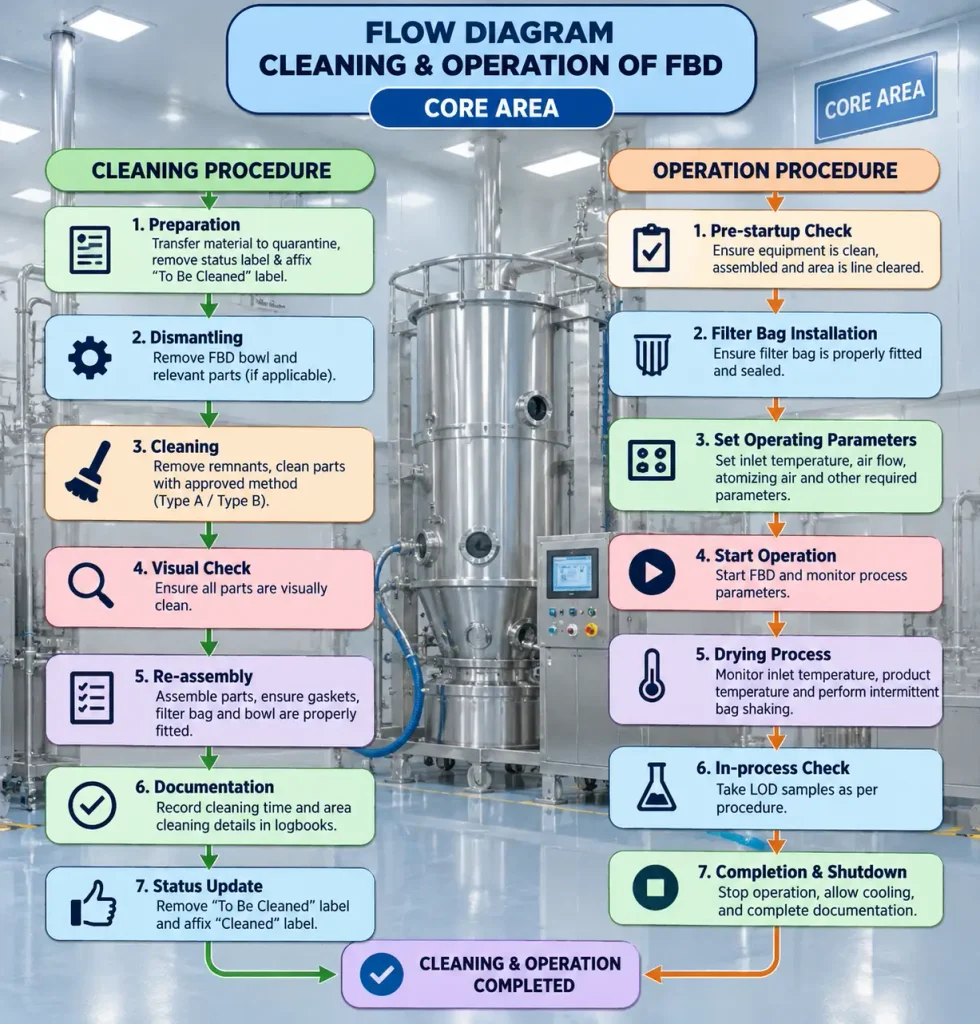
Before operation, equipment cleanliness, filter bag integrity, line clearance, and required approvals are verified. During operation, the FBD bowl is positioned and sealed, operating temperature is set as per the Batch Manufacturing Record, the exhaust blower is started, and drying is continued with intermittent bag shaking and racking. Drying continues until the required Loss on Drying (LOD) is achieved. After completion, the blower is stopped, the bowl and filter bag are removed, equipment status is updated, and all relevant records are completed.
3. Benefits of Following SOP for Cleaning & Operation of FBD:
Following the SOP for Cleaning & Operation of Fluid Bed Dryer (FBD) helps ensure that the equipment is cleaned, prepared, operated, monitored, and shut down in a controlled and consistent manner. The SOP defines responsibilities for Production personnel and QA/QC oversight and establishes documented requirements for equipment cleaning, status labeling, visual inspection, and operational checks.
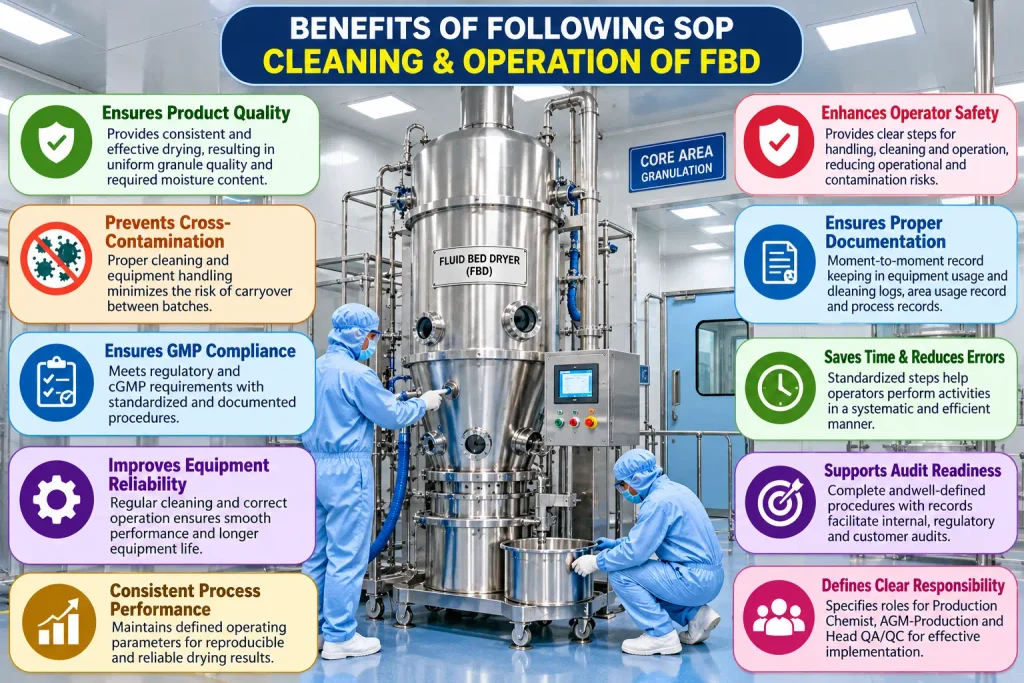
Proper adherence to the cleaning procedure supports effective removal of previous-product remnants, cleaning of product-contact parts, verification of visual cleanliness, correct reassembly, and maintenance of equipment cleaning records. For Type B cleaning, the SOP further includes process-water cleaning, detergent cleaning, purified-water rinsing, drying, visual inspection, and rinse-water sampling. , During operation, following the SOP ensures pre-startup verification, correct filter-bag installation, controlled inlet temperature, appropriate drying, intermittent bag shaking, and monitoring of Loss on Drying. OF FBD Overall, compliance with the SOP supports consistent drying performance, proper documentation, equipment reliability, contamination control, operator safety, GMP compliance, and audit readiness.
4. Brainstorming for SOP Failure – Cleaning & Operation of FBD:
The brainstorming analysis for SOP failure in Cleaning & Operation of FBD identifies possible causes that may lead to ineffective cleaning, improper equipment operation, documentation gaps, or loss of process control. The analysis considers factors related to man, method, machine, material, measurement, environment, management, and documentation. Potential causes include inadequate operator training, failure to follow approved cleaning steps, unclear procedures, improper dismantling or reassembly, damaged gaskets or filter bags, insufficient cleaning, poor visual inspection, incorrect monitoring of operating parameters, incomplete logbook entries, and inadequate supervisory review.
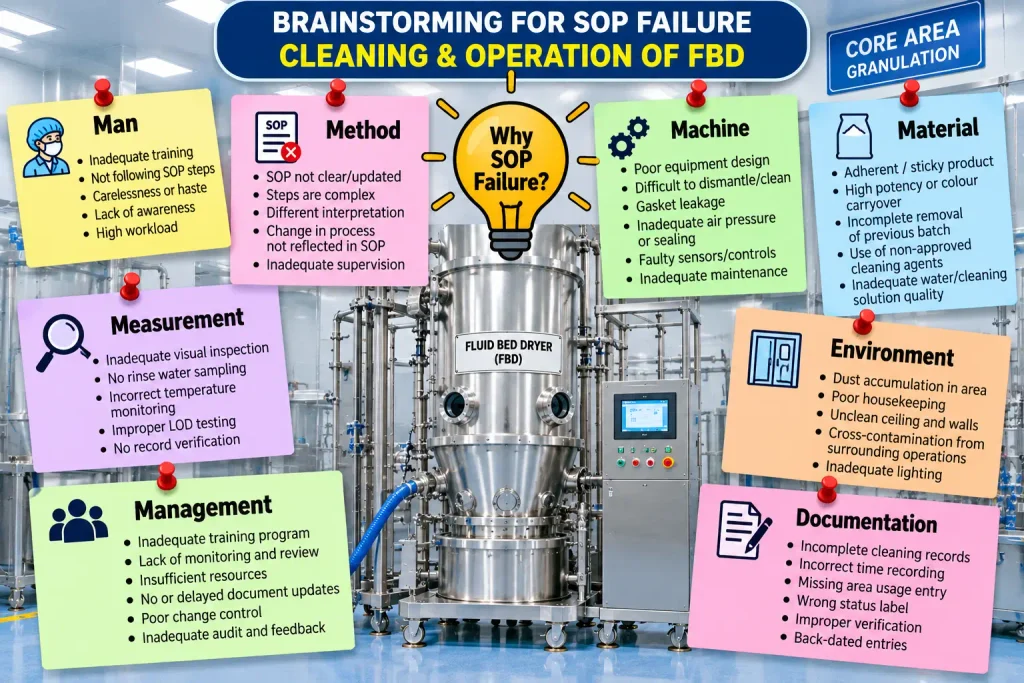
These factors are relevant because the SOP requires defined cleaning activities, visual cleanliness checks, recording of cleaning start/stop times, verification of cleaned status, pre-startup checks, proper filter bag installation, operating controls, LOD monitoring, and shutdown documentation. , Brainstorming helps the investigation team systematically identify potential failure points so that significant causes can be evaluated further through 5-Why Analysis, Fishbone Analysis, Fault Tree Analysis, and CAPA.
5. 5-Why Analysis for SOP Failure – Cleaning & Operation of FBD:
The 5-Why Analysis for SOP Failure in Cleaning & Operation of FBD is used to investigate the underlying reason for deviation from the approved cleaning and operating procedure. The analysis begins with the immediate problem, such as improper cleaning or incorrect operation of the Fluid Bed Dryer, and progressively asks “Why?” until the fundamental cause is identified.
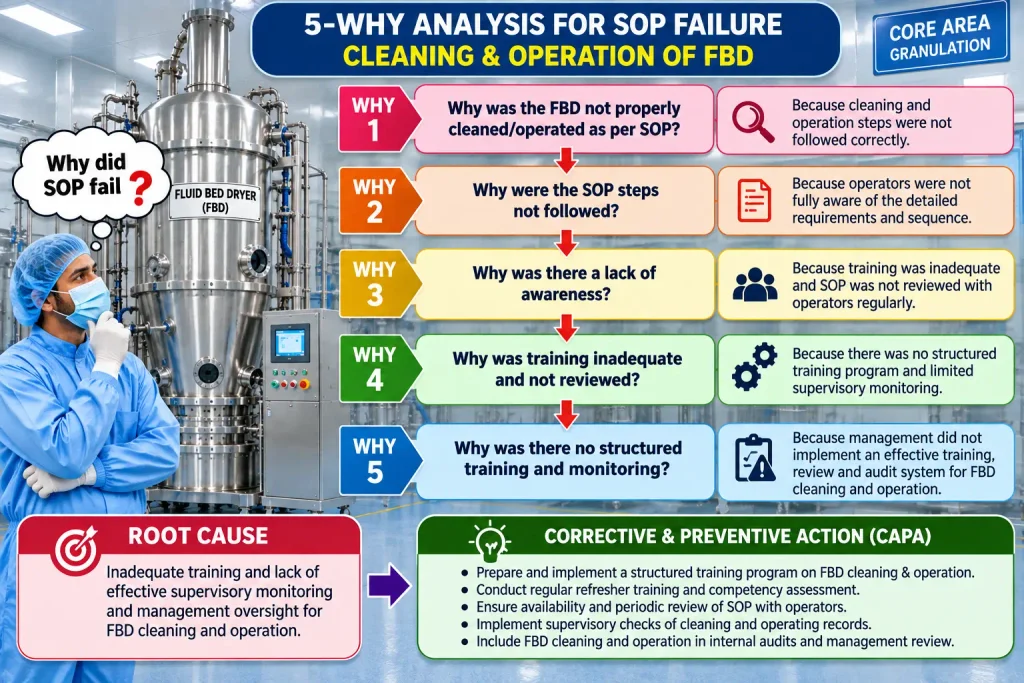
Possible causes may include failure to follow defined cleaning steps, inadequate understanding of the sequence, insufficient operator training, weak supervisory monitoring, and lack of effective management review. This is especially relevant because the SOP requires defined cleaning activities, visual cleanliness verification, equipment status labeling, logbook recording, pre-startup checks, filter bag verification, controlled operating steps, LOD monitoring, and proper shutdown. The purpose of the 5-Why analysis is to move beyond the visible failure and identify a system-level root cause that can be addressed through appropriate CAPA, such as retraining, SOP review, competency assessment, strengthened supervision, and periodic compliance monitoring.
6. Fishbone Analysis for SOP Failure – Cleaning & Operation of FBD:
The Fishbone Analysis for SOP Failure in Cleaning & Operation of FBD is used to systematically identify potential causes that may contribute to improper cleaning, incorrect operation, documentation deficiencies, or process deviations associated with the Fluid Bed Dryer. The analysis groups possible causes under major categories such as Man, Machine, Method, Material, Measurement, Environment, and Management.
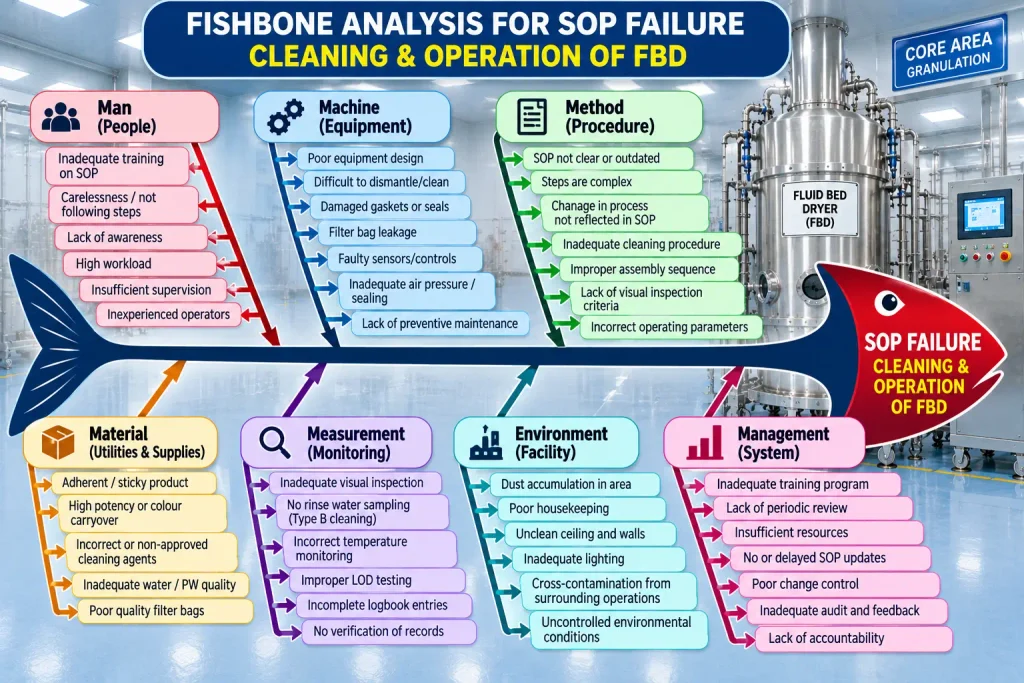
Personnel-related causes may include inadequate training, lack of awareness, failure to follow SOP steps, or insufficient supervision. Machine-related causes may involve damaged gaskets, filter bag problems, faulty controls, or poor sealing. Method-related causes include unclear procedures, improper cleaning sequence, or incorrect operating parameters. Measurement issues may include inadequate visual inspection, improper LOD monitoring, or incomplete record verification. These categories are relevant because the SOP requires defined cleaning steps, visual cleanliness checks, equipment reassembly, status labeling, pre-startup verification, filter bag checks, controlled drying parameters, LOD testing, and documented shutdown activities. The Fishbone Analysis helps the investigation team organize possible causes and select the most probable ones for further verification, root-cause confirmation, and development of suitable Corrective and Preventive Actions (CAPA).
7. Fault Tree Analysis for SOP Failure – Cleaning & Operation of FBD:
The Fault Tree Analysis for SOP Failure in Cleaning & Operation of FBD evaluates how different failures can combine to result in ineffective cleaning, incorrect operation, poor documentation, or contamination risk during use of the Fluid Bed Dryer. The top event is defined as “SOP Failure in Cleaning & Operation of FBD.” The fault tree breaks this top event into major intermediate events such as inadequate cleaning of FBD, incorrect operation, inadequate documentation, and contamination risk. Basic causes may include failure to follow cleaning steps, unsuitable cleaning conditions, incorrect operating parameters, incomplete pre-startup checks, missing logbook entries, inadequate visual verification, carryover from the previous batch, or poor environmental control.
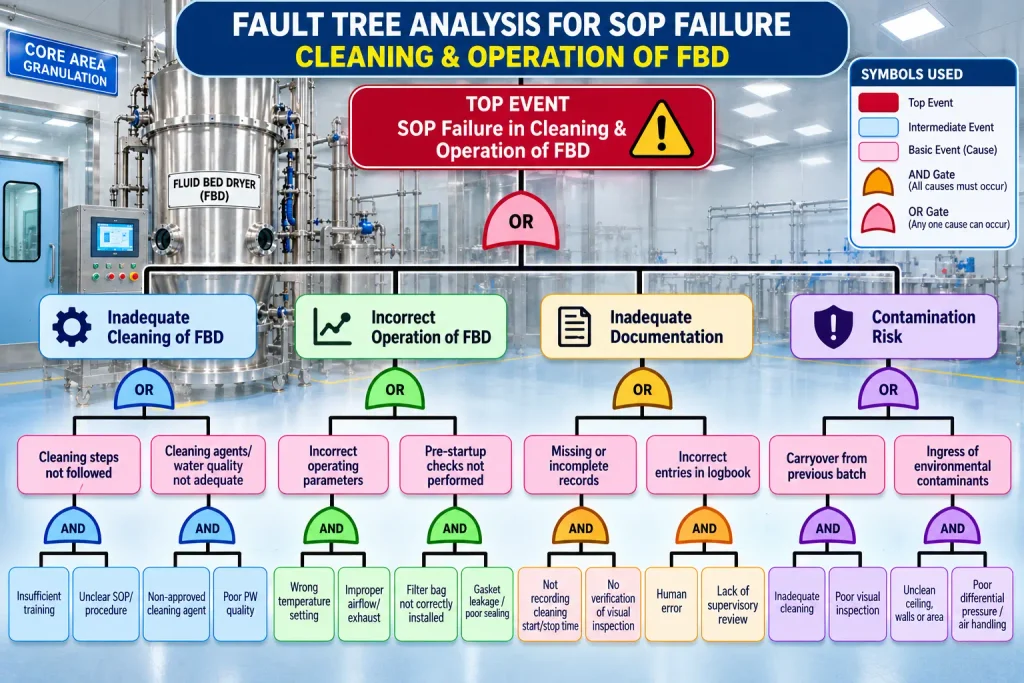
These failure modes are relevant to the SOP because it requires documented cleaning, visual cleanliness checks, correct assembly, pre-startup verification, filter bag installation, equipment status labeling, controlled drying parameters, LOD monitoring, and proper shutdown documentation. Fault Tree Analysis helps identify the combination of basic and intermediate events that can lead to SOP failure, allowing the investigation team to prioritize controls and develop effective Corrective and Preventive Actions (CAPA).
8. Impact Assessment for SOP Failure – Cleaning & Operation of FBD:
The Impact Assessment for SOP Failure in Cleaning & Operation of FBD evaluates the possible consequences that may arise when the approved cleaning or operating procedure is not followed correctly. The assessment considers potential effects on product quality, equipment condition, operator safety, documentation, production continuity, cost, and regulatory compliance. Failure to follow the cleaning procedure may result in inadequate removal of previous-product residues, improper equipment cleanliness, or incorrect reassembly. The SOP specifically requires removal of remnants, cleaning of contact parts, visual cleanliness checks, drying, reassembly, and completion of cleaning records.
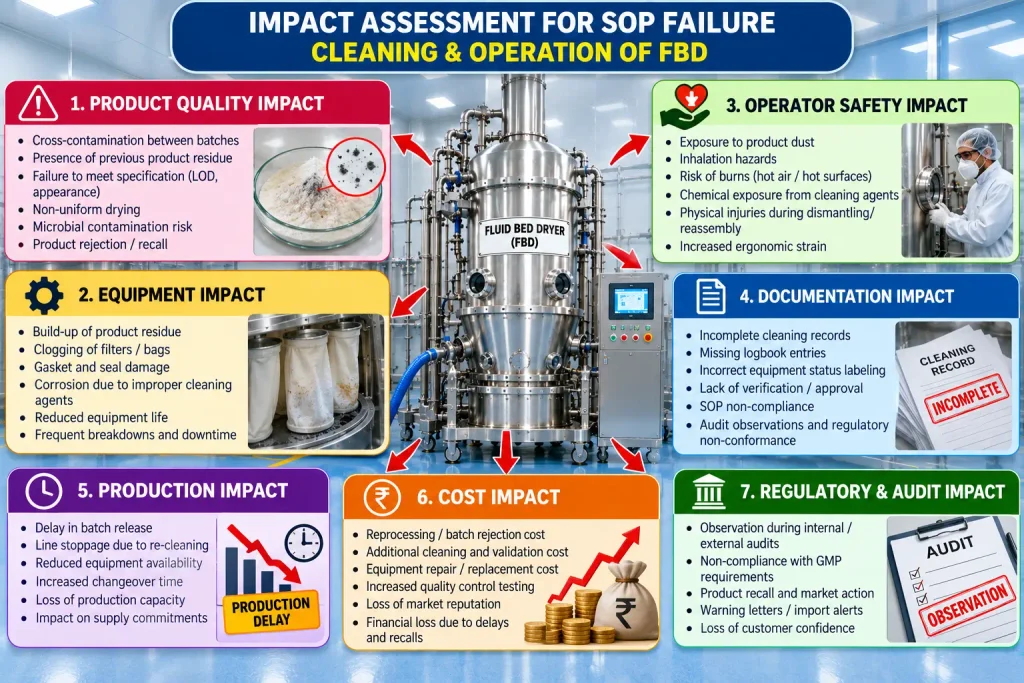
Operational failure may affect drying performance because the SOP requires verification of equipment cleanliness, filter bag integrity, proper sealing, inlet temperature control, intermittent bag shaking, and continued drying until the required Loss on Drying is achieved. Documentation failures may also lead to incomplete traceability, as the procedure requires recording cleaning and operating activities in the relevant logbooks and Batch Manufacturing Record. Overall, SOP failure can lead to quality risk, re-cleaning, batch delays, equipment downtime, documentation non-compliance, investigation requirements, and possible audit observations, making strict adherence to the approved procedure essential.
9. CAPA for SOP Failure – Cleaning & Operation of FBD:
The CAPA for SOP Failure in Cleaning & Operation of FBD is intended to correct identified deviations and prevent recurrence of failures related to equipment cleaning, operation, documentation, or process control. Corrective actions may include immediate retraining of operators, re-cleaning of the FBD, correction of operating parameters, completion or correction of logbook and BMR entries, verification of filter bags and gaskets, and additional inspection of the affected equipment or batch. Preventive actions should focus on strengthening the overall system through structured training, periodic SOP review, competency assessment, supervisory verification, cleaning checklists, line-clearance controls, and routine internal audits.
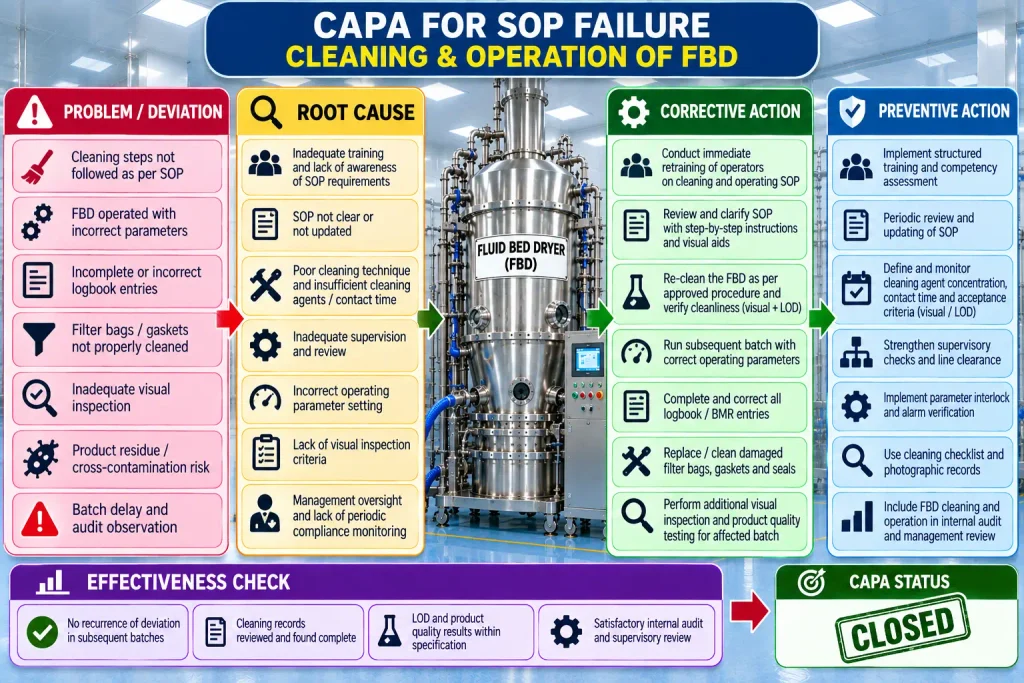
These actions are aligned with the SOP requirements for defined cleaning, visual cleanliness verification, equipment status labeling, pre-startup checks, correct filter bag installation, controlled operating conditions, LOD monitoring, and proper documentation. effectiveness should be verified through review of subsequent cleaning and operating records, absence of repeat deviations, satisfactory batch results, and successful supervisory or audit review before formal closure.
Question & Answer – SOP for Cleaning & Operation of FBD:
- What is the objective of the SOP for Cleaning & Operation of FBD?
The objective is to define the procedure for proper cleaning and operation of the Fluid Bed Dryer (FBD). - Where is the FBD located?
The FBD is located in the Granulation area. - Who is responsible for execution of this SOP?
The Production Chemist is responsible for execution of the SOP. - Who is responsible for effective implementation of the SOP?
AGM-Production and Head QA/QC are responsible for effective implementation. - What is Type A cleaning?
Type A cleaning is performed during batch changeover of the same product or ascending strength, provided the colour is the same. - What is Type B cleaning?
Type B cleaning is performed during product changeover with different actives, descending potency, post-maintenance of contact parts, when the next product is unknown, and after eight consecutive Type A cleanings. - What label is affixed before cleaning the FBD?
The existing status label is removed and a “To Be Cleaned” label is affixed. - How are remnants of the previous batch removed?
Previous batch remnants are removed from dismantled parts using a dust extraction hose. - How is visual cleanliness verified?
The cleaned equipment parts and surfaces are visually inspected to ensure that no visible residue remains. - What cleaning solution is used during Type B cleaning?
The SOP specifies approximately 1000 mL of 0.1% v/v Teepol solution, followed by process-water cleaning until free from foam and then purified-water rinsing. - How are the cleaned parts dried?
Cleaned parts are dried using compressed air and lint-free cloth. - What sample is collected after Type B cleaning?
An IPQA chemist collects the rinse-water sample after cleaning. - What should be done if the FBD is not used for seven days?
The equipment should be rinsed with purified water and dried before use. - What must be checked before starting the FBD?
Equipment cleaning records, Type A/Type B cleaning status, approved swab/rinse results for Type B, visual cleanliness, cleaned label approval, and line clearance should be verified before operation. - Why is filter bag integrity checked?
Filter bag integrity is checked before operation to ensure the bag is properly fitted and suitable for use. - How is the inlet temperature controlled?
The inlet temperature is adjusted according to the Batch Manufacturing Record (BMR) using the temperature controller. - What is done during intermittent drying?
The filter bag is shaken intermittently, and after every 10–15 minutes, the exhaust blower is stopped for intermittent racking of the material. - How is the drying end point determined?
A sample is collected and Loss on Drying (LOD) is checked using an IR Moisture Analyzer. If LOD is not within the specified limit, drying is continued. - What is done if the filter bag is found damaged after operation?
Further processing of the batch is stopped, and the Plant Manager and Quality Assurance Manager are informed for necessary action. - What should be done in an emergency during FBD operation?
The Emergency switch on the control panel should be pressed to stop the operation immediately, if required.
- Reference Guidelines – SOP for Cleaning & Operation of FBD:
- WHO GMP for Pharmaceutical Products – requirements for equipment cleaning, maintenance, prevention of contamination, manufacturing controls, and documentation.
- EU GMP – EudraLex Volume 4
- Chapter 3: Premises and Equipment
- Chapter 4: Documentation
- Chapter 5: Production
- PIC/S Guide to GMP (PE 009) – requirements for equipment cleanliness, production controls, documentation, and prevention of cross-contamination.
- US FDA 21 CFR Part 211
- §211.63 – Equipment design, size and location
- §211.67 – Equipment cleaning and maintenance
- §211.100 – Written procedures and deviations
- §211.182 – Equipment cleaning and use log
- ICH Q9 – Quality Risk Management – risk-based evaluation of failures related to FBD cleaning and operation.
- ICH Q10 – Pharmaceutical Quality System – CAPA, change management, monitoring, training, and continual improvement.
- Schedule M, Drugs Rules, India – GMP requirements for pharmaceutical premises, equipment, production operations, sanitation, and documentation.