







1. Introduction – Monitoring and Control of FBD Bags:
The Monitoring and Control of FBD Bags SOP establishes a systematic procedure for the receipt, identification, cleaning, drying, storage, usage, inspection, re-inspection, and rejection of Fluid Bed Dryer (FBD) bags used in pharmaceutical manufacturing. The procedure is intended to maintain the integrity and cleanliness of FBD bags and to minimize risks of contamination, cross-contamination, product carryover, and damage during routine manufacturing operations. New FBD bags are visually inspected for physical integrity, assigned unique identification numbers, cleaned before use, and maintained under controlled storage conditions. Product-wise dedicated bags are required, and cleaning includes washing, removal of adhered material, purified-water rinsing, rinse-water sampling, and drying in the FBD The SOP also requires integrity checks before and after use, periodic bioload monitoring, appropriate status labeling, and documented issuance, usage, cleaning, receipt, re-inspection, and disposal. Bags are re-inspected after five years and rejected after eight years of use or earlier if any defect or damage is observed.
Skip to PDF content2. Flow Diagram – Monitoring and Control of FBD Bags:
The Monitoring and Control of FBD Bags procedure defines a controlled lifecycle for FBD bags from receipt through final rejection. Newly received bags are visually checked for integrity, assigned identification numbers, cleaned, dried, and stored with proper status labeling. Cleaning is carried out using water without detergent, with scrubbing where required, followed by rinsing, rinse-water sampling, assembly with the FBD ring, and drying inside the Fluid Bed Dryer.
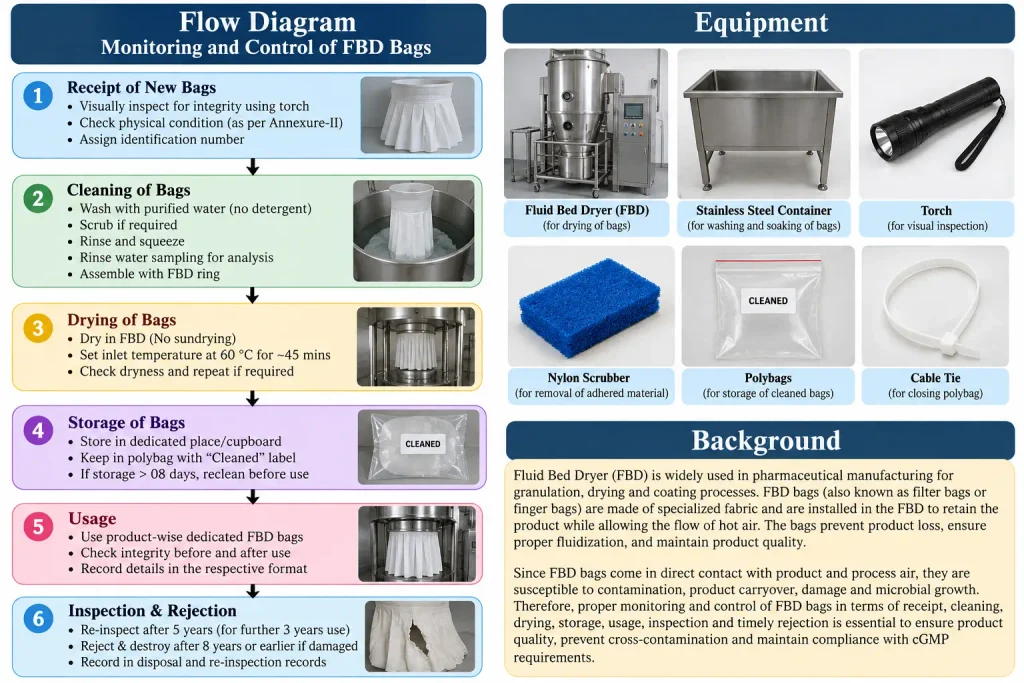
Cleaned and dried bags are stored in a dedicated location, and bags stored for more than eight days are re-cleaned before use. Product-wise dedicated FBD bags are used, with integrity checks performed before and after use and all activities documented in the specified records. The SOP also requires periodic bioload monitoring and defined re-inspection and rejection controls. Bags are re-inspected after five years and may continue in use for another three years with approval if satisfactory. They are rejected after eight years or earlier if damaged, with disposal and re-inspection records maintained accordingly.
3. Benefits of Following SOP – Monitoring and Control of FBD Bags:
Following the Monitoring and Control of FBD Bags SOP helps ensure that FBD bags remain clean, intact, identifiable, and suitable for pharmaceutical manufacturing throughout their lifecycle. Product-wise dedicated bags, controlled cleaning, rinse-water sampling, drying, storage, and integrity checks reduce the possibility of contamination, cross-contamination, product carryover, and use of damaged bags.
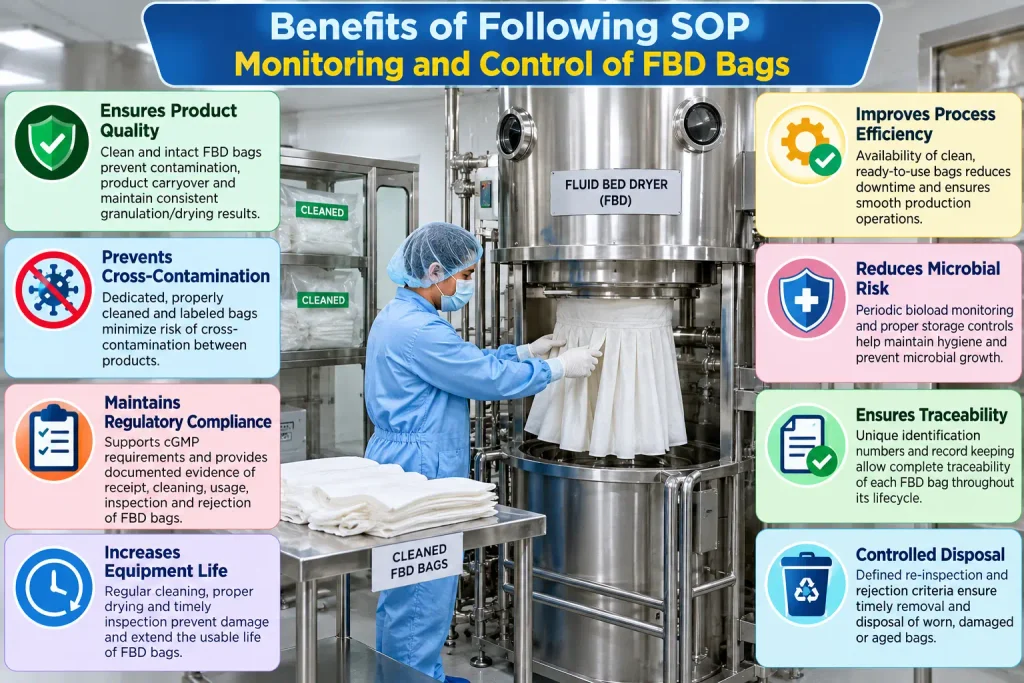
Proper storage in dedicated locations with “Cleaned” status labeling supports hygienic control and ready availability of bags for production. Bags stored for more than eight days are required to be re-cleaned before use, while integrity is checked before and after use to maintain control over their condition. The SOP also improves traceability and compliance through documented issuance, usage, cleaning, receipt, re-inspection, and disposal records. Periodic bioload monitoring provides additional microbiological control, while defined re-inspection and rejection criteria ensure that aged or damaged bags are removed from service in a controlled manner.
4. CPP & CQA – Monitoring and Control of FBD Bags:
The Critical Process Parameters (CPPs) and Critical Quality Attributes (CQAs) for monitoring and control of FBD bags are mainly related to cleaning, rinsing, drying, storage, integrity, microbiological condition, identification, and service life. The SOP requires product-wise dedicated bags, washing without detergent, removal of adhered material where necessary, purified-water rinsing, rinse-water sampling, and drying in the FBD. A key CPP is the FBD drying condition, where the inlet temperature is set at 60°C for approximately 45 minutes. If the bag is not dry, drying is repeated for an additional 15 minutes. Cleaned and dried bags are then stored in a dedicated location with proper status labeling, and bags stored for more than eight days are re-cleaned before use.
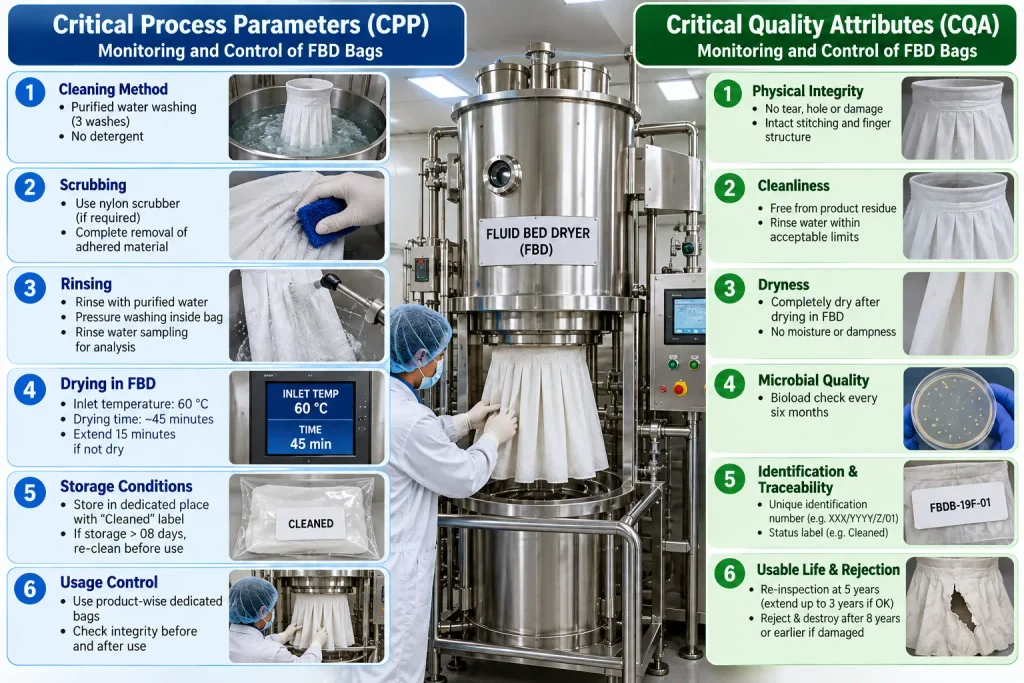
Important CQAs include physical integrity, cleanliness, adequate dryness, controlled bioload, correct identification, and suitability for continued use. Integrity is checked before and after use, while washed FBD bags undergo bioload monitoring every six months. Bags are re-inspected after five years and rejected after eight years or earlier if damage or defects are observed.
5. Brainstorming for SOP Failure – Monitoring and Control of FBD Bags:
The Brainstorming Analysis for SOP Failure – Monitoring and Control of FBD Bags identifies potential causes that may lead to ineffective control of FBD bags during pharmaceutical manufacturing. Major failure possibilities include improper receipt inspection, inadequate cleaning, incomplete removal of adhered material, failure to collect rinse-water samples, insufficient drying, incorrect identification, improper storage, and use of non-dedicated bags.The SOP specifically requires visual integrity inspection of newly received bags, product-wise dedication, washing without detergent, rinse-water sampling, drying in the FBD, proper identification, and controlled storage.
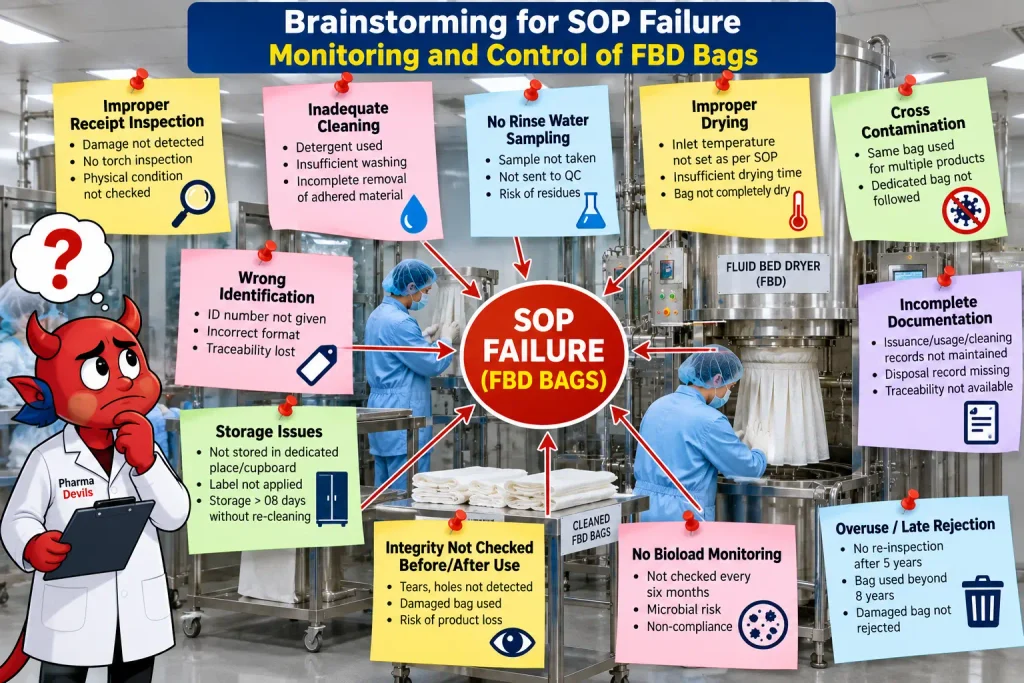
Other important brainstorming causes include failure to check bag integrity before and after use, incomplete issuance/usage/cleaning records, missed six-monthly bioload monitoring, delayed re-inspection, and continued use of damaged or over-aged bags. These failures can result in cross-contamination, microbial risk, product loss, poor traceability, and GMP non-compliance. This brainstorming exercise helps the Production and Quality teams identify weak points in FBD bag control so that appropriate corrective and preventive measures can be established before these failures affect product quality.
6. 5-Why Analysis for SOP Failure – Monitoring and Control of FBD Bags:
The 5-Why Analysis for SOP Failure – Monitoring and Control of FBD Bags is used to identify the underlying reasons behind failures in FBD bag handling and control. Typical problems include use of inadequately cleaned bags, damaged bags being used in production, missed bioload monitoring, improper storage, and incorrect identification or poor traceability. For example, an inadequately cleaned FBD bag may result from incomplete washing, failure to follow the defined cleaning sequence, insufficient operator awareness, or weak supervision. Similarly, use of a damaged bag may occur because the required integrity check before use was skipped. The SOP specifically requires integrity verification before and after use and controlled cleaning and storage practices.
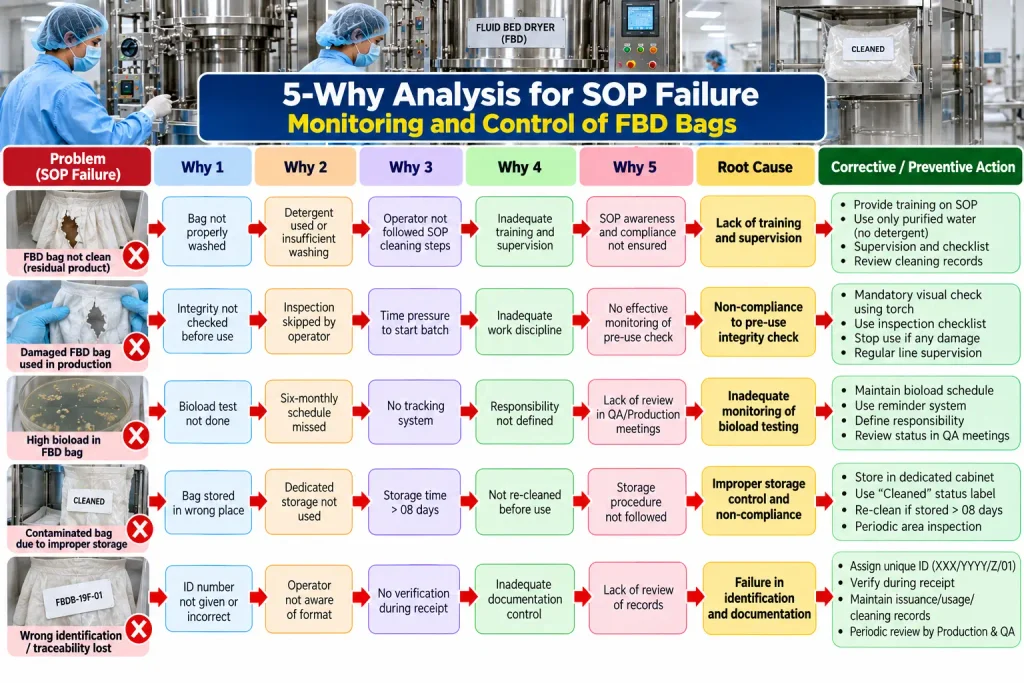
Other failures can occur when six-monthly bioload monitoring is missed, bags are stored beyond eight days without re-cleaning, or identification and usage records are not properly maintained. These conditions can lead to contamination risk, loss of traceability, and use of unsuitable bags. The 5-Why approach therefore helps identify root causes such as inadequate training, insufficient supervision, weak monitoring, poor documentation control, and failure to follow defined storage and inspection requirements. The outcome of this analysis should be used to establish focused corrective and preventive actions such as retraining, checklist implementation, periodic review, defined responsibilities, and stronger verification of FBD bag records.
7. Fishbone Analysis for SOP Failure – Monitoring and Control of FBD Bags:
The Fishbone Analysis for SOP Failure – Monitoring and Control of FBD Bags is used to systematically identify potential causes that can lead to failure in the handling, cleaning, storage, usage, monitoring, and disposal of FBD bags. The analysis groups possible causes under major categories such as Man, Method, Machine, Material, Measurement, Environment, Management, Manpower, Mother Nature, and Records.
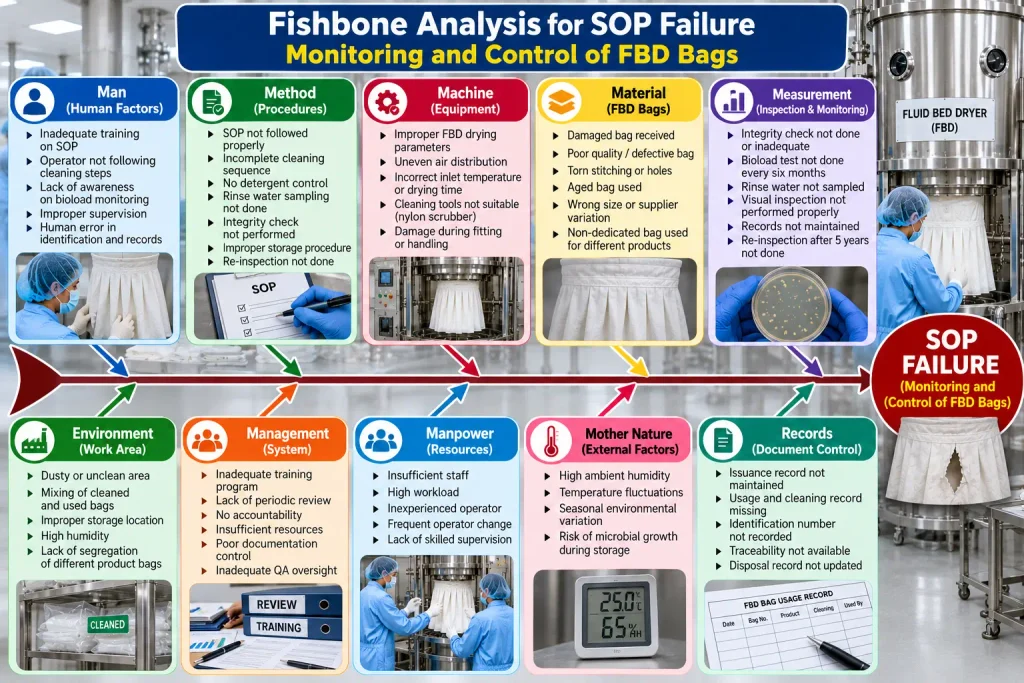
Human-related causes may include inadequate training, poor supervision, and failure to follow defined cleaning or inspection steps. Method-related failures can include incomplete cleaning, missed rinse-water sampling, improper storage, or failure to perform integrity checks. Equipment-related causes may involve incorrect drying conditions or unsuitable cleaning tools. Material-related causes include damaged, defective, aged, or non-dedicated bags. Measurement and monitoring failures may include missed bioload testing, inadequate visual inspection, or failure to perform re-inspection. The SOP requires bioload checks every six months, integrity checks before and after use, controlled storage, and defined re-inspection and rejection criteria. Environmental and documentation-related causes such as poor storage conditions, mixing of clean and used bags, incomplete records, or missing identification can further increase the risk of contamination, loss of traceability, and GMP non-compliance. This fishbone analysis helps identify probable root causes and supports development of appropriate CAPA for effective control of FBD bags.
8. Fault Tree Analysis for SOP Failure – Monitoring and Control of FBD Bags:
The Fault Tree Analysis for SOP Failure – Monitoring and Control of FBD Bags evaluates how individual failures can combine and lead to the top event of an unsuitable, contaminated, or defective FBD bag being used in production. The main intermediate failure branches include inadequate cleaning, use of damaged or unsuitable bags, improper storage and handling, and inadequate monitoring or documentation. Cleaning-related failures may arise from improper washing, incomplete removal of adhered material, missed rinse-water sampling, or inadequate drying. The SOP requires product-wise dedicated bags, cleaning without detergent, rinsing, rinse-water sampling, assembly with the FBD ring, and drying in the FBD.
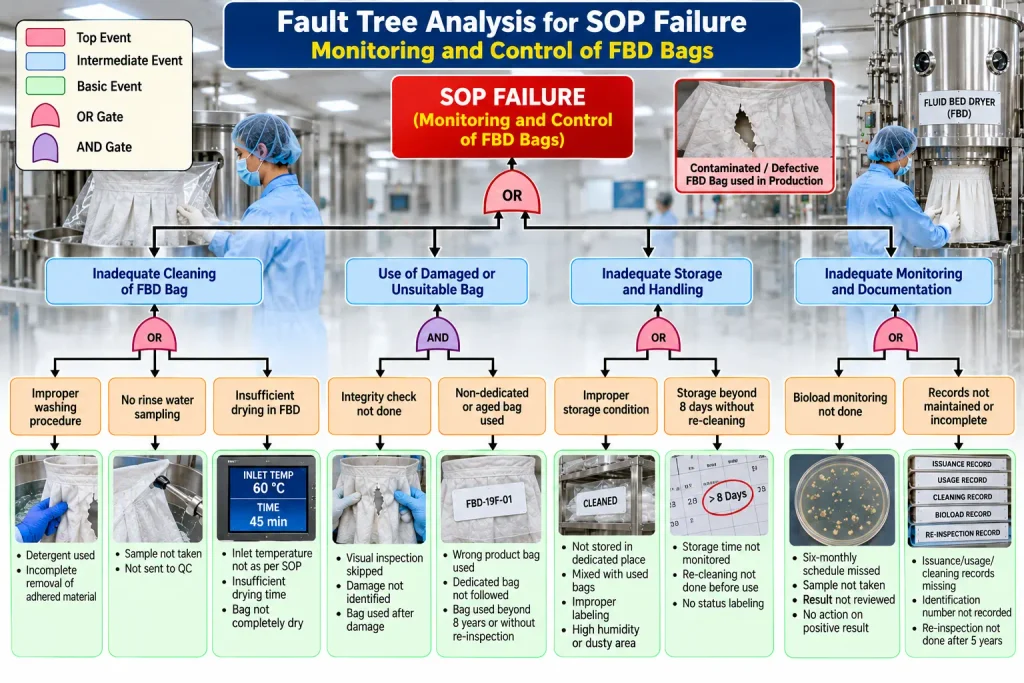
Storage and usage failures can occur when cleaned bags are not kept in a dedicated location, status labeling is inadequate, bags stored for more than eight days are not re-cleaned, or integrity checks before and after use are missed. Monitoring and documentation failures may include missed six-monthly bioload checks, incomplete usage or cleaning records, delayed re-inspection, or continued use of damaged or over-aged bags. These events can ultimately increase the risk of contamination, loss of traceability, and use of an unsuitable FBD bag in manufacturing. The fault tree therefore helps identify the critical failure paths requiring stronger controls, monitoring, documentation, training, and timely corrective and preventive action.
9. Impact Assessment – Monitoring and Control of FBD Bags:
The Impact Assessment for SOP Failure – Monitoring and Control of FBD Bags evaluates the possible consequences when FBD bags are not properly cleaned, dried, inspected, stored, identified, monitored, or documented. Failure to follow the defined controls can affect product quality, patient safety, regulatory compliance, production continuity, cost, environmental control, and traceability. The SOP requires product-wise dedicated FBD bags, proper cleaning and rinsing, rinse-water sampling, controlled drying, labeled storage, integrity checks before and after use, and periodic bioload monitoring.
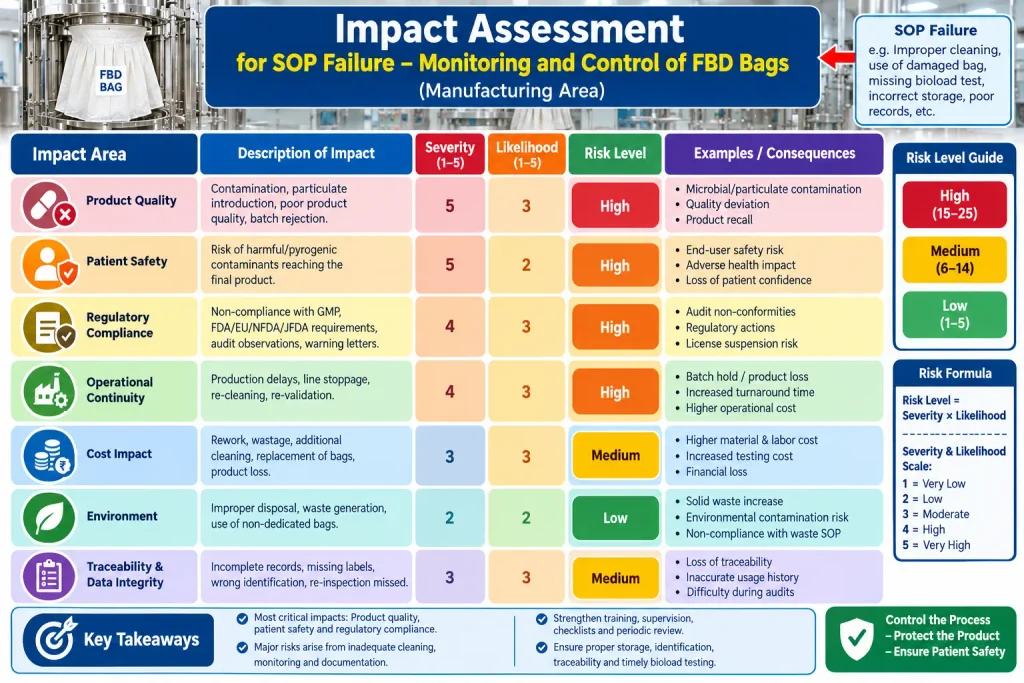
If these controls fail, potential impacts include contamination, cross-contamination, use of damaged bags, product carryover, poor drying performance, batch rejection, additional cleaning, production delays, and loss of traceability. Missed bioload checks or improper storage may also increase microbiological risk. The SOP further requires re-inspection after five years and rejection after eight years or earlier if defects are observed, helping to prevent continued use of unsuitable bags. Overall, the assessment shows that failures affecting product quality, contamination control, and GMP compliance should receive the highest attention. Effective training, supervision, documentation, inspection, and timely CAPA are essential to reduce these risks and maintain controlled use of FBD bags.
10. CAPA for SOP Failure – Monitoring and Control of FBD Bags:
The Corrective and Preventive Action (CAPA) for SOP Failure – Monitoring and Control of FBD Bags is intended to eliminate identified failures and prevent their recurrence during receipt, cleaning, storage, usage, monitoring, re-inspection, and disposal of FBD bags. Corrective actions may include immediate removal of damaged bags from use, re-cleaning of improperly cleaned bags, collection and testing of missed rinse-water samples, completion of overdue bioload monitoring, segregation of clean and used bags, verification of identification numbers, and correction of incomplete records. These actions are aligned with the SOP requirements for cleaning, rinse-water sampling, integrity checking, storage, and documentation.
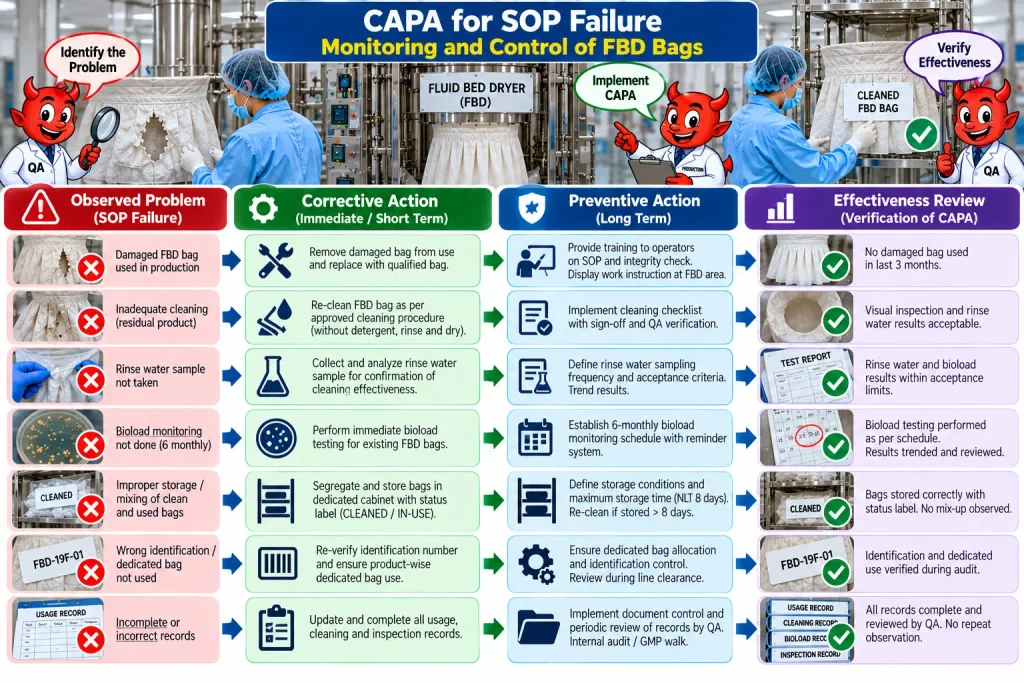
Preventive actions should focus on operator training, supervision, use of cleaning and inspection checklists, scheduled six-monthly bioload monitoring, dedicated storage, proper status labeling, product-wise bag dedication, and periodic QA review of records. The SOP also requires re-inspection after five years and rejection after eight years or earlier if the bag is defective or damaged. CAPA effectiveness should be verified through periodic record review, physical inspection of FBD bags, confirmation of acceptable rinse-water and bioload results, storage verification, and monitoring for repeat observations. Successful effectiveness review demonstrates that the implemented actions are sustainable and that FBD bags remain properly controlled throughout their lifecycle.
Questions & Answers – Monitoring and Control of FBD Bags:
Q1. What is the purpose of the SOP for Monitoring and Control of FBD Bags?
The purpose is to define a controlled procedure for receipt, cleaning, storage, usage, inspection, re-inspection, and rejection of Fluid Bed Dryer bags.
Q2. Who is responsible for execution of this SOP?
Concerned production personnel and Production Chemists are responsible for execution, while the Production Manager is responsible for effective implementation.
Q3. What should be checked when a new FBD bag is received?
The bag should be visually inspected for integrity using a torch, and its physical condition should be recorded as per the specified checklist.
Q4. Are FBD bags required to be product-wise dedicated?
Yes. The SOP specifies that dedicated FBD bags should be used product-wise.
Q5. Can detergent be used for cleaning FBD bags?
No. The SOP states that newly received FBD bags are to be washed using purified water and that detergent should not be used.
Q6. How is adhered material removed from the FBD bag?
The bag may be scrubbed using a nylon scrubber, if required, until adhered material is completely removed.
Q7. Is rinse-water sampling required after cleaning?
Yes. After pressure washing the inside of the bag, IPQA is requested to collect a rinse-water sample and send it to QC for analysis.
Q8. How are washed FBD bags dried?
Washed FBD bags are dried in the FBD. Sun drying is specifically not allowed
Q9. What drying condition is specified in the SOP?
The FBD inlet temperature is set at 60°C for approximately 45 minutes. If the bag is not dry, drying is repeated for another 15 minutes.
Q10. How should cleaned FBD bags be stored?
Cleaned and dried bags should be stored in their dedicated place or cupboard with proper labeling.
Q11. What happens if an FBD bag is stored for more than 8 days?
It must be re-cleaned before use.
Q12. When should FBD bag integrity be checked?
Integrity should be checked before and after use.
Q13. How frequently is bioload monitoring performed?
The washed FBD bag is checked for bioload every six months.
Q14. When is an FBD bag re-inspected for continued use?
After completion of five years, the bag is re-inspected for physical intactness. If satisfactory, it may be used for a further three years after the required approvals.
Q15. When should an FBD bag be rejected and destroyed?
It should be rejected and destroyed after eight years of usage or earlier if any defect or damage is observed.
Q16. Which records are maintained under this SOP?
The SOP includes records for FBD bag issuance, usage, cleaning and receipt, new bag receipt, disposal, and re-inspection.
Q17. Why is proper monitoring of FBD bags important?
It helps ensure that only clean, intact, properly identified, and controlled bags are used during production, while maintaining traceability throughout their lifecycle.
Q18. What action should be taken if an FBD bag is found damaged during cleaning or use?
The damage should be reported to the Production Chemist for necessary action, and a defective bag should not continue in use.
Q19. What is the role of status labeling?
Status labeling identifies the condition of the bag, such as “Cleaned,” and supports controlled storage and prevention of mix-ups.
Q20. What is the main GMP objective of this SOP?
The main objective is to maintain consistent control over FBD bag cleanliness, integrity, identification, usage, storage, monitoring, and disposal so that unsuitable bags are not used in manufacturing.
Reference Guidelines – Monitoring and Control of FBD Bags:
- SOP for “Bio-Burden Analysis of Primary Packaging Materials, FBD Bags, Gowns, Caps & Cleaned Equipment” – referenced for periodic microbiological monitoring of cleaned FBD bags.
- FBD Bag Issuance, Usage, Cleaning & Receipt Record – used for documenting bag lifecycle activities including issuance, use, cleaning, return, checking, and verification.
- New FBD Bag Receipt Checklist – Annexure II – used for inspection and acceptance of newly received FBD bags.
- Disposal Record of FBD Bags – Annexure III – used for documenting rejected and destroyed bags.
- FBD Bag Re-Inspection Record – Annexure IV – used to document periodic re-inspection and continued suitability of bags.
- Standard Operating Procedure (SOP) System – the procedure should be implemented under the site’s approved document-control, training, deviation, CAPA, and change-control systems.
- Current Good Manufacturing Practices (cGMP) – principles related to equipment cleanliness, contamination prevention, documentation, traceability, and controlled production practices should be followed.