





In cleaning validation, worst case acceptance criteria for visual inspection define the strictest, most challenging conditions under which equipment is still considered acceptably clean. The principle is simple: if the cleaning process can consistently meet “no visible residue” requirements under worst case conditions, it provides a strong assurance that it will perform adequately in routine, less-challenging scenarios.
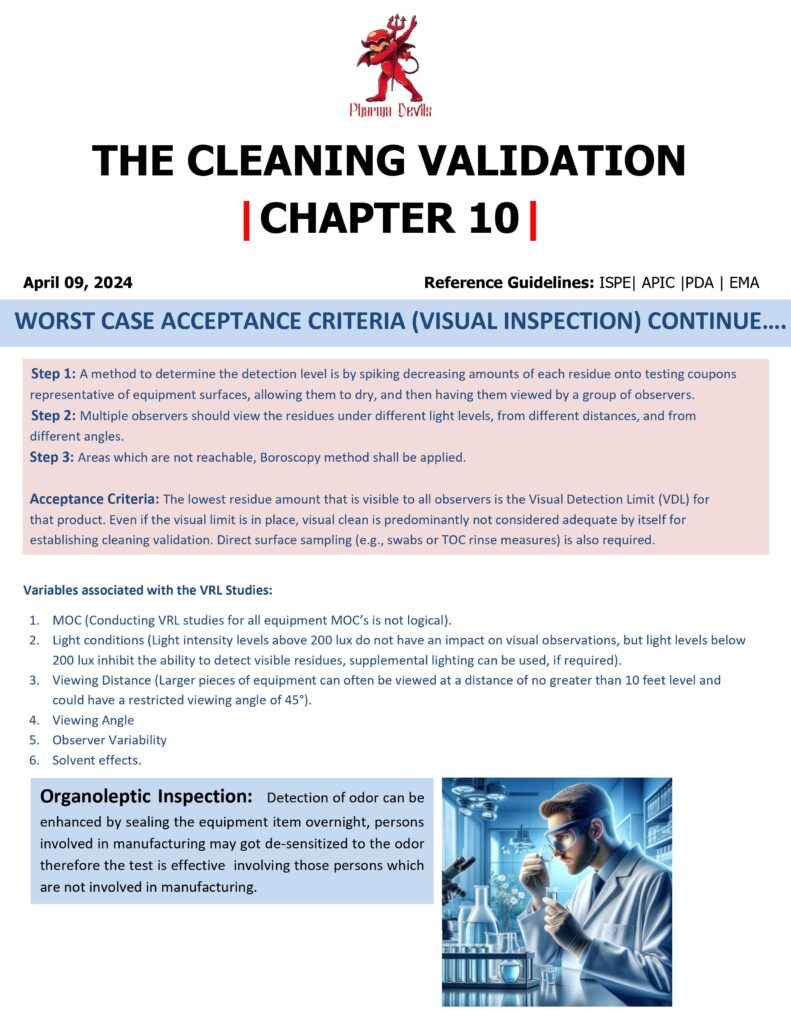
Worst case selection usually includes the hardest-to-clean product (e.g., sticky, poorly soluble, or strongly coloured), the highest product strength or batch size, maximum number of batches between cleans, and the most complex or least accessible equipment surfaces. For visually-based acceptance criteria, this also covers the least favourable, but still controlled, inspection conditions – defined lighting, viewing distance, angle, and exposure time.
Under these defined conditions, the core worst case visual acceptance criterion is typically:
“No visible residues, stains, discoloration, or foam on product-contact surfaces.”
To make this claim scientifically sound, visual inspection limits are supported by data. This may include:
- Visual limit studies, where known low levels of residue are applied to surfaces to confirm detectability.
- Linkage to analytical limits, ensuring that if nothing is visible, any remaining residue is below calculated MACO / PDE-based limits.
- Operator qualification, demonstrating that trained inspectors can reliably detect residues at or below the established worst case visual limit.
Documented acceptance criteria should clearly state: the inspection method, conditions (lux level, distance, time), surfaces to be inspected, how to handle stains or water marks, and actions required if residues are found (e.g., re-cleaning and investigation).
By setting Cleaning Validation visual criteria at the worst case, manufacturers ensure that visual inspection is not a cosmetic check but a critical, validated control step, directly linked to patient safety, cross-contamination control, and regulatory expectations for GMP-compliant operations.