
Chemical SOP

Microbiology SOP

Warehouse SOP

Manufacturing SOP

Information technology SOP

admin
Amulya is a content contributor at Pharma Devils, specializing in pharmaceutical documentation including Standard Operating Procedures (SOPs), User Requirement Specifications (URS), and equipment qualification protocols. With a focus on GMP compliance and regulatory standards, Amulya helps create clear, accurate, and industry-relevant technical content for pharmaceutical professionals worldwide.
Worst Case Location Selection in Cleaning Validation
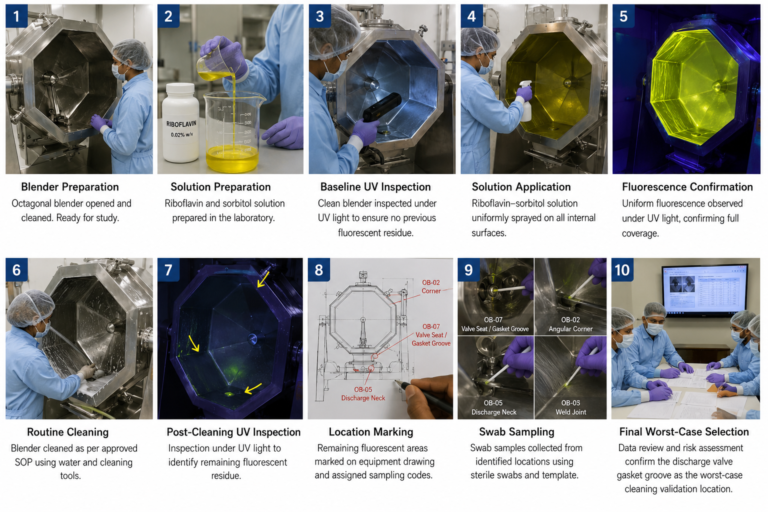
Worst-Case Location Selection for Cleaning Validation of an Octagonal Blender Worst-case location selection for cleaning validation of an octagonal blender should be performed using a scientific and risk-based approach. The purpose is to identify product-contact surfaces where residue is most…
WORST CASE ACCEPTANCE CRITERIA
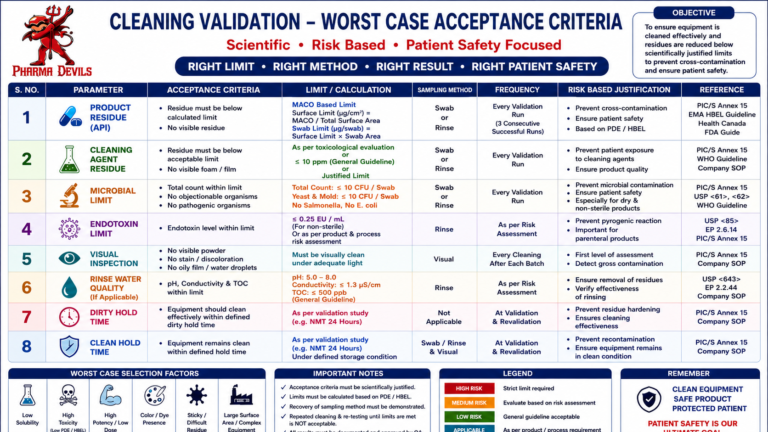
Cleaning validation worst-case acceptance criteria are scientifically defined limits used to prove that equipment cleaning is effective and safe for the next product. The purpose is to ensure that residues from the previous product, cleaning agents, microorganisms, endotoxins, and visible…
WORST CASE SELECTION CRITERIA (POTENCY/ SOLUBILITY/TOXICITY)
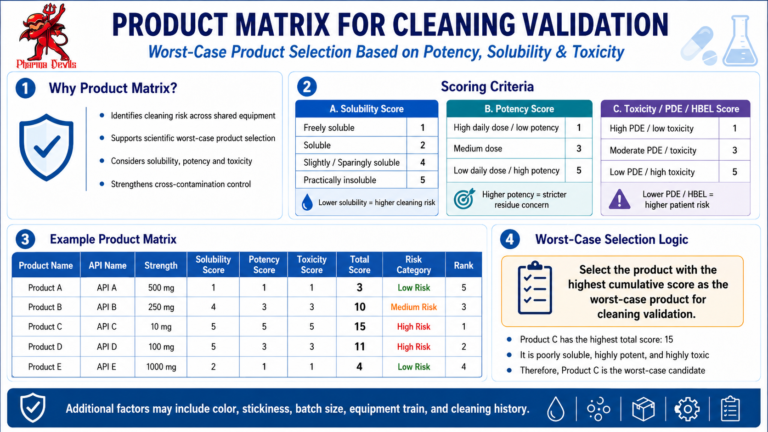
Cleaning validation WORST CASE SELECTION CRITERIA (POTENCY/ SOLUBILITY/TOXICITY) approach used to identify the product that presents the highest risk of carryover on shared equipment. The purpose is to validate the cleaning procedure against the most difficult challenge, so that other…
GRAM STAINING
Hans Christian Gram, in 1884 working in his laboratory on the discovery of Gram staining.
ANALYTICAL METHOD VALIDATION REPORT FOR SODIUM LAURYL SULPHATE (SLS)
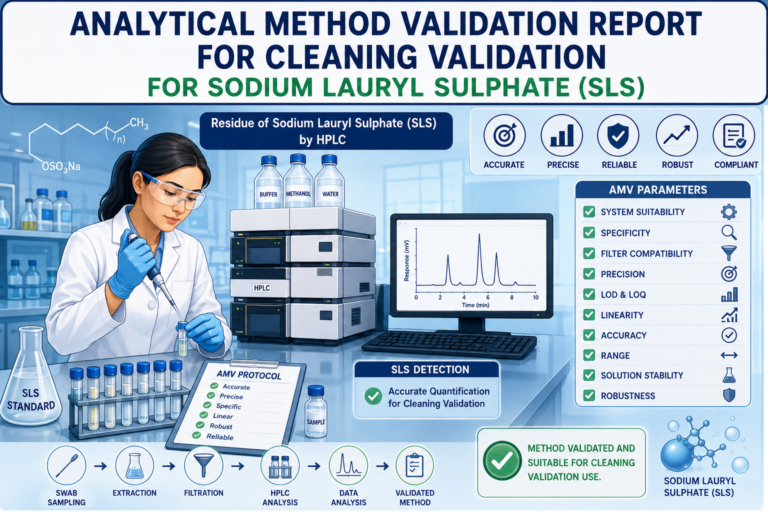
The ANALYTICAL METHOD VALIDATION REPORT FOR SODIUM LAURYL SULPHATE (SLS) / Sodium Dodecyl Sulfate residue by HPLC was prepared to demonstrate that the method is suitable for cleaning validation residue analysis from stainless steel surfaces. The protocol describes the complete…
ANALYTICAL METHOD VALIDATION PROTOCOL FOR SODIUM LAURYL SULPHATE (SLS)
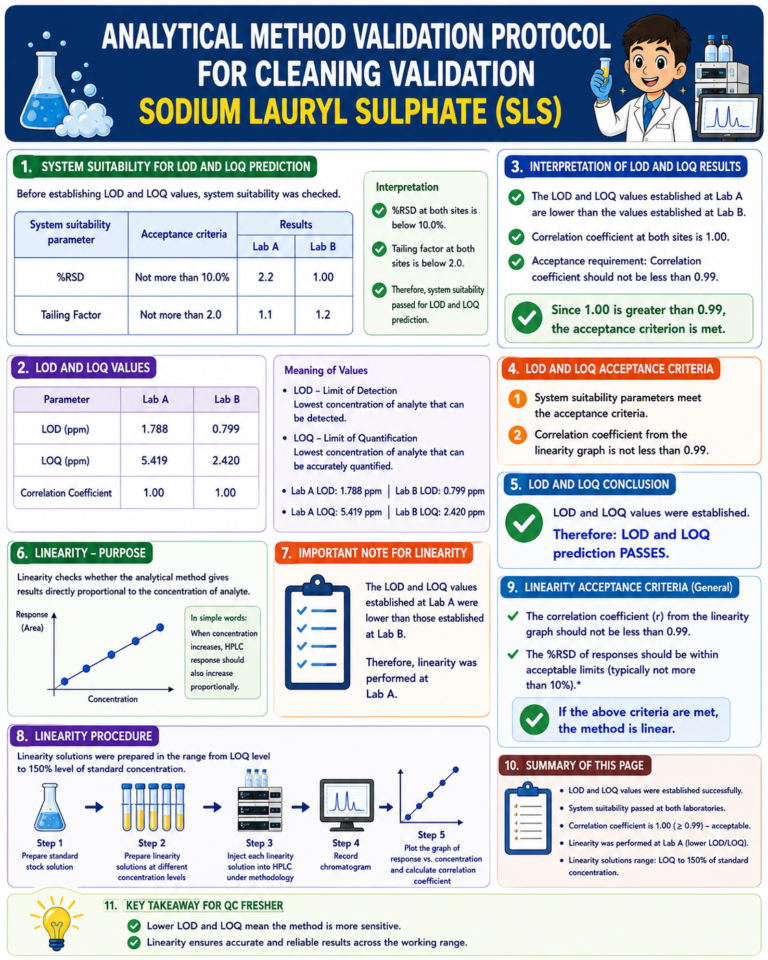
The ANALYTICAL METHOD VALIDATION PROTOCOL FOR SODIUM LAURYL SULPHATE (SLS) residue by HPLC was prepared to prove that the method is suitable for cleaning validation residue analysis from stainless steel surfaces. The objective was to validate the HPLC method as…
DICLOFENAC SODIUM ASSAY (METHOD 4)
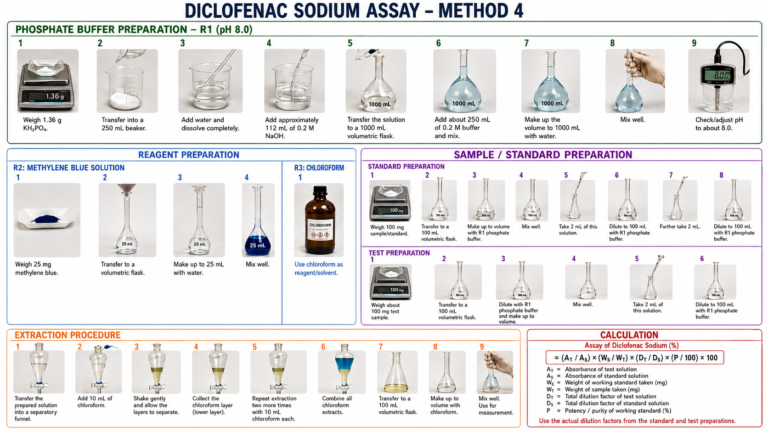
Diclofenac Sodium Assay Method 4 is based on the formation of an ion-pair complex between diclofenac sodium and methylene blue under alkaline phosphate buffer conditions. Diclofenac sodium is an acidic drug and exists mainly in ionized form in phosphate buffer…
DICLOFENAC SODIUM ASSAY – ACIDIFICATION – EXTRACTION METHOD 3
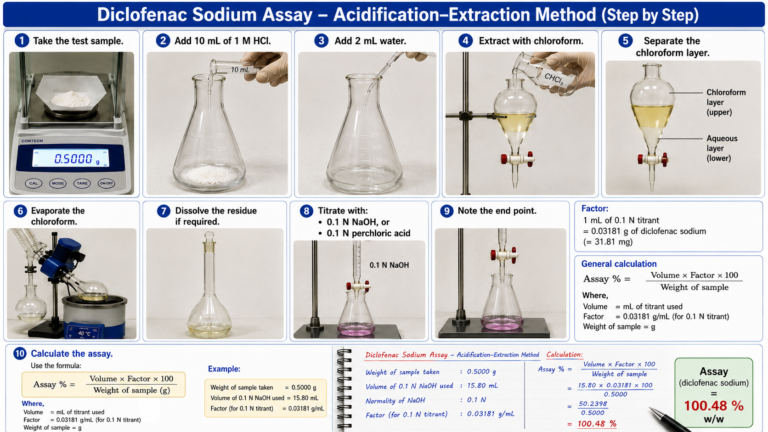
Diclofenac Sodium Assay – Acidification–Extraction Method The acidification–extraction assay method for Diclofenac Sodium is a widely used analytical procedure in pharmaceutical quality control laboratories. This method is based on converting Diclofenac Sodium into its free acid form through acidification, followed…
GREAT SCIENTIST WHO SERVED PHARMA SECTOR
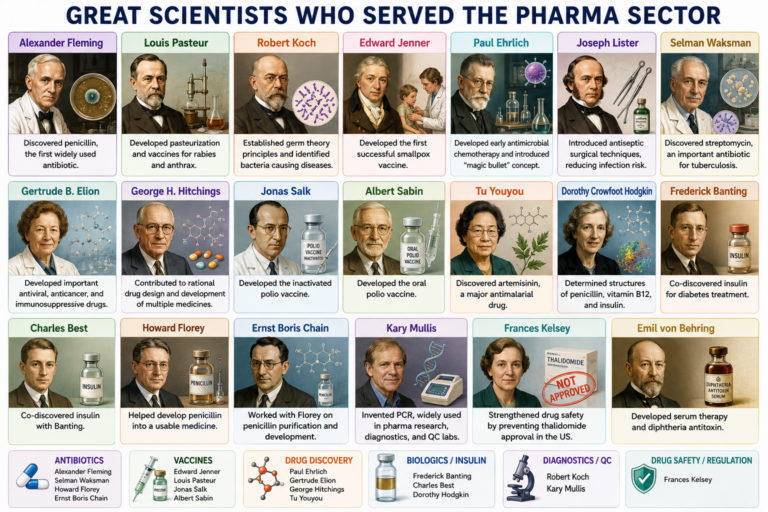
Great scientists have played a major role in the growth and success of the pharmaceutical sector. Their discoveries helped develop life-saving medicines, vaccines, diagnostic methods, and safer drug regulations. The pharma industry today stands on the foundation created by these…