






Cleaning validation demonstrates that manufacturing equipment is consistently cleaned to acceptable, predefined limits. A robust programme identifies both Critical Process Parameters (CPPs) and Critical Quality Attributes (CQAs) to ensure product quality, patient safety and regulatory compliance.
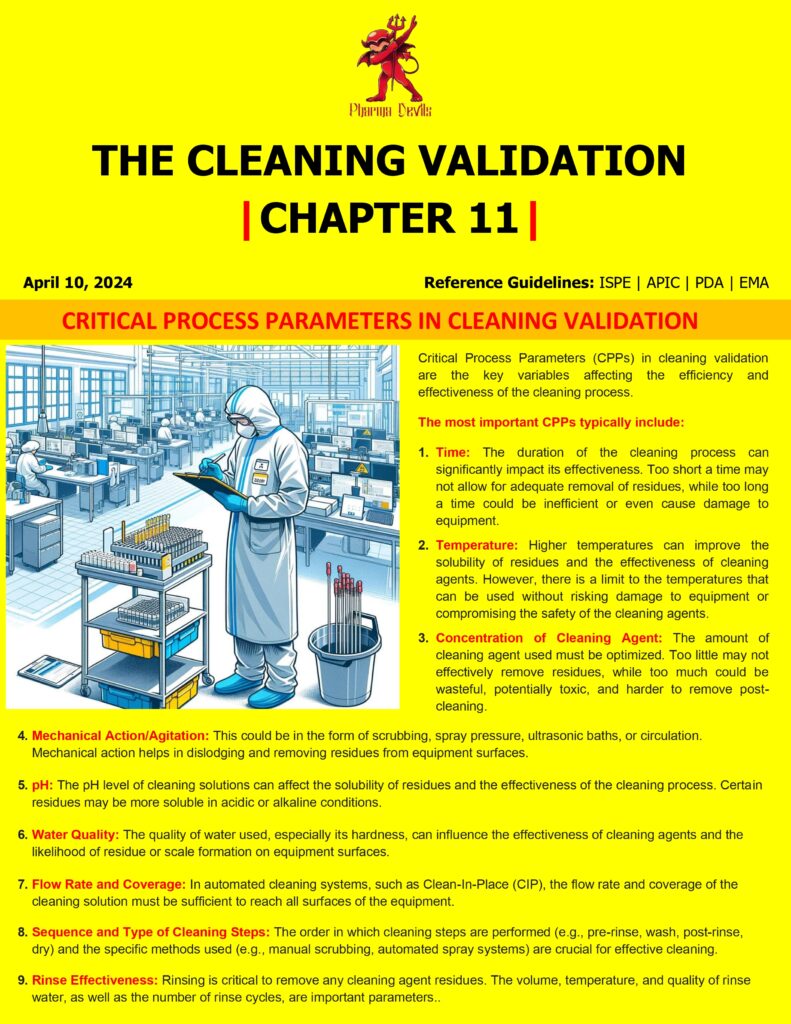
Critical Process Parameters are the key variables that directly influence cleaning performance. Typical CPPs include selection and concentration of detergent or cleaning agent, wash and rinse temperature, contact time, mechanical action (spray pressure, turbulence, flow rate), and number and sequence of cleaning cycles. Additional CPPs are dirty hold time (time between production and cleaning), clean hold time (storage of cleaned equipment), water quality, equipment design features (dead legs, gaskets, difficult-to-clean areas) and operator technique for manual cleaning. These parameters must be defined, justified, controlled and monitored, as variation can lead to ineffective residue removal and failed cleaning validation.
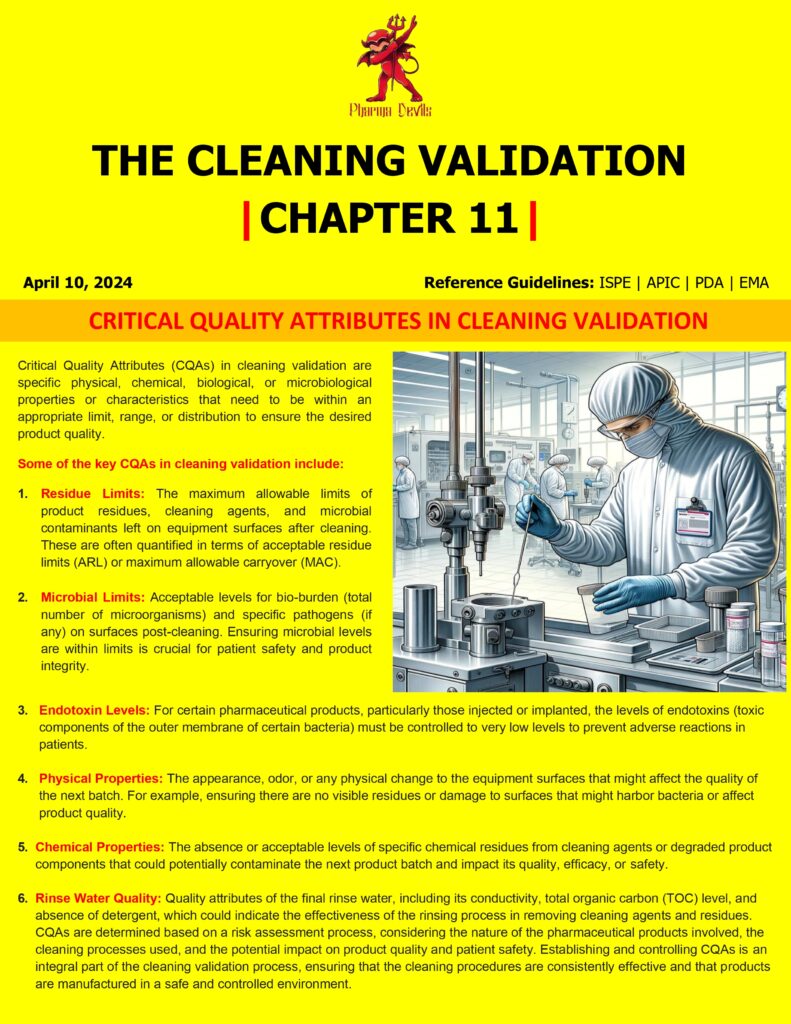
Critical Quality Attributes are the measurable outputs that confirm the effectiveness of the cleaning process. Key CQAs include residue levels of active pharmaceutical ingredient (API), degradants, cleaning agents and excipients, all compared against health-based or toxicity-based acceptance limits. Microbial and endotoxin levels, visual cleanliness, and analytical test results (e.g., TOC, specific assays, conductivity, pH) are also essential CQAs. Recovery efficiency of swab and rinse sampling methods, and consistency of results across multiple validation runs, further support the reliability of the cleaning process.
By linking CPPs to CQAs through risk assessment and validation studies, companies can establish robust, reproducible cleaning procedures, reduce cross-contamination risk and ensure ongoing compliance with GMP expectations.