






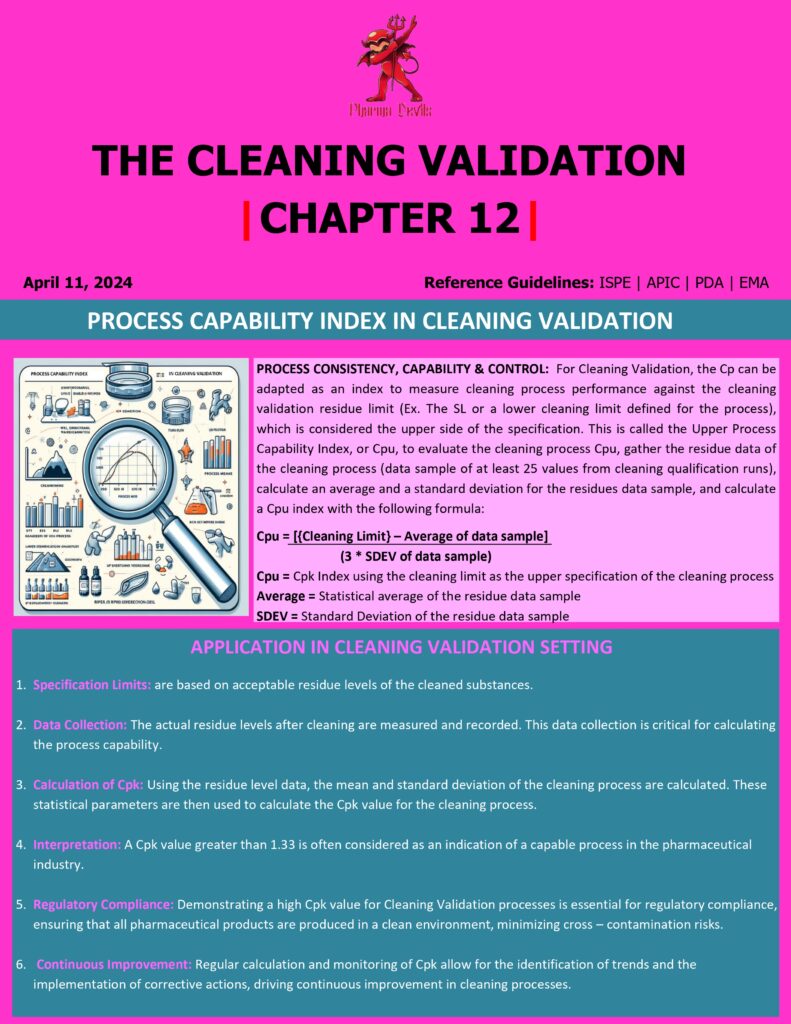
In cleaning validation, the Process Capability Index (PCI)—most commonly reported as Cp, Cpk (and sometimes Pp, Ppk)—is a statistical measure that shows how well a cleaning process can consistently meet the predefined cleaning acceptance limit (e.g., residue limit such as MACO/RL, or swab/rinse limit). It converts routine cleaning performance data into a single, easy-to-interpret indicator of process robustness.
Cp (potential capability) compares the natural spread of cleaning results (variation) to the allowable spread between specification limits. In cleaning, many results are one-sided (must be ≤ limit), so Cp is less informative unless both upper and lower specs exist. Cpk (actual capability) is more useful because it also considers centering—how close the average residue level is to the limit. For one-sided cleaning specs, capability is typically evaluated against the Upper Specification Limit (USL) only, using a one-sided capability approach (often reported as Cpk or Cpu). A higher Cpk means residues are not only low on average but also show low variability, making failures unlikely.
Pp/Ppk are similar but use overall (long-term) variation, whereas Cp/Cpk often reflect short-term (within-study) variation. For cleaning, capability assessment is meaningful when you have enough data points from multiple routine cleaning runs, ideally covering worst-case product, equipment, and hold times.
How it is used:
- Demonstrates that the validated cleaning process is in control and capable beyond “3-run compliance.”
- Helps justify revalidation frequency, alert/action limits, and continuous verification.
- Identifies whether issues are due to high variability (improve procedure, tools, training) or mean too close to limit (increase cleaning strength, change parameters).
As a general industry expectation, Cpk ≥ 1.33 indicates a capable process; ≥ 1.67 or 2.0 is preferred for high-risk or highly potent products—provided the underlying data is stable and representative.